|

EASA proposes a new set of harmonised European rules to avoid crew fatigue

Similar Posts

  • NTSB PRESS RELEASE

    NTSB CHAIRMAN HERSMAN TESTIFIES ON AIRCRAFT ICING

    NTSB Chairman Deborah A.P. Hersman today, in testimony
    before the House Aviation Subcommittee, Committee on
    Transportation and Infrastructure, discussed the dangers of
    aircraft flying in icing conditions and highlighted
    longstanding Safety Board recommendations that have yet to
    be adopted by the Federal Aviation Administration to address
    the issue.

    Reducing the dangers of flying in icing conditions has been
    on the NTSB’s Most Wanted List of Transportation Safety
    Improvements since 1997. Last week, the NTSB voted to keep
    the issue area, along with its four open recommendations to
    the FAA, on the 2010 Most Wanted List with a “red”
    classification. The red classification indicates an
    unacceptable response by the FAA.

    “Although the NTSB relies on others to implement these
    recommendations, we have worked to educate the pilot
    community about some of the hazards associated with icing
    conditions through our Safety Alerts,” Hersman said.

    In 1981, the NTSB published a report titled “Aircraft Icing
    Avoidance and Protection” and recommended the FAA review
    icing certification criteria. The special study followed a
    series of icing-related accidents where aircraft operating
    in icing conditions and the varying consequences that ice
    accretion had on different types of aircraft raised concern,

    In the 1990s the NTSB re-examined the issue of airframe
    structural icing and concluded that the icing certification
    process continues to be inadequate. The Board also became
    concerned about airplanes that fly in supercooled large
    droplet conditions and that used pneumatic boots to deice
    the aircraft in flight. In the last decade, the Board has
    investigated more than 50 accidents involving aircraft
    icing, resulting in over 200 fatalities and it continues to
    investigate accidents where icing is a factor.

    In the last few years, the FAA has addressed some of the
    recommendations related to icing by issuing a number of
    final and proposed regulations. However, not all of the
    NTSB’s recommendations on icing have been addressed.

    To include the featured image in your Twitter Card, please tap or click their icon a second time.
  • | | |

    FAA and Singapore Sign Aviation Safety Agreement

    FAA and Singapore Sign Aviation Safety Agreement

    SINGAPORE—The Federal Aviation Administration (FAA) signed a milestone Maintenance Agreement Guidance (MAG) yesterday with the Civil Aviation Authority of Singapore (CAAS). The agreement allows for mutual surveillance conducted on certified repair stations located abroad for each of the agreement partners.

    It provides guidance for the implementation of the previously agreed-upon. In cases where there are sufficient certificated facilities in both partner countries, MIPs may reduce the number of surveillance activities, free up inspector resources for the authorities, and reduce the regulatory burden on industry. There are 58 FAA-approved repair stations located in Singapore.

    The MAG furthers the Maintenance Implementation Procedures (MIP) agreement signed by FAA Administrator Michael Huerta and CAAS on February 16, 2016. That agreement was the first of its kind in Asia and reduces costs by allowing the reciprocal acceptance of Singapore and the United States’ surveillance of maintenance work.

    The MIP and MAG permits reliance on each other’s surveillance systems to the greatest extent possible while maintaining safety. Agreements such as the MIP allow for greater efficiency and ultimately save valuable industry and authority resources. The FAA and the CAAS have agreed to conduct surveillance on each other’s behalf to ensure compliance with the respective regulatory requirements for maintenance and the applicable Special Conditions. Both agreements build on the 2004 U.S-Singapore Bilateral Safety Agreement (BASA) which has benefitted both countries by saving time and reducing costs in aircraft design and manufacturing.

    FAA Assistant Administrator for NextGen James Eck and Executive Director for International Affairs Carey Fagan are participating in the World Civil Aviation Chief Executives Forum this week in Singapore as part of the agency’s continued collaboration with Association of Southeast Asian Nations (ASEAN) member states.

    As part of the strong U.S.-Singapore bilateral relationship, the FAA and the CAAS also partner under Singapore’s Air Traffic Management Center of Excellence to expand understanding and build Air Traffic Management capacity in the region.

    To include the featured image in your Twitter Card, please tap or click their icon a second time.
  • |

    Boeing Celebrates Premiere of New 747-8 Intercontinental

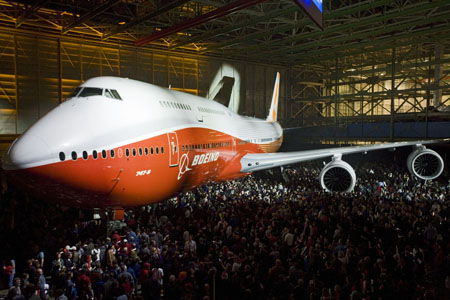
    EVERETT, Wash., Feb. 13, 2011 /PRNewswire/ — Boeing (NYSE: BA) today unveiled its new 747-8 Intercontinental, the new high-capacity passenger airplane that offers airlines the lowest operating costs and best economics of any large passenger airplane while providing enhanced environmental performance.
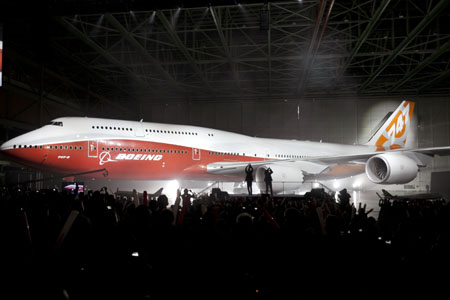
    Approximately 10,000 guests, including customers, Boeing employees, government officials, partners and suppliers, gathered in the factory in Everett, Wash., to witness the premiere of the Intercontinental at an event themed “Incredible, Again.” Boeing Commercial Airplanes President and Chief Executive Officer Jim Albaugh said the newest 747 incorporates technological advancements that make it an extremely productive airplane for customers.
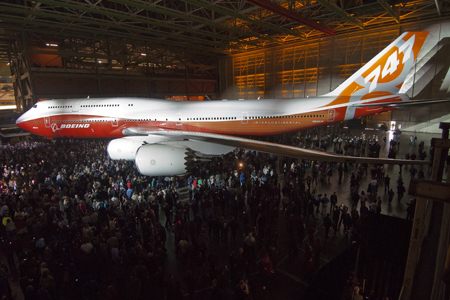
    “The new 747-8 Intercontinental features the latest in innovative technologies — applying many of the breakthroughs also found on the 787 Dreamliner,” said Albaugh. “We think our customers will value the low operating costs and passengers will enjoy the comfort of the striking new interior.”

    “The 747-8 Intercontinental will be a great complement to our fleet, fitting nicely into the 400-seat category, improving our fleet’s eco-efficiency even further,” said Nico Buchholz, executive vice president, Lufthansa Group Fleet Management. “As launch customer, we are looking forward to welcoming this new aircraft to our fleet next year as it adds to our ongoing fleet modernization and environmental efforts.”
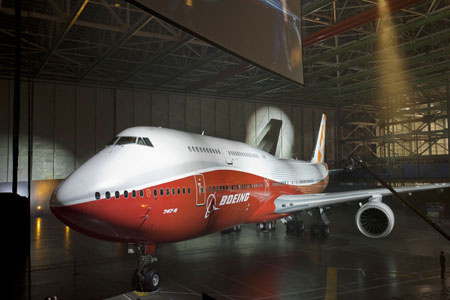
    Korean Air and VIP customers have joined launch customer Lufthansa in ordering a total of 33 747-8 Intercontinentals. First delivery of the 747-8 Intercontinental is scheduled for the fourth quarter.

    “As the only airplane in the 400 to 500-seat market, the 747-8 Intercontinental will give operators an airplane perfectly suited for long, heavily traveled routes around the world,” said Pat Shanahan, vice president and general manager, Airplane Programs, Boeing Commercial Airplanes. “The new 747-8 Intercontinental will set a new standard in economic and environmental performance, while providing a world-class passenger experience.”

    The 747-8 Intercontinental will have the lowest seat-mile cost of any large commercial jetliner, with 12 percent lower costs than its predecessor, the 747-400. The airplane provides 16 percent better fuel economy, 16 percent less carbon emissions per passenger and generates a 30 percent smaller noise footprint than the 747-400. The 747-8 Intercontinental applies interior features from the 787 Dreamliner that includes a new curved, upswept architecture giving passengers a greater feeling of space and comfort, while adding more room for personal belongings.
    The airplane unveiled today is painted in a new Sunrise livery of red-orange that only will appear on the first 747-8 Intercontinental and is a significant departure from Boeing’s standard blue. The new color palette honors many key Boeing customers whose cultures recognize these colors as symbols of prosperity and good luck.

    To include the featured image in your Twitter Card, please tap or click their icon a second time.
  • |

    JetSelect Aircraft Maintenance Services, LLC Obtains FAA Certification as a Part 145 Repair Station

    COLUMBUS, Ohio, Feb. 22, 2011
    — JetSelect Aviation, LLC, a Global Aviation Service Provider, announced today that its maintenance division has obtained FAA Certification as a Part 145 Repair Station. JetSelect Maintenance Services, LLC operates its repair station and offers aircraft maintenance services from their primary base at the Port Columbus International Airport (CMH), Columbus, Ohio.
    JetSelect’s Maintenance Team consists of highly skilled and experienced technicians who have proven their capabilities maintaining one of the largest private charter fleets in the U.S. With this latest certification, they will be able to market their expertise and private jet maintenance services to the aviation community.

    Robert Austin, CEO for JetSelect Aviation, commented, “Our aircraft maintenance team has worked very hard for this achievement and we are very proud to have our private jet maintenance capabilities stand out in the aviation marketplace. As an organization we are experiencing solid and planned growth on several fronts and this certification will strengthen our ability to support our operations as well as to enhance our revenue streams.”

    Gordon MacSwain, Director of Aircraft Maintenance for JetSelect Aviation, said today, “We are pleased with this major achievement which is the result of a lot of hard work by our team. The timing is right, the location is right, and our market is steadily growing. We are excited about our accomplishments and you can expect us to build upon our outstanding capabilities, technology and experience to create a legacy of superior private jet maintenance service.”

    Mario Bustamante, Manager of JetSelect’s Avionics Department, added, “This is what we have been working towards. Our Airframe, Engine and Avionics capabilities can now be fully leveraged by the marketplace. We are extremely excited about this milestone achievement in the airplane maintenance industry.

    To include the featured image in your Twitter Card, please tap or click their icon a second time.
  • |

    Letter to Chairmen Oberstar and Costello and Ranking Members Mica and Petri Regarding FAA’s Efforts to Implement RTCA Task Force Recommendations for NextGen

    Summary

    On December 21, we (DOT OIG) issued a letter to the Chairmen and Ranking Members of the House Transportation and Infrastructure Committee and Aviation Subcommittee regarding FAA’s efforts to implement the Next Generation Air Transportation System (NextGen). Last September, a RTCA task force recommended mid-term actions for advancing NextGen. The task force findings and recommendations are consistent with our work, covering areas such as maximizing the use of equipment already on aircraft and new procedures, enhancing information sharing among FAA and airspace users, and reducing delays. We are reporting our results thus far with respect to (1) FAA’s progress in responding to the task force report, (2) potential barriers to implementing the task force recommendations and realizing benefits, and (3) ongoing problems with a key modernization effort that could materially affect the pace of NextGen. In summary, FAA is incorporating RTCA’s recommendations in its NextGen plans but has not specified how it will execute key initiatives for addressing delays in major metropolitan areas. For example, FAA is still working to establish definitive milestones to integrate new airspace designs and procedures at metroplex locations. FAA also has yet to establish a mechanism for integrating metroplex initiatives with programs to better manage airport surface operations. At the same time, FAA faces several organizational, policy, logistical, and training challenges that could impede NextGen implementation in the midterm; these include working across diverse agency lines of business and establishing policies on data sharing. FAA must also resolve implementation problems with critical modernization projects, such as En Route Automation Modernization (ERAM)–a $2.1 billion NextGen tool for processing flight data–which has experienced software problems and delays at key sites.

    To include the featured image in your Twitter Card, please tap or click their icon a second time.
  • | |

    American Airlines and American Eagle Extend Ticketing Deadline to Help Customers Affected by Mexicana Airlines Service Suspension

    FORT WORTH, Texas, Sept. 3 /PRNewswire/ — American Airlines and its regional affiliate, American Eagle, today announced that the deadline for the special 20 percent discount off of any published fare for customers holding tickets for confirmed bookings on cancelled Mexicana flights has been extended until Sept. 12, 2010.

    Under an offer that became effective on Aug. 30, 2010, American and American Eagle will replace a customer’s travel itinerary with a new confirmed ticket to their original destination or to the closest airport served by the carriers. This offer is only valid for travel between the U.S. and Mexico. Changes to the closest airport served by American or American Eagle are permitted only if American or American Eagle do not serve the original destination. Travel must occur within seven days of the original travel dates. Travel must be completed by Oct. 28, 2010.

    To take advantage of this special offer, customers may call American Airlines reservations:

    U.S.-based Customers

    1-800-433-7300 (English)
    1-800-633-3711 (Spanish)

    Mexico-based Customers

    5209-1400 (Mexico City only)
    01-800-904-6000 (Rest of Mexico)

    To include the featured image in your Twitter Card, please tap or click their icon a second time.