Boeing-built LightSquared Space-Based Network Ready to Begin Service
EL SEGUNDO, Calif., Feb. 14, 2011 — Boeing [NYSE: BA] today announced that it has completed the post-launch testing and on-orbit handover of the first LightSquared satellite and Space-Based Network (SBN). The satellite system has been accepted by LightSquared and is ready to begin service.
“Boeing has delivered LightSquared’s SkyTerra 1 satellite after integrating the satellite’s communications with the ground segment to form the first integrated wireless broadband and satellite network,” said Craig Cooning, vice president and general manager of Boeing Space & Intelligence Systems. “The LightSquared SBN is an end-to-end satellite communications system that draws on Boeing’s proven performance on large-scale integration programs. It demonstrates again that Boeing is the first choice to provide next-generation satellite systems to customers seeking leading-edge communications solutions.”
The LightSquared SBN will combine satellite and terrestrial technologies to enable high-capacity data use for standard cell phones, PDAs and other wireless devices. The SkyTerra 1 satellite carries a 22-meter L-band antenna — the largest commercial antenna reflector in space. The SkyTerra 1 satellite will relay high-data-rate radio frequency (RF) signals to four ground stations in the United States and Canada that use state-of-the-art beam-forming equipment to seamlessly direct transmissions to the complete wireless network.
The SkyTerra 1 satellite was launched Nov. 14 on an International Launch Services Proton vehicle from the Baikonur Cosmodrome in Kazakhstan.
Boeing, the prime contractor for LightSquared’s satellites, built SkyTerra 1 at its integration and test complex in El Segundo. Harris Corp. of Melbourne, Fla., developed the satellite’s L-band reflector. ViaSat’s Comsat Laboratories in Germantown, Md., provided the ground-based beam-forming equipment, the uplink beacon stations and the ground stations’ control and monitoring system. SED Systems of Saskatoon, Canada, provided the antennas, RF elements and integration services at the gateway stations.
 EVERETT, Wash., Feb. 13, 2011 /PRNewswire/ — Boeing (NYSE: BA) today unveiled its new 747-8 Intercontinental, the new high-capacity passenger airplane that offers airlines the lowest operating costs and best economics of any large passenger airplane while providing enhanced environmental performance.
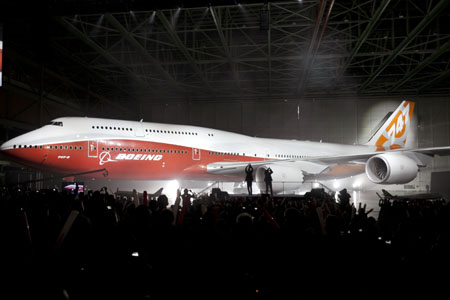 Approximately 10,000 guests, including customers, Boeing employees, government officials, partners and suppliers, gathered in the factory in Everett, Wash., to witness the premiere of the Intercontinental at an event themed “Incredible, Again.” Boeing Commercial Airplanes President and Chief Executive Officer Jim Albaugh said the newest 747 incorporates technological advancements that make it an extremely productive airplane for customers.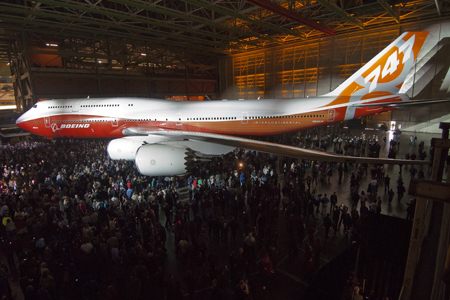
 Korean Air and VIP customers have joined launch customer Lufthansa in ordering a total of 33 747-8 Intercontinentals. First delivery of the 747-8 Intercontinental is scheduled for the fourth quarter.
 ENGLEWOOD, Colo., Feb. 11, 2011 — Jeppesen today announced that Executive Jet Management has received authorization from the Federal Aviation Administration to use the Jeppesen Mobile TC App for iPad as an alternative to paper aeronautical charts. The authorization allows Executive Jet Management to use iPad and the Jeppesen Mobile TC App as the sole reference for electronic charts, even during taxi, takeoff and landing. Executive Jet Management, a wholly owned subsidiary of NetJets Inc., is a leading provider of worldwide jet charter and aircraft management services.