|

IATA: Re-Think Volcano Measures

Similar Posts

  • |

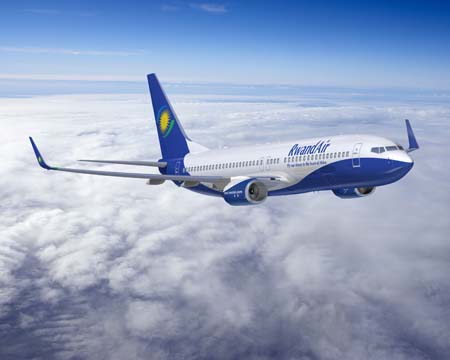
    Boeing and RwandAir announce an order for Next-Gen 787-800

    SEATTLE, May 6 — Boeing and RwandAir today announced an order for two Next-Generation 737-800s.

    Based in Kigali, Rwanda, the airline is renewing and expanding its fleet to broaden its network. RwandAir currently operates a fleet of regional jets.

    “Boeing’s Next-Generation 737-800s will enable us to eventually expand to regional hubs across Africa and the Middle East,” said John Mirenge, RwandAir chairman. “They will become the mainstay of our fleet.”

    “Boeing is honored that RwandAir has selected the Next-Generation 737-800 to support its fleet and growth strategy,” said Marlin Dailey, vice president of Sales, Boeing Commercial Airplanes. “The airplane offers reduced operating costs and environmental impact, as well as a new cabin interior that will delight RwandAir’s customers.”

    The new 737 Boeing Sky Interior features bigger stowage bins that pivot up and out of the way, and sculpted side walls that draw attention to the windows. A new design creates a more open feel in the cabin with overhead lighting that resembles the sky.

    To include the featured image in your Twitter Card, please tap or click their icon a second time.
  • |

    NTSB ISSUES RECOMMENDATIONS DEALING WITH EMERGENCY LOCATOR TRANSMITTERS IN GENERAL AVIATION AIRCRAFT FOLLOWING CRASH INVOLVING SENATOR STEVENS

    FOR IMMEDIATE RELEASE: January 5, 2011
    SB-11-02

    The National Transportation Safety Board today issued two safety recommendations to the Federal Aviation Administration requiring a detailed inspection of all emergency locator transmitters (ELT) installed on general aviation aircraft to ensure that their mountings maintain their retention capabilities during an accident sequence.

    An ELT is designed to broadcast a signal through an externally mounted antenna that contains the aircraft’s registration information and the global positioning system coordinates of the original signal. Also, the “homing signal” can be detected locally by other aircraft, air traffic control facilities, or rescue personnel who use a compatible receiver.

    “In this case, the airplane was equipped with a functioning 406 megahertz ELT, which can be a tremendous aid to search and rescue operations,” said NTSB Chairman Deborah A.P. Hersman. “But this vital life-saving technology won’t do anyone any good if it doesn’t stay connected to the antenna.”

    On August 9, 2010, a de Havilland turbine Otter airplane crashed in mountainous tree-covered terrain approximately 10 miles from Aleknagik, Alaska. Nearly five hours after the crash, volunteer airborne search personnel located the aircraft approximately 19 miles from where the flight originated. The pilot and four passengers, including former U.S. Senator Ted Stevens, sustained fatal injuries. The other four passengers were seriously injured.

    Aircraft involved in the search and rescue efforts and satellites did not detect any ELT signals. Following the discovery of the airplane, a pararescuer found the ELT loose on the floor of the airplane. The ELT had activated but had separated from its mounting bracket and antenna.

    To include the featured image in your Twitter Card, please tap or click their icon a second time.
  • |

    American to Move Its Asia-Pacific Regional Office to the Japan Airlines Building in Tokyo

    Move Further Demonstrates Ties Between the Two Airlines

    FORT WORTH, Texas, Sept. 1 /PRNewswire/ — American Airlines today announced it will move its Asia-Pacific Regional Office to the JAL Building, the headquarters of Japan Airlines (JAL), in the Shinagawa district of Tokyo. American plans to complete the move from its current office in Uchisaiwaicho by January 2011.

    “With the lease on our current Tokyo office location due to expire in December 2010 we have been reviewing opportunities to relocate our regional office. After completing a comprehensive review of available commercial property in Tokyo, we have identified a mutually beneficial opportunity for American to move into vacant offices on the 25th floor of the Japan Airlines headquarters building,” said Theo Panagiotoulias, American’s Vice President and Managing Director – Asia-Pacific. “This move will provide us with excellent office space and meeting facilities, while offering convenience and easy access for our employees.”

    Early in 2010, American and JAL jointly filed a request with the governments of both the United States and Japan to acquire antitrust immunity that will allow a Pacific joint business designed to benefit passengers, shippers, shareholders and employees, as well as other oneworld® Alliance partners. The two airlines are awaiting decisions from the U.S. Department of Transportation (DOT) and from Japan’s Ministry of Land, Infrastructure, Transport and Tourism.

    “With American’s proposed Pacific joint business with JAL anticipated to receive government approval by the end of this year, co-locating our offices with those of JAL will be beneficial and enable us to forge closer working relationships with our valued partner,” Panagiotoulias added. “We have been working closely so that we will be able to implement our joint business as quickly as possible after government approvals are received. We have also been discussing with JAL best practices in areas such as fuel hedging and aircraft management, all in an effort to lower our costs and improve the efficiency of the services we offer our customers.”

    On May 7, 2010, American was awarded the right to fly from New York’s John F. Kennedy International Airport (JFK) to Tokyo International Airport at Haneda (HND) and will begin this new service Jan. 20, 2011. The new flights will complement American’s service to Tokyo’s Narita International Airport (NRT) and benefit Japan Airlines and other oneworld carriers. American is working with JAL officials for ground handling services at Haneda. The two airlines also are continuing to pursue co-location of facilities at key airports including New York Kennedy, Chicago O’Hare and Los Angeles.

    Commenting on the relocation, Tsutomu Ando, Executive Officer of International Affairs at Japan Airlines said: “We warmly welcome American’s move of its Asia-Pacific regional offices into the same premises as JAL’s headquarters. JAL intends to maximize the effect of our alliance strategy and plans to engage in close collaboration with American Airlines upon obtaining necessary approval from the authorities. As both airlines are endeavoring to work more firmly together on ways to create greater benefits for our customers, there is no better timing than now for our offices to also be close in proximity. We are certainly looking forward to greater communications and a deeper relationship with American.”

    To include the featured image in your Twitter Card, please tap or click their icon a second time.
  • |

    QBE Forms U.S. General Aviation Underwriting Group

    NEW YORK, Feb. 4, 2011 /PRNewswire/ — QBE the Americas has announced the creation of a U.S.-based general aviation underwriting operation.

    Headquartered in Atlanta, QBE the Americas’ Aviation Team is designed to expand the company’s global aviation activities. QBE is already a major aviation insurance writer in Europe, Australia, New Zealand, Asia and the Pacific.

    The new team of seasoned aviation insurance professionals with a proven track record consists of William P. McGloin, Roger M. Ridings, Michael Clark and Russell Walker.

    “The U.S. is the largest market for general aviation in the world,” says QBE’s Chief Executive Officer for the Americas, John Rumpler. “We’re pleased to start this operation that will offer a broad range of coverage and bring our company full circle as a true worldwide provider for general aviation insurance services. The aviation team that has been created will work in collaboration with QBE Aviation European Operations.”

    General aviation insurance includes all types of aircraft except for military and major airlines. QBE the Americas’ Aviation Team of seasoned aviation professionals will work with personal-use aircraft owners, as well as corporations and airports to provide physical damage, liability and workers’ compensation coverage.

    QBE Insurance Group Limited is one of the top 25 insurers and reinsurers worldwide. Headquartered in Sydney, Australia, QBE operates out of 49 countries around the globe, with a presence in every key insurance market. The Americas Division, headquartered in New York, conducts business through various property and casualty insurance subsidiaries in 10 countries. QBE’s Americas Division produced $4 billion in gross written premium in 2009 and an 89.7 percent combined operating ratio. QBE Insurance companies are rated “A” (Excellent) by A.M. Best and “A+” by Standard and Poor’s. For more information, visit qbe.com.

    To include the featured image in your Twitter Card, please tap or click their icon a second time.
  • |

    Boeing Reports Third-Quarter Deliveries

    CHICAGO, Oct. 7 — The Boeing Company ) announced today deliveries across its commercial and defense operations for the third quarter of 2010.

    Major Programs

    3rd Quarter
    2010

    Year-to-Date
    2010

    Commercial Airplanes Programs

    737 Next Generation

    100

    281

    747

    767

    3

    9

    777

    21

    56

    Total

    124

    346

    Defense, Space & Security Programs

    AEW&C

    3

    Apache (New Builds)

    2

    11

    Chinook (New Builds)

    5

    13

    C-17

    4

    10

    Delta II – Commercial

    Delta IV – Commercial

    1

    F-15

    3

    10

    F/A-18E/F and EA-18G

    15

    39

    Satellites (Government & Commercial)

    3

    767 Tanker (International)

    To include the featured image in your Twitter Card, please tap or click their icon a second time.
  • |

    Purdue University Opening New Aviation Engine Testing Facility

    WEST LAFAYETTE, Ind. – Purdue University will operate a new federally funded facility to test aircraft engines and develop alternative fuels in work that also aims to reduce the nation’s reliance on imported oil.
    The National Test Facility for Fuels and Propulsion is funded with a $1.35 million grant from the U.S. Air Force and will be housed in the Niswonger Aviation Technology Building at the Purdue Airport.

    “The aerospace industry now has an unprecedented interest in developing green aircraft using biofuels,” said David L. Stanley, an associate professor of aeronautical engineering technology at Purdue and principal investigator of the facility. “Testing will be conducted while fuels are being researched for development. This means input will be provided during the development phase, not after the fuel has been developed, which helps to ensure the best results possible.”

    The facility, expected to open in late 2010 or early 2011, will test aerospace hardware in engines and aircraft and provide data related to fuel-sustainability and emissions goals and for economic assessments.

    “This is a multidisciplinary research approach that begins with growing crops, developing fuels from those crops in the laboratory and then testing those fuels in engines,” said Denver Lopp, a professor of aviation technology and one of two co-principal investigators.

    The other co-principal investigator is J. Mark Thom, a professor of aviation technology.

    Work will focus on jet engines but will include some testing related to piston engines.

    “The project involves faculty members in the colleges of Agriculture, Engineering, Science and Technology to develop a well-rounded and capable research team for fuels research, with particular focus on aviation and aerospace,” Lopp said. “Purdue is strong in each of these areas, and having an airport also enhances these strengths.”

    The researchers will work with the Air Force, industry and government agencies to develop the fuels.

    “Roughly 17 billion gallons of turbine fuel are burned annually in the United States, and clearly a portion of this could be saved by blending alternative fuels,” Stanley said. “The U.S. Air Force intends to be able to operate its fleet on blends of these fuels.”

    The work will tackle four major bottlenecks to aerospace progress: access to hardware testing; development of control logic and systems permitting flex-fuel operation and realization of improved efficiencies; sustainability of biofuels related to crop productivity, as well as bio and synthetic fuels’ ability to meet both near- and long-term aerospace requirements; and regulatory compliance.

    “The overall goal is to update and maintain a multifaceted national testing facility with dedicated administration to support development and testing of alternative energy sources for aerospace equipment,” Lopp said. “This facility will address all energy sources and will not be an advocate of any particular fuel.”

    Writer: Emil Venere, 765-494-4709, venere@purdue.edu

    Sources: David Stanley, 765-494-6266, stanledl@purdue.edu

    Denver Lopp, 765-494-6387, denver@purdue.edu

    Purdue News Service: ( 765 ) 494-2096; purduenews@purdue.edu

    To include the featured image in your Twitter Card, please tap or click their icon a second time.