
Date: 01 February 2010 – Singapore – he International Air Transport Association (IATA) said that in 2009 intra-Asia-Pacific travel had eclipsed the number of travelers in North America as the world’s largest aviation market. Asia-Pacific’s travelers numbered 647 million compared the 638 million who travelled within North America (including domestic markets). By 2013 an additional 217 million travelers are expected to take to the skies within Asia–Pacific.
“Achieving Asia-Pacific’s tremendous potential is contingent upon short-term efforts to battle the impacts of the economic downturn with cost reductions and efficiency gains. Longer-term Asia-Pacific must also face global challenges including environment, security and liberalization,” said Giovanni Bisignani, IATA’s Director General and CEO at the start of the Singapore Air Show Aviation Leadership Summit.
The global aviation industry is expected to reduce losses from US$11.0 billion in 2009 to US$5.6 billion in 2010. The loss reduction is being led by Asia-Pacific’s carriers who are expected to see their losses shrink from US$3.4 billion in 2009 to US$700 million in 2010. “Asia-Pacific’s prospects are improving faster than other regions,” said Bisignani.
Bisignani noted that the Asia-Pacific region is diverse, dynamic and with great potential:
Diverse: Asia-Pacific is home to two of the world’s top five airlines in terms of profitability. At the same time, the region’s governments provided over US$10 billion in government bailouts to airlines in the first quarter of the year. The region’s two biggest growth markets—India and China—face completely different circumstances. India’s challenge is to reduce costs and improve infrastructure, while China is adjusting to new global trade patterns.
Dynamic: Over the last decade China replaced Japan as Asia-Pacific’s largest player. Today China’s fleet is 1,400 aircraft compared to Japan’s 540. Its domestic market of 5.7 million weekly seats is more than double Japan’s 2.6 million and China’s 1.4 million weekly international seat market is now slightly larger than Japan’s 1.3 million.
Potential: In the US, there are three aircraft seats per year for each of the 300 million people who live there. China’s population of 1.3 billion is served by only 0.3 seats per person and India’s 1.1 billion population has only 0.1 seats available per person. “The global air transport industry will triple in size when Asians travel as much as those in the US,” said Bisignani.
“Asia-Pacific’s diversity, dynamism and potential are a great opportunity. Rapidly developing markets are defining aviation’s future. Is Asia-Pacific prepared for the challenges that this will bring?” said Bisignani. In his opening address, Bisignani highlighted three global issues for Asia-Pacific leadership:
Environment: The global aviation industry presented the UNFCCC Climate Change talks in Copenhagen with three targets shared by airlines, airports, air navigation service providers and manufacturers. These are: improving fuel efficiency by an average of 1.5% per year to 2020, stabilizing emissions with carbon-neutral growth from 2020 and cutting our emissions in half by 2050 compared to 2005. These targets are backed by a clear strategy based on technology investment, effective operations, efficient infrastructure and economic measures.
“Even without a binding agreement in Copenhagen aviation is united and committed to its targets. The ICAO Assembly in September-October is an opportunity to build government consensus leading to COP-16 in Mexico,” said Bisignani.
The challenges for Asia include: working through ICAO to accommodate the diverse needs of the region, taking advantage of the tremendous business opportunities in developing sustainable second generation biofuels Biofuels have the potential to reduce aviation’s carbon footprint by up to 80%. “Five airlines have successfully tested biofuels and we expect certification within 2011 at the latest. Aviation biofuel is a US$100 billion plus business opportunity. And I hope that this region will play a key role in its early development,” said Bisignani.
Security: “We live in a global world—global connectivity and global threats. Governments and industry must protect the connectivity and eliminate the threats. That challenge requires industry and governments to work together for effective and efficient security measures,” said Bisignani.
“Ten days ago, I saw some hope for a new collaborative approach when the Secretary of the US Department of Homeland Security consulted the airline industry in our Geneva offices,” said Bisignani. IATA presented recommendations to (1) work together, (2) align requirements with the industry’s capability to implement, (3) make passenger collection more efficient, (4) ensure that governments coordinate their requirements across borders and (5) look to develop a new approach to checkpoint screening that combines technology and intelligence so that we look for bad people, not just bad objects.
Asia-Pacific must define government/industry cooperation on security and find a better way to deal with the cost burden. Currently airlines pay US$5.9 billion a year for security. “These are national security measures. That is a government responsibility, including the bill,” said Bisignani.
Liberalization: “Asian aviation will not reach its potential if the airlines are constrained to old ways of doing business. Industry is preparing for regional liberalization of market access with the ASEAN target date of 2015. It is important that the target date is met. This is already well-behind the industry leading developments in the US-EU Open Skies agreement. Second stage talks will conclude this year with ownership being the most important issue,” said Bisignani.
“To move liberalization forward, IATA took the extra-ordinary step of calling governments together with IATA’s Agenda for Freedom. After a year of talks, in November 2009, seven governments, including the US, the European Commission, Singapore and Malaysia signed a multilateral statement of policy principles. These principles preserve a level playing field while addressing liberalization of market access, pricing and ownership. The challenge for Asia is to implement these principles in the region’s bilateral arrangement,” said Bisignani. Click to view Bisignani’s speech

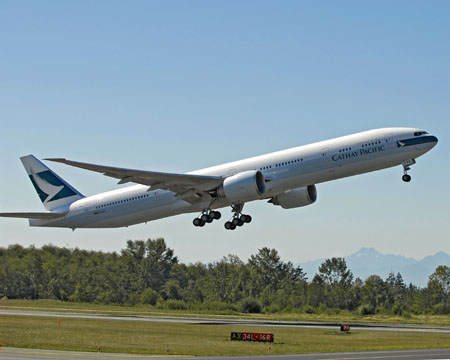 SEATTLE, Sept. 22 — Boeing and Cathay Pacific Airways today announced the Hong Kong-based carrier has exercised existing purchase rights for six additional Boeing 777-300ERs (extended range).

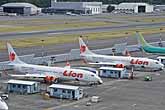 SEATTLE, July 1 e-FirstCall/ — Coinciding with the 10th anniversary of Lion Air, Boeing (NYSE: BA) today delivered two Next-Generation 737-900ERs (extended range) to the Jakarta-based carrier. Lion Air, which operates an all-Boeing fleet, was the launch customer of the 737-900ER and is currently the largest operator of the airplane. With today’s deliveries, the Lion Air fleet consists of 36 737-900ERs and two 747-400s. In addition, Lion Air is a launch customer for the new 737 Boeing Sky Interior.