• SAID released

    EASA Distributes FAA Recommendation: Special Airworthiness Information Bulletin


    FAA Aviation Safety
    SPECIAL AIRWORTHINESS INFORMATION BULLETIN
    SAIB: NM-10-12
    SUBJ: Navigation: Flight Management System Date: January 7, 2009
    This is information only. Recommendations aren’t mandatory.
    Introduction
    This Special Airworthiness Information Bulletin (SAIB) advises registered owners and operators of
    the transmission of incorrect information from the Honeywell NZ-2000 Primus Epic Flight
    Management System (FMS) software having part number (P/N) VAR9XX, VAR10XX, or
    VAR11XX and installed on Hawker Beechcraft Corporation (Type Certificate Previously Held
    by Raytheon Aircraft Company) Model 4000 airplanes, Gulfstream Aerospace Corporation
    Model G-IV, GIV-X, and GV-SP airplanes, Agusta AW-139 helicopters, and Cessna Aircraft
    Company Model 680 airplanes.

    Background
    During an RNAV approach an airplane programmed with NZ-2000 FMS software (version 5.2), flew
    the WATTS THREE ARRIVAL (RNAV) Standard Terminal Arrival Route (STAR). A different
    runway was selected in the FMS during the STAR, and resulted in the FMS navigating the airplane
    toward the initial STAR waypoint instead of the next sequential STAR waypoint. As a result of this
    incident, Honeywell International Inc. issued Service Information Letter, D200909000044, dated
    October 15, 2009, to provide operators with guidelines for flight plan modifications made on the
    ARRIVAL page, including a destination runway change. This SAIB addresses the Primus Epic FMS
    because its software was a derivative of the NZ-2000 FMS software. At this time, the airworthiness
    concern is not an unsafe condition that would warrant airworthiness directive (AD) action under Title
    14 of the Code of Federal Aviation Regulations (14 CFR) part 39.

    Recommendations
    The FAA recommends that all owners and operators of Model 4000 airplanes, Model G-IV, GIV-X,
    and GV-SP airplanes, Agusta AW-139 helicopters, and Model 680 airplanes with NZ-2000 Primus
    Epic Flight Management System software ensure their flight crews are familiar with the procedures
    outlined in Honeywell Service Information Letter, D200909000044, dated October 15, 2009.
    For Further Information Contact

    Daniel Bui, Aerospace Engineer, Systems and Equipment Branch, ANM-130L, FAA, Los
    Angeles Aircraft Certification Office, 3960 Paramount Boulevard, Lakewood, California
    90712-4137; telephone (562) 627-5339; fax (562) 627-5210.
    For Related Service Information Contact
    Technical Publications and Distribution, 21111 N. 19th Avenue, Phoenix, Arizona 85027-2708;
    telephone (800)601-3099; fax 602-365-5577; Internet http://portal.honeywell.com/wps/portal/aero.

    See Also the Service Information Letter: http://ad.easa.europa.eu/ad/NM-10-13 pdf

    To include the featured image in your Twitter Card, please tap or click their icon a second time.
  • | | | | |

    Unreleased Technical Issue Grounds Easyjet Airbus


    Click to view full size photo at Airliners.net
    Contact photographer Mark McEwan

    What: Easyjet Airbus A319-100 en route from London to Tallinn Estonia
    Where: Copenhagen
    When: Jan 11th 2010
    Who: not available
    Why: While en route, the flight developed a technical problem and decided to divert to Copenhagen. No details about the problem have been released. Replacement transportation was provided.

    To include the featured image in your Twitter Card, please tap or click their icon a second time.
  • Five Reportable Incidents Added To Notification Requirements

    The NTSB is amending its regulations concerning notification
    and reporting requirements regarding aircraft accidents or
    incidents. In particular, the NTSB is adding regulations to require
    operators to report certain incidents to the NTSB. The NTSB is also
    amending existing regulations to provide clarity and ensure that
    the appropriate means for notifying the NTSB of a reportable
    incident is listed correctly in the regulation.

    On October 7, 2008, the NTSB published an NPRM titled
    “Notification and Reporting of Aircraft Accidents or Incidents and
    Overdue Aircraft, and preservation of Aircraft Wreckage, Mail,
    Cargo, and Records” in the Federal Register. This NPRM proposed,
    and the final rule codifies the addition of five reportable
    incidents, the reporting of which the NTSB believes will improve
    aviation safety.

    The operator of any civil aircraft, or any public aircraft not
    operated by the Armed Forces or an intelligence agency of the
    United States, or any foreign aircraft shall immediately, and by
    the most expeditious means available, notify the nearest National
    Transportation Safety Board (NTSB) office when an aircraft accident
    or any of the following listed serious incidents occur:

    • Failure of any internal turbine engine component that results
      in the escape of debris other than out the exhaust path.
    • In-flight fire.
    • Aircraft collision in flight.
    • Release of all or a portion of a propeller blade from an
      aircraft, excluding release caused solely by ground contact.
    • A complete loss of information, excluding flickering, from more
      than 50 percent of an aircraft’s cockpit displays known as
      Electronic Flight Instrument System (EFIS) displays, Engine
      Indication and Crew Alerting system (EICAS) displays, Electronic
      Centralized Aircraft Monitor (ECAM) displays, or other displays of
      this type, which generally include a primary flight display (PFD),
      primary navigation display (PND), and other integrated
      displays.
    • Airborne Collision and Avoidance System (ACAS) resolution
      advisories issued either when an aircraft is being operated on an
      instrument flight rules flight plan and compliance with the
      advisory is necessary to avert a substantial risk of collision
      between two or more aircraft, or to an aircraft operating in class
      A airspace.
    • Damage to helicopter tail or main rotor blades, including
      ground damage, that requires major repair or replacement of the
      blade(s).
    • Any event in which an aircraft operated by an air carrier lands
      or departs on a taxiway, incorrect runway, or other area not
      designed as a runway, or experiences a runway incursion that
      requires the operator or the crew of another aircraft or vehicle to
      take immediate corrective
    • action to avoid a collision.

    The final rule was published in the Federal Register January
    7th, and the revisions and additions published in this final rule
    become effective March 8, 2010.

    www.ntsb.gov
    To include the featured image in your Twitter Card, please tap or click their icon a second time.
  • | | |

    Chilean Crash Kills 4

    What: single-engine Mooney plane en route from La Serena to Santiago.
    Where: 474 km north of the Chilean capital of Santiago
    When: Jan 11, 2010
    Who: 4 fatalities (pilot and 3 businessmen)
    Why: The light plane crashed for unknown reasons. A beacon initially led searchers to Chicurea but the wreckage was found by Chile’s Air Force Search and Rescue (two Chilean air force planes and a helicopter) in La Cachimba valley, 22 km from La Serena.

    To include the featured image in your Twitter Card, please tap or click their icon a second time.
  • | | | | |

    Airbus Thrust Reverser Malfunctions


    Click to view full size photo at Airliners.net
    Contact photographer F. Camirand

    What: Air Canada Airbus A320-200 en route from Toronto, Canada to El Catey Dominican Republic
    Where: Toronto
    When: Jan 10th 2010
    Who: not available
    Why: After takeoff, the Airbus thrust reverser malfunctioned and the crew had to return to the airport. They made a safe landing half an hour later, and passengers disembarked, eventually boarding another plane.

    To include the featured image in your Twitter Card, please tap or click their icon a second time.
  • Why We Fly Sober

    After Muhammad Abu Tahir drank 5 airline bottles of wine, when the crew refused to give him any more, he became abusive and belligerent and locked himself in the bathroom. For this, the Air Tran Airways jet had a fighter jet escort. The Department of Justice says Tahir faces “up to 20 years in federal prison, a fine of up to $250,000, as well as restitution to the airline. ”

    I really hate to see drunks go to jail for being drunk and stupid but really, keeping this guy in jail and out of harm’s way might be doing him a favor.

    To include the featured image in your Twitter Card, please tap or click their icon a second time.
  • | | | | |

    Engine Fire; Engine Shut Down; Airport Closed


    Click to view full size photo at Airliners.net
    Contact photographer Carlos A. Morillo Doria

    What: TRIP Linhas Aereas Aerospatiale ATR-72-500 en route from Curitiba to Cascavel Brazil
    Where: Cascavel
    When: Jan 10th 2010
    Who: 70 on board
    Why: Near Cascavel the left engine caught fire. The engine was shut down and the fire suppression system activated and put it out. However, Cascavel was closed due to low visibility, and the flight diverted to Iguassu Falls. Cascavel travelers were bussed from Iguassu Falls.

    Dourados and Campo Grande passengers were provided connecting flights.

    To include the featured image in your Twitter Card, please tap or click their icon a second time.
  • | | |

    Airbus Birdstrike


    Click to view full size photo at Airliners.net
    Contact photographer Georg Noack

    What: Lufthansa Airbus A320-200 en route from Munich Germany to Istanbul Turkey
    Where: Istanbul
    When: Jan 10th 2010
    Who: not available
    Why: While on approach, the airbus flew through a flock of sea gulls breaking a landing light; it was the first of six bird strikes at the airport within thirty minutes.

    To include the featured image in your Twitter Card, please tap or click their icon a second time.
  • | | | | |

    Helicopter Crash in Mexico Kills 6

    What: Saba Group Helicopter en route from Toluca to Mexico City
    Where: Mina Vieja in Cuajimalpa, near La Marquesa
    When: Jan 10, 2010
    Who: Fatalities included Moises Saba Masri, 46, his father, Alberto Saba Raffoul, and Umberto Saba, also Capt. Armando Fernandez and Judith Casal and Yadel Toachi.
    Why: The helicopter crashed during foggy weather; the tail struck a residence at 85 Melchor Ocampo Street, and the blades struck a tree. Two vehicles were damaged but no one on the ground was injured.

    To include the featured image in your Twitter Card, please tap or click their icon a second time.
  • | | | |

    Airbus Navigation Fault Sends Jet Back to Dublin


    Click to view full size photo at Airliners.net
    Contact photographer Javier Bravo Muñoz

    What: Aer Lingus Airbus A330-300 en route from Dublin to New York
    Where: Shannon
    When: Jan 11th 2010
    Who: not available
    Why: While en route, just over the Atlantic, the flight developed a navigation problem. The crew turned the Airbus around and returned to Dublin where they made a safe landing. Repairs were made or maintenance was completed, apparently; and a little over an hour and a half later, the same plane re-embarked to New York.

    To include the featured image in your Twitter Card, please tap or click their icon a second time.
  • | | | | | |

    Ryanair Emergency Landing in Finland


    Pictured: A Ryanair Boeing 737-8AS photographed in Tampere Finland
    Click to view full size photo at Airliners.net
    Contact photographer Jussi Seppala

    What: Ryanair en route from Tampere to Frankfurt, Germany
    Where: Skavstan Airport, Nyköping Sweden
    When: Jan 10, 2010
    Who: not available
    Why: While en route, the flight developed engine problems. The flight diverted to Nyköping Sweden where passengers disembarked, and were provided an alternate plane.

    To include the featured image in your Twitter Card, please tap or click their icon a second time.
  • | | | |

    Swiss Airbus Birdstrike


    Click to view full size photo at Airliners.net
    Contact photographer Alejandro Ruiz

    What: Swiss Airlines Airbus A319-100 en route from St. Petersburg to Zurich
    Where: St. Petersburg
    When: Jan 10th 2010
    Who: 123 passengers and 5 crew
    Why: After a successful takeoff, the flight crew informed ATC that there were vibrations in one of the engines. The plane returned to Pulkovo Airport and made a safe landing, where maintenance confirmed a bird strike.

    To include the featured image in your Twitter Card, please tap or click their icon a second time.
  • | | | |

    Horizon Air Emergency Landing with Smokey Cockpit in Portland


    Pictured: A Horizon Air De Havilland Canada DHC-8-402Q Dash 8
    Click to view full size photo at Airliners.net
    Contact photographer Phil Hyde

    What: Alaska/Horizon Air de Havilland Dash 8-400 en route from Portland to Seattle
    Where: Portland
    When: Jan 9th 2010
    Who: 3 aboard
    Why: Twenty minutes after smoke was reported in the cockpit, the plane returned to Portland where it made a safe landing. The plane was taken out of commission, and passengers provided alternative transport.

    To include the featured image in your Twitter Card, please tap or click their icon a second time.
  • | | | |

    United Airlines Airbus Emergency Landing in Newark


    Pictured: A United Airlines Airbus A319-131
    Click to view full size photo at Airliners.net
    Contact photographer David J Transier

    What: United Airlines Airbus 319 en route from Chicago to Newark
    Where: Newark NJ
    When: Jan 10, 2010, 9:30 a.m.
    Who: 48 passengers 5 crew
    Why: On landing, the plane’s right gear failed to properly deploy. After maintaining a holding pattern attempting to extend the landing gear (etc), the pilot landed. It was, apparently a safe landing, causing airport delays but no reported injuries, not even during the slide evacuation.

    On landing, the plane lurched to one side; and the airport was closed down for safety concerns.

    George’s Point of View

    We have emergency landings all the time all over the world. This website attests to that. But after the year Airbus has had, whenever I hear there’s an Airbus incident, even if it is only a small one, my hair—what little I have—stands on end. I can’t help believing that they should take this plane back to the drawing board and start over.

    To include the featured image in your Twitter Card, please tap or click their icon a second time.
  • Unruly: The Ten Cent Solution

    As far as amenities, like leg room, food, wine and beverage service, seat width, pitch, video access, laptop power, and WIFI are concerned, Economy, Premium, Business or First Class offer varying combinations depending on the airline. But for those “unruly” passengers who seem to be in the news more frequently, the airlines should come up with a new, discounted standing-room-only corner class called Time Out.

    For Time Out class, of course, there would be no leg room, service, or amenities whatsoever. I would vote for a metal bar for them to hang on to for stability, but no doubt the airline would probably have to put in some kind of secure safety harness for insurance purposes. And, the unruly being by nature unruly, this time out area would also have to be sound-proofed, to keep from disturbing the other passengers.

    If pressurization weren’t an issue, I’d even suggest a “rumble” seat on the exterior of the plane, from which in an emergency the objectionable passenger could be ejected (with parachute of course, we’re not heathens) or at least isolated. Certainly ejection of a parachuted passenger is a more democratic solution that the threat of fighter jets shooting down a commercial airliner carrying 131 paying customers and 1 drunken idiot. The experience of riding a “rumble seat” would no doubt present an entirely new perspective on flying to the drunken idiot.

    I did mention that this would be a “discounted” class. I would expect that the aforementioned discount would not apply back to the passenger’s wallet; the difference between the origin ticket and the minimal expense of “Time Out” class would be forwarded to establish ongoing psychiatric therapy which would inevitably result from riding the rumble seat on the exterior of a plane.

    Of course, none of this editorial is true–except for the fighter jet escort threatening to shoot down a commercial plane carrying 132 passengers.

    The San Francisco bound flight that was escorted by two F-16 fighter jets was being escorted because a drunken, disruptive passenger locked himself in the bathroom. I do hope when the U.S. Gov’t lets him out of jail, they send him the bill.

    To include the featured image in your Twitter Card, please tap or click their icon a second time.
  • U.S. Virgin Applauds DOT Decision

    Virgin America Cleared for Take-Off in 2010

    San Francisco – January 8, 2010 – Virgin America, a privately-held domestic airline, today applauded the Department of Transportation’s (DOT) decision confirming the carrier’s financial fitness and U.S. citizenship status. Earlier today, the DOT issued a ruling that the airline and its proposed new ownership structure will remain fully compliant with U.S. ownership laws. U.S. law requires that domestic airlines remain under the control of U.S. citizens, with no more than 25% of the voting stock being held by foreign citizens. As a matter of policy, the DOT reviews any proposed ownership changes of over 10 percent of the voting stock of any U.S.-domiciled airline.

    “Today is a great day for airline competition, for our traveling guests and for our teammates,” said Virgin America President and CEO David Cush. “We’re extremely pleased with the Department of Transportation’s announcement. With this behind us, we intend to focus on what we do best: injecting new competition into markets as we grow, creating new jobs and delivering an unrivalled guest experience.”

    The proposed new ownership structure will reflect a change among Virgin America’s U.S. investors and also allow the Company’s teammates to participate in the airline’s future via an Employee LLC. Under the new structure, the airline’s voting stock will remain in its previous configuration with 75 percent held by the U.S.-based VAI Partners, LLC and 25 percent held by Virgin Group. However, the U.S. investors comprising VAI Partners will change with the following entities now comprising the VAI stake:

    Cyrus Aviation Investor, LLC – 55.5 percent
    VAI MBO Investors, LLC—27.8 percent
    VX Employee Holdings, LLC—16.7 percent
    VAI Management, LLC—less than 1 percent
    Cyrus Aviation Investor, LLC is an entity related to long-time Virgin America investor, Cyrus Capital. Under the new structure it will substantially increase its investment to become the airline’s principal U.S. investor.

    VAI MBO Investors, LLC is comprised of five individual investors. Four of the investors, Don Carty, Sam Skinner, Cyrus Freidheim, and David Cush, are current Virgin America Board members, and a fifth, Robert Nickell, will assume a Board seat at the closing of this transaction.

    VX Employee Holdings, LLC is an entity established to hold the economic value of 16.7 percent of VAI for distribution to the employees of Virgin America at the time of a qualified liquidity event, such as an initial public offering.

    “Given that our success to date is due to the efforts of this entrepreneurial start-up team, we are pleased that our teammates will now have a stake in the financial success of our airline,” added Cush.

    As part of the proposed transaction, Virgin America will obtain an additional $68.4 million in unsecured debt from its shareholders. This facility will further improve the liquidity of the company, positioning it for additional growth in 2010 and beyond.

    The company will continue to have a U.S. controlled Board of Directors (with seven of nine seats held by U.S. citizens). Although a privately-held company, the airline is announcing these details given DOT’s public ruling earlier today.

    Since its August 2007 launch, the San Francisco-based Virgin America has created more than 1500 new jobs, swept all the major reader-based travel awards, and lowered fares and improved service in the new markets it has entered. The start-up airline’s most recently reported financial results included the announcement of its first quarterly operating profit, a year-over-year revenue increase of 38 percent, record load factors and improved unit costs for the third quarter of 2009.

    Virgin America flies to San Francisco, Los Angeles, New York, Washington D.C., Seattle, Las Vegas, San Diego, Boston, Orange County and Fort Lauderdale. Virgin America has flown over 6.2 million guests since its inaugural flights and now counts over 1.2 million Elevate loyalty program members. In just over two years flying, Virgin America has captured a list of travel industry best-in-class awards, including “Best Domestic Airline” in the Condé Nast Traveler Readers’ Choice Awards and in Travel + Leisure’s World’s Best Awards.

    # # #

    Virgin America is a U.S.-controlled, owned and operated airline. It is an entirely separate company from Virgin Atlantic. Sir Richard Branson’s Virgin Group is a minority share investor in Virgin America.

    To include the featured image in your Twitter Card, please tap or click their icon a second time.
  • | | |

    Air Berlin Boeing Slides off the Runway


    Click to view full size photo at Airliners.net
    Contact photographer JRC

    What: Air Berlin Boeing 737-800 en route from Nuremberg to Dusseldorf
    Where: Nuremberg
    When: Jan 8th 2010
    Who: 133 aboard
    Why: While taxiing to the runway prior to takeoff, the plane skidded off the paved surface of the runway. Passengers disembarked without further incident.

    To include the featured image in your Twitter Card, please tap or click their icon a second time.
  • | | |

    Chautauqua Precautionary Cancellation


    Pictured: A Chautauqua Airlines Embraer EMB-145EP (ERJ-145EP)
    Click to view full size photo at Airliners.net
    Contact photographer Paul Leach

    What: Delta/Chautauqua Embraer ERJ-145 en route from Boston to Columbus
    Where: Boston
    When: Jan 8th 2010
    Who: 25 passengers,3 crew
    Why: The crew rejected takeoff because of the smell of smoke possibly attributed to de-icing fluid.

    To include the featured image in your Twitter Card, please tap or click their icon a second time.
  • | | | | |

    Cougar Flight 491 Suit Settles

    Sikorsky, Keystone Helicopters and their parent company, United Technologies Corp. have settled in court with the the families of passengers who died on March 12, 2009. In court last July plaintiffs “voluntarily discontinued” the lawsuit to begin negotiations on a possible settlement. That settlement has been resolved, but the details are not public.

    Because pilots believed the Sikorsky met U.S. FAA regulations that the aircraft could operate for 30 minutes after losing oil, they flew toward the shore rather than landing on the water.

    To include the featured image in your Twitter Card, please tap or click their icon a second time.
  • NTSB TO RELEASE FACTUAL REPORTS ON FATAL 2009 HELICOPTER ACCIDENT IN LOUISIANA

    The National Transportation Safety Board will open its public docket Thursday on a January 2009 helicopter accident that killed 8 persons.

    On January 4, 2009, a Sikorsky S-76C++ helicopter (N748P), operated by PHI, Inc., crashed into swampy terrain just north of the Gulf of Mexico coastline near Morgan City, Louisiana. The aircraft was on a Part 135 revenue flight to an oil platform when it crashed about 7 minutes after takeoff. Eight of the nine persons aboard lost their lives.

    The docket will contain factual reports prepared by the investigative team, including reports on aircraft structures, aircraft systems, the transcript of the cockpit voice recorder, and toxicology reports. A comprehensive materials laboratory report on the windscreen structure and a report on the flight data recorder information will be added to the docket in the next several weeks.

    The docket will be published on the Board’s website at www.ntsb.gov, under “Accident Dockets” on the home page, at 1:00 p.m. Eastern Standard Time, Thursday, January 7. No determination of cause will be rendered at this time. This is a factual release only; no interviews will be conducted by NTSB personnel.

    To include the featured image in your Twitter Card, please tap or click their icon a second time.
  • | | | |

    Air Canada Airbus Cracks Window Diverts to Halifax


    Click to view full size photo at Airliners.net
    Contact photographer Hongyin Huo

    What: Air Canada Airbus A321-200 en route from St. John’s Toronto
    Where: Iles de la Madeleine
    When: Jan 7th 2010
    Who: not available
    Why: When the crew discovered a cracked windshield, the pilot descended to a lower altitude and diverted to Halifax where they made a safe landing. A replacement flight was provided.

    To include the featured image in your Twitter Card, please tap or click their icon a second time.
  • FAA OKs Four More Portable Oxygen Concentrators

    WASHINGTON — The Federal Aviation Administration (FAA) announced today that passengers needing medical oxygen now have the option of using four additional portable oxygen concentrators while traveling, bringing the total number of approved units to 11.

    The newly authorized devices are DeVilbiss Healthcare’s iGo, International Biophysics Corporation’s LifeChoice, Inogen’s Inogen One G2 and Oxlife’s Independence Oxygen Concentrator.

    “This is our latest step toward making air travel more accessible for people who need medical oxygen,” said FAA Administrator Randy Babbitt. “We want these passengers to have as many options as possible while ensuring all of our safety guidelines are being met.”

    Portable oxygen concentrators are small, portable devices that separate oxygen from nitrogen and other gases in the air and provide oxygen to users at greater than 90 percent concentration. They do not use compressed or liquid oxygen, which the government classifies as hazardous material.

    The Department of Transportation requires that U.S. carriers allow passengers to use portable oxygen concentrators approved by the FAA during all phases of a flight – including taxiing, takeoff and landing – if the unit displays a manufacturer’s label that indicates it meets FAA requirements for portable medical electronic devices, is properly stowed, and meets certain other applicable safety-related conditions.

    For example, passengers must ensure the unit is in good working order and must be able to respond to the unit’s warning alarms. They must protect extra batteries in carry-on baggage from short circuits and physical damage. Carriers also must let passengers operate these FAA-approved concentrators while moving about the cabin whenever the captain turns off the “Fasten Seat Belt” sign.

    Carriers can legally refuse to allow inflight use of an FAA-approved portable oxygen concentrator that does not have a manufacturer’s label indicating that the device complies with FAA requirements. However, the Department encourages airlines to voluntarily allow the inflight use of such devices. Inflight use of an FAA-approved portable oxygen concentrator, whether labeled or not, poses no safety danger so long as carriage of the device is in accordance with instructions provided by the FAA.

    The FAA previously approved these portable oxygen concentrators for use:

    Delphi Medical Systems RS-00400
    Invacare XPO2
    AirSep Lifestyle
    AirSep Freestyle
    Inogen One
    SeQual Eclipse
    Respironics EverGo
    ###

    To include the featured image in your Twitter Card, please tap or click their icon a second time.
  • IATA Comment on New US Security Procedures

    Geneva – IATA understands the need for government-mandated emergency security measures as a result of the attempted downing of Northwest Flight 253 on 25 December 2009. Security is a government responsibility. Emergency measures should be revised as information is gathered in the investigation.

    The 3 January announcement by the US Transportation Security Administration (TSA) to replace the original emergency requirement for 100 percent pat-down screening of all US-bound passengers with threat based and random screening is a welcome step in the right direction.

    The TSA announcement is in line with requests made by IATA in a letter to Janet Napolitano, Secretary of the Department of Homeland Security (DHS) on 29 December. “It is critical that DHS partner with industry to identify the most effective and efficient ways to address this challenge going forward. Clearly, the air transport system cannot support 100 percent pat-down searches over the long term. However, a smaller percentage of intensive pat downs accompanied by trace detection technology may reduce delays and achieve near-term security requirements as we focus on longer-term technology solutions to address the ongoing threat,” said Giovanni Bisignani, IATA’s Director General and CEO.

    Long-term, sustainable aviation security must be globally harmonized, risk-based and have efficient processes for passengers.

    One lesson already learned from this incident is the importance of combining screening procedures with intelligence. Following the new TSA announcement, IATA calls on DHS and TSA to work with their international counterparts to look at a next generation checkpoint. This should give screeners access to effective intelligence to deliver proportional screening measures based on intelligence driven risk assessments.

    IATA continues to urge the US and other governments to coordinate security requirements and to work closely with industry for their effective implementation.

    For more information, please contact:
    Steve Lott
    Head of Corporate Communications
    North America
    lotts@iata.org
    Tel: + 1 202 628-9292

    To include the featured image in your Twitter Card, please tap or click their icon a second time.
  • | | | |

    Emergency Landing at Sioux Gateway Airport

    What: Delta
    Where: Sioux Gateway Airport
    When: Jan 06, 2010, 11:15
    Who: Not Available
    Why: While en route, one of the plane’s engines developed a problem. The involved engine was shut down and the plane returned safely to Sioux Gateway Airport within fifteen minutes of takeoff. It is standard procedure on a flight, if there is engine trouble with a plane with multiple engines, that the problematic engine is shut down to avoid fires or causing further damage.


    The local television station presented video and news of the incident involving a Delta.
    However aviation sources including Flight Aware indicate it was a Mesaba Airlines Saab FOR Delta. Which is why I spent half of the afternoon on Flight Aware trying to find a Delta prefix. Special thanks to Simon Hradecky who always gets it right.


    Pictured: A Delta Connection (Mesaba Airlines) Saab 340B/Plus over Minneapolis / St. Paul
    Click to view full size photo at Airliners.net
    Contact photographer Gary Chambers
    What: Northwest/Mesaba Airlines Saab 340B en route from Sioux City to Minneapolis

    To include the featured image in your Twitter Card, please tap or click their icon a second time.
  • | | | | |

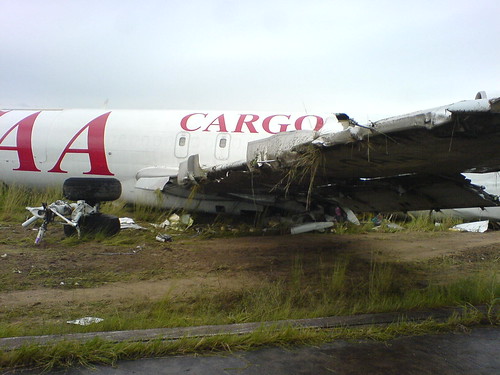
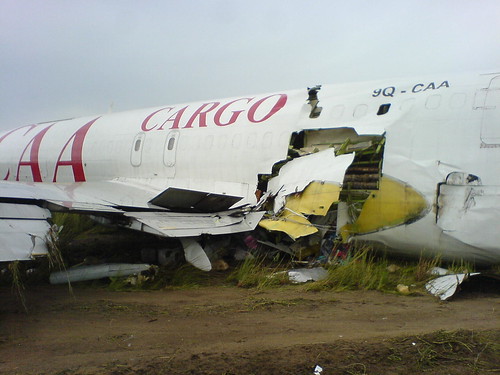
    Compagnie Africaine Boeing Crashes in Congo


    Pictured: A CAA – Compagnie Africaine d’Aviation Cargo Boeing 727-231/Adv(F/RE) Super 27 photographed in Goma, August 27, 2006
    Click to view full size photo at Airliners.net
    Contact photographer Guido Potters

    What: Compagnie Africaine d’Aviation Boeing 727-231F Super 27
    Where: Kinshasa-N’Djili Airport, D.R. Congo
    When: Jan 2, 2010
    Who:
    Why: The plane landed in very heavy rain and standing water on runway 06 and hydroplaned off the runway, skidding right on the main gears.

    9Q-CAA (ex-N54354) appears to be the only Boeing in the fleet.


    To include the featured image in your Twitter Card, please tap or click their icon a second time.