Public Statement

  • |

    Review of the Security and Controls over the Civil Aviation Registry Systems – Federal Aviation Administration

    The Federal Aviation Administration (FAA) is responsible for setting, overseeing, and enforcing safety standards in the aviation industry. FAA’s Flight Standards Service promotes aviation safety by managing systems for registration of civil aircraft and airman records. These registry systems contain FAA’s official records of civil aircraft registration and ownership, and airman certification, ratings and authorizations. DOT OIG has initiated an audit of the security of the registry systems’ information.

    Audit objectives are to determine whether: (1) personally identifiable information is secure from unauthorized use or access; (2) information in the registry systems is sufficient for managing aircraft registrations and airmen’s records; and (3) registry contingency planning ensures FAA’s continued ability to accomplish its mission of aviation safety.

  • |

    FAA Proposes $275,000 Civil Penalty Against Continental Airlines

    For Immediate Release
    December 22, 2010

    SEATTLE– The Federal Aviation Administration (FAA) is proposing a $275,000 civil penalty against Continental Airlines Inc., of Houston, for operating two Boeing 737-900ER (extended range) aircraft on 73 flights when they were not in compliance with Federal Aviation Regulations.

    The FAA alleges Continental mechanics failed to follow the 737 Airplane Maintenance Manual when they installed incorrect main landing gear wheel-tire assemblies on two aircraft and released them for service on Nov. 7 and 19, 2009.

    The manual contains specific instructions to mechanics not to use wheel-tire assemblies intended for the B-737-700, -800 and -900 on the heavier B-737-900ER. The manual says using the incorrect assemblies on the heavier version of the B-737 might lead to damage to the aircraft or injury to people working on and around the aircraft.

    Continental has 30 days from receipt of the FAA’s enforcement letter to respond to the agency

  • |

    FAA proposes $275,000 civil penalty against Continental Airlines

    For Immediate Release
    December 22, 2010

    SEATTLE– The Federal Aviation Administration (FAA) is proposing a $275,000 civil penalty against Continental Airlines Inc., of Houston, for operating two Boeing 737-900ER (extended range) aircraft on 73 flights when they were not in compliance with Federal Aviation Regulations.

    The FAA alleges Continental mechanics failed to follow the 737 Airplane Maintenance Manual when they installed incorrect main landing gear wheel-tire assemblies on two aircraft and released them for service on Nov. 7 and 19, 2009.

    The manual contains specific instructions to mechanics not to use wheel-tire assemblies intended for the B-737-700, -800 and -900 on the heavier B-737-900ER. The manual says using the incorrect assemblies on the heavier version of the B-737 might lead to damage to the aircraft or injury to people working on and around the aircraft.

    Continental has 30 days from receipt of the FAA’s enforcement letter to respond to the agency.

  • |

    FAA Needs To Improve Risk Assessment Processes For Its Air Transportation Oversight System

    On December 16, 2010, we (the FAA) issued our report on the Federal Aviation Administration’s (FAA) Air Transportation Oversight System (ATOS). FAA uses ATOS to conduct surveillance of nearly 100 airlines that transport more than 90 percent of U.S. airline passenger and cargo traffic. While ATOS is conceptually sound, our prior reports have found that FAA needs to strengthen national oversight of the system. Following safety lapses at a major airline in 2008, the Senate Committee on Science, Commerce, and Transportation and the House Committee on Transportation and Infrastructure asked us to assess weaknesses systemwide. Accordingly, our audit objectives were to determine (1) whether FAA has completed timely ATOS inspections of air carriers’ policies and procedures for their most critical maintenance systems; (2) how effective ATOS performance inspections have been in testing and validating that these critical maintenance systems are working properly; and (3) how well FAA implemented ATOS for the remaining Part 121 air carriers and what, if any, oversight challenges FAA inspection offices face.

    While FAA has worked to continuously improve ATOS, we found that FAA inspectors did not complete ATOS inspections of air carriers’ maintenance policies and procedures or systems performance on time. In addition, FAA transitioned all of its Part 121 inspection offices to ATOS at the end of 2007, but–due in part to training gaps–some inspectors for smaller air carriers had difficulty adapting ATOS to those carriers’ operations. We made seven recommendations to FAA to improve its data, training, and risk assessment processes for ATOS. FAA concurred with four of our seven recommendations and partially concurred with three.

  • | |

    American Traveling Public Says ‘There Has to Be a Better Way’ to Conduct Air Travel Security Screening

    Overwhelming Majority Support a Trusted Traveler Program That Could Help Spur $84.6 Billion in More Travel

    Blue Ribbon Panel of Experts Convened By U.S. Travel Association to Make Recommendations in Coming Weeks

    WASHINGTON, Dec. 21, 2010 — As airports begin welcoming passengers during one of the busiest air travel periods of the year, a new survey reveals three in four air travelers believe “there has to be a better way” to conduct air travel security screening. Eight in 10 support a trusted traveler program that would provide alternative screening measures for American citizens who submit to a background check and meet other risk criteria. Respondents would take an average of two to three more trips per year if the hassle involved in flying could be reduced without compromising security. Those additional trips would add $84.6 billion in travel spending and support 888,000 additional jobs, according to research from the U.S. Travel Association.

    “Americans are clamoring for a better way, and it should be a wake-up call for our leaders in Washington,” said Roger Dow, president and CEO of the U.S. Travel Association, which commissioned the survey. “An efficient air travel security screening system that streamlines the process for trusted travelers can strengthen our security and economy. Let’s get to work building the system Americans crave.”

    A majority of those surveyed believe Congress should make air travel security a top priority in the new term that begins in January.

    According to the Consensus Research Group, which conducted the survey, “Travelers’ frustration with the system is not limited to just one or two security measures. It is across the board and includes a range of issues.”
    Among the survey findings:

    The U.S. Travel Association has convened a Blue Ribbon Panel for Frictionless Aviation Security comprised of industry and security experts and former government officials. The panel will recommend how to improve air travel security in a way that maximizes security and minimizes the burden on travelers. The panel is expected to issue its report in early 2011.

    The survey was conducted online by Consensus Research Group on behalf of the U.S. Travel Association between November 29 and December 10. The survey includes a nationally representative sample of 1,000 business and leisure air travelers who have flown during the past two years, are aged 25 or older, and who reside in the U.S.

    • Having to remove shoes before going through a metal detector received a higher negative response from those surveyed than newly implemented pat-down body searches by Transportation Security Administration (TSA) personnel.
    • Nearly 9 in 10 respondents believe it is possible to achieve an air travel screening system that is both secure and efficient, while virtually the same number believe if we can put a man on the moon, we can create a passenger security system that doesn’t frighten or inconvenience travelers.
    • Three in four air travelers support recruiting more professional security personnel who are trained to use personal observation, dogs and sophisticated computer analyses that have proven to be effective screening techniques in the past.

    One page summary of the survey:

    Travelers Frustrated with National Air Security System Public Believes “There Has To Be a Better Way”
    Three in four American travelers (75%) believe there has to be a better way to provide air travel security than the procedures used today.
    • Two-thirds of air travelers (66%) believe air travel security is a complicated problem and will not accept heavy-handed procedures unless they are more effective and efficient – 72% of business travelers agree.
    • Eight in ten (82%) agree that if we can put a man on the moon, we can create a passenger screening system that doesn’t frighten or inconvenience air travel passengers.
    More travelers describe the current passenger screening process as “inconsistent,” “stressful,” or “embarrassing” than describe it as being “fair” or “effective.”

    Top ten words air travelers use to describe today’s screening procedures:
    o Inconsistent 64% o Stressful 58% o Embarrassing 41% o Intimidating 40% o Intrusive 39%
    o Fair 30% o Ineffective 29% o Effective 23% o Rude 22% o Frightening 16%
    More would travel by air if the screening process was improved – and the economy would benefit.
    • Nearly two in every three air travelers (64%) said they would fly more if security procedures remained as effective but were less intrusive and less time-consuming.
    • Travelers would take an average of two to three more trips a year (2.48/year) if the hassle could be reduced without compromising security effectiveness. These additional trips could add $84.6 billion in spending and 888,000 more jobs.
    • 80% agree there should be alternative screening measures for American citizens who submit to a background check and meet other risk criteria. In fact, half (50%) of those who have traveled recently “strongly agree” with this.
    • Three in four air travelers (74%) support recruiting more professional security personnel who are trained to use personal observation, dogs and sophisticated computer analyses.
    • A majority of air travelers support common-sense measures such as creating a special security lane for frequent travelers (60%) and a special screening lane for families, infrequent travelers and people who need boarding assistance (58%).
    American travelers believe fixing air travel security should be a top priority in the 112th Congress.
    • A majority of air travelers (54%) believe Congress should make air travel security a top priority in the new term that begins in January.

  • | |

    American Airlines Schedules and Fares No Longer Available on Orbitz.com

    Citing Failure to Reach a Mutually Beneficial Commercial Agreement American Revokes Orbitz Authority to Display and Sell American Airlines Fares

    FORT WORTH, Texas, Dec. 21, 2010 — Effective immediately, American Airlines will discontinue displaying and selling fares through Orbitz (www.orbitz.com) and its subsidiary Orbitz for Business. Tickets for travel already purchased through Orbitz remain valid but changes must be made through American Airlines reservations by calling 1-800-433-7300.

    Tickets for travel on American Airlines and American Eagle – including all international and domestic classes of service – are widely available through a number of outlets, including American’s own website, AA.com, which features our Lowest Fare Guarantee. Tickets, fares and schedules are also available through American’s reservations agents, thousands of travel agencies in locations worldwide, other online travel agencies such as Priceline.com, and metasearch engines such as Kayak.com.

    “American Airlines regrets any inconvenience this may cause our customers. While we could not reach an agreement with Orbitz, we are committed to letting customers know of the multitude of options they have to purchase travel on American Airlines,” said Derek DeCross, Vice President – Sales. “In today’s competitive marketplace, it is important for American to be free to customize its product offerings to improve the customer experience as well as distribute its products in a way that does not result in unnecessary costs.”

    American also continues to provide its fare content to travel agency partners, both through global distribution systems and through American’s own direct connection technology that is powered by Farelogix. There is no charge to agencies for using American’s direct connection, which allows travel agencies to offer their customers more complete and tailored travel choices, including fares and optional services

  • |

    Boeing Receives US Air Force Contract for C-17 Training Devices

    ST. LOUIS, Dec. 22, 2010 — The Boeing Company today announced it has received a contract from the U.S. Air Force to deliver C-17 training devices to three sites. The contract value is $44 million initially and up to $72 million if two options are exercised.

    The first set of devices is an Integrated Training Center (ITC) to be delivered to Wright-Patterson Air Force Base, Ohio, in the first quarter of 2012. The ITC will consist of a weapon systems trainer, pilot and co-pilot station, loadmaster station and related courseware and support equipment. A second weapon systems trainer will be installed at McChord Air Force Base, Wash., in the third quarter of 2012 and a third ITC will go to a new C-17 training site in early 2013.

    “Wright-Patterson is set to receive its first of eight C-17s next year and McChord has 54,” said Mark McGraw, Boeing vice president for Training Systems & Services. “We are proud to add to the Air Force’s training capability and support warfighter readiness with these new devices.”

    The ITCs support pilot and co-pilot instruction in flight operations, mission planning and emergency procedures through computer-based training, advanced aircraft simulation and other desktop training devices. C-17 loadmasters also receive computer-based and aircraft training in addition to training on the loadmaster station, cargo loading models and cargo compartment trainer. Additionally, maintenance personnel can use the ITCs for training on engine run procedures.

  • |

    Boeing Completes Acquisition of Summit Aeronautic Group in Montana

    SEATTLE, Dec. 21, 2010 / — Boeing announced today the completion of the acquisition of the business and operations conducted by Summit Aeronautics Group in Helena, Montana. Terms of the transaction, announced on Nov. 22, were not disclosed.

    The newly acquired business will be named Boeing Helena. It will become part of Boeing Fabrication, a division of Boeing Commercial Airplanes. Boeing Helena will manufacture titanium and other hard-metal structures for Boeing commercial aircraft including the 747-8, 767 and 787.

    Forward-Looking Information Is Subject to Risk and Uncertainty
    Certain statements in this release may be “forward-looking” within the meaning of the Private Securities Litigation Reform Act of 1995. Words such as “may,” “will,” “should,” “expects,” “plans,” “intends,” “projects,” “believes,” “estimates,” “targets,” “anticipates,” and similar expressions are used to identify these forward-looking statements. Examples of forward-looking statements regarding the proposed acquisition of Summit include, but are not limited to, statements regarding the expected timetable for completing the transaction, future business prospects, our guidance relating to 2010 and 2011 financial and operating performance, product development and benefits and synergies of the transaction, as well as any other statement that does not directly relate to any historical or current fact. Forward-looking statements are based upon assumptions about future events that may not prove to be accurate. These statements are not guarantees of future performance and involve risks, uncertainties and assumptions that are difficult to predict. Actual outcomes and results may differ materially from what is expressed or forecasted in these forward-looking statements. As a result, these statements speak to events only as of the date they are made and we undertake no obligation to publicly update or revise any forward-looking statements, whether as a result of new information, future events or otherwise, except as required by federal securities laws. Specific factors that could cause actual results to differ materially from forward-looking statements include, but are not limited to, the effect of economic conditions in the United States and globally, the ability of the parties to satisfy the transaction conditions and complete the acquisition, the risk that competing offers will be made, our ability to successfully integrate Summit’s business and realize anticipated synergies, and other important factors disclosed previously and from time to time in our filings with the Securities and Exchange Commission.

  • |

    Massive flight cancellations into and out of Frankfurt – German domestic flights and connections to European destinations equally affected – Long-haul flights still being flown

    The winter weather over the past few days has severely disrupted flight operations and kept passengers stranded on the ground, especially at Lufthansa’s home airport in Frankfurt. Since the weather is expected to get even worse, Lufthansa has been forced to operate to a special timetable, in which numerous flights on German and European routes into and out of Frankfurt will have to be cancelled. This measure is necessary in order to reinstate flight operations on their customary stable basis. Lufthansa long-haul flights are not affected.

    All Lufthansa passengers are urged to check the status of their flight before beginning their journey at Arrival & Departure. Passengers on intraGerman flights are advised anyway to utilise an alternative means of travel. In view of the extraordinary situation, Lufthansa flight tickets can be used for journeys by train without any problem. Electronic tickets can be exchanged for travel vouchers at the customer-operated check-in terminals.

    Should there not be enough time to convert the ticket at a Lufthansa Quick-Check-in machine, Lufthansa recommends the purchase of a train ticket. The refund of the ticket can be obtained by presenting the train ticket and the flight ticket to the office that has issued the flight ticket after having completed the journey.

    Passengers affected by flight cancellations should contact the dedicated Lufthansa Call Center set up specially for the purpose. The free phone number to call from Germany is: 0800 850 60 70. Callers from outside Germany should phone their local Lufthansa phone number .

    Lufthansa deeply regrets the inconvenience caused to many of its passengers in these days and will do its utmost to lessen the impact as much as possible.

    Deutsche Lufthansa AG
    Corporate Communications

  • | |

    GOL Announces Commercial Agreement with Passaredo Linhas Aereas

    GOL adds six cities to its route network with Passaredo’s routes, which will be available in its sale channels

    SAO PAULO, Dec. 21, 2010 -FirstCall/ — GOL Linhas Aereas Inteligentes S.A., the largest low-cost and low-fare airline in Latin America, has signed a commercial agreement to sell, in all its sales channels, tickets of Passaredo Linhas Aereas, a Brazilian domestic airline that recorded growth of 130.89% last year.

    Passaredo currently operates 103 flights to 20 destinations in Brazil. As a result of the agreement, GOL will add the cities of Marilia, Ribeirao Preto, Sao Jose de Rio Preto (Sao Paulo), Barreiras, Vitoria da Conquista (Bahia) and Ji-Parana (Rondonia) to its route network. GOL, operating through Passaredo, also offers eight new direct flights, including Porto Alegre (Rio Grande do Sul) to Goiania (Goias) and Uberlandia (Minas Gerais) to Rio de Janeiro (Santos Dumont Airport).

    GOL passengers connecting with Passaredo flights will only need to check-in once and their baggage will go directly to the final destination.

    Based in Ribeirao Preto, Passaredo Linhas Aereas began operations in 1995. Its fleet currently comprises 15 aircraft – five Embraer EMB-120s and ten Embraer ERJ-145 jets, with a capacity for 30 and 50 passengers, respectively. By July 2011, however, it will be operating 23 aircraft, with the addition of eight already contracted ERJ-145s.

    “This is a strategic agreement for GOL because Passaredo is a well-known regional airline which will add important destinations to our route network, improving our penetration and offering our passengers new direct flight options”, declared Claudia Pagnano, GOL’s Market Vice-President.
    The routes will be handled by all GOL’s sales channels, available for purchase up to the day before the flight. The agreement does not include the accumulation of SMILES mileage on Passaredo flights.

    For Captain Felicio, the CEO of Passaredo Linhas Aereas, the company is assuming a strategic position in the market. “GOL is an excellent partner. We believe in a strong regional aviation market, where we will be operating with penetration for one of the leading airlines in Latin America. This is the system they use in North America and Europe”, he concluded.

    About Passaredo Linhas Aereas

    Passaredo has expanded more than any other airline in Brazil since 2004, recording annual growth of close to 100%, and currently operates 103 daily flights to 20 cities in 10 Brazilian states. It focuses on flights carrying up to 50 passengers, operating on medium-potential routes with high-tech aircraft, high fuel consumption efficiency and low-cost maintenance. Its aircraft are manufactured by Embraer and there are more than 1,200 units operating worldwide. Passaredo puts great emphasis on top-class customer service, prioritizing comfort, safety, efficiency and punctuality. Given its intention of maintaining its regional identity, the partnership with GOL will complement its operations, allowing it to offer a wider range of destinations to its clients.

    About GOL Linhas Aereas Inteligentes S.A.

    GOL Linhas Aereas Inteligentes S.A. (NYSE: GOL and BM&FBOVESPA: GOLL4), (S&P/Fitch: BB-/BB-, Moody`s: Ba3), the largest low-cost and low-fare airline in Latin America, offers more than 900 daily flights to 59 destinations that connect all the important cities in Brazil and 14 major destinations in South America and Caribbean. The Company operates a young, modern fleet of Boeing 737 Next Generation aircraft, the safest and most comfortable of its class, with high aircraft utilization and efficiency levels. Fully committed to seeking innovative solutions through the use of cutting-edge technology, the Company – via its GOL, VARIG, GOLLOG, SMILES and VoeFacil brands – offers its clients easy payment facilities, a wide range of complementary services and the best cost-benefit ratio in the market.

    This release contains forward-looking statements relating to the prospects of the business, estimates for operating and financial results, and those related to growth prospects of GOL. These are merely projections and, as such, are based exclusively on the expectations of GOL’s management concerning the future of the business and its continued access to capital to fund the Company’s business plan. Such forward-looking statements depend, substantially, on changes in market conditions, government regulations, competitive pressures, the performance of the Brazilian economy and the industry, among other factors and risks disclosed in GOL’s filed disclosure documents and are, therefore, subject to change without prior notice.

  • |

    AA Credit Union Employees Donate $3,090 to the North Texas Food Bank Virtual can Drive

    FORT WORTH, Texas, Dec. 20, 2010 — AA Credit Union has proudly presented the North Texas Food Bank (NTFB) with a $3,090 donation as a result of the Credit Union’s weeklong virtual canned food drive.

    In early December, Credit Union employees participated in a special Dress Down Days fund-raiser, contributing $5 a day or $20 for the entire week in exchange for being able to wear jeans and sneakers to work.

    The drive was part of the North Texas Food Bank’s “Close the Gap on Hunger in North Texas” campaign. “Close the Gap” is the NTFB’s three-year initiative to unite the community to narrow the food gap by providing access to 50 million meals annually by 2011.

    “Virtual Canned Food Drives eliminate the hidden costs associated with a regular canned food drive,” said Sophia Sindalovsky, Volunteer Coordinator of the NTFB. “It also provides much more assistance to North Texans by leveraging donations to provide four meals for every dollar raised. Giving has never been easier.” The Credit Union’s donation equates to nearly 12,360 meals for North Texans.

    “After donating hundreds of pounds of canned goods in last year’s drive, we were excited — and somewhat relieved — to throw our efforts behind a virtual canned food drive this year,” said Pedro Noda, the fund-raiser’s director and eMarketing Manager at AA Credit Union. “We’re excited to make this donation on behalf of AA Credit Union and the many employees who helped make this possible.”

    “This time of year, it is particularly important to remember those who are less fortunate,” said Angie Owens, AA Credit Union President and CEO. “I once again could not be more proud of all our employees for opening up their hearts to help the North Texas Food Bank reach such admirable goals.”

    About American Airlines Federal Credit Union

    AA Credit Union was founded in 1936, and today serves the present and retired employees of American Airlines, their family members and others who work in the air transportation industry. AA Credit Union has more than 223,000 member-owners and assets of more than $5 billion. As a cooperative financial services institution, the Credit Union’s goal is to provide the best possible benefits and services for its member-owners.

    About the North Texas Food Bank

    The North Texas Food Bank (NTFB) is a nonprofit hunger relief organization that distributes donated, purchased and prepared foods through a network of 1,146 feeding programs in 13 North Texas counties. The NTFB supports the nutritional needs of children, families and seniors through education, advocacy and strategic partnerships. Founded in 1982, the NTFB is a member of Feeding America (feedingamerica.org). Each month agency pantries distribute food to more than 53,000 families and on-site meal programs serve 435,000 meals/snacks. Every dollar donated to the NTFB provides four meals for the hungry. Imagine… A World Without Hunger. www.ntfb.org.

  • |

    Boeing Delivers Air Austral’s First Next-Generation 737-800

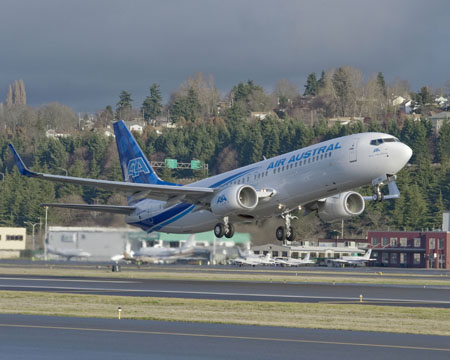
    SEATTLE, Dec. 20, 2010 — Boeing delivered a Next-Generation 737-800 to Air Austral, as part of the airline’s modernization plan for its medium-haul fleet. The airplane is the first of two the airline ordered to replace one 737-300 and one 737-500 in its fleet. The new airplane continues the Boeing-Air Austral relationship that began 20 years ago with the 737 Classic. The delivery ceremony was attended by Gerard Etheve, president of the directory and chief executive officer of Air Austral. The airline is headquartered in St. Denis, Reunion, a French Department island located east of Madagascar in the Indian Ocean.

  • | |

    Boeing Fabricará 3 Satélites para el Gobierno de México

    EL SEGUNDO, California, 20 de diciembre de 2010 — Boeing [NYSE: BA] anunció hoy la adjudicación de un contrato por aproximadamente US$1,000 millones de parte del gobierno mexicano para la entrega de un sistema integral de comunicaciones satelitales. El sistema, denominado MEXSAT, consta de tres satélites, dos estaciones terrenas, los sistemas de operaciones de red correspondientes y terminales de usuario de referencia. MEXSAT proveerá comunicaciones seguras para las necesidades de seguridad nacional de México, así como una cobertura mejorada para las telecomunicaciones civiles.

    “MEXSAT es la cuarta generación de satélites que Boeing ha suministrado a México para comunicaciones satelitales gubernamentales y civiles,” dijo Craig Cooning, director general ejecutivo (CEO) de Boeing Satellite Systems International. “MEXSAT ha sido desarrollado con base en 13 años de experiencia de parte de Boeing en el diseño y la fabricación de avanzados sistemas de satélites geoestacionarios para servicios móviles.”

    Conforme a los términos del contrato, Boeing entregará un sistema llave en mano completo que se compone de dos satélites geoestacionarios para servicios móviles (o “GEO-Mobile”) Boeing 702HP denominados MEXSAT 1 y MEXSAT 2, así como un satélite para banda C extendida y banda Ku, llamado MEXSAT 3, que proveerá servicios satelitales fijos (FSS) desde una órbita geosíncrona. El primer lanzamiento programado es el de MEXSAT 3, a finales de 2012.

    Cada satélite Boeing suministrará 14 kilowatts de potencia mediante alas de arreglos de cinco paneles solares dotadas de celdas fotovoltaicas de arseniuro de galio de triple unión de alta eficiencia. Cada una de las naves transportará un reflector de banda L de 22 metros para servicios satelitales móviles (MSS), complementado por una antena de banda Ku de 2 metros.
    Boeing subcontratará la fabricación del satélite MEXSAT 3 y de un centro de operaciones a su empresa asociada Orbital Sciences Corporation [NYSE: ORB]. MEXSAT 3, un satélite Orbital Star 2.4, brindará cobertura total al territorio mexicano y sus aguas patrimoniales, y transmitirá comunicaciones civiles a fin de coadyuvar al desarrollo socioeconómico del país.

    Asimismo, Boeing desarrollará dos estaciones terrenas equipadas con avanzada tecnología de flexibilidad de conformación del haz para dirigir haces puntuales de usuario móvil a dependencias gubernamentales que operan en México y sus aguas patrimoniales, tanto en el litoral del Pacífico como en el Golfo de México.

    Con anterioridad, Boeing suministró cinco satélites para el gobierno mexicano: los satélites Morelos 1 y Morelos 2, ambos puestos en órbita en 1985; los satélites Solidaridad 1 y Solidaridad 2, lanzados en 1993 y 1994; y el Satmex 5, lanzado en 1998. Solidaridad 2, que ya ha rebasado la vida útil estipulada en el contrato, aún continúa en servicio, y se espera que el satélite Satmex 5 deje de operar en 2012.

    Boeing Defense, Space & Security, una unidad de The Boeing Company, es una de las mayores empresas del mundo en el sector de defensa, espacio y seguridad. Se especializa en ofrecer a sus clientes soluciones innovadoras desarrolladas a partir de capacidades operacionales y es el fabricante más grande y versátil de aeronaves militares en el mundo. Con sede en St. Louis, Boeing Defense, Space & Security es una empresa de US$34,000 millones con una plantilla de 68,000 trabajadores en todo el mundo.

  • |

    Boeing to Build 3-Satellite System for Government of Mexico

    EL SEGUNDO, Calif., Dec. 20, 2010 — Boeing today announced that it has received a contract for approximately $1 billion from the government of Mexico to deliver an end-to-end satellite communications system. The system, known as MEXSAT, will consist of three satellites, two ground sites, associated network operations systems and reference user terminals. MEXSAT will provide secure communications for Mexico’s national security needs, as well as enhanced coverage for the country’s civil telecommunications.

    “MEXSAT is the fourth generation of satellites Boeing has provided to Mexico for government and civilian satellite communications,” said Craig Cooning, chief executive officer of Boeing Satellite Systems International. “MEXSAT builds on Boeing’s 13 years of experience in designing and delivering advanced geomobile systems.”

    Under the contract, Boeing will deliver a complete turnkey satellite system comprised of Boeing 702HP geomobile satellites MEXSAT-1 and MEXSAT-2 and one extended C- and Ku-band satellite, MEXSAT-3, which will provide fixed satellite services from geosynchronous orbit. MEXSAT-3 is scheduled to launch first, at the end of 2012.

    Each Boeing 702HP satellite will supply 14 kilowatts of power through five-panel solar array wings that use high-efficiency, ultra triple-junction gallium arsenide solar cells. Both satellites will carry a 22-meter L-band reflector for mobile satellite services, complemented by a 2-meter Ku-band antenna.

    Boeing will procure MEXSAT-3 and a spacecraft operations center from its supplier partner Orbital Sciences Corporation [NYSE: ORB]. MEXSAT-3, an Orbital Star 2.4 satellite, will provide full coverage of Mexico and its patrimonial seas and relay civil communications for socioeconomic development.

    Boeing also will develop two ground sites in Mexico with advanced beam-forming flexibility to direct mobile user spot beams to government agencies operating in Mexico and its patrimonial seas, including the Pacific Ocean and Gulf of Mexico.

    Boeing has previously provided five satellites that serve Mexico, beginning with Morelos 1 and Morelos 2, both launched in 1985; the Solidaridad 1 and Solidaridad 2 satellites, launched in 1993 and 1994; and Satmex 5, which was launched in 1998. Solidaridad 2, which has exceeded its contract life, is still in service, and Satmex 5 is expected to end its service life in 2012.

    A unit of The Boeing Company, Boeing Defense, Space & Security is one of the world’s largest defense, space and security businesses specializing in innovative and capabilities-driven customer solutions, and the world’s largest and most versatile manufacturer of military aircraft. Headquartered in St. Louis, Boeing Defense, Space & Security is a $34 billion business with 68,000 employees worldwide.

  • |

    Boeing-built C-17 Fleet Surpasses 2 Million Flight Hours


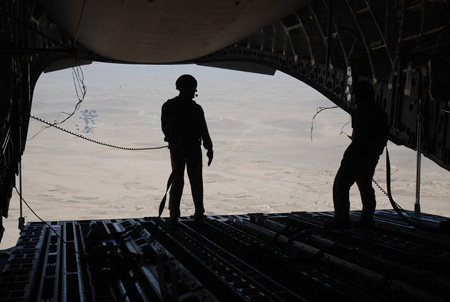
    LONG BEACH, Calif., Dec. 20, 2010 — The worldwide fleet of C-17 Globemaster III airlifters built by The Boeing Company [NYSE: BA] surpassed 2 million flying hours during an airdrop mission over Afghanistan on Dec. 10. Reaching 2 million flight hours equates to 1.13 billion nautical miles – the equivalent of a C-17 flying to the moon and back 2,360 times.
    The representative mission, flown by a U.S. Air Force C-17, airdropped 74,000 pounds of jet fuel in support of U.S. and coalition troops just south of Kabul.

    The C-17 has a mission readiness rate of more than 85 percent. It is the world’s only strategic airlifter with tactical capabilities that allow it to fly between continents, land on short, austere runways, and airdrop supplies precisely where they are needed.

    “There’s tremendous satisfaction in knowing that in those 2 million hours, the C-17 fleet has saved countless lives around the world,” said Bob Ciesla, Boeing C-17 program manager. “Boeing congratulates the U.S. Air Force and our international C-17 customers on reaching this milestone. We’re very proud that the C-17 continues to exceed expectations for performance and reliability.”

    The C-17 fleet, now in its 17th year of service, has supported humanitarian and disaster-relief missions worldwide. With 226 airlifters in service around the world, the C-17 fleet continues to operate at an accelerated rate due to the recent troop surge in Afghanistan, reaching the 2 million flight-hours milestone less than five years after reaching 1 million flight hours in March 2006, when 152 C-17s were in service. This year, lifesaving aeromedical evacuations of wounded troops from Afghanistan and Iraq, along with relief missions for natural disasters such as earthquakes in Pakistan, Chile and Haiti, have intensified the C-17’s normal workload.

    Boeing helps keep the C-17 flying through a worldwide support and sustainment program. “Boeing has had the honor of supporting the entire C-17 fleet since the delivery of the first aircraft to Charleston Air Force Base in 1993,” said Gus Urzua, program manager for the Boeing C-17 Globemaster III Sustainment Partnership. “Through innovative Performance-Based Logistics contracting and partnering with the Air Force, we have maintained the highest level of aircraft readiness while continuously reducing the cost of ownership.”

    While providing relief to Haiti in January and February, C-17s delivered nearly 14,000 short tons of cargo and transported some 25,000 passengers and 280 patients. C-17s also played a key role in a record year for airdrops in support of Operation Enduring Freedom in Afghanistan. As of Oct. 31, C-17s and other airlifters have airdropped more than 45 million pounds of cargo to troops in remote locations.

    Boeing has delivered 20 C-17s to international customers. The U.S. Air Force — including active duty, National Guard, and Air Force Reserve units — has taken delivery of 206. Other customers include the U.K. Royal Air Force, the Canadian Forces, the Royal Australian Air Force, the United Arab Emirates Air Force, the Qatar Emiri Air Force, and the 12-member Strategic Airlift Capability initiative of NATO and Partnership for Peace nations. India is expected to be the next C-17 customer.

    A unit of The Boeing Company, Boeing Defense, Space & Security is one of the world’s largest defense, space and security businesses specializing in innovative and capabilities-driven customer solutions, and the world’s largest and most versatile manufacturer of military aircraft. Headquartered in St. Louis, Boeing Defense, Space & Security is a $34 billion business with 68,000 employees worldwide. Follow us on Twitter: @BoeingDefense.

  • |

    Boeing to Increase 777 Production Rate

    SEATTLE, Dec. 20, 2010 — Boeing ( today announced its production rate for the 777 program will increase to 8.3 airplanes per month in the first quarter 2013. This is the second production increase announced for the program this year. In March the program announced it would increase production from five to seven airplanes per month beginning in mid-2011.
    “In response to strong customer demand globally, we are increasing our yearly production to 100 777s,” said Boeing Commercial Airplanes President and CEO Jim Albaugh. “The 777 is the twin-aisle market leader because of its superior operating economics, unmatched range and preference among travelers’ needs.”

    The 777 has a large installed operator base, and a track record of proven performance including 1,163 orders, 907 deliveries and a backlog of more than 250 airplanes. Suppliers are prepared to support the rate increase.
    Watch a video on what customers have to say about the 777 airplane: http://bit.ly/elmgWE.

    The current production rate decision is not expected to have a material impact on 2010 financial results.

    Forward-Looking Statements
    Certain statements in this report may be “forward-looking” within the meaning of the Private Securities Litigation Reform Act of 1995. Words such as “expects,” “intends,” “plans,” “projects,” “believes,” “estimates,” “targets,” “anticipates,” and similar expressions are used to identify these forward-looking statements. Forward-looking statements are based upon assumptions about future events that may not prove to be accurate. These statements are not guarantees of future performance and involve risks, uncertainties and assumptions that are difficult to predict. Actual outcomes and results may differ materially from what is expressed or forecasted in these forward-looking statements. As a result, these statements speak to events only as of the date they are made and we undertake no obligation to publicly update or revise any forward-looking statements, whether as a result of new information, future events or otherwise, except as required by federal securities laws. Specific factors that could cause actual results to differ materially from forward-looking statements include, but are not limited to, statements we make regarding our guidance relating to future financial and operating performance, the effect of economic conditions in the United States and globally, and general industry conditions as they may impact us or our customers, as well as the other important factors disclosed previously and from time to time in our other filings with the Securities and Exchange Commission.

  • |

    Boeing and Ethiopian Airlines Partner With Non-Profits to Deliver Needed Medical Supplies


    Ethiopian Airlines’ 777-200LR carries more than $500K worth of anesthesia equipment to Ethiopia’s largest hospital

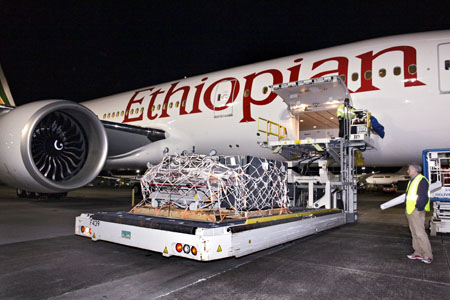
    EVERETT, Wash., Dec. 17, 2010 — Boeing partnered with Ethiopian Airlines and Seattle Anesthesia Outreach (SAO) for this week’s 777-200LR (longer range) delivery to Ethiopian Airlines to transport much needed anesthesia equipment to Black Lion Hospital – Ethiopia’s largest hospital.

    “Boeing and its airline partners have been working together to fill what is sometimes empty cargo space to help bring relief to people around the globe,” said Liz Warman, director of Boeing Global Corporate Citizenship for the Northwest region. “Our company has a history in humanitarian efforts. Our Humanitarian Delivery Flights program is another way we can continue leveraging our resources to help those in need.”

    “Since its inception, Ethiopian Airlines has been engaged in various corporate social responsibility activities, which support community initiatives and development efforts,” said Ato Girma Wake, CEO of Ethiopian Airlines. “We see our airplanes as not only a resource for our airline, but also a source of vital service for the people of Ethiopia and when we can use that resource in a manner such as this; it truly reaffirms our commitment to undertake social responsibilities whenever and wherever we can.”

    Ethiopian Airlines’ new 777-200LR (its second of five 777-200LRs on order) will deliver approximately 12,000 pounds (5,443 kg) of medical supplies, mainly anesthesia machines, monitors and books, from Seattle Anesthesia Outreach to Black Lion Hospital in Addis Ababa, Ethiopia. Black Lion Hospital is the largest hospital in Ethiopia as well as the largest teaching hospital for the University of Addis Medical School.

    “We’re thrilled at the opportunity to work with Boeing and Ethiopian Airlines to use this flight to support our efforts in Ethiopia,” said Dr. Mark Cullen, vice president and co-founder of SAO. “These supplies will prove critical when a group of 20 doctors travel to Ethiopia in February as part of our ongoing humanitarian trips to the region.”

    A majority of the medical supplies being shipped to Ethiopia were donated by Swedish Medical Center, which is the largest and most comprehensive non-profit health provider in the greater Seattle area. In addition to the donation of medical supplies, 12 affiliated physicians and clinical staff from Swedish have donated vacation time to volunteer as part of SAO’s humanitarian trips to Ethiopia.

    The Boeing Humanitarian Delivery Flights (HDF) program is a collaboration effort between Boeing, airline customers and non-profit organizations to deliver humanitarian aid throughout the world to communities in need or crisis. The humanitarian items are loaded into the empty cargo space of new airplanes being delivered and transported to the customer’s home destination.
    Ethiopian Airlines as a responsible corporate firm is committed to support worthy social activities, which are designed to help build sustainable livelihoods for individuals, the community and the society in general. In doing so, it has left its mark on major social initiatives.

  • DOT PANEL’S RECOMMENDATIONS IDENTIFY CHILD SAFETY IMPROVEMENTS IN AVIATION BUT DO NOT GO FAR ENOUGH, NTSB CHAIRMAN SAYS

    National Transportation Safety Board Chairman Deborah A. P. Hersman said that the recommendations issued today by a federal advisory panel dealing with child safety in aviation are a step in the right direction, but they do not go far enough to ensure the safety of the smallest children in airplanes.

    The Department of Transportation’s Future of Aviation Advisory Committee (FAAC) presented 23 recommendations to DOT Secretary Ray LaHood today. Among those recommendations was a call that Secretary LaHood utilize the full resources of his office to educate the flying public about the dangers of lap children in aviation. The FAAC also requested that the Secretary to update economic and safety data concerning small children, and to take decisive steps, which may include rulemaking, to address child passenger safety in aviation.

    Chairman Hersman stated, “We appreciate the FAAC acknowledging the dangers associated with children flying on their parents’ laps, but we would have preferred to see the FAA be mandated to require that every person including our youngest children be restrained appropriately for their age and size.” She continued, “We know that the safest place for children younger than age two traveling on airplanes is in an appropriate child safety seat. The era of the lap child on airplanes should come to an end.”

    The NTSB recently held a Public Forum on Child Passenger Safety in the Air and in Automobiles on December 9, 2010. A webcast of that forum, and presentations and videos concerning child passenger safety are available at www.ntsb.gov/children.

    The NTSB will continue its efforts to promote child passenger safety in the coming year through education and advocacy that is aimed toward the caregivers of children, regulatory agencies, and the transportation industry.

  • North American Airlines and VT Systems Plan Conversion of Boeing 757-200 to Combi Configuration

    ALEXANDRIA, Va., Dec. 17, 2010 — North American Airlines, a subsidiary of Global Aviation Holdings Inc., and the aerospace division of Vision Technologies Systems, Inc. (VT Systems), a subsidiary of ST Engineering, today announced that they have entered into an agreement for the conversion of Boeing 757-200 passenger aircraft to Combi configuration. In the Combi configuration, the aircraft will accommodate up to 10 cargo pallets and provide comfortable cabin seating for 45 passengers.

    “The Boeing 757 Combi will be utilized on routes where our customers require the shipment of heavy supplies as well as personnel,” said Brian Bauer, Chief Commercial Officer of Global Aviation. “As a longtime operator of the passenger Boeing 757, North American will be able to offer customers a seamless upgrade using this modern and fuel-efficient platform.”

    “This agreement is a vote of confidence in our strong MRO and engineering track record in the U.S. and our capability to offer tailored solutions to meet customers’ special operating requirements,” said General (Retired) John G. Coburn, Chairman and Chief Executive Officer of VT Systems. “We look forward to supporting North American Airlines with a complete solution – from design and development to implementing the conversion at our MRO facilities.”

    VT Systems’ aerospace division, which owns maintenance, repair and overhaul (MRO) facilities in Mobile and San Antonio, is the largest private employer in Mobile, and the largest private independent MRO employer in San Antonio. Managed by ST Aerospace as part of its global network of MRO facilities, these facilities have been performing heavy maintenance and modification works for numerous aircraft types, including the Boeing 757. The Mobile facility previously designed and converted two Royal New Zealand Air Force 757-200 passenger aircraft into multi-role combination configuration. It also jointly developed the engineering solution with Boeing for the 757-200 passenger-to-freighter (PTF) conversion and redelivered 17 converted freighters to Boeing’s customer DHL. It is currently performing PTF conversions for FedEx Express, following the award of a conversion contract for 87 Boeing 757-200 aircraft. ST Aerospace is the aerospace arm of ST Engineering.

    North American Airlines is a provider of customized, non-scheduled air transport services. Founded in 1989, North American operates Boeing 757-200 and Boeing 767-300ER aircraft. North American is a subsidiary of Global Aviation Holdings Inc. which is the largest provider of contracted air transportation services to the U.S. Military.

  • |

    Boeing and Fujitsu Form Strategic Alliance in Airline Information Maintenance Services

    SEATTLE, Dec. 17, 2010 — Boeing and Fujitsu have established a strategic alliance in which the companies will develop a service to enable greater efficiency in aircraft maintenance operations. The partnership will employ unique tools such as Radio Frequency Identification Devices (RFID) and Contact Memory Buttons (CMB) to allow customers to use these technologies without needing to retrofit their own fleets. Airlines can reduce costs by reducing inventory and manual data entry errors without having to create new processes.

    Under the new alliance, Fujitsu will provide Boeing with a globally-shared platform that includes automated identification technology devices, device readers, software applications and a system integration and deployment service. Boeing will tailor solutions for each customer’s needs, integrate those solutions into the customer’s operational environment and establish a long-range plan that will expand automated identification technology solutions across the customer’s enterprise. Boeing plans to launch this service (with a formal name) for airlines in the first quarter of 2012. The service will be available for Boeing and non-Boeing fleets and will be rapidly adaptable to any customer.

    “We have been working with Boeing for more than five years to promote RFID implementation in the aviation industry and we are very excited to start this project jointly,” said Mitsutoshi Hirono, corporate vice president Fujitsu Limited.

    The Boeing Transformation Service will enable customers to better manage aircraft components, equipment and materials by retrofitting them with automated identification technology devices, allowing automated data management and highly visible supply chain related maintenance processes. Prior to the launch of the new service in early 2012, the service will undergo three phases of beta testing through deployment with a launch customer.

    “Our customers have told us they need these types of innovative solutions to improve operational efficiency,” said Per Noren, vice president, Boeing Commercial Aviation Services, Information Services. “We see an opportunity for the aviation industry that surpasses past expectations in establishing this partnership with Fujitsu.”

  • |

    Harrison Ford

    Wright Memorial Dinner

    Good evening, and thank you, Lisa [Piccione]. I’ve got to tell you … I had to resist the go-to move to, in the interest of safety, to spend some time talking about why doing “Indiana Jones” style stunts in an airplane would be a really, reallybad idea.

    But that’s not what tonight is all about. We’re honoring a pilot, a man who in spite of being a very well known celebrity has used his passion to serve as a springboard for aviation. Even in this room, Harrison Ford’s passion for aviation stands out. When he and I met and talked at a fundraiser at Oshkosh a few years ago, I learned pretty quickly that this is somebody who just loves aviation. Here’s a guy who is on Hollywood’s speed dial, and he wants to talk about hisidea of fun… which is actually a two-parter: flying, or talking about flying.

    In my book, he’s very clearly a student of the craft. Our system is as good as it isbecauseof him and people like him. There’s no special setting for pedigree on the yoke. You have to know your aircraft, and youhave to make sure that you’re both current and qualified when it comes to flying it.

    The good news here is that is exactly what we find in Harrison Ford. I’ve been flying now for almost five decades myself, and after a while you learn that you really can separate the ones that have it from the ones that don’t… Well, trust me, he’s got it.

    There’s a hangar in Santa Monica that shows he’s got it bad for things that fly. Fixed wing and rotorcraft rated. Walk in that hangar, you’ll find a Bell, a Beaver, a Husky, a Bonanza and a Caravan. He’s a one-man air show. That’s the inventory of someone who is a student of aviation.

    But I must tell you, that list of aircraft takes a back seat to what he has given toour industry. As chairman of the Young Eagles, he has been instrumental in giving our youth their first taste of aviation … their first flight. In his case, the word “chairman” was not a ceremonial title. You might expect that as chairman, he might have flow a fewyoungsters by himself. But you know what? He’s actually flown 306 … to be exact. That’s right kids; Han Solo is the pilot in command. Except you can bet those kids didn’t want to be Han Solo. They wanted to be Harrison Ford, the pilot.

    We’re always looking to ways to boost aviation… to inspire the next generation into aviation, especially to the youth of America. Here’s a guy who does it. We’re all about getting more science, more math, more engineering into our school curriculums. With aviation, you can do all three in with just a barrel roll or two. Wall Street can have Michael Douglas. We got Harrison Ford. Score one for aviation.

    Harrison has also been an outspoken advocate for aviation safety. He’s spoken up about runway incursions and airborne turbulence. His ticket shows me enough ratings to know that he’s not casual about aviation … he’spassionate. And when I talk about professionalism, I’m talking about the man we’re honoring here tonight.

    He has given much to aviation, but his legacy will be as a pilot… as an advocate… as a man whose passion is to enjoy the cockpit view of the horizon … and to give others a chance to do the same. And thatis a very fine legacy and certainly worthy of the honor he’s receiving tonight. Thank you.

  • |

    Southwest Airlines and Flight Simulator Technicians Ratify Contract Extension

    DALLAS, Dec. 16, 2010 COMTEX/ —

    Southwest Airlines (NYSE: LUV) is pleased to announce that its Flight Simulator Technicians, represented by the International Brotherhood of Teamsters (IBT) Airlines Division, voted to ratify an extension to their current agreement. The agreement is for a two-year contract extension through October 2013. The current contract would have become amendable on November 1, 2011.

    “I want to congratulate both sides for ratification of a contract that delivers mutually beneficial enhancements to pay, benefits, and work rules to our dedicated Flight Simulator Technicians,” said Mike Van de Ven, Southwest Airlines Executive Vice President and Chief Operating Officer. “The negotiating teams were able to balance our competitive needs with our Technicians’ requests to quickly come to an agreement as we head toward our 40th year of operation.”

    After nearly 40 years of service, Southwest Airlines continues to differentiate itself from other low fare carriers–offering a reliable product with exemplary Customer Service. Southwest Airlines is the nation’s largest carrier in terms of originating domestic passengers boarded, now serving 69 cities in 35 states. Southwest also is one of the most honored airlines in the world known for its commitment to the triple bottom line of Performance, People, and Planet. To read more about how Southwest is doing its part to be a good citizen, visit southwest.com/cares to read the Southwest Airlines One Report(TM). Based in Dallas, Southwest currently operates more than 3,100 flights a day and has nearly 35,000 Employees systemwide.

  • | |

    Delhi International Airport Partners with IBM to Create a Smarter Air Terminal

    NEW DELHI, Dec. 16, 2010 — Delhi International Airport (P) Limited (DIAL) has partnered with IBM (NYSE: IBM) India to establish a common-use infrastructure in New Delhi’s Passenger Terminal Building 3 that will automate its operations and improve customer satisfaction to give the airport a competitive edge through quality service. The unified network solution integrates all of the communications across Terminal 3 and its facilities so that airport operations, airlines and other tenants can better share and exchange key information across their related operations to more efficiently deploy their resources and meet the growing demands of the India aviation market.

    “IBM’s solution reflects the need of Delhi International Airport (P) Limited — a solution providing quality management of our internal systems and delivering greater service to the users of the airport while reducing issues pertaining to interoperability through this infrastructure,” said I. Prabhakara Rao, CEO Airport Project Development, DIAL. “We are happy to be working with IBM where they have placed us better in catering to our immediate business requirement.”

    DIAL chose IBM’s Managed Network Infrastructure (MNI) solution, which forms backbone for all the IT and non-IT systems in Terminal 3. It combines video, voice and data over a single network platform using Intelligent Cable Management System with high levels of redundancy and scalability. IBM designed and implemented this network to meet DIAL’s objective of achieving a world class common use IT infrastructure for its customers, thereby supporting and improving service quality levels due to its high available design. The MNI covers the length and breadth of Terminal 3 with wired and wireless network coverage providing common use but highly virtualized network services to airport core systems, IT and non-IT systems, corporate users, government offices, lounges and public facilities. All this has been done with well defined work methods statements, detailed working plans and test and integration plans.

    “DIAL wanted a partner who could understand the complexity of airport systems while being equipped with extensive experience in handling large-scale deployments at international airports,” said Sameer Batra, Vice President, Distribution Sector, IBM India/South Asia. “This project will help DIAL in addressing their requirement for a unified and secure solution that aims at improving the airport experience while positioning them for future growth.”

    With more than 50 years experience working with the world’s leading airlines and airports, IBM provides consulting services and information technology to top airlines and airports across the globe to enable them to deliver more highly differentiated customer experiences and improve their operational efficiency.

  • |

    Southwest Airlines Announces 20 Firm Boeing 737-800 Deliveries in 2012

    DALLAS, Dec. 15, 2010 —

    Today, Gary Kelly, Southwest Airlines Chairman, President, and CEO spoke at the Wings Club in New York City and shared additional details on introducing the Boeing 737-800 to the Southwest fleet.

    Kelly announced the Company will substitute 20 of its 737-700 orders for -800s, with the first delivery scheduled for March 2012. With both its Pilots’ and Flight Attendants’ Unions ratifying their contracts to add the -800 to their current collective bargaining agreements, the Company is continuing to finalize discussions with the Boeing Company regarding substitutions of the -800s for the -700 positions, and configuration and equipage options.

    “The -800 represents many exciting opportunities for our Employees and our Customers,” Kelly said. “We are looking to the future and the -800 sets the stage to bring more destinations into the realm of possibilities for Southwest, to operate a more economical aircraft, and to offer better scheduling flexibility in high-demand, slot-controlled, or gate-restricted markets.”

    The current plan is to deliver these 20, 737-800 aircraft in full Extended-range Twin-engine Operational Performance Standards (ETOPS) configuration. The current configuration also includes the Boeing Company’s Sky Interior that offers a quieter cabin, improved operational security features, and LED reading and ceiling lighting.

    After nearly 40 years of service, Southwest Airlines (NYSE: LUV) continues to differentiate itself from other low fare carriers–offering a reliable product with exemplary Customer Service. Southwest Airlines is the nation’s largest carrier in terms of originating domestic passengers boarded, now serving 69 cities in 35 states. Southwest also is one of the most honored airlines in the world known for its commitment to the triple bottom line of Performance, People, and Planet. To read more about how Southwest is doing its part to be a good citizen, visit southwest.com/cares to read the Southwest Airlines One Report(TM). Based in Dallas, Southwest currently operates more than 3,100 flights a day and has nearly 35,000 Employees systemwide.

    Cautionary Statement Regarding Forward-Looking Statements

    This news release contains forward-looking statements related to Southwest’s plans and expectations regarding the introduction of the Boeing 737-800 to its fleet. These statements are forward-looking statements within the meaning of Section 27A of the Securities Act of 1933 and Section 21E of the Securities Exchange Act of 1934. These forward-looking statements are based on the Company’s current intent, expectations, and projections and are not guarantees of future performance. These statements involve risks, uncertainties, assumptions, and other factors that are difficult to predict and that could cause actual results to vary materially from those expressed in or indicated by them. Factors include, among others, (i) the impact of fuel prices and economic conditions on the Company’s overall business plan and strategies; (ii) consumer demand for air travel; (iii) actions of competitors, including without limitation pricing, scheduling, and capacity decisions, and consolidation and alliance activities; (iv) the impact of governmental regulations on the Company’s operations; and (v) other factors, as described in the Company’s filings with the Securities and Exchange Commission, including the detailed factors discussed under the heading “Risk Factors” in the Company’s Annual Report on Form 10-K for the fiscal year ended December 31, 2009, and under the heading “Forward-looking statements” in the Company’s Quarterly Reports on Form 10-Q for the quarters ended March 31, 2010, June 30, 2010, and September 30, 2010.

    www.southwest.com

    SOURCE Southwest Airlines

  • Air Transport Association Applauds FAAC Recommendations

    Recognizes need for industry global competitiveness and viability, and its importance to the nation’s economic recovery

    WASHINGTON, Dec. 15, 2010 /PRNewswire-USNewswire/ — The Air Transport Association of America (ATA), the industry trade organization representing the leading U.S. airlines, today applauded the recommendations of the Future of Aviation Advisory Committee (FAAC) under the leadership of Secretary of Transportation Ray LaHood. Consisting of a cross section of aviation stakeholders – airlines, airports, manufacturers, labor, academia, finance, consumer interests and general aviation – the FAAC worked collaboratively and reached consensus on several recommendations for Secretary LaHood that will help drive the policy changes needed to ensure the viability and global competitiveness of the U.S. aviation industry.

    The recommendations, which the FAAC formally approved and will present to the Secretary today, address some of the most challenging and complex economic, environmental, safety and labor issues confronting the U.S. airline industry in an increasingly global and highly competitive market. We are supportive of and encouraged by the recommendations, which would:

    • Foster global airline alliances and unfettered access to the largest and fastest-growing global markets through Open Skies agreements
    • Accelerate NextGen implementation by providing government financial incentives to airline operators for equipage
    • Expedite the most cost-beneficial elements of NextGen, including ADS-B and performance-based procedures
    • Ensure that the federal aviation tax burden does not undermine the viability and competitiveness of the airline industry
    • Mitigate jet-fuel price volatility by supporting federal regulatory efforts to mitigate the impact of speculative activity on the price of oil
    • Reduce the impact of aviation on the environment through the use of sustainable fuels and improved aircraft technology
    • Further enhance aviation safety by strengthening FAA voluntary data-sharing programs and safety-risk discovery capabilities

    These important recommendations will help the U.S. airline industry continue its economic recovery and remain a world leader. We look forward to working with the administration and the 112th Congress to ensure that the FAAC recommendations are implemented expeditiously.