Public Statement

  • | |

    United and Continental Offer Rebooking Options to Customers Affected by Northeast Weather

    CHICAGO, Jan. 5, 2011 /PRNewswire via COMTEX/ —

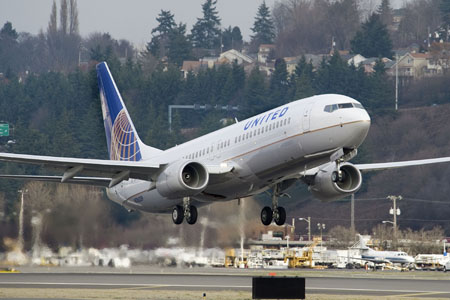
    United Continental Holdings, Inc. (NYSE: UAL) today announced travel options for United and Continental customers whose flight plans may be affected by severe winter weather forecast for the Northeast U.S. this weekend. Weather conditions are expected to lead to the cancellation or delay of certain flights at United’s hub at Washington Dulles International Airport and at Continental’s hub at Newark Liberty International Airport. Operations at other airports throughout the Northeast may also be affected.

    Change Flights for No Fee at united.com or continental.com

    Customers scheduled on flights to, from or through the affected airports Jan. 7 through Jan. 9 may reschedule their itinerary with a one-time date or time change, and the change fees will be waived. If a flight has been canceled, a refund in the original form of payment may be requested. Complete details and eligible travel dates are available at united.com and continental.com. The fastest and most convenient way to change travel plans is via united.com or continental.com. Customers should continue to manage their reservations on the respective company’s website from which their tickets were purchased. Customers may also book a new reservation, change an existing reservation or check flight status by calling United Reservations at 800-UNITED-1, Continental Reservations at 800-525-0280 or their travel agents. Another way to receive information about flight delays, cancellations and gate changes is with United’s EasyUpdate service or Continental’s TripAlert service, which provide customers notifications via phone, text or e-mail.

  • |

    Continental Announces New Tentative Agreement With Flight Attendants

    CHICAGO, Jan. 4, 2011

    Continental Airlines today announced that it has reached a tentative agreement on a new labor contract with the International Association of Machinists and Aerospace Workers (IAM) representing Continental flight attendants. The IAM is expected to hold a ratification vote in the coming weeks.

    “The negotiation teams were able to reach a fair agreement that is another positive step forward as we work to combine our companies,” said Sam Risoli, vice president of Inflight Service for the combined company.

    The agreement covers approximately 9,300 Continental flight attendants located throughout the United States.

  • |

    Statement of American Airlines in Response to Sabre’s Actions

    FORT WORTH, Texas, Jan. 5, 2011 / — American Airlines today received notice from Sabre that it has taken a set of punitive actions against the airline and its customers, despite the fact that American has met all its obligations and continues to work in good faith with Sabre.

    The actions, which include biasing its shopping displays, are anti-consumer, anti-competitive and harmful to its subscribing agents.

    Sabre’s actions are discriminatory and patently inconsistent with both its contractual obligations and its professed goal of ensuring full transparency for the benefit of consumers and travel agents. In contrast, the actions only serve to protect Sabre’s market position and attempt to force airlines and travel agencies to rely exclusively on its legacy systems that only lead to higher fares and fewer choices for consumers.

    American is committed to working with all efficient distribution channels, including traditional travel agencies, online travel agencies and global distribution systems

    American Airlines and American Eagle fares and schedules – including all international and domestic classes of service – are widely available through a number of outlets, including American’s own website, AA.com, which features our Lowest Fare Guarantee, as well as through American’s reservations agents, thousands of travel agencies in locations worldwide, online travel agencies such as Priceline.com and metasearch engines such as Kayak.com.

  • |

    Pet Airways Appoints Andrew Warner as President and Chief Financial Officer


    DELRAY BEACH, Fla., Jan. 4, 2011 — Pet Airways Inc. (PAWS.PK), the world’s first airline designed specifically for the comfortable, efficient and safe transportation of pets, today announced that Andrew Warner has been named President and Chief Financial Officer. Mr. Warner also serves as a member of the Pet Airways board of directors.

    Mr. Warner has more than 25 years of experience in financial and general management, with leadership positions in both public and private companies. He specializes in nurturing rapid growth in young consumer-oriented companies, particularly with respect to consumer technology.

    Prior to joining Pet Airways, Mr. Warner served as Chief Financial Officer of EnergyConnect Group, Inc., a leading provider of smart grid demand response services and technologies. Prior to that, Mr. Warner was the Chief Financial Officer of SmartDisk Corporation, which provided electronic storage solutions and was subsequently acquired by Verbatim. Mr. Warner was also the Chief Executive Officer of Zio Corporation, a private, digital consumer electronics company that was acquired by SmartDisk Corporation. Prior to Zio Corporation, Mr. Warner served as Chief Financial Officer, President of the U.S. Division and Executive Vice President of SCM Microsystems Inc., a global provider of digital security and identity management technology.

    “We are delighted that Andrew has agreed to join the Pet Airways team. With his strong financial and business experience, we believe that he will be instrumental in helping Pet Airways become a household name and solidify our leadership position in pet transportation,” said Dan Wiesel, Chairman and Chief Executive Officer of Pet Airways. “In particular, his experience growing successful companies, managing transactions and raising capital will be invaluable to us.”

    Andrew Warner commented, “Pet Airways is an exciting company that has the potential to fundamentally change the travel category. Pets are a very important part of the family, and by providing a safe and caring alternative to cargo, Pet Airways can transform the concept of family travel. I am thrilled to join the Pet Airways executive team, to work with Dan to broaden Pet Airways’ services and expand the company’s infrastructure.”

    Since Pet Airways’ launch in July 2009, flight capacity has nearly doubled with expansion from the original five destinations to the current nine. Revenue for the first nine months of 2010 more than tripled over the prior year, with over 3,000 pets flown through September 2010. The company continues to enjoy significant national and regional press coverage and recently announced a partnership with Petmate®, the leading provider of portable carriers.

    About Pet Airways, Inc.
    Pet Airways is the first airline specifically designed for the safe and comfortable transportation of pets. Pet Airways’ pawsengers™ travel in the specially equipped main cabin of its planes – where pets are continuously monitored by an In-Flight Pet Attendant and the climate is controlled for maximum pet comfort. With Pet Airways, pet parents can be assured their animals will be treated with tender, loving care throughout the journey. The airline launched flight operations in 2009 and currently serves coast-to-coast destinations across the United States, including Los Angeles, Phoenix, Denver, Omaha, Chicago, Baltimore, New York, Atlanta and Ft. Lauderdale. For more information go to www.petairways.com.

  • | |

    Boeing, Qatar Airways, AmeriCares Partner for Relief Flight

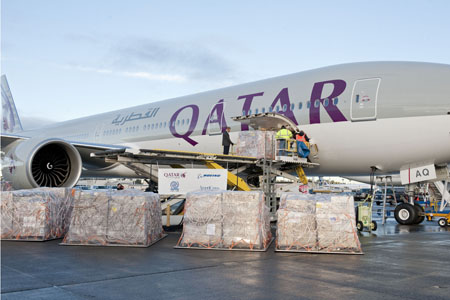
    New Qatar Airways 777-300ER carries medical supplies to Pakistan
    EVERETT, Wash., Jan. 4, 2011 /PRNewswire/ — Boeing (NYSE: BA) again has partnered with Qatar Airways and the non-profit global health and disaster relief organization AmeriCares to deliver a second consignment of relief supplies to areas in Pakistan that are still recovering from the massive floods that ravaged the country in August. The first shipment was delivered in September 2010.

    A consignment of about 35,000 pounds (15.8 metric tones) of medical supplies was loaded into the cargo hold of the new Boeing 777-300ER (extended range) delivered to Qatar Airways. The airline subsequently will ship the relief goods from Doha, Qatar to Pakistan.

    “This is the second time in four months that Boeing has partnered with Qatar Airways and AmeriCares to help the people in Pakistan where the need is still great,” said Liz Warman, director of Global Corporate Citizenship Northwest Region, Boeing. “Providing timely medical care is critical; though the floods have receded, the aftereffects such as sickness and disease continue to affect the people in these disaster zones.”

    Over the years, Boeing and airline partners as well as non-profit partners in the Humanitarian Delivery Flights (HDF) program have collaborated on many humanitarian missions and the Boeing 777-300ER was used on a number of those missions.

  • |

    CIT, Boeing Announce Order for 38 Next-Generation 737 Airplanes

    Order Includes 737-800s and 737-900ERs

    NEW YORK and SEATTLE, Jan. 4, 2011 /PRNewswire/ — CIT Group Inc. (NYSE: CIT), and Boeing (NYSE: BA) today announced that CIT Aerospace placed an order for 38 Next-Generation 737 airplanes and purchase rights for seven additional 737s.

    The order, with deliveries into 2017, includes 15 737-900ER (extended range) and 23 737-800 airplanes. It is the largest order placed by a leasing company for the 737-900ER, the largest and newest member of the Boeing Next-Generation 737 family. This is also the largest order placed by CIT for Boeing airplanes.

    “This order of Next-Generation Boeing aircraft reflects our efforts to maintain one of the youngest and most technologically advanced fleets in the industry,” said C. Jeffrey Knittel, president of Transportation Finance at CIT. “As a leading aircraft lessor, it is important that we continue to maintain a portfolio of operationally dependable and fuel-efficient aircraft for our customers.”

    “CIT’s choice of the Next Generation 737 shows its confidence in the product family and especially in its newest member, the 737-900ER, which features incredible economics and operational capability,” said Marlin Dailey, vice president of Sales & Marketing, Boeing Commercial Airplanes. “CIT is one of the leading companies in global transportation finance, and clearly recognizes the value that the Next Generation 737 will bring to its airline customers. CIT will be receiving its 737s with the innovative Boeing Sky Interior and other performance improvements that will keep its airplanes at the leading edge of passenger comfort, efficient operations and reduced fuel consumption.”

    CIT owns or finances a fleet of more than 300 commercial aircraft. As of Sept. 30, 2010, CIT had 140 Boeing airplanes in its portfolio. With this new order, the company now has a total order book of 111 aircraft, of which 58 are Boeing.

  • |

    NTSB ISSUES UPDATE ON JACKSON HOLE B-757 RUNWAY OVERRUN INCIDENT

    NTSB Advisory
    National Transportation Safety Board
    Washington, DC 20594
    December 31, 2010

    In its continuing investigation of the runway overrun of a jetliner in Jackson Hole, Wyo., the National Transportation Safety Board has developed the following factual information:

    At about 11:38 am MT on Wednesday, December 29, American Airlines flight 2253, a B-757-200 (N668AA) inbound from Chicago O’Hare International Airport, ran off the end of runway 19 in snowy conditions while landing at Jackson Hole Airport. No injuries were reported among the 181 passengers and crew on board.

    The aircraft came to rest in hard packed snow about 350 feet beyond the runway overrun area. An initial inspection did not reveal any structural damage to the aircraft. Shortly after the aircraft came to a stop, in accordance with American Airlines’ procedures, the pilots pulled the circuit breaker to the cockpit voice recorder (CVR) to preserve all of the recorded information for investigators.

    The CVR and DFDR (digital flight data recorder) arrived at the Safety Board’s recorder laboratory on Thursday evening, Dec. 30, where investigators were standing by to download the contents of both recorders. The CVR provided a two-hour recording of excellent quality audio; the voices of each of the pilots on the flight deck were clearly audible. The DFDR provided 1200 recorded parameters of flight data and captured the entire incident.

    The crew, who were interviewed on Thursday evening, indicated that they saw the runway prior to reaching the minimum descent altitude before touchdown. Both crewmembers characterized the flight and approach to landing as uneventful prior to the runway overrun. The first officer was the flying pilot.

    The accident docket, which will contain additional factual information, is expected to be opened in 60-90 days. It will be available on the docket section of the NTSB website at http://go.usa.gov/rjR

    PROTOCALS FOR TRANSPORTING AIRCRAFT RECORDERS IN INCIDENT INVESTIGATIONS

    The Safety Board has long-established protocols for the handling and transportation of CVRs and DFDRs that contain recorded information from a commercial aviation incident, which by definition is one where no serious injuries or substantial damage to the aircraft or other property has occurred.

    In such incident investigations, the Safety Board frequently asks the airline involved to transport the recorders on their own aircraft as such an arrangement often provides the most expeditious means of conveying the devices to Safety Board labs in Washington. The airline is instructed to transport the recorders without delay and without accessing the information contained within them by any means. This practice has worked efficiently and without complication for more than 40 years.

    During this incident investigation, the Safety Board learned that the recorders were flown to Tulsa, Okla., where American Airlines technicians downloaded information from the DFDR; the CVR was not accessed by American.

    “Although a thorough examination by our investigators determined that no information from the DFDR was missing or altered in any way, the breach of protocol by American Airlines personnel violates the Safety Board’s standards of conduct for any organization granted party status in an NTSB investigation,” said NTSB Chairman Deborah A.P. Hersman. “Because maintaining and enforcing strict investigative protocols and procedures is vital to the integrity of our investigative processes, we have revoked the party status of American Airlines and excused them from further participation in this incident investigation.”

    American Airlines has assured the Safety Board that a full review of proper procedures and internal controls would be undertaken to ensure that such an occurrence is not repeated.

    Despite their removal from party standing, the NTSB will provide American Airlines with any and all information needed to ensure a timely response to operational safety deficiencies identified in the course of the investigation.

  • GE’s 1000th Dowty Propeller System Makes First Flight on C-130J


    Cincinnati, Ohio– GE Aviation joins Lockheed Martin today to mark the 1000th Dowty advanced propeller system on a C-130J aircraft. The first flight took place December 20 at Dobbins Air Reserve Base in Marietta, Georgia. The C-130J will be delivered to Dyess Air Force Base by year’s end.

    Performing the C-130J’s flight were Lockheed Martin test pilots Dick Shroeder and P R Helm.

    Oliver Towers, president of Dowty Propellers said: “We have provided the propeller system for the C-130J since 1994. The high integrity of the all-composite propeller system significantly contributes to the overall efficiency of the C-130J. Our Gloucester, UK propellers team is proud to help support successful missions for C-130J operators worldwide.”

    The six-bladed R391 propeller for the Lockheed Martin Hercules C-130J aircraft includes high-integrity all-composite blades with unmatched 25-year record of operational reliability. The propellers include a fail-safe electronic control system and low maintenance costs with a modular configuration and low parts count.

    GE Aviation, an operating unit of GE (NYSE: GE), is a world-leading provider of jet engines, components and integrated systems for commercial and military aircraft. GE Aviation has a global service network to support these offerings. GE Aviation Systems LLC and GE Aviation Systems Ltd are subsidiaries of General Electric Company. For more information, visit us at www.ge.com/aviation.

  • SPECIAL AIRWORTHINESS INFORMATION BULLETIN: Main Landing Gear – Tires and Wheels

    SAIB: CE-11-06 Date: December 15, 2010

    Introduction

    SPECIAL AIRWORTHINESS INFORMATION BULLETIN

    SAIB: CE-11-06 Date: December 15, 2010

    This Special Airworthiness Information Bulletin (SAIB) alerts you, registered owners and operators of small airplanes, to follow established safety criteria, guidance, and data when modifying your aircraft with tires that are oversized compared to the original equipment Federal Aviation Administration- (FAA-) approved type design. Oversized tires have been FAA approved by supplemental type certificates (STC) and field approvals on numerous small aircraft types for an assortment of reasons, such as maintaining ground clearance when installing larger propellers or improving landing performance for unique conditions. These oversized tires have customarily been referred to as “Tundra” tires.

    At this time, the FAA has determined that this airworthiness concern is not an unsafe condition that would warrant airworthiness directive (AD) action under Title 14 of the Code of Federal Regulations (14 CFR) part 39. Investigation of a recent accident highlights the need for reminding operators of part 23 certificated airplanes that oversized tire modifications require analysis and substantiation as well as periodic inspections to prevent unsafe conditions. This SAIB reiterates the criteria to apply when evaluating the use of oversized tires and for determining the appropriate requirements to obtain necessary FAA approval.

    Background

    Recently, there was a non-fatal accident involving an Allied Ag Cat Productions, Inc. (Ag-Cat) (also known as Schweizer) Model G-164B airplane (Type Certificate Data Sheet 1A16) equipped with the larger 29×11-10 tires. The aircraft encountered a wheel failure that caused a wheel brake to lock up, which resulted in the aircraft departing the runway, coming to rest in a ditch.

    An investigation determined the likely failure sequence of the accident was due to an initial crack of unknown origin in the inner flange. The weakened flange allowed the larger pressurized tire to fail the flange at the crack. The wheel flange broke into several pieces 360 degrees around the wheel assembly circumference. The broken flange pieces pressed inward by the existing tire/tube pressure, contacted the calipers, and caused the wheel brakes to lock up. The aircraft subsequently left the runway and came to rest in a ditch. The facts provided from the initial on-site investigation were insufficient to determine the precise failure scenario.

    Some G-164B aircraft have been modified with “Geared” Pratt & Whitney R-1340 engines having larger diameter propellers. With the reduced ground clearance these propellers tended to siphon up debris on unimproved airstrips when at flight attitude during take-off, thereby damaging the propellers. To improve ground clearance, some operators replaced the standard 8.50×10 tires with the larger 29×11-10 tires on the original Cleveland Wheel and Brake wheel part number 40-101. This practice subsequently continued with the turbo propeller configured aircraft. The larger tires on the 40-101 wheels reduced the running clearance between the tire sidewalls and the wheel brake calipers.

    1We have not been able to identify a documented FAA approval to install these larger tires on the G-164B aircraft. However, an STC that authorizes the larger tire approval on similar aircraft (Air Tractor) has been issued. This STC has been used by operators and repair stations as a basis for field installations for the G-164B aircraft.

    Recommendations

    All operators of 14 CFR part 21, section 21.25 Restricted Category and 14 CFR part 23 Normal Category certificated airplanes that are currently operating with or may modify their aircraft to operate with oversized tires different from the aircraft’s approved type design, should acquire an STC or field approval supported by FAA-approved data with similar original equipment manufacturer (OEM) restrictions for installation, pressure, etc. before doing so. The approved data should include flight test requirements and their results as well as system design and structural analysis. Guidance for replacing OEM tires with oversized tundra tires is provided in FAA Advisory Circular (AC) AC 23-17B. The AC summarizes the results of flight tests recommended by National Transportation Safety Board and conducted by the FAA for evaluation of tundra tires installed on a Piper PA-18. In addition, the AC provides information of these tires as well as testing of their installation. Although the guidance in the AC is based specifically on the Piper Aircraft, Inc. PA-18, it identifies issues and guidance that can be extended to other airplane types equipped with oversized tires. The AC also identifies the possible performance effects and flight and ground handling characteristics that may be altered with the installation of the tundra tires. Potential propulsion system effects such as unusable fuel may be affected by changes in normal flying attitude. Review of all these potential effects as identified in AC 23-17B should be evaluated.

    Before

    installation of larger tires operators should do the following as a minimum:

    1. Initially inspect wheels for cracks using an industry standard fluorescent penetrant process with annual inspections thereafter.

    2. Install only approved vendor supplied tires. 3. Install new tubes. 4. Determine the appropriate tire pressure for your specific tire, aircraft, and aircraft operations

    in consultation with the approved tire manufacturer and FAA Advisory Circular, AC 23-17B. 5. Check for clearance between the tire and brake components. 6. Check the tire pressure and abnormal wear at 2 week intervals or less.

    Additional safety information to the public of potential problems associated with aircraft with oversized tires is also provided in Safety Alert for Operations (SAFO) 10007, dated 5/24/10. The SAFO provides recommended actions for persons interested in operating aircraft with oversized tundra tires as well as with skis, or wheel/ski installations.

    Owners and operators of Restricted Category and Normal Category airplanes who intend to modify their aircraft with oversized tires should review the above documents for guidance and the issues to consider and evaluate when replacing the manufacturer’s recommended main landing gear wheels and/or tires with oversized replacements.

    For Further Information Contact

    Werner Koch, Aerospace Engineer, FAA, Airplane Certification Office, ASW-150, 2601 Meacham Blvd, Fort Worth, TX 76137; phone: (817) 222-5133; fax: (817) 222-5960; e-mail: werner.g.koch@faa.gov.

  • |

    NTSB Safety Recommendations A-10-159 through -168

    the National Transportation Safety Board recommends that the U.S. Forest Service:

    Develop mission-specific operating standards for firefighter transport operations that include procedures for completing load calculations and verifying that actual aircraft performance matches predicted performance, require adherence to aircraft operating limitations, and detail the specific 14 Code of Federal Regulations Part 135 regulations that are to be complied with by its contractors. (A-10-159)

    Require its contractors to conduct firefighter transport operations in accordance with the mission-specific operating standards specified in Safety Recommendation A-10-159. (A-10-160)

    Create an oversight program that can reliably monitor and ensure that contractors comply with the mission-specific operating requirements specified in Safety Recommendation A-10-159. (A-10-161)

    Provide specific training to inspector pilots on performance calculations and operating procedures for the types of aircraft in which they give evaluations. (A-10-162)

    Require a hover-out-of-ground-effect power check to be performed before every takeoff carrying passengers from helispots in confined areas, pinnacles, and ridgelines. (A-10-163)

    Review and revise policies regarding the type and use of gloves by firefighting personnel during transport operations, including but not limited to, compatibility with passenger restraints and opening emergency exits. (A-10-164) Review and revise your contract requirements for passenger transport by aircraft so that the requirement to install shoulder harnesses on passenger seats provides improved occupant crashworthiness protection consistent with the seat design. (A-10-165)

    Require that helispots have basic weather instrumentation that has the capability to measure wind speed and direction, temperature, and pressure and provide training to helitack personnel in the proper use of this instrumentation. (A-10-166) Modify your standard manifest form to provide a place to record basic weather information and require that this information be recorded for each flight. (A-10-167)

    Require all contracted transport-category helicopters to be equipped with a cockpit voice recorder and a flight data recorder or a cockpit image recorder with the capability of recording cockpit audio, crew communications, and aircraft parametric data. (A-10-168)

  • |

    NTSB SAFETY RECOMMENDATION

    The National Transportation Safety Board recommends that the Federal Aviation Administration:

    Require that the hover performance charts published by helicopter manufacturers reflect the true performance of the helicopter in all conditions for which the charts are applicable, including light and variable wind conditions. (A-10-148)

    Develop and implement a surveillance program specifically for 14 Code of Federal Regulations (CFR) Part 135 operators with aircraft that can operate both as public aircraft and as civil aircraft to maintain continual oversight ensuring compliance with 14 CFR Part 135 requirements. (A-10-149)

    Take appropriate actions to clarify Federal Aviation Administration (FAA) authority over public aircraft, as well as identify and document where such oversight responsibilities reside in the absence of FAA authority. (A-10-150)

    Require the installation of fuel tanks that meet the requirements of 14 Code of Federal Regulations 29.952 on S-61 helicopters that are used for passenger transport. (A-10-151) Require that S-61 helicopters that are used for passenger transport be equipped with passenger seats and seat mounting structures that provide substantial improvement over the requirements of Civil Air Regulations 7.260, such as complying with portions of 14 Code of Federal Regulations 29.561 and 29.562. (A-10-152)

    Require operators of transport-category helicopters to equip all passenger seats with restraints that have an appropriate release mechanism that can be released with minimal difficulty under emergency conditions. (A-10-153)

    Require that Advisory Circular 21-34 be used to evaluate all shoulder harness retrofit installations and to determine that the installations reduce the risk of occupant injury. (A-10-154)

    Require operators of Sikorsky S-61 helicopters with General Electric model CT58-140 engines to install 10-micron airframe fuel filters. (A-10-155)

    Require Carson Helicopters, Inc., to put a conspicuous notification on the title page of the Instructions for Continuing Airworthiness that accompany its supplemental type certificate for installing side-mounted seats indicating that the installation does not provide enhanced occupant protection over that provided by the originally installed seats and meets Civil Air Regulations 7.260 standards. (A-10-156)

    Require all applicants for supplemental type certificate (STC) seat installations in any type of aircraft to put a conspicuous notification on the title page of the Instructions for Continuing Airworthiness that accompany the STC indicating whether the installation provides enhanced occupant protection over that provided by the originally installed seats and the certification standard level met by the seating system. (A-10-157)

    Require supplemental type certificate (STC) applicants to improve the crashworthiness design of the seating system, such as complying with portions of 14 Code of Federal Regulations 29.561 and 29.562, when granting STC approval for older transport-category rotorcraft certificated to Civil Air Regulations 7.260 standards. (A-10-158)

    Also, the National Transportation Safety Board reiterates the following previously issued recommendation to the Federal Aviation Administration:

    Do not permit exemptions or exceptions to the flight recorder regulations that allow transport-category rotorcraft to operate without flight recorders, and withdraw the current exemptions and exceptions that allow transport-category rotorcraft to operate without flight recorders. (A-06-18)

  • |

    American Airlines Provides Business Update Following Commercial Disputes With Orbitz and Expedia

    Company Thanks Customers For Continued Loyalty

    FORT WORTH, Texas, Dec. 29, 2010 — American Airlines today thanked customers for their continued loyalty in the wake of a commercial dispute with two online travel agencies, Expedia and Orbitz, that is preventing American Airlines fares from being featured on those sites.

    American Airlines said it has seen a year-over-year increase in its overall ticket sales since Dec. 21, when it removed its schedules and airfares for American Airlines and American Eagle flights from Orbitz.com and websites powered by Orbitz.com, and since Dec. 23, when Expedia.com began discriminating against American’s flights and schedules by listing them lower in the search display than those of other airlines.

    While the year-over-year increase in ticket sales is roughly comparable to that seen earlier in December, American has noted a shift in ticket sales to other channels, notably online travel agencies, such as Priceline.com, and referrals from metasearch engines, such as Kayak.com, as well as increased volume on its own website, AA.com.

    “Our results to date show that consumer choice is alive and well and that our customers continue to have thousands of options to purchase American’s competitive fares and convenient schedules,” said Derek DeCross, American’s Vice President and General Sales Manager. “It is also clear to us that other online travel sites and traditional travel agencies are capitalizing on this market opportunity to gain business. Beyond that, we want to thank our customers and travel partners for their continued loyalty and support. We appreciate your business.”

    DeCross reiterated that American is committed to working with all distribution channels, including traditional travel agencies, online travel agencies and global distribution systems, to benefit from adopting its direct connection model, powered by Farelogix, which delivers to travel agencies and their customers more customized travel choices and options. There is no cost to tap into American’s direct connection.

    “Our direct connection offers a path to a new era of buying and selling travel services,” DeCross added. “Traditionally, airline products have consisted of different flavors of airfares. In the future, however, we envision the world of travel evolving into a much wider variety of products and services beyond fares. Our direct connection will help travel agencies help their own customers by giving them access to customized choices and delivering the best value to travelers. We do not envision a future in which we only sell to our customers through our own branded website. Our goal is to have broad distribution channels and choices for our customers, with our products and services delivered efficiently and without unnecessary costs flowing through the process.”

  • | |

    Boeing Delivers First 737 Boeing Sky Interior to Continental Airlines


    Passengers now able to enjoy interior in four regions of the world

    SEATTLE, Dec. 29, 2010 /PRNewswire/ — Another new Boeing (NYSE: BA) Next-Generation 737-800 with the new Boeing Sky Interior took to the skies over Seattle today, as Continental Airlines, a wholly owned subsidiary of United Continental Holdings, Inc., became the first U.S.-based carrier to fly with the new interior. Continental’s jet features the new United Airlines livery.
    Wednesday’s flight marks completion of 13 deliveries to the first five launch customers for the innovative 737 Boeing Sky Interior. The airplane also marks a new record for 737 yearly deliveries of 376. The previous record was 372 deliveries in 2009.

    “We are proud to be the first carrier in North America to introduce the brand-new Boeing Sky Interior to our customers,” said Ron Baur, United fleet vice president. “The new lighting and sculpted side panels give the 737 a modern and more spacious look, while providing increased overhead storage space.”

    The 737 Boeing Sky Interior is part of Boeing’s strategy to continuously improve the 737 for both airlines and passengers by making it more efficient and economical to operate and maintain and more comfortable for passengers. Today’s Next-Generation 737 operators fly 737s that are 5 percent more fuel-efficient than the first Next-Generation 737s delivered in 1998, and another 2 percent improvement is on the way.

    In mid-November, another 737-800, also in the new United Airlines livery, successfully completed an early flight test to begin certification of the aerodynamic and engine changes that will result in the 2 percent improvement. Testing and certification will continue through April 2011. Boeing is phasing into production the performance improvement package, beginning in mid-2011 through early 2012.

    One percent of the savings comes from reducing resistance as air flows around the airplane. The upper and lower anti-collision lights change from round to a more aerodynamic, elongated teardrop shape. Wheel-well fairings are re-contoured to smooth the air flow near the main landing gear. A redesign of the environmental control system, exhaust vent and streamlined wing slat and spoiler trailing edges round out the aerodynamic changes.

    CFM is introducing the new CFM56-7BE engine enhancement program to coincide with Boeing’s airframe changes. Low- and high-pressure turbine modifications will result in a 1 percent reduction in fuel consumption. In addition, Boeing is optimizing the engine’s primary nozzle and plug. Together, the changes result in cooler-running engines that may provide up to 4 percent lower maintenance costs.

    The CFM56-7BE engine is currently undergoing a 10,000 cycle endurance test at Snecma facilities in Villaroche, France. The test should be complete in early 2011. These tests simulate conditions far more extreme than would be experienced in commercial service to validate the reliability and durability of the hardware.

  • | |

    NTSB INVESTIGATING TODAY’S JETLINER RUNWAY EXCURSION IN WYOMING

    The National Transportation Safety Board has opened an investigation into an incident in which a passenger jetliner departed the runway while landing at Jackson Hole Airport in Wyoming.

    At about 11:38 am MT today, American Airlines flight 2253, a B-757 (N668AA) inbound from Chicago O’Hare International Airport, ran off the end of runway 19 while landing at Jackson Hole Airport. No injuries were reported among the 181 passengers and crew on board.

    The aircraft came to rest in hard packed snow about 350 feet beyond the runway overrun area. The weather was reported to be snowing at the time of the incident. No damage to the aircraft has been reported.

    Senior NTSB Air Safety Investigator Joseph Sedor has been designated as the Investigator-In-Charge.

    At this time, parties to the investigation are American Airlines, Boeing, the Allied Pilots Association, and the Federal Aviation Administration.

    Improving runway safety has been on the NTSB’s Most Wanted List of Safety Improvements since its inception in 1990: http://go.usa.gov/rTn

  • |

    Delta Offers Winter Weather Travel Assistance to Customers Across U.S. Southeast, East Coast

    Customers encouraged to make changes, check flights at delta.com

    ATLANTA, Dec. 23, 2010 – Delta Air Lines (NYSE: DAL) is offering customers whose flight plans may be affected by winter weather expected this weekend across the U.S. Southeast and East Coast the ability to make one-time changes to their travel schedules without fees. Delta’s weather advisory encourages customers to consider postponing or re-routing their travel to avoid possible inconvenience from expected flight delays.

    Customers booked on Delta-ticketed flights to, from or through the following cities may immediately rebook for travel before or after their original travel dates as long as new flights are ticketed and rescheduled travel begins by Dec. 29, 2010.

    • Atlanta (for travel originally booked for Saturday and Sunday, Dec. 25-26)
    • Baltimore (for travel originally booked for Sunday and Monday, Dec. 26-27)
    • Boston (for travel originally booked for Sunday and Monday, Dec. 26-27)
    • Newark (for travel originally booked for Sunday and Monday, Dec. 26-27)
    • New York City (for travel originally booked for Sunday and Monday, Dec. 26-27)
    • Washington, D.C. (for travel originally booked for Sunday and Monday, Dec. 26-27)

    Flight delays are possible at these airports as a result of winter weather, and Delta will proactively reduce flight schedules to minimize delays.

    Delta encourages customers to make changes and manage their travel at delta.com. All customers traveling in impacted markets should check their flight status at delta.com before arriving at the airport.

    Changes to origin or destination may result in a fare increase. Any fare difference between the original ticket and the new ticket will be collected at the time of rebooking. Customers whose flights are cancelled may request refunds.

  • |

    Severe Winter Weather Continues to Affect United and Continental Flights in the Northeast Region This Week

    CUSTOMERS TRAVELING TO IMPACTED CITIES MAY RESCHEDULE WITHOUT PENALTY ON UNITED.COM OR CONTINENTAL.COM

    CHICAGO, Dec. 27, 2010
    United Continental Holdings, Inc. (NYSE: UAL) today extended travel options for United and Continental customers whose flight plans may be affected by severe winter weather in the Northeast region. Weather conditions are making air travel difficult, causing delays and cancellations of flights at Continental’s hub at New York / Newark Liberty International Airport and United’s hub at Washington Dulles. Flights at Newark are expected to resume on Monday afternoon, with a limited schedule. Operations at other airports throughout the Northeast region may also be affected.

    Change Flights for No Fee at united.com or continental.com

    Customers scheduled on flights, through Dec. 28, to, from or through the impacted areas may reschedule their itinerary with a one-time date or time change, and the change fees will be waived. If a flight has been canceled, a refund in the original form of payment may be requested. Complete details and eligible travel dates are available at united.com and continental.com.

    The fastest and most convenient way to change travel plans is via united.com or continental.com, and customers should continue to manage their reservations on the respective company’s website from which their ticket was purchased. Customers may also book a new reservation, change an existing reservation or check flight status by calling United Reservations at 800-UNITED-1 or Continental Reservations at 800-525-0280 or their travel agent.

    Another excellent way to receive information about flight delays, cancellations and gate changes is with United’s EasyUpdate service or Continental’s TripAlert service, which provide customers notifications via phone, text or e-mail.

  • |

    Letter to Chairmen Oberstar and Costello and Ranking Members Mica and Petri Regarding FAA’s Efforts to Implement RTCA Task Force Recommendations for NextGen

    Summary

    On December 21, we (DOT OIG) issued a letter to the Chairmen and Ranking Members of the House Transportation and Infrastructure Committee and Aviation Subcommittee regarding FAA’s efforts to implement the Next Generation Air Transportation System (NextGen). Last September, a RTCA task force recommended mid-term actions for advancing NextGen. The task force findings and recommendations are consistent with our work, covering areas such as maximizing the use of equipment already on aircraft and new procedures, enhancing information sharing among FAA and airspace users, and reducing delays. We are reporting our results thus far with respect to (1) FAA’s progress in responding to the task force report, (2) potential barriers to implementing the task force recommendations and realizing benefits, and (3) ongoing problems with a key modernization effort that could materially affect the pace of NextGen. In summary, FAA is incorporating RTCA’s recommendations in its NextGen plans but has not specified how it will execute key initiatives for addressing delays in major metropolitan areas. For example, FAA is still working to establish definitive milestones to integrate new airspace designs and procedures at metroplex locations. FAA also has yet to establish a mechanism for integrating metroplex initiatives with programs to better manage airport surface operations. At the same time, FAA faces several organizational, policy, logistical, and training challenges that could impede NextGen implementation in the midterm; these include working across diverse agency lines of business and establishing policies on data sharing. FAA must also resolve implementation problems with critical modernization projects, such as En Route Automation Modernization (ERAM)–a $2.1 billion NextGen tool for processing flight data–which has experienced software problems and delays at key sites.

  • |

    NASA AWARDS AGENCY CONSOLIDATED END-USER SERVICES (ACES) CONTRACT

    WASHINGTON — NASA awarded on Dec. 27 a 10-year contract to HP
    Enterprise Services of Herndon, Va., for Agency Consolidated End-user
    Services, or ACES.

    This firm-fixed-price, indefinite delivery/indefinite quantity
    contract has a maximum value of $2.5 billion and four-year base
    period with two three-year option periods. The contract will be
    managed at the NASA Shared Services Center (NSSC) in Mississippi.

    The ACES contract will develop a long-term outsourcing arrangement
    with the commercial sector to provide and manage most of NASA’s
    personal computing hardware, agency-standard software, mobile
    information technology (IT) services, peripherals and accessories,
    associated end-user services, and supporting infrastructure.

    NASA personnel use IT to support NASA’s core business, scientific,
    research and computational activities. HP Enterprise Services will
    provide, manage, secure and maintain these essential IT services for
    the agency.

    The NSSC is a partnership among NASA, Computer Sciences Corporation
    and the states of Mississippi and Louisiana. The NSSC performs
    selected business activities for all 10 NASA centers.

  • |

    NTSB REQUESTING COMMENTS ON PROPOSED PROCEDURAL RULES FOR AVIATION CERTIFICATE ENFORCEMENT CASE

    The NTSB has issued an Advance Notice of Proposed Rulemaking (ANPRM) seeking comments from the public regarding amendments to its procedural rules dealing with review of Federal Aviation Administration (FAA) certificate actions and its rules concerning applications for fees and expenses under the Equal Access to Justice Act.

    The NTSB listed three main reasons for its undertaking a review of 49 CFR parts 821 and 826: (1) to respond to parties’ suggestions for changing the rules; (2) to update rules that may be outdated; and (3) to modernize the rules to accommodate prospective electronic filing and document availability in case dockets.

    The ANPRM indicates that certain parties have approached the NTSB concerning emergency certificate actions, which involve cases in which the FAA issues an immediately effective order revoking or suspending a certificate. In such cases, the NTSB’s procedural rules allow a party to challenge the emergency status of the case, and provide an expedited timeline for doing so. The rules currently require the NTSB’s administrative law judges to “consider whether, based on the acts and omissions alleged in the Administrator’s order, and assuming the truth of such factual allegations, the Administrator’s emergency determination was appropriate under the circumstances.” The ANPRM invites public comments concerning this standard of review, as well as other aspects of the emergency review process, such as whether a hearing should occur to allow parties to provide evidence concerning whether the case should be treated as an emergency. The ANPRM further invites comments concerning whether parties should have an opportunity for another level of appeal to challenge the emergency status determination.

    In addition, the ANPRM also solicits comments concerning electronic filing of documents for aviation certificate cases, and requests specific consideration as to whether such electronic filing is feasible for individuals who opt not to retain an attorney. The ANPRM further seeks feedback concerning whether any outdated information exists in the current procedural rules.

    The 60-day comment period for the ANPRM concludes on February 22, 2011. The ANPRM may be accessed at the following link: http://origin.www.gpo.gov/fdsys/pkg/FR-2010-12-22/pdf/2010-32056.pdf.

  • Flight Attendants Safely Usher Travelers to Holiday Destinations

    Upcoming Anniversary of the 2009 Christmas Day Bomber Reminds All that There is Never a Holiday from Safety and Security Work for Flight Attendants

    WASHINGTON, Dec. 23, 2010 /
    — The Association of Flight Attendants-CWA (AFA), the world’s largest Flight Attendant union, reminds the traveling public of the heroic acts of Flight Attendants to thwart the terror attempt during the final approach of Delta flight 253 into Detroit on December 25, 2009. Flight Attendants are always vigilant and focused on their work as the last line of defense as well as their responsibilities as first responders. The traveling public can fly with confidence in the care of the nation’s Flight Attendants.

    “As the last line of defense, professional Flight Attendants are a vital link in the chain of commercial aviation security,” said AFA International President-Elect Veda Shook. “We are an integral part of a crew that works in concert for the security of each flight. In working to defend the best interests of professional Flight Attendants, AFA is in turn defending the best interests of the flying public and our national security.”

    One year ago on Christmas Day, Umar Farouk Abdulmutallab attempted to take down Delta flight 253 by detonating an explosive. Swift action by the crew stopped the potentially tragic events and saved the lives of everyone on board. The professional Flight Attendants quickly took control of the situation, successfully averting a possible tragedy. Two Flight Attendants, with the assistance of one passenger, extinguished the fire, stripped and searched the offender and ultimately restrained him. In the midst of the chaos, the rest of the Flight Attendant crew acted to maintain control of the cabin and ensure the well-being of all passengers.

    The flight deck remained locked down as Flight Attendants assumed their role as first responders and maintained their role as the last line of defense by taking any and all measures to protect the integrity of the flight deck. Relying on communication with the pilots, their training and on personal judgment, they implemented the appropriate response to the security threat.

    Trained and certified in passenger safety, the nation’s Flight Attendants will not only usher millions of passengers to friends and family over the holidays, but also stand alert and ready to respond to any potential threats in the aircraft cabin.

  • |

    He’s Making a List, Checking it Twice – Santa Claus is Coming to Town

    From One Continent to the Next, AirTran Airways Tracks Santa’s One-Night World Tour –

    ORLANDO, Fla., Dec. 24, 2010 /PRNewswire/ — For the seventh consecutive year, AirTran Airways, a subsidiary of AirTran Holdings, Inc. (NYSE: AAI), is providing its first of three Satellite-based Aviation Navigational Tracking Apparatus (S.A.N.T.A.) reports. The following information regarding Santa Claus’ international flight is based on data from AirTran Airways’ System Operations Control Center in Orlando:

    As December is shaping up for a somewhat warm time of year in Antarctica, the first confirmed satellite data found Santa and his reindeers flying up to a rookery to watch newborn penguin chicks cluster and brood at their parents’ feet.

    As Santa and his reindeer zipped up the coastline, they took to warmer summer climates in Santiago, Chile. Who can blame Santa for wanting to make a pit stop in a country known for its bountiful range of delicious desserts?

    Satellite data indicates that Santa next headed west over the Pacific Ocean, bringing holiday cheer to the lush island of New Zealand to unassumingly watch a rugby match before beginning his trek through Asia.

    As Santa covered Asia in record time, he slowed down to admire the terra cotta warriors and horse figurines in Beijing that date back to 210 BC. After a much-needed snack of cookies and hot chocolate on the Great Wall of China, Santa and his reindeer headed further west toward India.

    The next S.A.N.T.A. update is scheduled to cross the national wire at 3 p.m. EST.

  • |

    Severe Winter Weather Expected to Affect United and Continental Flights in the Northeast Region This Week

    CUSTOMERS TRAVELING TO IMPACTED CITIES MAY RESCHEDULE WITHOUT PENALTY ON UNITED.COM OR CONTINENTAL.COM
    CHICAGO, Dec. 23, 2010 /PRNewswire via COMTEX/ — United Continental Holdings, Inc. (NYSE: UAL) today announced travel options for United and Continental customers whose flight plans may be affected by severe winter weather forecast for the Northeast region. Weather conditions are expected to make air travel difficult, forcing some delays and cancellations of flights at United’s hub at Washington Dulles and Continental’s hub at New York / Newark Liberty International Airport for travel from Dec. 25 through Dec. 27. Operations at other airports throughout the Northeast region may also be affected.

    Change Flights for No Fee at united.com or continental.com

    Customers scheduled on flights to, from or through the impacted areas may reschedule their itinerary with a one-time date or time change, and the change fees will be waived. If a flight has been canceled, a refund in the original form of payment may be requested. Complete details and eligible travel dates are available at www.united.com and www.continental.com.

    The fastest and most convenient way to change travel plans is via united.com or continental.com, and customers should continue to manage their reservations on the respective company’s website from which their ticket was purchased. Customers may also book a new reservation, change an existing reservation or check flight status by calling United Reservations at 800-UNITED-1 or Continental Reservations at 800-525-0280 or their travel agent.

    Another excellent way to receive information about flight delays, cancellations and gate changes is with United’s EasyUpdate service or Continental’s TripAlert service, which provide customers notifications via phone, text or e-mail.

  • |

    Boeing Resumes 787 Flight Testing

    – Interim solution verified through extensive testing
    – Schedule assessment expected to conclude in January

    EVERETT, Wash., Dec. 23, 2010 — Boeing will resume flight test activities on the 787 Dreamliner later today. The company has installed an interim version of updated power distribution system software and conducted a rigorous set of reviews to confirm the flight readiness of ZA004, the first of the six flight test airplanes that will return to flight.

    “Initially, we will resume a series of Boeing tests that remain to be completed in the flight test program. That testing will be followed later by a resumption of certification testing,” said Scott Fancher, vice president and general manager of the 787 program. Today’s testing will include an intentional deployment of the Ram Air Turbine (RAT), which is a small turbine that is deployed when back-up power is required.

    Boeing and Hamilton Sundstrand completed testing of the interim software updates earlier this week. Verification of the system included laboratory testing of standalone components, integration testing with other systems, flight simulator testing and ground-based testing on a flight test airplane.

    In the last several weeks, the company continued ground testing as part of the certification program. Additional ground testing will be done by the company on the production version of the airplane to further verify performance of the changes being made.

    “As we return to flight test and determine the pace of that activity, we remain focused on developing a new program schedule,” Fancher added. “We expect to complete our assessment of the program schedule in January.”

    Flight testing of the 787 was suspended last month following an in-flight electrical incident on a test flight in Laredo, Texas.

  • |

    Press Release – FAA Proposes $330,000 Civil Penalty Against American Eagle Airlines

    For Immediate Release

    FORT WORTH – The Federal Aviation Administration (FAA) is proposing a $330,000 civil penalty against American Eagle Airlines Inc., of Fort Worth, for operating an Embraer 135 regional jet on 12 revenue passenger flights when it was not in compliance with Federal Aviation Regulations.

    The FAA alleges American Eagle mechanics failed to note broken passenger seats and armrests on two aircraft during a Dec. 18, 2008 inspection and did not follow the approved maintenance manual instructions during those inspections. FAA inspectors discovered seats on two aircraft that would not raise and stow into the upright and locked position for takeoffs and landings. FAA inspectors also found damaged center arm rests that would not stow in the upright and locked position.

    The FAA further alleges that American Eagle used one of the aircraft on 12 revenue passenger flights between the inspection and eventual repair of the seats and armrests. The other aircraft did not fly again until the airline completed the required work.

    American Eagle has 30 days from receipt of the FAA’s enforcement letter to respond to the agency.

  • |

    EASA proposes a new set of harmonised European rules to avoid crew fatigue

    EASA published today a Notice of Proposed Amendment (NPA 2010-14) on flight and duty time limitations and rest requirements (FTL) for commercial air transport by aeroplanes. FTL rules aim at avoiding crew fatigue by introducing limitations to the way crews can be scheduled by airlines. This NPA proposes a number of safety improvements and areas for European harmonisation.

    The European Parliament and the European Commission requested EASA to conduct a scientific and medical evaluation of the current regulation which allows national provisions in areas such as augmented flight crew, split duty, time zone crossing, reduced rest and standby, and to propose a set of fully harmonised rules. The new proposal is the result of the work of a rulemaking group that includes National Aviation Authorities, Airlines and Flight and Cabin Crew representatives.

    This proposal is the first step in a fully transparent public consultation process. Comments will be reviewed and a Comment Response Document (CRD) will be available for public consultation. At the end of the consultation process, EASA will present a final Opinion to the European Commission that will then launch the final process for adoption by the European Parliament and European Council in April 2012.

    http://easa.europa.eu/rulemaking/docs/npa/NPA%202010-14.pdf