Public Statement

  • |

    American Airlines in Distribution Agreement With Priceline.com

    FORT WORTH, Texas, Jan. 18, 2011 /PRNewswire/ — American Airlines said today that it has entered into an agreement with priceline.com to utilize American’s direct connect technology to access fares as well as customized travel products and services.

    Priceline.com expects to begin issuing American Airlines tickets through the link in the near future. Terms of the agreement were not disclosed.

    The link is part of a long-term relationship between American Airlines and priceline.com.

  • |

    Vegas.com Cyllenius Division First to Announce it has Implemented American Airlines Direct Connect

    Company Reveals Partnership with American Through Direct Connect

    FORT WORTH, Texas, and LAS VEGAS, Jan. 17, 2011 / — American Airlines said today it has entered into an agreement with VEGAS.com and its technology division, Cyllenius, to utilize American’s direct connect technology to access fares as well as customized travel products and services.

    VEGAS.com and Cyllenius have been issuing American Airlines tickets through the link for the past five months. Terms of the agreement were not disclosed. The link is part of a long-term relationship between American Airlines and VEGAS.com.

    Cyllenius also powers Lasvegas.com, Espanol.VEGAS.com and Mexico.com, which are also using direct connect. Cyllenius provides a full range of products integrated into a proprietary, private-labeled travel shopping cart including hotel rooms, air-hotel packages, show tickets, nightclub passes, tours and golf for multiple leisure destinations and travel providers.

  • |

    Boeing Sets 787 First Delivery for Third Quarter

    EVERETT, Wash., Jan. 18, 2011 /PRNewswire/ — Boeing (NYSE: BA) announced today that it expects delivery of the first 787 Dreamliner in the third quarter of this year. The new delivery date reflects the impact of an in-flight incident during testing last November and includes the time required to produce, install and test updated software and new electrical power distribution panels in the flight test and production airplanes.

    “This revised timeline for first delivery accommodates the work we believe remains to be done to complete testing and certification of the 787,” said Scott Fancher, vice president and general manager of the 787 program. “We’ve also restored some margin in the schedule to allow for any additional time that may be needed to complete certification activities,” Fancher said.

    The 787 program has been gradually returning individual airplanes to the flight test program. After receiving interim software and hardware improvements, four flight test airplanes have been subjected to extensive ground testing and a thorough review to ensure their readiness to return to flight. The remaining two airplanes will be returning to flight in the days ahead to bring the full flight test fleet back up to flight status.

    The revised first delivery date is not expected to have a material impact on 2010 financial results. Financial guidance and anticipated initial 787 deliveries for 2011 will be discussed in the company’s earnings call on Jan. 26.

  • |

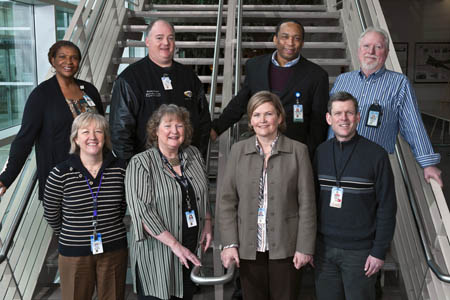
    Employees Community Fund of Boeing Puget Sound Elects New Board Trustees


    SEATTLE, Jan. 17, 2011 /PRNewswire/ — The Employees Community Fund (ECF) of Boeing (NYSE: BA) Puget Sound has elected a new slate of board trustees for 2011.

    Pictured from left to right: (first row) Patty Rhodes, first-year trustee; Joyce Nugent, secretary; Andrea Hutchins, first-year trustee; and Bob Malone, treasurer; (second row) Sukari Mdogo, vice president; Robley Evans, president; Renard Burnett, first-year trustee; and Dave Hopkins, first-year trustee.
    Serving for two years, ECF trustees manage the day-to-day operations of the Puget Sound region fund. Since 1951, Boeing employees have donated more than $500 million to ECF Puget Sound, which celebrates its 60th birthday on Sept. 20. The companywide Boeing ECF is one of the world’s largest employee-owned and operated charitable funds.

  • | |

    FAA proposes $359,000 in Civil Penalties Against SkyWest Airlines

    For Immediate Release
    January 18, 2011

    SEATTLE – The FAA has proposed $359,000 in civil penalties against SkyWest Airlines, Inc., of St. George, Utah, for alleged violations of Federal Aviation Regulations.

    The FAA proposed a penalty of $220,000 for alleged failure to document heavy checked bags, motorized mobility aids and a heavy shipment carried in the cargo compartment of the company’s passenger aircraft. As a result, the company operated the aircraft on five flights between April 21 and May 25, 2010 with incorrect weight and balance data. The FAA alleges the violations occurred because the carrier’s employees failed to follow required procedures for documenting cargo carried on revenue passenger flights.

    The other two proposed civil penalties are for allegedly operating two Bombardier Regional Jet aircraft when they were not in compliance with Federal Aviation Regulations.

    In the first case, a proposed civil penalty of $70,500, the FAA alleges SkyWest employees failed to follow the company’s Continuous Airworthiness Maintenance Program (CAMP) and the Bombardier maintenance and inspection manual during five attempts by mechanics to correct an avionics system cooling problem on one aircraft. SkyWest operated the aircraft on at least five revenue passenger flights between July 15 and 21, 2009 when it was not in compliance

    In the second case, the FAA is proposing a civil penalty of $68,500, alleging SkyWest operated another Bombardier jet on eight revenue passenger flights between May 30 and June 1, 2010 when it was not in compliance with regulations. The FAA alleges SkyWest mechanics failed to follow procedures required in the airline’s CAMP when replacing the right air conditioning pack’s pressure-regulating and shutoff valve.

    SkyWest has 30 days from receipt of the FAA’s enforcement letters to reply to the agen

  • |

    Safety Enhancements for Private Aircraft

    Interested in making your aircraft safer? Check out the latest issue of FAA Safety Briefing. In her article, “Small Cost, Big Benefit: A Look at Lifesaving Aircraft Safety Enhancements,” FAA aerospace engineer Della Swartz offers a variety of improvements that can have a positive effect on your safety and well-being without an undue strain on the wallet. Among the enhancements described are inflatable restraints, or air bags, whose safety benefits the NTSB recently highlighted. According to Swartz, inflatable restraint kits are available for about $1,000 per seat plus the cost of installation. The kit includes a shoulder harness, another inexpensive yet key life-saving device. Swartz also writes about helmets and emergency locator transmitters (ELT). For more on how to outfit your aircraft with low-cost and high-value safety enhancements, see the article on page 18 of the January/February 2011 issue of FAA Safety Briefing at www.faa.gov/news/safety_briefing/.

  • |

    NASA TV TO BROADCAST JAPANESE CARGO CRAFT FLIGHT TO SPACE STATION

    HOUSTON — NASA plans live television coverage of the launch, grapple and berthing of the second unpiloted Japanese cargo ship that will deliver more than four tons of food and supplies to the International Space Station.

    The Japan Aerospace Exploration Agency (JAXA) is scheduled to launch an H-IIB rocket from the Tanegashima Space Center in southern Japan at 12:29 a.m. CST (3:29 p.m. Japan time) on Thursday, Jan. 20. The launch vehicle will send the Kounotori2 H-II Transfer Vehicle (HTV2) orbit on a week-long rendezvous with the station. “Kounotori” is the Japanese word for white stork, emblematic of delivering happiness and joy.

    On Jan. 27, Expedition 26 Flight Engineers Cady Coleman and Paolo Nespoli will command the station’s robotic arm, Canadarm2, to reach out, grapple Kounotori2, and attach it to the Earth-facing port of the Harmony module.

    In the following days, a pallet loaded with spare station parts will be extracted from a slot in the cargo ship and attached to an experiment platform outside the Japanese Kibo module. Other cargo will be transferred internally to the station.

    The cargo vehicle will be filled with trash, detached from the station and sent to burn up in the Earth’s atmosphere at the end of March.

    NASA Television’s programming schedule for HTV2 events includes (all times CST):

    Thursday, Jan. 20:

    12 a.m. — Launch coverage, anchored from NASA’s Johnson Space Center in Houston, begins. Launch is scheduled at 12:29 a.m. Thursday, Jan. 27:

    5 a.m. — Grapple coverage, anchored from Johnson, begins. The grapple of HTV2 is scheduled at 5:44 a.m.

    8 a.m. — Berthing coverage, anchored from Johnson, begins. The attachment should be complete at approximately 10 a.m.

  • Hughes and Tachyon Join Forces to Develop Advanced Airborne Networking Solutions for Military & Government

    SAN DIEGO and GERMANTOWN, Md., Jan. 18, 2011 /PRNewswire/ — Tachyon Networks, developer of aXiom end-to-end satellite solutions for fixed, portable and comms-on-the-move (COTM) applications and Hughes Network Systems, LLC (HUGHES) the global leader in broadband satellite networks and services, today announced their intention to cooperate in the development of end-to-end airborne COTM solutions for military and government markets. This broad-based cooperation will focus on solutions for manned and unmanned aircraft, initially fixed-wing and later rotary wing aircraft, which require full-motion HD video transmission capabilities.

    “We are pleased to be working with Tachyon on the development of airborne COTM solutions,” stated Rick Lober, Vice President and General Manager of the Defense & Intelligence Systems Division (DISD) at Hughes. “Both Hughes and Tachyon have developed advanced technologies for airborne networking, which together offer an excellent opportunity to address the challenges associated with high-speed video transmission from various types of aircraft while in flight.”

    Tachyon has developed its aXiom end-to-end satellite broadband solutions for air, land and sea, and will integrate a key element – the Linux-based aXiom Services Platform (ASP) – to the solutions resulting from its cooperation with Hughes. The ASP facilitates seamless integration across all communications equipment onboard aircraft, as well as enabling interoperability with the end-to-end satellite network. The ASP also enables onboard display of all network monitoring applications and operational data with an easy-to-use graphical user interface (GUI).

    Hughes has recently demonstrated its Airborne Video Solution, which employs the high-performance Hughes HX router, for fixed wing aircraft. Hughes is building on its commercial aviation broadband offering, thereby facilitating adoption of a COTS-based solution by the airborne Intelligence, Surveillance and Reconnaissance (ISR) community. The cooperation with Tachyon will allow Hughes to migrate this solution to new military and government programs.

    “Hughes has successfully demonstrated its advanced modem solution for fixed wing aircraft,” said Dan Negroni, VP of Sales and Marketing for Tachyon Networks. “Tachyon is excited to have an opportunity to jointly develop a solution that brings full-motion video capability to additional aircraft platforms, including a future focus on rotary wing aircraft, in support of the ISR community.”

  • |

    Frequent flyers vote Lufthansa top-of-class in two categories: Best Business Class in Germany/Europe and best Airline Website for Business Travellers

    Readers of the Business Traveller Deutschland magazine ranked Lufthansa in top place in two categories in 2010. In a magazine poll of around 2,000 readers, Lufthansa clinched the best marks for superb service from a majority of the respondents, placing the airline twice at the top of the scorecard.

    Besides winning in the “Best Business Class on German and European Routes“, the biggest German carrier left the competition trailing in the voting for the “Best Airline Website for Business Travellers” category”. This is not the first time the www.lufthansa.com homepage has been among the awards. Business travellers also value Lufthansa for its high security standards.

    Stefan Schuermann, Head of Lufthansa Product Management European Traffic, was presented with the award at the Hilton Hotel in Frankfurt am Main last Friday.

    The prestigious prizes in the business travel segment have been conferred for the past 20 years. In a yearly readership poll conducted by an independent market research institute for the Business Traveller Deutschland periodical, magazine readers evaluate companies from diverse sectors in the tourist industry. On the basis of the ballot, awards in different categories are conferred on airlines, hotel and car rental companies as well as individual hotels and airports.

  • |

    CASA Media Release – Tuesday 18 January 2011 Canberra aerodrome flight safety checks

    Special flight safety checks are being carried out at Canberra aerodrome this week.

    There will be a series of low-level flights to make sure flight paths at the aerodrome continue to operate safely.

    A twin-engine Cessna Conquest aircraft will be used to conduct the safety checks within an area up to 35 kilometres from the aerodrome.

    The two pilots flying the aircraft will ensure navigation aids are operational and not suffering interference, as well as looking for any new obstacles that could be a danger to aviation safety.

    The Civil Aviation Safety Authority requires these checks to be carried out every three years to maintain a high level of air safety at Canberra aerodrome.

    Low-level flying is an essential part of the safety exercise, with aircraft down as low as several hundred feet at times.

    Local residents may notice an uncommon flying pattern, but this is to make sure obstacles are accurately marked on charts and no new obstacles exist. Obstacles can be towers, trees, masts or buildings that can be a danger to aircraft.

    The checks are scheduled to be carried out on Tuesday 18 January 2011.

    If poor weather or other factors do not allow the safety checks to go ahead on the planned days they will be carried out as soon as possible.

    CASA has contracted the operation of the special check flights out to Radiola Aerospace Pty Ltd – a company with wide international expertise in these specialist operations.

  • |

    Boeing Names Kim Hammonds Chief Information Officer

    CHICAGO, Jan. 13, 2011 /PRNewswire/ — Boeing (NYSE: BA) has named Kim Hammonds chief information officer and vice president of the company’s Information Technology organization. Hammonds, who was formerly vice president of the Boeing Information Technology Infrastructure organization, replaces John Hinshaw, who has been named vice president and general manager of Boeing’s new Information Solutions division in Boeing Defense, Space & Security.

    Hammonds, 43, will report to John Tracy, Boeing chief technology officer and senior vice president of Engineering, Operations & Technology. She will lead the Information Technology organization and be responsible for all IT strategy, systems, infrastructure, architecture, processes and people companywide. “Kim’s extensive background and demonstrated leadership will ensure both the continuity and success of Boeing’s efforts to integrate and streamline its global operations with the most capable, reliable and secure IT system in the world,” said Tracy.

    In her previous role, Hammonds was responsible for developing and maintaining solutions inclusive of network, computing, server, storage, collaboration and infrastructure technologies. She joined Boeing in August 2008 as the vice president of Boeing IT’s Business Systems Organization, where she managed application, development and maintenance activities in support of Finance, HR, Internal Services, Sales/Marketing and Boeing Capital Corporation.

    Prior to joining Boeing, Hammonds was director of Americas Manufacturing Operations at Dell where she was responsible for global systems development for service logistics, supply chain and quality systems. She was also responsible for IT production support for all 18 global manufacturing operations.
    Before joining Dell in 2007, Hammonds was with the Ford Motor Company for 16 years, where she held positions in product engineering, manufacturing, quality, marketing and Information Technology leadership roles. Her last position at Ford was as director of Manufacturing Systems for North America, supporting 48 plants, manufacturing engineering, supply chain and production systems.

    Hammonds received an MBA from Western Michigan University and a bachelor’s degree in mechanical engineering from the University of Michigan. She is an active supporter of the American Cancer Society and is the founder and president of a non-profit organization providing art programs for cancer patients, which she established in 2004.

  • |

    CASA Media Release – Moree aerodrome flight safety checks

    Special flight safety checks are being carried out at Moree aerodrome next week.

    There will be a series of low-level flights to make sure flight paths at the aerodrome continue to operate safely.

    A twin-engine Cessna Conquest aircraft will be used to conduct the safety checks within an area up to 35 kilometres from the aerodrome.

    The two pilots flying the aircraft will ensure navigation aids are operational and not suffering interference, as well as looking for any new obstacles that could be a danger to aviation safety.

    The Civil Aviation Safety Authority requires these checks to be carried out every three years to maintain a high level of air safety at Moree aerodrome.

    Low-level flying is an essential part of the safety exercise, with aircraft down as low as several hundred feet at times.

    Local residents may notice an uncommon flying pattern, but this is to make sure obstacles are accurately marked on charts and no new obstacles exist. Obstacles can be towers, trees, masts or buildings that can be a danger to aircraft.

    The checks are scheduled to be carried out on Wednesday 19 January 2011 and Thursday 20 January.

    If poor weather or other factors do not allow the safety checks to go ahead on the planned days they will be carried out as soon as possible.

    CASA has contracted the operation of the special check flights out to Radiola Aerospace Pty Ltd – a company with wide international expertise in these specialist operations

  • |

    ASTRONAUT JOSE HERNANDEZ LEAVES NASA

    HOUSTON — After a decade working in various roles, astronaut Jose Hernandez has left NASA for a position in the aerospace industry.

    “Jose’s talent and dedication have contributed greatly to the agency, and he is an inspiration to many,” said Peggy Whitson, chief of the Astronaut Office at NASA’s Johnson Space Center in Houston. “We wish him all the best with this new phase of his career.”

    The son of Mexican migrant farm workers, he joined NASA in 2001 as a materials research engineer at Johnson. He was promoted to the Materials and Processes Branch chief in 2002 and served there until he was selected as a NASA astronaut in 2004.

    During the STS-128 shuttle mission in 2009, he managed the transfer of more than 18,000 pounds of supplies and equipment between the shuttle and International Space Station and assisted with robotics operations. He also served as a flight engineer in the shuttle’s cockpit during launch and landing.

  • |

    NASA ADMINISTRATOR PARTICIPATES IN MARTIN LUTHER KING JR. DAY CELEBRATIONS IN SOUTH CAROLINA

    WASHINGTON — NASA Administrator Charles Bolden will travel to his hometown of South Carolina to participate in three events on Jan. 18 to celebrate the life and legacy of Martin Luther King Jr. Media representatives may attend the presentations.

    Bolden, NASA’s first African-American administrator, will deliver the keynote address at the annual Martin Luther King Jr. business and professional breakfast beginning at 7:30 a.m. EST in the Exhibition Hall, Gaillard Municipal Auditorium, located at 77 Calhoun St. in Charleston. There will be a media availability at approximately 8:50 a.m.

    Following the breakfast, Bolden will visit the Ron McNair School at 3795 Spruill Ave. in North Charleston to discuss the importance of science, technology, engineering and mathematics education. Reporters can speak to the administrator following the event at 11:30 a.m. outside the school.

    Bolden will deliver the annual Heyward E. McDonald Lecture on Peace and Justice at 7 p.m. in the University of South Carolina Russell House Ballroom A/B on campus at 1400 Greene St. in Columbia. He will speak about the role of science and public schooling in advancing social justice. The lecture will be followed by a short question-and-answer session for attendees.

  • |

    NASA UPDATES SHUTTLE TARGET LAUNCH DATES FOR TWO FLIGHTS

    NASA UPDATES SHUTTLE TARGET LAUNCH DATES FOR TWO FLIGHTS

    WASHINGTON — NASA is targeting 4:50 p.m. EST on Thursday, Feb. 24,
    for the launch of space shuttle Discovery’s STS-133 mission to the
    International Space Station. The liftoff of shuttle Endeavour’s
    STS-134 flight is planned for 7:48 p.m. EDT on April 19, from NASA’s
    Kennedy Space Center in Florida.

    The target dates were selected Thursday during the Space Shuttle
    Program’s weekly Program Requirements Control Board meeting.

    NASA sets official launch dates for each shuttle mission following
    agency Flight Readiness Reviews, which typically occur about two
    weeks prior to launches. All target launch dates are subject to
    change.

  • |

    United Leads In On-Time Performance Among Peers For November 2010

    January 11, 2011

    CHICAGO, Jan. 11, 2011 – United Airlines today announced the company was first in on-time performance for domestic scheduled flights among America’s five largest global carriers* for November 2010, ending the month with 91.4 percent of flights arriving at their destinations within 14 minutes of the scheduled arrival time, according to data measured by the U.S. Department of Transportation (DOT) and published in the Air Travel Consumer report released today.

    The report released today also showed United ranked first among America’s five largest global carriers for the 12 months ending in November, and second overall for the month of November 2010 among all 18 carriers included in the Air Travel Consumer Report, irrespective of size.

  • |

    Southwest Airlines’ Pilots Begin Flying Required Navigation Performance Efficient Procedures at 11 Airports

    DALLAS, Jan. 11, 2011 — Now ready for departure—Southwest Airlines’ Pilots begin Required Navigation Performance (RNP) efficient flight procedures today at 11 airports nationwide. This major milestone to reduce environmental impact with a more efficient operation and to assist the Federal Aviation Administration (FAA) on NextGen initiatives is the culmination of a four-year project with partners Boeing, GE, and Honeywell. RNP is satellite-based navigation that brings together the accuracy of GPS (Global Positioning System), the capabilities of advanced aircraft avionics, and new flight procedures.

    “RNP sets the stage for Southwest to continue doing its part to conserve fuel, improve safety, and reduce carbon emissions and Greenhouse gases, while simultaneously taking advantage of the high-performance characteristics that exist in an airline’s fleet,” said Captain Jeff Martin, Southwest’s Vice President of the Operations Coordination Center. “The efficiencies RNP introduces help Southwest be a good neighbor while also maintaining our low fares.”

    The Company’s Pilots and Dispatchers now follow these new efficient flight procedures and enhanced avionics to fly specifically designed satellite-based navigation approaches to many Southwest airports. The primary airports with efficient RNP procedures include Amarillo*, Birmingham, Boise, Corpus Christi*, Los Angeles, Chicago Midway, Oakland, Oklahoma City, West Palm Beach, Raleigh-Durham, and San Jose.

    With RNP/NextGen procedures designed at 11 Southwest airports, the Company’s projected savings is $16 million a year, with an anticipated savings of more than $60 million per year once all Southwest airports have efficient RNP procedures.

    “RNP is a significant step in the future for the NextGen Air Traffic Control system,” said Mike Van de Ven, Southwest’s Executive Vice President and Chief Operating Officer. “This milestone culminates substantial efforts by our Company working with the FAA to position Southwest as a leading participant in a modernized air traffic control system.”

    In addition to modifying 345 Boeing 737-700s with new flight display software and ensuring that all new aircraft are RNP ready, this cross-company effort involving Technology, Maintenance & Engineering, and the Operations Coordination Center also featured intense training efforts to support achieving this milestone.

    “I am very proud of our Flight Operations Team for the design, training, and implementation of NextGen procedures, including training more than 5,900 Pilots to fly Primary Flight Display Navigation Display (PFD/ND) procedures,” said Captain Chuck Magill, Vice President of Flight Operations. “This extensive training allows us to capture RNP procedures as well as provide flexibility in any new aircraft platform we might use in the future.”

  • |

    Lockheed Martin Receives $360 Million in Contracts to Support U.S. Navy MH-60R Helicopter Fleet

    WASHINGTON, Jan. 12, 2011 /PRNewswire/ — The U.S. Navy demonstrated its continued commitment to keeping its MH-60R Seahawk helicopter fleet at the forefront of anti-submarine and anti-surface warfare, awarding Lockheed Martin (NYSE: LMT) a variety of production and development contracts totaling $360 million. The end-of-year awards cover a spectrum of systems aboard the MH-60R, built by Sikorsky Aircraft Corporation (NYSE: UTX).

    “The Navy’s investment in the MH-60R fleet ensures our pilots and aircrews have the best and most advanced equipment for every mission,” said Capt. Dean Peters, U.S. Navy MH-60 program manager. “We are looking for reliable, modern aircraft upgraded efficiently and affordably, and that’s why we have devoted these resources to the MH-60 fleet.”

    As Lockheed Martin prepares for its 300th cockpit delivery milestone in late February, the Navy exercised a $38 million option under the current multi-year contract to cover production of the next lot of common cockpits for MH-60S and MH-60R helicopters. The bulk of the work will be performed at Lockheed Martin’s facility in Owego, N.Y., and is scheduled for completion by April 2013.

    Additionally, the Navy will provide MH-60R/S crews with improved situational awareness by incorporating Lockheed Martin’s Situational Awareness Technology Insertion (SATI) aboard the aircraft under a $35 million contract. The award covers a pre-development iteration of SATI, an eight-component package of upgrades and improvements to the helicopter’s flight management system. Improvements include a new integrated digital map to give pilots a clear picture of their operating area, and an upgrade to the Identification Friend-or-Foe (IFF) system. The IFF upgrade will prevent interference during transmission and ensure interoperability with the Federal Aviation Administration and other agencies.

    One of the most highly advanced systems aboard the MH-60R – Automatic Radar Periscope Detection and Discrimination (ARPDD) – will transition from system development and demonstration (SDD) to production under a $36 million contract award. The Telephonics radar used in ARPDD is the latest iteration of the radar currently deployed with the MH-60R, but adds a new mode requiring improved radar performance and eight times the processing power of the previous version.

    In October 2010, Lockheed Martin and the Navy successfully completed initial flight tests of the system aboard an MH-60R, marking the first time a helicopter has had the functionality for its on-board radar to automatically discriminate between a periscope and other small surface objects, significantly improving the probability of finding a submarine. This recent contract award covers the infrastructure required to meet full-rate production and the fielding of the ARPDD radar system aboard six MH-60R production aircraft to support Initial Operational Capability in 2013.

    Construction of the next lot of 24 MH-60R mission avionics suites and 18 MH-60S cockpits will begin under a $72 million Multi-Year II advanced acquisition contract award that covers long-lead items for the helicopters and cockpit systems. Lockheed Martin and partner Sikorsky Aircraft have delivered more than 85 MH-60R helicopters to date and are on track to reach the century mark early in 2011.

    Headquartered in Bethesda, Md., Lockheed Martin is a global security company that employs about 133,000 people worldwide and is principally engaged in the research, design, development, manufacture, integration and sustainment of advanced technology systems, products and services. The Corporation’s 2009 sales from continuing operations were $44 billion.

  • |

    Hainan Airlines Wins Prestigious 5-Star Rating From SKYTRAX

    BEIJING, Jan. 13, 2011 /PRNewswire-Asia/ — Hainan Airlines was awarded the honor of a “SKYTRAX Five-Star Airline” at a gala awards ceremony in Beijing. The award was presented by SKYTRAX President Edward Plaisted to Hainan Airlines President Wang Yingming. With this award, Hainan Airlines officially becomes the world’s seventh five-star airline.

    London-based SKYTRAX, a research and certification organization for the air transportation industry founded in 1989, evaluates more than 200 airlines around the world each year in regards to their service quality. The star rankings reflect the customer experience – not just the platform of product standards offered by an airline such as cabin seating, in-flight entertainment and catering, but the assessment of service quality – using a rating system made up of more than 800 different areas of product and service delivery for each airline. As a global leader in the industry, SKYTRAX offers the most professional evaluation and rating services. Star ratings for the airline industry can vary from one to five stars, with “five stars” being the highest rating.

    Founded in 1993, Hainan Airlines has grown into a successful international airline offering personalized and gracious service. It was the first mainland Chinese airline to be awarded SKYTRAX four-star status in 2009. In accordance with SKYTRAX’s rigorous evaluation standards and the airlines’ own Chinese-style service concept, Hainan Airlines built an international brand through its superior service programs that encompass “convenience, hospitality and surpassing expectations” as its core values. Hainan provides its customers with unique and premium ground and cabin service, in-flight catering and entertainment based on diversified customer needs. As a result of its exceptional brand values and service, Hainan Airlines transitioned from four-star to five-star status in just one year, a significant achievement. Hainan Airlines is one of the airlines in the HNA Group of companies.

    At the SKYTRAX award ceremony, HNA Group Chairman Mr. Chen Feng said, “By winning the ‘SKYTRAX five-star award’, Hainan Airlines now becomes one of the most successful brands in the industry.”

    SKYTRAX also rated Hainan the best airline in China in 2008 and 2010, and the company has earned numerous awards including the “Customer Satisfaction Award” in the Chinese civil aviation industry repeatedly since 1998. In 2008, it received CCTV’s “60 Years- 60 Brands Award”, the only airline to be so honored.

    Hainan has a large network in China and also throughout Asia, Europe, Africa, the Middle East, and North America. Beginning January 19, Hainan spreads its wings “down under” to Sydney, Australia.

  • |

    American Way Magazine Commemorates 45 Years of Publication With a Full Redesign


    FORT WORTH, Texas, Jan. 11, 2011 /PRNewswire/ — American Way, the award-winning inflight magazine of American Airlines and American Eagle, commemorates 45 years of publication with a redesign which debuts with the first issue of 2011, onboard planes now.

    “American Way is still the only inflight magazine published twice monthly, which is a great service to our frequent travelers,” said Susan Gordon, American Airlines Publishing President and Group Publisher. “We pride ourselves on consistently delivering an industry leading magazine to our customers, so it makes sense to redesign the magazine as our culture changes.”

    Most notable will be the new American Way masthead, inspired by the typeface on a 1930s-era American Airlines DC-3. Redesigned departments include the combination of UpFront and DownLow to create a new super-department called Itineraries, as well as the addition of Briefs, which highlights both a celebrity and a destination.

    “The goal was to bring a more contemporary and graphically pleasing palate to the magazine, while continuing to serve our readers as an invaluable source of information and entertainment,” said David Radabaugh, American Way Design Director.

    Other changes include the addition of new maps and helpful widgets, the organization of stories in a more reader-friendly format, and incorporating an unconventional approach to original photography and illustration. Every issue can be found online in its entirety at www.americanwaymag.com.

  • |

    GE Aviation’s Flight Management System Provides Technology behind Southwest Airlines RNP

    January 12, 2011
    GE Aviation’s Flight Management System Provides Technology behind Southwest Airlines RNP
    –Grand Rapids, MI — GE Aviation’s flight management system TrueCourseTM is providing the technology to enable Southwest Airlines’ pilots to begin flying Required Navigation Performance (RNP) procedures at 11 airports. TrueCourse is standard on all Boeing 737 aircraft. RNP is a satellite-based navigation that brings together the accuracy of GPS (Global Positioning System), the capabilities of advanced aircraft avionics, and new flight procedures.

    With RNP/NextGen procedures designed at 11 Southwest airports, Southwest Airlines’ projected savings is $16 million a year, with an anticipated savings of more than $60 million per year once all Southwest airports have efficient RNP procedures.

    “TrueCourse enables operators to fly the most efficient RNP operations available,” said Chris Beaufait, president of Avionics for GE Aviation Systems. “Southwest is well equipped and is positioning to lead the way in the expansive use of these approved routes realizing fuel, emission and noise reductions.”

    The TrueCourse flight management system controls the aircraft track to an accuracy of 10 meters (33 feet) and the time of arrival to within 10 seconds to any point in the flight plan. Benefits include the ability to fly shorter flight paths and idle-thrust descents which reduces fuel consumption, thereby lowering emissions and community noise levels. Software and hardware updates provide the latest technology to continue to meet the needs of the world’s evolving airspace requirements, offering safe and efficient improvements to aircraft operations and dispatch reliability.

    Southwest Airlines’ pilots and dispatchers now follow these new efficient flight procedures and enhanced avionics to fly specifically designed satellite-based navigation approaches. The primary airports with efficient RNP procedures include Amarillo*, Birmingham, Boise, Corpus Christi*, Los Angeles, Chicago Midway, Oakland, Oklahoma City, West Palm Beach, Raleigh-Durham, and San Jose.

  • |

    Boeing Forms Information Solutions Business to Address Growing IT/Cyber Market

    ARLINGTON, Va., Jan. 13, 2011 — Boeing [NYSE: BA] today announced that it has formed a new Information Solutions business to more efficiently offer proven, military-grade, software-based solutions for customers including the Department of Defense, the U.S. Intelligence Community, federal and international governments, and Fortune 1000 customers. John Hinshaw, Boeing’s former chief information officer, will lead the new business as its vice president and general manager.
    Information Solutions, a division of Network & Space Systems, part of the Boeing Defense, Space & Security (BDS) operating unit, combines teams with similar operating cultures and software-development expertise from across BDS, including:

    • The cybersecurity and intelligence capabilities of Network & Space Systems’ Intelligence & Security Systems division
    • The logistics command and control (LogC2) business Tapestry Solutions and international LogC2 work, both from Boeing Global Services & Support.

    “We have built significant cyber, logistics and information services capabilities across Boeing through internal research and development as well as by targeted acquisitions,” said Roger Krone, president of Network & Space Systems. “By bringing those resources together into one customer-focused organization, we are not only better aligned as a company, but also better able to serve our customers’ growing information solutions needs across the dot-ic, dot-gov, dot-mil and dot-com domains.”

    Information Solutions is headquartered in Arlington and has approximately 4,000 employees.
    “As the chief information officer of two Dow 30 enterprises — Boeing and Verizon Wireless — I’ve lived through the challenges that customers face in delivering integrated, reliable, and secure information technology to enable their operations,” said Hinshaw. “Boeing knows how to deliver complex, mission-critical products and services, and we now will extend that expertise into the broader information technology market.”

    Of Boeing’s 10 acquisitions during the past three years, eight are now part of Information Solutions: the cyber/C4ISR-related acquisitions of RavenWing, DRT, Kestrel Enterprises, exMeritus, and Narus, and the LogC2-related acquisitions of Tapestry Solutions, Federated Software Group, and CDM Technologies.

    “Aligning that collection of talented employees in one organization validates our strategy to significantly build our information services capability for the cybersecurity and logistics command and control markets,” said Chris Raymond, vice president of BDS Business Development.

  • |

    Russian Report on Polish Crash

    This document is an English translation of the Final Report on the accident on 10 April 2010, on Smolensk “Severny” airdrome, to the Tupolev Tu-154M tail number 101 of the Republic of Poland. The translation was done as accurate as the translation may be to facilitate the understanding of the Final Report for non-Russian speaking people. The use of this translation for any purpose other than for the prevention of future accidents could lead to erroneous interpretations.
    In case of any difference or misunderstanding the original text in Russian is the work of reference.

    Download here:
    INTERSTATE AVIATION COMMITTEE AIR ACCIDENT INVESTIGATION COMMISSION
    FINAL REPORT.pdf

  • |

    Office Closures Due to Inclement Weather

    Due to inclement weather, the following FAA regional offices are closed for normal business today, Wednesday, January 12, 2011:

    Eastern Region office in Jamaica, New York
    New England Region office in Burlington, Massachusetts
    Southern Region office in College Park, Georgia
    Employees and contractors who work in those offices should follow local procedures to obtain more information.

  • |

    NTSB STUDY SHOWS THAT AIRBAGS CAN PROVIDE OCCUPANT PROTECTION IN GENERAL AVIATION ACCIDENTS

    National Transportation Safety Board
    Washington, DC 20594

    FOR IMMEDIATE RELEASE: January 11, 2011
    SB-11-03

    Today the National Transportation Safety Board adopted a study that concluded that general aviation (GA) airplanes equipped with airbags provide additional protection to occupants in accidents involving survivable forward impacts.

    Airbags are designed to mitigate head and upper body injuries and are installed in the lap belt or shoulder harness portions of the restraint system. They were first approved for use in the pilot and co-pilot seats in GA aircraft in 2003. Currently, there are nearly 18,000 airbag- equipped seats in over 7,000 of the 224,000 GA aircraft in the United States.

    “Although airbags have been mandated in automobiles for over a decade, the aviation industry has no such requirement for small aircraft,” said NTSB Chairman Deborah A.P. Hersman. “The good news is that over 30 manufacturers have stepped up to the plate and offer airbags as standard or optional equipment.”

    The study, which examined 88 accidents involving airbag- equipped airplanes that occurred between 2006 and 2009, found no instances where the airbag caused harm in properly restrained occupants. In addition, the study found 10 survivable accidents in which the crash forces were severe enough to cause injury and/or to deploy the airbag.

    Within the group of 10 accidents, 12 occupants experienced airbag deployments, and the study found that the airbag likely mitigated injuries for two of the occupants.

    The study also noted that there were no negative consequences as a result of airbag deployments. For instance, there were no cases in which the airbags were expected to deploy but did not. Nor were there any cases that involved airbags deploying under unexpected circumstances, hindering egress, fueling post-crash fires or interfering with rescue attempts. Yet investigators did uncover some safety issues with restraint systems.

    One such issue involved the incorrect usage or adjustment of seat belts. In certain aircraft types, the seat belts in the left and right seats can become reversed, which could result in the wrong airbag being activated if only one of the seats is occupied.

    There were also concerns with optimal airbag protection for occupants whose body mass indexes (BMI) classified them as either overweight or obese (BMIs of 25 or higher). The NTSB questions whether the airbag-equipped restraints were designed and tested with the high-BMI population in mind.

    An additional finding of this study was the strong affirmation that correctly installed shoulder harness/lap belt combinations provide significantly greater protection in GA accidents than that offered by a lap belt alone. Based on an analysis of over 37,000 GA accidents, the Board concluded that the risk of fatal or serious injury was 50 percent higher when an occupant was only restrained by a lap belt as compared to the combination lap belt and shoulder harness.

    “The simplest and cheapest improvement to the safety of general aviation aircraft occupants is the mandatory installation of shoulder harnesses,” said Hersman.

    The five-Member Board voted to adopt six safety recommendations, all directed to the Federal Aviation Administration:

    1. Require manufacturers to modify restraint systems vulnerable to being used incorrectly in newly built GA airplanes and to modify restraints in existing airplanes.

    2. Revise the guidance and certification standards for restraint systems to reduce the likelihood of misuse.

    3. Modify the guidance to GA airbag manufacturers as to how they should demonstrate that an airbag design provides adequate protection for a greater range of body sizes, including very small and very large individuals.

    4. Require the retrofitting of shoulder harnesses on all general aviation airplanes that are not currently equipped with such restraints.

    5. Evaluate the feasibility of requiring airbag-equipped aircraft to capture and record crash dynamics data to determine whether the system performed as designed.

    6. Develop a system to track safety equipment, such as restraint systems, airbags, and aircraft parachutes, designed to improve crash outcomes.

    The complete safety study will be available at www.ntsb.gov in several weeks.