pilot error

  • | | | |

    Drunk Delta Pilot Heads to UK Court

    What: Delta Boeing 737 London to Detroit
    Where: London
    When: Nov 1
    Who: 213 passengers plus pilot George LaPerle
    Why: Scotland Yard took Delta pilot George LaPerle from his plane.

    He was so drunk…(how drunk was he? Five times the pilots legal limit, that’s how drunk.) He was so drunk, he thought his Detroit flight was bound for New York. With him at the controls, he wouldn’t have gotten out of Heathrow much less across the Atlantic.

    LaPerle is suspended by Delta and will be going to court in the UK on Nov 16. Let’s hope for his sake he shows up sober, and already on his ten step plan.

    Filing this one under “pilot error.”

  • | |

    Zambia Crash Endangers President’s Staff

    What: Zambia Air Force plane registration # AF 215 en route to Kasempa
    Where: Mukinge airstrip in Kasempa
    When: October 16, 2010
    Who: Government officials from President Rupiah Banda’s staff
    Why: According to published reports, the pilot delayed his descent, landed too far down the runway. He applied emergency brakes and lost control of the plane, which crashed past the end of the runway.

    Government workers including Minister Mike Mulongoti, Community Development Minister, Michael Kaingu and Finance Minister Situmbeko Musokotwane were aboard but unharmed

  • | | | |

    Pilot Flies off with Fuel Hose attached

    What: BELL 206B crop-dusting helicopter
    Where: Newton Texas
    When: October 13, 2010
    Who: pilots name not released
    Why: After reloading the chemical tanks and refueling, the (registration 499BH ) N499BH BELL 206 ROTORCRAFT, lifted off while the fuel hose was still attached. The two seat helicopter went up, then, of course, crashed. It fell over on its side. One person on the ground was injured.

    George’s Point of View

    This is no joke, as someone on the ground was severely injured.

    However, it still reminds me of high school, when my date at the drive-in left the speaker hooked in the window, and when we left, I also left the window. The speaker took it out, hooked on the frame and kept the car from moving. We didn’t crash, or fall over, or even dent my window frame. Of course, we were in a Pinto.

    (I won’t go into how, when it was repaired, I tried to roll it up and it still wasn’t there, how the glass company goofed and replaced my perfectly good windshield, how I ended up with both a new door window AND a new windshield and an apology.)

    It’s a good thing the helicopter pilot’s name wasn’t released. Even if someone else was doing the refueling.

    How embarrassing.

  • | | | | |

    $1.2 Million Helicopter Settlement

    What: Midwestern Air Services LLC, Robinson R44 II, Raven, four-place, two-bladed, single main rotor, single-engine helicopter en route from Horseshoe Casino Heliport to Kenosha Regional Airport
    Where: Kenosha, Wisconsin
    When: September 21, 2008
    Who: pilot Alan Sapko and passenger Joan Anzalone
    Why: The National Transportation Safety Board ruled pilot error. A judge ruled that the pilot’s estate will pay the heirs of Joan Anzalone 1.2 million.

    The report of the crash states that the helicopter:
    “… was destroyed when it impacted an occupied house and terrain near Kenosha, Wisconsin. A ground fire subsequently occurred. The personal flight was operating under 14 CFR Part 91. Night instrument meteorological conditions prevailed at the time of the accident. No flight plan was on file. The private pilot and a passenger were fatally injured. The five occupants in the house were uninjured. The flight originated from the Horseshoe Casino Heliport (2IG3), near Whiting, Indiana, about 0507, and was destined for the Kenosha Regional Airport (ENW), near Kenosha, Wisconsin, when the accident occurred.

    According to information provided by Horseshoe Casino, the pilot landed at 1907 on September 20, 2008. The pilot and passenger had dinner, they observed a concert, and gambled. The pilot had a glass of wine with his dinner about 1930. About 0139 on September 21, 2008, a beverage confirmed to be a Captain Morgan’s and diet Coke in a short glass was given to the pilot. About 0146, another Captain Morgan’s and diet Coke in a tall glass was given to the pilot. About 0213, the pilot set the first glass down empty. About 0423, the pilot took a drink from the second drink glass. The glass was about half full. The pilot gambled until about 0449 and then he and his passenger departed for 2IG3. The pilot and passenger departed from 2IG3 about 0507.

    A Wisconsin State Patrol Trooper who was outside the weight facility on Interstate 94 at the Illinois and Wisconsin State Line about six miles south of the accident site heard a helicopter heading north at a “very low altitude” and estimated it at 500 feet. He did not see the helicopter or its lights due to the “dense fog.” He stated that the visibility there was about 300 to 500 feet.

    A witness who lived near the accident site gave a statement to the Kenosha Police Department. The witness stated that a low flying helicopter was heard. It circled once then went away and came back. The witness saw an orange flash through the window and heard a “boom.” The witness said the helicopter sounded “really low” and the “engine sounded like it was at low RPMs.”

    A witness from the occupied house on the northwest corner of 97th Avenue and 70th Street that was impacted by the helicopter gave a statement to the police department. The witness, in part, reported:

    My family and I were fast asleep in our residence when I heard and
    felt a loud bang like thunder, and then a cloud of debris came
    [through] our bedroom door. My wife and I were in the southeast
    bedroom. Our two sons were in the northeast bedroom and our
    daughter was the bedroom over the garage. We got our kids and
    [with] the help of our neighbors made it down the stairs and outside.
    None of us were injured. I saw the flames across the street and one
    of our neighbors told me a helicopter hit our house.

    The pilot held a Federal Aviation Administration (FAA) private pilot certificate. He held a FAA third-class medical certificate issued on April 3, 2006, with no limitations. At the time of that medical, he reported 60 hours total flight time to date and 30 hours in the six months prior to that examination. The pilot’s logbook indicated that the pilot had accumulated 329 hours of total flight time. The pilot recorded 37.25 hours of night flight time.

    A certified flight instructor (CFI) that instructed the accident pilot indicated that two previous CFIs had instructed the accident pilot and had endorsed the accident pilot for solo flight training operations. According to the CFI, the two previous CFIs believed that the accident pilot was flying in violation of his solo privileges and the CFIs removed the accident pilot’s solo endorsement. The CFI stated that he had no problems with the accident pilot’s training and solo activities.

    The accident pilot’s medical certificate and student pilot certificate had a solo endorsement with “revoked” written across it.”

    No one in the house was injured.

  • | | | |

    Boeing vs Cessna


    Click to view full size photo at Airliners.net
    Contact photographer Barry Shipley

    What: Cargojet Boeing 757-200 en route from Ottawa to Hamilton
    Where: Hamilton
    When: Mar 25th 2010
    Why: While on approach to Hamilton, a small privately owned Cessna turned into the Boeing’s path (reducing the distance between the two to 1.5nm horizontally and 200 feet vertically). The Cessna—on approach to the wrong runway—was corrected by ATC; and the Boeing landed safely.

    The Cessna pilot acknowledged error on his runway approach.

    This situation brings to mind two recent collisions- the March 20 Florida collision between a Piper and an experimental plane, and the February 6 Cirrus-Piper collision in Colorado. The circumstances of the collisions are entirely different but I should poitn out that neither of those collisions occurred under the direct eye of ATC. Perhaps there are extra kudos due to Air Traffic Control (or perhaps the Boeing pilot? whoever’s quick eye caught and cured the impending crisis) for the accident that did not happen.

    It would be interesting to find out if the error is fatigue related, or if there were some other hidden cause. Anytime a collision is averted is a good thing.

  • | |

    Expired Pilot Shelved in Amsterdam


    Click to view full size photo at Airliners.net
    Contact photographer Mathias Henig

    What: Corendon Airlines Boeing 737-400 en route from Amsterdam to Ankara
    Where: Amsterdam
    When: Mar 2nd 2010
    Who: 101 passengers
    Why: Passengers got a big surprise when this jet was readying for departure and the cockpit was stormed by police. Okay this may be something of an exaggeration; I don’t know if it was stormed; but at any rate, the pilot was removed from the cockpit for flying with a license…that expired 13 years ago. I don’t know how the Swedish found out, but the Swedish told the Dutch who told Turkish Civil aviation who promptly took action. Fortunately, someone had an alternative pilot to handle the flight.

  • | | | | |

    Angry Riots in Argentine Court over Aviation Decision


    Photo: A LAPA – Lineas Aereas Privadas Argentinas
    Boeing 737-2T4C/Adv photographed in July 2000, not the ill-fated LV-WRZ

    Click to view full size photo at Airliners.net
    Contact photographer James Richard Covington

    Relatives of victims disrupted the Argentine court when a two-year long trial ruled 6 LAPA (Lineas Aereas Privadas Argentinas) officials were not negligent. The operations manager and the 737 airlines chief both received three-year suspended sentences. Neither is currently employed in those positions.

    35 survived the 1999 crash; 65 were killed. On August 31, 1999, the LAPA Boeing 737 crashed at Buenos Aires, Argentina while taking off on a regularly scheduled passenger flight to Cordoba, Argentina. Witness reports indicate the pilot had aborted the takeoff. The airplane departed the airport property, crossed a highway, and came to rest on a golf course. There were 101 persons on board. The flight failed to take-off, broke through a perimeter fence and burst into flames on a golf course.

    The investigation attributed the crash to pilot error and found LAPA and air force deficiencies also contributed. The Argentine Air Force controlled civil and commercial aviation until 2009.

  • | | | |

    CAPTAIN’S INAPPROPRIATE ACTIONS LED TO CRASH OF FLIGHT 3407 IN CLARENCE CENTER, NEW YORK, NTSB SAYS

    NTSB PRESS RELEASE

    National Transportation Safety Board
    Washington, DC 20594

    FOR IMMEDIATE RELEASE: February 2, 2010
    SB-10-02

    CAPTAIN’S INAPPROPRIATE ACTIONS LED TO CRASH OF FLIGHT 3407 IN CLARENCE CENTER, NEW YORK, NTSB SAYS

    The National Transportation Safety Board determined that the
    captain of Colgan Air flight 3407 inappropriately responded
    to the activation of the stick shaker, which led to an
    aerodynamic stall from which the airplane did not recover.
    In a report adopted today in a public Board meeting in
    Washington, additional flight crew failures were noted as
    causal to the accident.

    On February 12, 2009, a Colgan Air, Inc., Bombardier DHC-8-
    400, N200WQ, operating as Continental Connection flight
    3407, was on an instrument approach to Buffalo-Niagara
    International Airport, Buffalo, New York, when it crashed
    into a residence in Clarence Center, New York, about 5
    nautical miles northeast of the airport. The 2 pilots, 2
    flight attendants, and 45 passengers aboard the airplane
    were killed, one person on the ground was killed, and the
    airplane was destroyed by impact forces and a postcrash
    fire. The flight was a 14 Code of Federal Regulations (CFR)
    Part 121 scheduled passenger flight from Newark, New Jersey.
    Night visual meteorological conditions prevailed at the
    time of the accident.

    The report states that, when the stick shaker activated to
    warn the flight crew of an impending aerodynamic stall, the
    captain should have responded correctly to the situation by
    pushing forward on the control column. However, the
    captain inappropriately pulled aft on the control column and
    placed the airplane into an accelerated aerodynamic stall.

    Contributing to the cause of the accident were the
    Crewmembers’ failure to recognize the position of the
    low-speed cue on their flight displays, which indicated that
    the stick shaker was about to activate, and their failure to
    adhere to sterile cockpit procedures. Other contributing
    factors were the captain’s failure to effectively manage the
    flight and Colgan Air’s inadequate procedures for airspeed
    selection and management during approaches in icing
    conditions.

    As a result of this accident investigation, the Safety Board
    issued recommendations to the Federal Aviation
    Administration (FAA) regarding strategies to prevent flight
    crew monitoring failures, pilot professionalism, fatigue,
    remedial training, pilot records, stall training, and
    airspeed selection procedures. Additional recommendations
    address FAA’s oversight and use of safety alerts for
    operators to transmit safety-critical information, flight
    operational quality assurance (FOQA) programs, use of
    personal portable electronic devices on the flight deck, and
    weather information provided to pilots.

    At today’s meeting, the Board announced that two issues that
    had been encountered in the Colgan Air investigation would
    be studied at greater length in proceedings later this year.
    The Board will hold a public forum this Spring exploring
    pilot and air traffic control high standards. This
    accident was one in a series of incidents investigated by
    the Board in recent years – including a mid-air collision
    over the Hudson River that raised questions of air traffic
    control vigilance, and the Northwest Airlines incident last
    year where the airliner overflew its destination airport in
    Minneapolis because the pilots were distracted by non-flying
    activities – that have involved air transportation
    professionals deviating from expected levels of performance.
    In addition, this Fall the Board will hold a public forum
    on code sharing, the practice of airlines marketing their
    services to the public while using other companies to
    actually perform the transportation. For example, this
    accident occurred on a Continental Connection flight,
    although the transportation was provided by Colgan Air.

    A summary of the findings of the Board’s report are
    available on the NTSB’s website at:
    http://www.ntsb.gov/Publictn/2010/AAR1001.htm
    -30-

  • | | | | |

    Iran Crash Totals Plane, 157 aboard, 40+ injured, No fatalities


    Click to view full size photo at Airliners.net
    Contact photographer Tiyam

    What: Taban Air/Kolavia Tupolev TU-154 en route from Abadan to Mashad (but diverted to Isfahan due to visibility)
    Where: Mashad
    When: Jan 24th 2010
    Who: 157 passengers and 13 crew
    Why: The flight had earlier been diverted to Isfahan due to poor visibility in Mashad, and had overnighted in Isfahan. While continuing to Mashad today, a passenger became ill, but poor visibility in Mashad was still an issue. The pilot attempted to land in Mashad in low visibility conditions citing an emergency because of the critically ill passenger.

    On touchdown, the plane veered from the runway, the gear landing on an unpaved surface collapsed, one wing impacted the ground and the airplane caught on fire, resulting in fire damage at the rear, where the aircraft’s three engines are mounted. The vertical fin and horizontal stabiliser are no longer attached. Both wings were sheared off. 42 were injured, no fatalities.

    Iranian Disaster Management said “The plane went off the runaway upon landing and part of its rear end broke away.”

    The carrier has been grounded and their certificate suspended.

    More than a decade of problems with Iranian aviation has been attributed to the poor condition of their old fleet, their lack of maintenance. Now perhaps we can add weather.

  • | | | | |

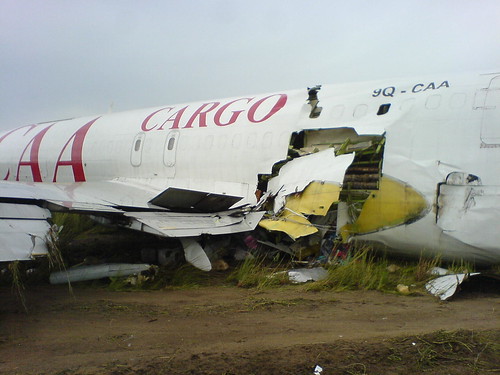
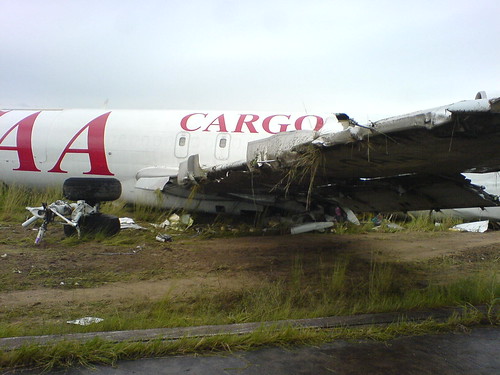
    Compagnie Africaine Boeing Crashes in Congo


    Pictured: A CAA – Compagnie Africaine d’Aviation Cargo Boeing 727-231/Adv(F/RE) Super 27 photographed in Goma, August 27, 2006
    Click to view full size photo at Airliners.net
    Contact photographer Guido Potters

    What: Compagnie Africaine d’Aviation Boeing 727-231F Super 27
    Where: Kinshasa-N’Djili Airport, D.R. Congo
    When: Jan 2, 2010
    Who:
    Why: The plane landed in very heavy rain and standing water on runway 06 and hydroplaned off the runway, skidding right on the main gears.

    9Q-CAA (ex-N54354) appears to be the only Boeing in the fleet.


  • | | | | | | | | |

    Colgan Air Reports Lack of Speed Warning

    Colgan’s Dec. 7 report to the U.S. National Transportation Safety Board said last February’s crash was probably caused by pilots’ “loss of situational awareness,” failure to follow the training and procedures, but pointed out contributing factors:

    • the cockpit warning system failed to adequately advise pilots when the speed is set below the calculated stall warning speed.
    • the lack of an adequate warning in the turboprop’s flight and operating manual regarding the effect of setting a non-ice reference speed during approach and landing
    • the crew’s failure to follow procedures regarding the proper response to a “stick shaker”
    • the crew’s failure to follow procedures regarding “non-pertinent conversation” by the flight crew during the descent and approach.

    Although Bombardier is withholding comment until the NTSB completes its investigation, a spokesman pointed out that the existing avionics are reliable and certified; and there are currently no requirements for systems to report abnormally low air speed.


    Click to view large photo at Airliners.net
    Contact Photographer Frank Robitaille

    What: Continental Airlines Flight 3407, Bombardier Q400 turboprop operated by regional carrier Colgan Air en route from Newark, New Jersey to Buffalo Niagara International Airport
    Where: Clarence Center, New York.
    When: Thursday Feb 12 struck a house at 10: 10 pm. Two homes were affected.
    Who: 44 passengers and four crew members, 1 off-duty pilot, 1 person on the ground, all fatalities. The passenger manifest has not officially been released.
    Why: The New Jersey-to-Buffalo flight was cleared to land on a runway pointing to the southwest. But the plane crashed with its nose pointed to the northeast. Seconds after two automatic warnings to the pilots that the plane was not moving fast enough to stay aloft, the twin turboprop aircraft went through a “severe pitch and roll” after positioning its flaps for a landing. It did not dive into the house, as initially thought, but landed flat on the house. Icing is emerging as the possible cause for why flight 3047 fell from the sky. The flight data recorder has been collected and is currently being examined.


    View Larger Map

  • | | | |

    Olympic Air Ooops


    Click to view full size photo
    Contact photographer Kostas D. Pantios

    What: Olympic Air Aerospatiale ATR-42-300 en route from Athens to Naxos
    Where: Paros
    When: Dec 12th 2009
    Who: not available
    Why: On approach to Naxos, the crew made a final approach to Paros (situated on side by side islands.)

    On advice from ATC, the pilots performed another go around, finding and landing on their planned destination.


    View Naxos in a larger map

  • | | |

    Helicopter Crashes in Islamorada FL

    What: G & S Helicopters Inc. Robinson R22 Beta II
    Where: Robbie’s Marina , Indian Key State Park, Islamorada Florida
    When: 2:30 p.m. Nov 30 2009
    Who: pilot
    Why: The pilot made an emergency landing on an island to inspect his plane. When he checked the tail rotor, the helicopter lifted off without him, at which point he tried to get back in but fell. The helicopter continued up about 70 feet before it crashed.

    The pilot received doctor’s care for his broken arm, after being rescued by a boat from a local marina.

    I’ve heard of people getting out of their car while it was running…But…a helicopter?

  • | | | |

    Pilots Walk Away from Totaled Plane


    A Beech 76 Duchess in Naples Florida
    Click to view full size photo at Airliners.net
    Contact photographer Erick Stamm

    What: Beechcraft model 76, twin engine, four-seater
    Where: George T. Lewis Airport
    When: 1:45 p. m. Saturday Oct 17
    Who: Pilot Mathias H. Ejegaard, 24, of Sweden; passenger (also a pilot) Ezekiel G. Andrews, 24, of Alabama
    Why: Ejegaard is a new pilot and has only had his license since March. On approach, the front landing gear indicator light was off so he made two more passes. He and his passenger (also a pilot) tried manually to lock the gear into place. When he made the landing, the pilot realized he was coming in too fast, but it was too late to stop and too late to take off again. The plane skidded off the runway into a marsh. A crane retrieved the plane, which was totaled.

    Maybe all runways should end in marshes.

  • | | | | | | |

    FAA Investigating Buffalo NY Crash


    Click to view large photo at Airliners.net
    Contact Photographer Frank Robitaille

    What: Continental Airlines Flight 3407, Bombardier Q400 turboprop operated by regional carrier Colgan Air en route from Newark, New Jersey to Buffalo Niagara International Airport
    Where: Clarence Center, New York.
    When: Thursday Feb 12 2009 10 pm.
    Who: 44 passengers and four crew members, 1 off-duty pilot, 1 person on the ground, all fatalities. The passenger manifest has not officially been released.
    Why: The New Jersey-to-Buffalo flight was cleared to land on a runway pointing to the southwest. But the plane crashed with its nose pointed to the northeast. Seconds after two automatic warnings to the pilots that the plane was not moving fast enough to stay aloft, the twin turboprop aircraft went through a “severe pitch and roll” after positioning its flaps for a landing. It did not dive into the house, as initially thought, but landed flat on the house.

    Although Icing is emerged as a factor for why flight 3047 fell, it has been found that the flight’s captain had lied on his job application to Colgan Air and only reported one of three failed FAA check rides. The co-pilot who could not afford to live in NY on her salary had flight-hopped across the country from Seattle and is recorded mentioning “a couch with her name on it.” The FAA investigators believe pilots made errors that contributed to the crash.

  • | | |

    High Drama in US Airspace

    What: Cessna 172 en route from a Canadian flight school into US Airspace
    Where: US Airspace
    When: about 3 p.m
    Who: one person aboard
    Why: The flight was intercepted by U.S. military aircraft when the unnamed pilot flew into US Airspace and did not respond. The plane was reported as stolen from a Thunder Bay, Canada flight school. Canadian authorities requested that U.S. aircraft tail the plane in U.S. airspace, hence the two U.S. Air Force F-16 jets.

    The pilot, Yavuz Berke aka Adam Leon, landed on Highway 60 in Ellsinore, Mo., at 9:50 p.m. ET, and was caught by Missouri State Highway Patrol officers. He’s an ex-pat Turk, and naturalized Canadian. He is reportedly depressed and either left his girlfriend (or left her a note.) In any case, he left his car and keys at the airport.

    With 2 F-16’s on his tail all day, he’s incredibly lucky to be alive and currently enjoying the hospitality of whatever government facility is housing him now (and likely to be housing him for a very long time.)

    The category selected here is “pilot error” and “alarm.” And while this is actually a misuse of the sorting system, I’m thinking it is warranted because if this is not an error of the pilot and cause for alarm, what is?

    George’s Point of View

    Yavuz Berke aka Adam Leon is going to be enjoying government hospitality for a long, long time. Yavuz–or if I may call you Adam–as a parent and a human being, I am very sorry that you have chosen to damage your own life so terribly; and I am amazed and warmed by the restraint of our jet pilots who were charged at bringing you down should you prove a threat.

  • | | | |

    March 2007: Yogyakarta Crash Landing

    This is the sad story of Marwoto Komar, a pilot with 22 years of flight experience.

    In March 2007, he piloted a Boeing 737-400 with 140 passengers on board which crashed on landing at the Yogyakarta airport. The plane came in for landing too high and too fast, and although the co-pilot called for a go-around, he landed on that pass anyway. The Boeing overran the runway and caught fire. Twenty-one people died in that crash.

    The* IFALPA position is that criminalisation of individuals does not improve air safety.

    In July 2008 he was arrested, tried and found guilty of negligence.

    An Indonesian court sentenced Komar to two years imprisonment for his role in the crash.

    * International Federation of Air Line Pilots Associations

    see src

    George’s Point of View

    You make a mistake.
    People get killed.
    You go to jail.

  • | |

    Cessna Runs out of Gas

    What: Cessna 150 en route to Lamar, Joplin, Neosho, and Bolivar,
    Where: emergency landing on U.S. 54 Highway near Iola
    When:
    Who: Malcolm E. Kucharski, 60, Pittsburg
    Why: Pilot error. The pilot left at 1 p.m. to go to Nevada MO, then the sun got in his eyes, he went to Iola and ran out of fuel.

    Audio

  • |

    Restored Plane Lands without Landing Gear

    What: Restored Thunder Mustang
    Where: Nampa Airport, Idaho
    When: 10:59 a.m Fri Sept 12
    Who: Only the pilot was aboard.
    Why:No fuel leaking, no other hazards. Pilot did not lower the landing gear. When the propeller hit the ground some wood components splintered.

  • |

    Pilot Error Down

    Blame it on better training.

    Blame what? The good news that mishaps due to pilots’ poor decision-making declined 71 percent 1983 and 2002.

    Thanks to Johns Hopkins Bloomberg School of Public Health for doing the research that says that though the overall rate of airline accidents remained stable during that period, the proportion of mishaps involving overall pilot error has decreased 40 per cent.

    The study’s lead author, Susan P. Baker says, “A 40 percent decline in pilot error-related mishaps is very impressive. Pilot error has long been considered the most prominent contributor to aviation crashes. Trends indicate that great progress has been made to improve the decision-making of pilots and coordination between the aircraft’s crew members. However, the improvements have not led to an overall decline in mishaps. The increase in mishaps while aircraft are not moving may require special attention.”

    Read more about Baker’s study in Aviation, Space, and Environmental Medicine.

  • | | |

    Gol Goes On and On

    According to Brazil’s Defense Minister Nelson Jobim, critics are “playing politics” when they disparage the state of Brazil’s aviation industry, in which occured in the past year, the crash of a Gol jetliner over the Amazon in which 154 people died, and July’s disaster when an Airbus crashed into a warehouse in Sao Paulo killing 199 people.

    Nevertheless, during a seminar in the United States, the President of the International Federation of Air Traffic Controllers, Marc Baumgartner criticized the Brazilian Air Force which oversees Brazil’s air traffic control system for trying to punish the controllers. “The Brazilian Air Force invested lots of energy to arrest and prosecute its own workers but none to fix its (air traffic control) system.” He also said that “it’s a question of time before a new air accident happens again in Brazil.”

    So far, a military court has declined to indict five Brazilian air traffic controllers for the GOL crash. Two American pilots face charges in a civilian criminal court in connection with the same crash. A Congressional commission report supports the indictment of pilots Joseph Lepore and Jan Paladino.

  • | | | |

    Pilot Error Suspected

    Sources Close to Probe Say Engine Wasn’t Idled

    Authorities believe pilot error caused the tragedy. If confirmed, it would cast doubt that poor runway conditions were to blame.

    Pilots had programmed the computerized engine controls — similar to a car’s cruise-control system — to maintain a speed of about 150 mph. When the plane was about 30 feet off the ground, the pilots correctly switched one of the engines to idle, but did not do so with the other engine. When the plane was braked, the second engine attempted to accelerate to maintain the preset speed.

    One of the airplane’s thrust reversers, a device used to slow the aircraft, was broken but the manufacturer claims plane is safe to fly with a disabled reverser.

    However, it has long been claimed that the short runway at Congonhas is unsafe in rainy conditions. The runway has been the site of problem landings before, and was even closed briefly this year, by court order.

    Air traffic controllers fear that government officials will use reports of pilot error to excuse themselves from making further improvements to the air safety system.

  • | | |

    Cessna Crash in Houston


    Pictured: A representative Cessna 501 Citation I/SP
    Click to view full size photo at Airliners.net
    Contact photographer Jerry Search

    What: Cessna 500
    Where: Houston, TX
    When: November 05, 2005
    Who: pilot and passenger
    Why: The 4,100-hour commercial pilot lost directional control of the single-pilot twin-engine turbojet while taking off, and impacted the ground 3,750 feet from the point of departure. The airplane climbed to approximately 150 feet, rolled to the right, descended, and struck the ground inverted. The weather was day VFR and the wind was reported from 170 degrees at 10 knots. The wreckage revealed that none of the main-entry door latching pins were in fully locked position. The accident occurred on its first test flight out of maintenance. Neither pilot nor passenger survived.

  • | | | | | | |

    Hendrick Motor Sports


    Pictured: A Beech 200 Super King Air
    Click to view full size photo at Airliners.net
    Contact photographer Carlos Barbosa

    What: Hendrick Motorsports Beechcraft Super King Air 200
    Where: Bull Mountain, seven miles from Blue Ridge Airport,
    When: October 24 2004
    Who: 2 pilots 10 passengers
    Why: On October 24 2004, en route to theNextel Cup Series, a Beechcraft Super King Air 200 owned by Hendrick Motorsports crashed in fog into Bull Mountain, seven miles from Blue Ridge Airport, carrying two pilots and ten passengers. Fatalities included Jon Hendrick and his twin daughters,and Ricky Hendrick. The plane missed its first landing attempt before veering off course and crashing; and the plane had not climbed to its temporarily assigned altitude of 2,600 feet; it instead descended to 1,800 feet before crashing. The cause was ruled failure to use an instrument approach and pilot error

    George’s Point of View