|

Lockheed Martin Delivers 300th Common Cockpit to the U.S. Navy

Similar Posts

  • |

    Press Release – FAA Announces Over $2.5 Million in Additional Recovery Act Airport Grants

    For Immediate Release
    September 28, 2010

    WASHINGTON – The U.S. Department of Transportation’s Federal Aviation Administration (FAA) today announced that three additional airport projects have been selected for funding, paid for with more than $2.5 million in American Recovery and Reinvestment Act dollars that became available because of airport projects that came in under budget nationwide.

    “With these additional Recovery Act dollars, we can provide a bigger boost to economic growth while we modernize more of our nation’s airports,” said U.S. Transportation Secretary Ray LaHood.

    Earlier this month, the FAA announced that five other airport projects would receive $9 million in Recovery Act funding that became available thanks to low bids and under-budget airport projects.

    “We are thrilled that we have been able to stretch Recovery Act dollars to meet the needs of more airports. These projects will improve airport operations and help our airspace system to run more efficiently,” said FAA Administrator Randy Babbitt.

    The three additional rehabilitation projects are:

    • Lawrence, Mass., Municipal Airport
      An ARRA grant for $1.2 million will fund several pavement rehabilitation projects on airport taxiways and aircraft parking aprons.
    • Hartsfield-JacksonAtlanta International Airport
      This $1 million ARRA grant will fund the ongoing construction and paving of the new international terminal apron.
    • CharlesM. Schulz-Sonoma County Airport, Santa Rosa, Calif.
      A $379,000 ARRA grant will allow the airport to complete the second phase of its terminal rehabilitation and replace the terminal building roof.

    Under the Recovery Act, more than $1.3 billion has been made available nationwide for both airport improvement projects and air traffic control facility and system upgrades. Because of low construction bids for projects, more Recovery Act dollars were available for additional facilities, equipment and airport projects. These grants have been distributed to airports that serve commercial passengers, cargo and general aviation.

    To include the featured image in your Twitter Card, please tap or click their icon a second time.
  • 4 Million Dollar Fine

    Private aviation service operator Spitfire Aviation may be find by the FAA for flights made by a pilot who lacked the proper authorization when a crash occurred. A whistleblower informed the FAA of the violations. Also, at the time, Spitfire had no pilot training and testing, maintenance or drug testing and alcohol misuse prevention programs, which are all FAA mandated.

    The FAA Press Release is below:

    For Immediate Release
    December 4, 2009
    Contact: Lynn Lunsford
    Phone: 817-222-4455

    FAA Proposes $4 Million Civil Penalty for Spitfire Aviation Services

    FORT WORTH, Texas — The Federal Aviation Administration (FAA) has proposed a $4 million civil penalty for Spitfire Aviation Services, LLC, of Fayetteville, Ark., for numerous violations of the Federal Aviation Regulations.

    The alleged violations include conducting at least 798 passenger-carrying revenue flights between November 2005 and October 2007, even though Spitfire held no air carrier certificate or the appropriate operations specifications required under federal regulations for charter operators. Inspectors also found that 262 of those flights were conducted by a pilot who did not hold an Air Transport Pilot Certificate with the appropriate type rating for the aircraft being flown.

    Spitfire had no FAA-approved pilot training and testing program in place, nor the approved maintenance program or drug testing and alcohol misuse prevention programs required by the government.

    During its investigation, the FAA determined that Spitfire operated three aircraft, including a Cessna CE-550 Citation, a Beechcraft BE-20 and a Beechcraft BE-36, on charter flights primarily in the central and southern United States. The FAA became aware of the violations through a complaint from a competitor.

    During the time it was operating in violation of regulations, Spitfire experienced a crash that destroyed the BE-36 and resulted in the death of the pilot. The three passengers on that flight survived the accident.

    Spitfire Aviation Services has 30 days from the receipt of the civil penalty letter to respond to the FAA.

    To include the featured image in your Twitter Card, please tap or click their icon a second time.

  • | |

    NTSB Assisting Dana Air Crash Investigation


    The NTSB is dispatching an investigator to assist the government of Nigeria in its investigation of the crash of a Dana Air Boeing MD-83 airplane, Flight # 0992.

    On June 3, 2012 at about 11:51 a.m. local time, the airplane, en route from Abuja to Lagos Nigeria, crashed outside the airport into a two story building. All 153 passengers and crew onboard were fatally injured, and an undetermined number of ground fatalities and injuries also occurred.

    As the state of design and manufacture of the Boeing MD-83, the NTSB has designated Senior Aviation Accident Investigator, Mr. Dennis Jones, as the traveling U.S. Accredited Representative. Mr. Jones will be assisted from NTSB headquarters by investigative staff specializing in operational factors, powerplants, and airworthiness as well as advisors from the Federal Aviation Administration (FAA), Boeing, and Pratt & Whitney.

    The investigation is being conducted by the Nigerian Accident Investigation Bureau.

    To include the featured image in your Twitter Card, please tap or click their icon a second time.
  • |

    EAA AirVenture 2010: Safety is Front and Center

    FAA RELEASE:

    If you’re in Oshkosh for EAA AirVenture, be sure and stop by the FAA Aviation Safety Center (next to the FAA control tower). This is where you can learn more about how the FAA is here to help you. There are exhibits on a host of aviation topics, from aircraft certification, air traffic control, and aerospace medicine, to the Next Generation Air Transportation System, runway safety, and the FAA Safety Team’s WINGS pilot proficiency program.

    The safety education forums held at the Aviation Safety Center cover such topics as “Aeronautical Decision Making,” “Surface Safety,” and “VFR Charts, Little Known Facts.”

    For more information on EAA AirVenture, go to www.airventure.org. You can also download a copy of the full FAA Aviation Safety Center schedule

    To include the featured image in your Twitter Card, please tap or click their icon a second time.
  • |

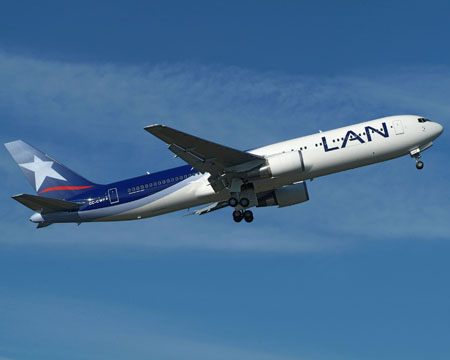
    Boeing, LAN Airlines Announce Order for Three 767s

    Additional 767-300ER airplanes part of the airline’s fleet expansion plans

    EVERETT, Wash., Feb. 18, 2011 /PRNewswire/ — Boeing (NYSE: BA) announced today that Chile’s LAN Airlines ordered three additional 767-300ER airplanes valued at $493 million at today’s list prices. Today’s order brings the total number of 767s ordered from LAN to 33.

    “This order for additional 767s builds on the long-standing relationship between Boeing and LAN,” said Marlin Dailey, vice president of Sales & Marketing for Boeing Commercial Airplanes. “LAN is one of the world’s premier airlines and we are happy to help them expand and grow their long-haul fleet.”

    The 767 family of airplanes is sized between the single-aisle 737 Next-Generation and the twin-aisle 777. As one of the most fuel-efficient airplanes in operation today, the 767 offers improved environmental performance and operating economics over competing jetliners.

    “The versatility, comfort, range and increased payload capabilities continue to make the 767 a staple in the fleets of today’s leading airlines,” said Dailey. “The 767 has benefited from years of technological improvements for greater efficiency and passenger comfort.”

    LAN’s fleet currently consists of 28 767-300ERs and 11 767-300 freighters. The airline has used Boeing’s product advancements to drive operational efficiencies into their long-haul fleet and increase passenger comfort including the passenger-pleasing Boeing Signature Interior.

    The Boeing 767 family is a complete family of clean, quiet, fuel-efficient airplanes that provide maximum market versatility in the 200- to 300-seat market. The Boeing 767 family includes three passenger models — the 767-200ER, 767-300ER and 767-400ER — and a medium-widebody freighter, which is based on the 767-300ER fuselage.

    To include the featured image in your Twitter Card, please tap or click their icon a second time.
  • NCAR Press Release: New NCAR System May Guide Transoceanic Flights Around Storms and Turbulence

    July 07, 2009

    BOULDER—The National Center for Atmospheric Research is developing a prototype system to provide aircraft with updates about severe storms and turbulence as they fly across remote ocean regions. The system is designed to help guide pilots away from intense weather, such as the thunderstorms that Air France Flight 447 apparently encountered before crashing into the Atlantic Ocean on June 1.

    The NCAR system, being developed with funding from NASA, combines satellite data and computer weather models with cutting-edge artificial intelligence techniques to identify and predict rapidly evolving storms and other potential areas of turbulence. The system is based on products that NCAR has developed to alert pilots and air traffic controllers about storms and turbulence over the continental United States.

    “Pilots currently have little weather information as they fly over remote stretches of the ocean, which is where some of the worst turbulence encounters occur,” says NCAR scientist John Williams, one of the project leads. “Providing pilots with at least an approximate picture of developing storms could help guide them safely around areas of potentially severe turbulence.”

    The component of the system that identifies major storms over the ocean is already available for aircraft use on an experimental basis.

    The entire prototype system, which will identify areas of turbulence in clear air as well as within storms, is on track for testing next year. Pilots on selected transoceanic routes will receive real-time turbulence updates and then provide feedback on the system to NCAR. The researchers will adjust the system as needed.

    When the system is finalized in about two years, it will provide pilots and ground-based controllers with text-based maps and graphical displays showing likely regions of turbulence and of storms.

    In addition to NCAR, other organizations taking part in the research include the Massachusetts Institute of Technology’s Lincoln Laboratory, the Naval Research Laboratory, and the University of Wisconsin-Madison.

    Flying with little information

    Pinpointing turbulence over the oceans is far more challenging than over land because of sparse observations. Weather satellites are often the only source of information over these remote regions. But the satellites provide images less frequently in general than over land, which can make it difficult to capture fast-changing conditions, and they do not directly measure turbulence.

    Pilots of transoceanic flights currently get preflight briefings and, in certain cases involving especially intense storms, in-flight weather updates every four hours. They also have onboard radar.

    All this information, however, is of limited value. Thunderstorms may develop quickly and move rapidly, rendering the briefings and weather updates obsolete. Onboard radars are designed to detect clouds and precipitation, but turbulence is often located far from the most intense precipitation. As a result, pilots often must choose between detouring hundreds of miles around potentially stormy areas or taking a chance and flying directly through a region that may or may not contain intense weather.

    In contrast, NCAR provides real-time maps of turbulence at various altitudes over the continental United States. Such a system, had it encompassed remote ocean regions, could have alerted the pilots of the doomed Air France flight to the stormy conditions along their flight path. The cause of that disaster has not been determined, and it is impossible to know whether the system could have prevented it.

    “It seems likely that the information provided by a real-time uplink of weather conditions ahead would have, at a minimum, improved the pilots’ situational awareness,” Williams says.

    Pinpointing the turbulence

    Williams and his colleagues have recently completed two critical steps in identifying turbulence over the oceans:

    The team has created global maps of clear air turbulence based on global computer weather models that include winds and other instabilities in the atmosphere. Clear air turbulence consists of erratic movements of air masses that occur in the absence of clouds and that sometimes buffet aircraft.

    Drawing on satellite images of storms, the scientists have created global views of the tops of storm clouds. Higher cloud tops are often correlated with intense storms, although not necessarily with turbulence.

    The next step is to identify areas of possible turbulence within and around intense storms. To do so, the team will study correlations between storms and turbulence over the continental United States where weather is more closely observed. The scientists will then infer the likelihood of turbulence associated with storms over the oceans, keying in on satellite indicators such as rapidly expanding clouds or places where the tops of storm clouds are cooling quickly.

    They will also develop mathematical equations to account for differences in cloud systems over the United States compared to over the oceans, including the tropics.

    Artificial intelligence at work

    In addition to providing aircraft and ground controllers with up-to-the-minute maps of turbulence, the NCAR team is turning to an artificial intelligence technique, known as “random forests,” to provide short-term forecasts of turbulence. The random forests, which have proven useful for forecasting thunderstorms over land, consist of many decision trees that each cast a yes-or-no “vote” on crucial elements of a storm at future points in time and space. This enables scientists to forecast the movement and strength of the storm over the next few hours.

    “Our goal is to give pilots a regularly updated picture of the likely storms ahead as they fly over the ocean so they can take action to minimize turbulence and keep their aircraft out of danger,” explains NCAR scientist Cathy Kessinger, a project team member. “Even over the middle of the ocean, where we don’t have land-based radars or other tools to observe storms in detail, we can still inform pilots about the potential for violent downdrafts, turbulence, and possibly lightning.”

    source:
    http://www.ucar.edu/news/releases/2009/ocean-air-turbulence.jsp#
    ©2009, UCAR

    To include the featured image in your Twitter Card, please tap or click their icon a second time.