Public Statement

  • | |

    American Airlines and Japan Airlines Thank U.S. Department of Transportation on Final Order Allowing Antitrust Immunity

    American and Japan Airlines Set To Launch Joint Business in 2011

    FORT WORTH, Texas and TOKYO, Nov. 10, 2010 /PRNewswire/ — American Airlines and Japan Airlines, members of the oneworld® Alliance, today thanked officials with the U.S. Department of Transportation (DOT) for granting final approval to their joint request for antitrust immunity and plans for a joint business between North America and Asia.

    “We appreciate the thorough review that DOT has given our request for antitrust immunity that will allow us to move forward with our joint business,” said Tom Horton, President of American Airlines. “We also look forward to officials from the United States government and the government of Japan signing an Open Skies agreement, which will allow for additional flights between the United States to Japan.”

    “This final U.S. government approval, following the recent grant by Japan’s Ministry of Land, Infrastructure, Transport and Tourism, clears all regulatory procedures necessary for Japan Airlines and American Airlines to begin working on our joint business,” said Masaru Onishi, President of Japan Airlines. “We would like to express our gratitude to everyone involved in making this positive decision, and will from hence, move expeditiously towards creating more benefits for our passengers, our companies, our financial supporters and our countries.”

    Both airlines anticipate launching their trans-Pacific joint business in early 2011. It will provide enhanced travel options and experiences for passengers of both American Airlines and Japan Airlines.

    American plans to start its new nonstop daily service between New York’s John F. Kennedy International Airport and Tokyo’s Haneda International Airport on Jan. 20, 2011. Japan Airlines began service from Haneda to San Francisco in late October. Both carriers will codeshare on these flights.

  • | |

    Department of Transportation Report Substantiates Whistleblower’s Safety Concerns at American Airlines Certificate Management Office


    U.S. Office of Special Counsel
    1730 M Street, N.W.,Suite 218
    Washington, D.C. 20036?4505

    FOR IMMEDIATE RELEASE

    WASHINGTON, DC/November 4, 2010—Today the U.S. Office of Special Counsel (OSC) transmitted to the President and Congress reports of the Department of Transportation (DOT) responding to a whistleblower’s allegations that the Federal Aviation Administration (FAA) failed to provide effective oversight of American Airlines and to address the air carrier’s non? compliance with inspection and maintenance requirements.

    The whistleblower, Mr. Andrew G. Blosser, an FAA Aviation Safety Inspector assigned to the American Airlines Certificate Management Office (CMO), in Fort Worth, Texas, alleged that CMO officials were unwilling or unable to obtain positive corrective actions from the air carrier and that the failure to enforce inspection and maintenance requirements has resulted in a poorly maintained fleet that represents a safety concern for the flying public. Mr. Blosser identified six areas of concern regarding American Airlines’ non?compliance: (1) maintenance procedures; (2) minimum equipment list (MEL) deferrals; (3) required inspection items (RII); (4) the repair station training needs assessment (TNA); (5) the Continuing Analysis and Surveillance System (CASS); and (6) the fuel tank system (FTS) maintenance program.

    The report and a supplemental report submitted to OSC by Secretary of Transportation Ray LaHood substantiated Mr. Blosser’s allegations that the CMO failed to ensure that American Airlines complied with requirements in four of the six areas identified above; specifically, maintenance procedures, MEL deferrals, RII requirements, and CASS requirements. The investigation found that at the time of Mr. Blosser’s disclosures, CMO Actions to ensure compliance were not effective. In addition, the investigation found that inaccurate and untimely FAA guidance for the review and approval of the air carrier’s FTS maintenance program most likely contributed to inspector confusion and uncertainty as to whether the program met federal regulations and airworthiness directive (AD) requirements. ADs are rules that FAA issues to address an unsafe condition that exists in an aircraft product or is likely to exist or develop in other products of the same type design.

    In response to the findings, FAA Administrator J. Randolph Babbitt pledged to take corrective action, including improving policies and procedures within the CMO. In addition, FAA removed or reassigned managers and noted that American Airlines replaced several senior level personnel. FAA further indicated that it plans to have an outside office provide oversight of the CMO to ensure corrective actions are taken. By March 2011, inspectors from outside the region will conduct an independent audit to assess the effectiveness of the corrective actions, and in July 2011, the FAA’s Flight Standards Quality Assurance Division will conduct an independent Flight Standards Evaluation Program evaluation of the CMO.

    OSC determined that the agency’s report contains all of the information required by statute and the findings appear reasonable.

    The U.S. Office of Special Counsel (OSC) is an independent investigative and prosecutorial agency and operates as a secure channel for disclosures of whistleblower complaints. Its primary mission is to safeguard the merit system in federal employment by protecting federal employees and applicants from prohibited personnel practices, especially retaliation for whistleblowing. OSC also has jurisdiction over the Hatch Act. For more information please visit our web site at www.osc.gov or call 1 (800) 872-9855.

  • | |

    Southwest Airlines and AirTran Holdings Each Receive Antitrust Second Request

    DALLAS, Tex. and ORLANDO, Fla., Nov. 9, 2010 /PRNewswire via COMTEX/ —
    Southwest Airlines Co. and AirTran Holdings, Inc. announced today that each received a request yesterday for additional information from the Antitrust Division of the United States Department of Justice (DOJ) in connection with Southwest’s previously announced proposed acquisition of AirTran. This action, often referred to as a “second request,” is a common part of the regulatory approval process under the Hart-Scott-Rodino Antitrust Improvements Act. Both parties are in the process of gathering information to respond to the second request and will continue to work cooperatively with the DOJ as it reviews the transaction. Completion of the transaction remains subject to the approval of AirTran stockholders, receipt of DOJ and any other necessary clearances, and fulfillment of customary closing conditions. While a definitive closing date cannot yet be determined, Southwest and AirTran maintain their expectation that the transaction will close in the first half of 2011.

  • oneworld Voted Leading Airline Alliance for Eighth Year Running

    VANCOUVER, British Columbia, Nov. 8 2010 /PRNewswire/ — oneworld® has been named the World’s Leading Airline Alliance 2010 in the World’s Travel Awards – described by the Wall Street Journal as the “travel industry’s equivalent of the Oscars”.

    It is the eighth year running that oneworld has won this honor, retaining the “best alliance” title since 2003.

    oneworld was also named World’s Best Airline Alliance in the 2010 World Airline Awards, presented by the Skytrax airline quality organisation in May. In addition, it has also won both the “best alliance for inflight wines” titles presented this year – in Global Traveler magazine’s Wines on the Wing awards in August and Business Traveller’s Cellars in the Sky in February. oneworld is also a three-time winner of the Best Airline Alliance title from Business Traveller magazine.

    oneworld member airlines also flew high in the World Travel Awards, with Cathay Pacific named World Leading Airline Economy Class, and American Airlines as North America’s Leading Airline.

    The 2010 World Travel Awards were presented at a ceremony in London last night, based on votes cast by more than 180,000 travel agents and other travel professionals worldwide.

    oneworld Managing Partner John McCulloch said: “oneworld’s focus has always been on the quality rather than the quantity of our members, so it is very heartening to retain our record of being the only alliance ever to win this World Travel Award since it was first presented. It is a tremendous vote of confidence once again from some of the most knowledgeable people in the travel industry worldwide in what has been a breakthrough year for oneworld.”

    The award is the latest landmark for oneworld in what is turning into a breakthrough year for the alliance. In other key milestones so far in 2010:

    S7 Airlines, Russia’s leading domestic carrier – and one of the biggest and best international airlines in the Commonwealth of Independent States – will join oneworld a week from today, on Nov. 15.
    India’s leading carrier Kingfisher Airlines became a oneworld member elect in June – followed by airberlin, Europe’s fifth biggest airline, in July.
    American Airlines, British Airways, Iberia, Finnair and Royal Jordanian in July received long-awaited final approval for their application for anti-trust immunity across the Atlantic, with American, BA and Iberia launching their trans-Atlantic joint business in October.

    Japan Airlines has been expanding its cooperation with its oneworld partners since reaffirming its membership of the alliance in February. In October it gained final approval from Japan’s authorities and tentative approval from the US regulators, to launch a joint business with American Airlines between Asia and North America from early next year. JAL has also substantially expanded codesharing with many other oneworld partners.
    British Airways and Iberia are on track to complete their merger by the end of the year.
    LAN Airlines celebrated its 10th anniversary as a oneworld member on June 1. Since joining, it has added to the grouping its affiliates in Argentina, Ecuador and Peru.
    oneworld’s biggest airport co-location project in Asia was completed at the end of October, with British Airways moving alongside all the other on-line oneworld airlines in Terminal 2 at JAL’s Tokyo Narita international base. At the same time, oneworld positioned itself as the leading alliance at Tokyo Haneda, as it opened to scheduled international services, offering the airport’s widest international network and biggest domestic operation.

    About oneworld

    oneworld brings together some of the best and biggest names in the airline business – American Airlines, British Airways, Cathay Pacific, Finnair, Iberia, Japan Airlines, LAN, Malev Hungarian Airlines, Mexicana, Qantas and Royal Jordanian, and around 20 affiliates including American Eagle, Dragonair, LAN Argentina, LAN Ecuador and LAN Peru. Russia’s S7 Airlines will join the alliance on 15 November 2010 with airberlin and India’s Kingfisher Airlines both member elects. Between them, these airlines:

    Serve almost 900 airports in nearly 150 countries, with some 9,500 daily departures.
    Offer more than 550 airport lounges for premium customers.
    Carry 340 million passengers a year.
    Operate a combined fleet of almost 2,500 aircraft.
    Generate around US$90 billion annual revenues in total.

  • |

    Boeing Delivers Malaysia Airlines’ First Next-Generation 737-800 With New Livery

    SEATTLE, Nov. 9, 2010 — Boeing and Malaysia Airlines last week celebrated the delivery of the airline’s first Next-Generation 737 with the new, passenger-inspired Boeing Sky Interior.

    The national carrier of Malaysia is the first full-service airline to operate the 737-800 with the new Boeing Sky Interior.

    The new 737 Boeing Sky Interior features sculpted sidewalls and window reveals, and new, larger stow bins that accommodate more bags while taking up less space in the cabin. Attendants can select from different LED lighting schemes from soft blue overhead sky simulation to a calm, relaxing, pallet of sunset colors. To date, 50 customers have ordered the new interior for 1,386 airplanes.

    Boeing Sky Interior is the latest in a series of improvements to the airplane. The next to come will be a package of performance improvements that will reduce fuel consumption and carbon emissions by 2 percent – making the airplane a full 7 percent more efficient than the first Next-Generation 737 delivered. The performance improvements to the airframe and engine are beginning certification test soon, and will be fully in service by early 2012.

    Malaysia Airlines is the second airline worldwide to take delivery of the new Boeing Sky Interior that offers an improved travel experience to passengers. Delivery of the airline’s initial Next-Generation 737 with the Boeing Sky Interior took place Oct. 29.
    Two flights are scheduled for Nov. 15; an inaugural flight from Kuala Lumpur to Kota Kinabalu followed by a commercial flight from Kota Kinabalu to Haneda, Tokyo.

  • |

    Air T, Inc. Announces Award of $10.5 Million Contract from the City of Charlotte

    MAIDEN, N.C., Nov. 9, 2010 /PRNewswire-FirstCall/ — Air T, Inc. (Nasdaq: AIRT) announced today that its wholly owned subsidiary, Global Ground Support, LLC, has been awarded a $10.5 million contract to supply deicer trucks and training simulators to the City of Charlotte. Global expects to deliver the first units under the contract in the current fiscal quarter ending December 31.

    Walter Clark, Air T’s CEO, stated that, “We are excited to have been selected by the City of Charlotte and look forward to working with them. Our equipment will be utilized to ensure that departing flights during inclement winter weather at Charlotte Douglas International Airport continue to operate safely and reliably. This contract was the result of a competitive process which we won due in part to the quality of product and the high level of service that Global Ground Support provides to all of its customers.”

    Air T, through its subsidiaries, provides overnight air freight service to the express delivery industry, manufactures and sells aircraft deicers and other special purpose industrial equipment, and provides ground support equipment and facilities maintenance to airlines. Air T is one of the largest, small-aircraft air cargo operators in the United States. Air T’s Mountain Air Cargo and CSA Air subsidiaries currently operate a fleet of single and twin-engine turbo-prop aircraft daily in the eastern half of the United States, Puerto Rico and the Caribbean Islands. Air T’s Global Ground Support subsidiary manufactures deicing and other specialized military and industrial equipment and is one of the largest providers of deicers in the world. The Global Aviation Services subsidiary provides ground support equipment and facilities maintenance to domestic airline customers.

  • | |

    XL Insurance Continues Regional Build Up of US Aviation Team, Establishing Chicago Underwriting Operations

    NEW YORK, Nov. 9, 2010 XL Insurance, the global insurance operations of XL Group plc today announced the launch of a new regional aviation underwriting group in Chicago with the appointment of Brian J. Ackland to Class Underwriter.

    Eric Donofrio, North American Regional Manager for XL Insurance’s Aviation unit, said: “We’re off to a good start in Chicago. Bringing both broker and underwriting experience, Brian is a strong addition to our underwriting team. Now with underwriters in Chicago, New York, and San Francisco, our brokers have more direct access to experienced staff who understands aviation risks and the needs of our clients. We’re looking forward to expanding this team in the very near future to be even more responsive to needs of the aviation industry in the US Midwest.”

    Mr. Ackland joins XL Insurance from Aviation Insurance Services (AIS) of Illinois, Inc. In addition to his experience as a broker with AIS, his professional experience includes various underwriting positions with AIG Aviation and United States Aircraft Insurance Group, both in Chicago. A graduate of Embry-Riddle Aeronautical University, Mr. Ackland holds a commercial pilot certificate with multi-engine, instrument and rotorcraft ratings.

    XL Insurance’s global Aerospace operations provide a broad spectrum of coverage for US based and international airlines, products manufacturers, general aviation and space risks around the world.

    XL Insurance is the global brand used by XL Group plc’s insurance companies and underwriting divisions offering property, casualty, professional and specialty insurance products throughout the world. More information about XL Insurance is available at www.xlinsurance.com. XL Group plc, through its subsidiaries, is a global insurance and reinsurance company providing property, casualty, and specialty products to industrial, commercial, and professional firms, insurance companies and other enterprises on a worldwide basis. More information about XL Group plc is available at www.xlgroup.com.

  • |

    AAR to Relocate Airlift Group to Melbourne, Florida

    Named as one of ‘The Most Trustworthy Companies’ by Forbes Magazine, AAR Reaches Major Milestones with the Transformation of New Airlift and Modifications Businesses.

    WOOD DALE, Ill., Nov. 8, 2010 — AAR announced today that it has selected Melbourne, Fla. as the new location for its airlift services and specialized aircraft modifications businesses, which the Company acquired in April 2010. Since completing the acquisition, AAR has installed a new leadership team and is rebranding the businesses as part of its overall integration strategy.

    “When we acquired Aviation Worldwide Services and its subsidiaries earlier this year, we shared our plans to relocate the operations, transform the leadership team with our people to instill AAR values and rebrand the business,” said David P. Storch, Chairman and Chief Executive Officer of AAR CORP. “I’m very pleased with the progress our team has made toward these goals and I look forward to being an important part of Melbourne’s business community and economy. I want to thank the State of Florida for their support and for working diligently to help make this move happen.”

    The business will move to hangars, facilities and offices at and near Melbourne International Airport. The relocation will be conducted in phases and is expected to be completed by spring 2011. AAR will establish an on-site management team and begin hiring select positions immediately. The business is expected to create as many as 225 jobs by the end of 2012.

    The business will operate as AAR Airlift Group, with airlift services provided by AAR Airlift and specialized aircraft modifications performed by AAR Aircraft Services – Melbourne. AAR Airlift Group is led by Jeffrey Schloesser, a former U.S. Army major general with more than 20 years of senior-level leadership and operations experience, which includes leading the Army’s modernization and transformation plan for a fleet of 4,000 aircraft and 76,000 personnel.

    AAR collaborated with elected officials from the State, economic development groups and the city of Melbourne to identify locations that would support AAR’s requirement for world-class flight operations, warehousing and administrative facilities and to develop a partnership to ensure the future growth of the business.

    “Aviation and aerospace is one of Florida’s targeted industries for stimulating economic growth and diversification; therefore, AAR’s entry is in line with our expansion strategy for this key sector,” said John Adams Jr., president & CEO of Enterprise Florida, the state’s principal economic development organization. “This project has exemplified Florida’s competitiveness; our ability to attract progressive and innovative businesses as we compete in the global economy.”

    Senate President–designate, Mike Haridopolos said, “We are pleased to welcome a company of AAR’s recognized quality and expertise to the Space Coast. Its relocation to Florida will create high-quality jobs, provide an instant economic boost, and solidify the leadership of the Space Coast in the defense and aerospace sectors.”

    “This is fantastic news for the Space Coast,” said U.S. Sen. Bill Nelson, who urged the company to relocate its airlift operations to Melbourne. “This move will bring much needed jobs to the area and provide a boost to the local economy. I applaud AAR’s decision to select Melbourne as the home for their airlift group.”

    “Companies like AAR will create the types of jobs we need in Florida during this critical time of transition in the aerospace industry,” noted State Senator Thad Altman, who represents East Central Florida. “In addition, the technological expertise and capabilities of AAR could lead to a terrific partnership with the state of Florida in areas such as emergency management preparation and civil defense.”

    “AAR is a highly respected, very successful company and we knew that this project would be extremely competitive,” said Lynda Weatherman, President and Chief Executive Officer, Economic Development Commission of Florida’s Space Coast. “We developed a creative package that showcased the Space Coast’s core capabilities, including the tax advantage benefits of a Florida location. We are delighted that AAR recognized our competitive advantages and look forward to the company’s success here at the Space Coast.”

    “AAR is a great example of the type of company that will help Florida diversify its aerospace economy to position for success in the coming months and years,” noted Space Florida President Frank DiBello. “This company is well-established in the defense industry and will bring continued innovation to Florida’s aerospace industry. We are extremely pleased to welcome them to the Space Coast.”

    AAR currently has facilities in Clearwater, Jacksonville, Medley and Miami, employing 1,200 highly-skilled workers and contributing approximately $150 million annually in economic impact to the state of Florida. At full employment, the new Melbourne location is projected to add an additional $42.3 million to the state’s economy.
    “All over the country communities are working hard to land companies of AAR’s caliber. We’re fortunate Melbourne International Airport was chosen as the site for this significant expansion. It’s good for Melbourne. It’s good for the region,” said Harry Goode, Mayor of Melbourne and Chairman, Melbourne Airport Authority.

  • | |

    Release: Pilots: How to Handle Abnormal Situations

    http://www.faa.gov/news/safety_briefing/
    Now available online, the November/December 2010 issue of FAA Safety Briefing focuses on a subject fundamental to pilot safety: how to handle abnormal and emergency situations. The issue stresses the delicate art of planning for the unplanned and outlines several tools and resources pilots can draw upon to handle emergencies.
    Articles provide tips on unusual attitude recovery, partial-power takeoffs, and knowing what to do when your aircraft’s electrical system fails. Also, this issue’s Hot Spots article highlights the work FAA has been doing to identify the leading causes of GA fatal accidents and lists the top 10 causes. The Vertically Speaking column lists the top 10 causes of helicopter accidents and highlights the regional safety seminars the FAA Safety Team is conducting with Helicopter Association International.

    For Aviation Maintenance Technicians, the Nuts, Bolts, and Electrons article explains the Service Difficulty Reporting System and encourages AMTs to use it.

  • | |

    UPS/Pilots Sign Agreements on Safety and Security

    LOUISVILLE, Ky., Nov. 4, 2010 /PRNewswire-USNewswire/ — United Parcel Service and the Independent Pilots Association, the collective bargaining unit for its 2,800 pilots, today signed a memorandum of understanding that establishes joint UPS/IPA Safety and Security Task Forces. Both will be made up of six members, three named by each party.
    “This agreement reaffirms our common objective of efficiently and effectively operating the UPS airline with safety and security as our twin priorities and guiding principles. We appreciate the company efforts in reaching this agreement,” said IPA President Captain Robert Thrush.

    The Safety Task Force will address the following issues: Emergency Vision Assurance System (EVAS); full face oxygen masks; comprehensive fire mitigation and suppression systems; checklists procedures for smoke and fire; and the carriage of lithium batteries and other fire/smoke hazards.

    “UPS and IPA acknowledge that the air cargo/express package industry faces unique threats in the era of global terrorism. We also recognize the key role our pilots can play in the mitigation and management of these threats both from the flight deck and by working together to improve cargo security and screening,” said Captain Thrush.

    The Security Task Force will address the following issues: communication and coordination within/between UPS, affected crewmembers, and the IPA; air cargo security procedures; threat procedures; improved access to security directives; perimeter security; and background checks for those who have access to UPS aircraft.

  • NTSB Safety Recommendation A-10-130

    National Transportation Safety Board
    Washington, DC 20594

    November 4, 2010

    The National Transportation Safety Board recommends that the
    European Aviation Safety Agency:

    Require Eurocopter to review the design of the fuel flow
    control lever (FFCL) and/or its detent track on AS350-series
    helicopters and require modification to ensure that the FFCL
    is protected to prevent unintentional movement out of its
    detents and that it does not move easily to an unintended
    position. (A-10-131)

  • |

    Boeing Achieves Power On for New 747-8 Intercontinental

    EVERETT, Wash., Nov. 5, 2010 /PRNewswire/ — Boeing (NYSE: BA) has completed the power on sequence for the new 747-8 Intercontinental. This milestone enables the program to begin functional tests on the airplane.

    “This is a critical step in the assembly process for the new 747-8 Intercontinental,” said Elizabeth Lund, 747 deputy program manager, Boeing Commercial Airplanes. “The airplane’s systems are now live. This milestone is a reflection of the focus and hard work of our engineers, mechanics and suppliers.”

    Power on is a complex series of tasks that methodically energize and activate the airplane’s systems. In this critical stage of the assembly process, the electrical, hydraulic and pneumatic systems are brought on line.

    Mechanics connected the 747-8 to an external power cart to energize the flight-deck display and maintenance systems. The electricity coursing through the airplane’s 133 miles (214 km) of wire will be as high as 105 kilovoltampere (kVa).

    The program also activated the airplane’s hydraulic and pneumatic systems. Pressurized to 3,000 pounds per square inch (psi), the hydraulics power the flight control surfaces, landing gear, brakes and steering systems. The 160 psi applied to the pneumatic system enables the airplane to operate the environmental control systems and the leading-edge flaps.

    “We are very methodical in ensuring the integrity of the airplane’s systems,” said Todd Zarfos, vice president of 747 engineering, Boeing Commercial Airplanes. “This accomplishment is a key milestone in validating the design, installation and functionality of the electrical, hydraulic and pneumatic systems.”

    A video that gives you an inside look at the power on sequence is available at http://bit.ly/dlXgym.

    The program is expected to complete assembly of the 747-8 Intercontinental in the first quarter of 2011. The airplane is scheduled to enter service in late 2011 following the flight test program.

    The 747-8, which includes the 747-8 Intercontinental and the 747-8 Freighter, was launched in November 2005. Boeing has 109 orders for the 747-8 — 33 for the 747-8 Intercontinental and 76 for the 747-8 Freighter. The first 747-8 Intercontinental is scheduled to deliver in late 2011.

    The new 747-8 Intercontinental offers the lowest operating costs and best economics of any large passenger airplane, while providing enhanced environmental performance. The 747-8 provides new revenue opportunities that allow airlines to maximize profits. Eighteen feet longer than the 747-400, the 747-8 has 51 additional seats to accommodate 467 passengers in a typical three-class configuration, and it also offers 26 percent more cargo volume.

  • |

    FAA Proposes Safety Management Systems for Airlines

    For Immediate Release
    November 4, 2010

    WASHINGTON – In a continuing effort to take the U.S. aviation system to the next level of safety, the Federal Aviation Administration (FAA) has proposed to require Safety Management Systems (SMS) for most commercial airlines.
    Safety management systems give operators a set of business processes and management tools to examine data from everyday operations, isolate trends that may be precursors to incidents or accidents, and develop and carry out appropriate risk mitigation strategies. They are a formal approach to managing an organization’s safety through four key components – safety policy, safety risk management, safety assurance, and safety promotion.

    “Safety is our top priority,” said U.S. Transportation Secretary Ray LaHood. “This program can help airlines identify possible safety problems and correct them before they lead to accidents.”

    “We need a holistic approach to safety that allows us to spot trends in aviation and make necessary changes to help avoid incidents and accidents,” said FAA Administrator Randy Babbitt. “Safety Management Systems are a critical piece of a successful safety culture.”

    The requirements of the SMS proposal would define “what” is expected rather than “how” the requirement is to be met. This allows for development and implementation of an SMS that matches the size, complexity and business models of diverse organizations in ways appropriate to their unique systems and operating environments.

    Under the proposed rule, scheduled air carriers and a few others operating under Part 121 of federal aviation regulations would be required to implement an SMS within three years. The carriers would have to submit their SMS implementation plans to the FAA within six months of the final rule’s effective date. The plan would be required to show how the airline intends to comply with the rule within the three-year implementation period. An SMS would not take the place of regular FAA oversight, inspection and audits to ensure compliance with existing regulations

    The FAA began exploring system safety-based oversight concepts in the mid- to late- 1990s. During that time, the agency concluded system safety has to be practiced by operators, repair stations, flight schools, other aviation service providers and the agency itself. In 2006, the International Civil Aviation Organization (ICAO) required that all member countries implement SMS standards for operators and approved maintenance organizations.

    The FAA’s own Air Traffic Organization has already begun implementing an SMS, and the agency recently issued a notice of proposed rulemaking that would require FAA-certified airports to establish SMS for all airfield and ramp areas.

    The estimated cost of this proposed rule for U.S. air carriers is $390 million, with estimated benefits of $470 million. The proposal conforms to ICAO SMS provisions.

  • |

    BOEING OFFERS EXCHANGE PROGRAM FOR 787 DREAMLINER PARTS

    SEATTLE, Nov. 3, 2010 / — Boeing today announced the availability of a rotable exchange services program, that will support the operation of the Boeing 787 Dreamliner. This program will help airline customers reduce inventory costs by providing access to a Boeing-managed inventory pool of parts that is available to ship within 24 hours of request.

    “The 787 Rotables Exchange Services Program will provide a dedicated pool of high-value, dispatch-critical parts for airlines, while helping them to improve operations support and cash flow,” said Dale Wilkinson, vice president, Material Services for Boeing Commercial Airplanes. “The program manages configuration, warranty and reliability for the covered parts, freeing the airline to focus on passengers and the operation of the airplane.”

    The exchange program is available to support initial entry into service for 787 operators – this is the first time that such a program has been developed in conjunction with entry into service of a new fleet type.

    With the Boeing 787 Rotable Exchange Program, the airline removes a part from the airplane and ships it for exchange with a new unit from Boeing’s exchange pool. Boeing plans to support up to 600 high-value rotable parts, including such items as the Auxiliary Power Unit and Variable Frequency Starter Generator. By providing coverage for parts typically priced in the hundreds of thousands of dollars, the exchange program can provide considerable inventory cost savings for airlines.

    The program provides a flight-hour cost basis that enables the customer to better forecast maintenance costs, while spreading out high-cost expenditures for rotable parts over the 10-year term of the agreement.

  • |

    Seats Available for NTSB Event

    National Transportation Safety Board
    Washington, DC 20594
    November 2, 2010

    The National Transportation Safety Board’s course,
    “Transportation Disaster Response – A Course for Emergency
    Responders,” scheduled for November 16-18, 2010, at the NTSB

    Training Center in Ashburn, Virginia, still has openings for
    those who may have a role in responding to major
    transportation accidents.

    NTSB specialists and speakers from the FBI, the New Jersey
    State Police, and other emergency response agencies and
    organizations with response roles in recent accidents will
    discuss the operational and organizational challenges
    encountered in responding to large-scale, high-profile
    transportation accidents.

    The complete course description, agenda, and information on
    registration process and cost are available at:
    http://www.ntsb.gov/Academy/CourseInfo/TDA402_2010.htm

  • |

    Boeing and State Corporation Rostechnology Finalize Order for Next-Generation 737s

    MOSCOW, Oct. 29 — Boeing and the State Corporation Rostechnology today announced the finalization of an order for 50 Next-Generation 737 airplanes. The order includes purchase rights for an additional 35 Next-Generation 737s. The State Corporation’s Supervisory Board approved the definitive agreement that was signed and announced on Sept. 17 during the Sochi Investment Forum in Russia. The order is valued at $3.7 billion at average list prices. Rostechnology’s order includes 15 Next-Generation 737-700s, 25 737-800s and 10 737-900ERs (extended range). 

    "The order of Next-Generation 737s by Rostechnology represents a substantial investment in our future and will accelerate the significant progress we are making in improving the global competitiveness and efficiency of our airline industry," said Roman Pakhomov, chief executive officer of Aviation Capital Services, aviation leasing division of Rostechnology. "This agreement continues to build upon the strategic partnership between Rostechnology and Boeing."

    The economic benefits, comfort and operating efficiencies consistently demonstrated by the Next-Generation 737 directly support Rostechnology’s plan to provide Russian airlines with efficient and reliable airplanes that will help them profitably grow domestic and international operations.

    "This is a great day in the history of our long and enduring partnership with Rostechnology," said Marlin Dailey, vice president of Sales, Boeing Commercial Airplanes. "Today’s order for 737-700s, 737-800s and 737-900ERs underscores Rostechnology’s confidence in the world’s most successful single-aisle airplane. The entire Next-Generation 737 family offers superior operating economics and the 737-900ER has the best seat mile cost of any single-aisle airplane and provides our Next-Generation 737 customers with a compelling low-risk growth opportunity."

    Rostechnology 737s will be delivered with the all-new 737 Boeing Sky Interior. Inspired by the passenger experience, it promises to redefine the 737 travel experience. In addition to the new design, Boeing also announced a performance improvement package offering a 2 percent reduction in fuel consumption through various airframe and engine improvements.

    Over the past 20 years, Boeing’s joint programs in Russia have resulted in almost $6 billion in highly successful joint projects with its Russian partners making Boeing the largest international aerospace investor in Russia.

    Boeing announced in September that its production rate for the Next-Generation 737 program will increase from the current rate of 31.5 airplanes per month to 35 in early 2012 and to 38 airplanes per month in the second quarter of 2013.

  • | |

    Suspicious Packages on UPS and Fed Ex Cargo Flights

    What: UPS flight
    Where: East Midlands
    When: Oct 29 2010
    Why: A suspicious package on a UPS cargo flight (a toner cartridge with wires attached and a white powder) has raised the US Transportation Security Administration to order UPS flights searched for suspicious cargo. Officials indicate that tests on the device came back negative for explosives.

    Fed Ex Statement
    Yemen Shipment Embargo
    In cooperation with the FBI, local authorities have confiscated a suspicious package at the FedEx facility in Dubai. The shipment originated in Yemen and as an additional safety measure, FedEx has embargoed all shipments originating from Yemen. The Company is cooperating fully with the authorities on this matter; any additional information regarding this matter must come from the FBI.

  • |

    Press Release – FAA Awards $18 Million Environmental Grant to Seattle-Tacoma International Airport

    WASHINGTON – The Federal Aviation Administration (FAA) announced the award of its largest Voluntary Airport Low Emission (VALE) grant for an $18.3 million project at Seattle-Tacoma International Airport (Sea-Tac) to improve air quality and to reduce the use of conventional fuels at the airport.

    With the VALE grant, Sea-Tac will be able to install a centralized preconditioned air plant that will allow aircraft arriving at the gates to shut off their auxiliary power units and connect to a cleaner central heating and cooling system. This project will greatly reduce aircraft emissions on the ground.

    “This program is helping airports around the country make needed technological investments so they can be more environmentally friendly,” said U.S. Transportation Secretary Ray LaHood.

    Since the first VALE grant award in 2005, the FAA has funded 40 projects totaling $83 million dollars.

    FAA Administrator Randy Babbitt announced the grant during a press conference in Seattle where he highlighted environmental efforts under way at Sea-Tac and by the Alaska Air Group (AAG) as examples of the kind of innovative work being done in the aviation community.

    “The FAA is encouraging airlines and airports to find creative ways to reduce aviation’s impact on the environment,” said Administrator Babbitt. “NextGen technology will also help aviation go even greener by significantly reducing the amount of fuel burned during air travel.”

    Administrator Babbitt discussed an innovative program under way in the Sea-Tac area known as the Greener Skies over Seattle project. The project began in early 2009 with the Alaska Air Group (AAG), which includes Alaska Airlines and Horizon Airlines, the Port of Seattle and the Boeing Co. The AAG is seeking to improve efficiency at Sea-Tac through expanded use of NextGen satellite-based technologies to provide more direct and optimized descent paths to landing.

    The program has the potential to provide environmental benefits to the region through reducing fuel burn, emissions, and the number of people impacted by aircraft noise. In addition, lessons and benefits gained from this effort may be transferred to other airports around the nation. In mid-2010 Greener Skies over Seattle became a FAA project and the first phase of Performance Based Navigation instrument flight procedure development is now under way.

  • |

    Dubai-based flydubai receives first interior on Next-Generation 737-800

    SEATTLE, Oct. 27 — Boeing and Dubai-based flydubai today celebrated delivery of the first Next-Generation 737 with the new, passenger-inspired Boeing Sky Interior.
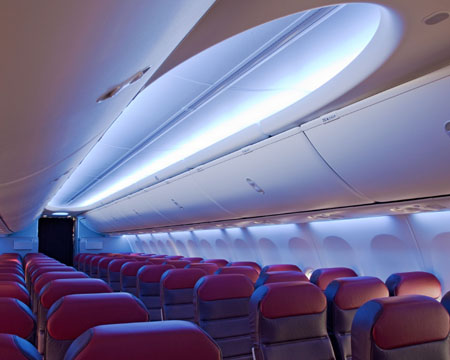
    “The superior passenger experience of this exciting new interior is the result of many years’ work by Boeing employees and suppliers,” said Beverly Wyse, 737 vice president and general manager. “Our airline customers will draw value from the many practical improvements we have made in the new design.”

    Since the Next-Generation 737 was introduced in 1997, customers have taken advantage of continuous improvements to this best-selling airplane that have made it ever more efficient, reliable and passenger-friendly. Boeing Sky Interior is the latest in a series of improvements to the airplane. The next to come will be a package of performance improvements that will reduce fuel consumption and carbon emissions by 2 percent – making the airplane a full 7 percent more efficient than the first Next-Generation 737 delivered. The performance improvements to the airframe and engine are beginning certification test soon, and will be fully in service by early 2012.

    With the new 737 Boeing Sky Interior, airlines will welcome their passengers into a cabin featuring modern, sculpted sidewalls and window reveals. The ingenious design of the new, larger stow bins allows them to accommodate even more bags than before, while taking up less space in the cabin. The innovative assist mechanism of the new bins gives easy access, and as they pivot up and out of the way, there is much more headroom around the aisle seats and a greater sense of space in the cabin.

    Airlines will select from different lighting schemes that range from a welcoming, soft blue overhead sky simulation to a calm, relaxing, pallet of sunset colors.

    LEDs (light emitting diodes) are brighter and replace incandescent signage, attendant and halogen reading lights. With an estimated 40,000 hours between replacements, LEDs last 10 times longer than the previous standard of lights.

    Other features that passengers particularly will appreciate are a quieter cabin, intuitive placement of switches and call buttons, and improved sound quality and clarity through new speakers in each passenger row.

    “We are very proud to be the first to offer our passengers an enhanced onboard experience with the brand new Boeing Sky Interior,” said Ghaith Al Ghaith, CEO, flydubai. “We have achieved much in our first 16 months of service and will continue to bring our passengers the best product offerings on one of the newest 737 fleets in service.” The airplane, a Next-Generation 737-800, will enter service in November.

    A total of 46 airlines and leasing companies have ordered the 737 Boeing Sky Interior for more than 1,200 of their airplanes. flydubai is the first of five airlines that will receive Next-Generation 737s with the new interior this year.

  • |

    Press Release – FAA Dedicates New Reno Air Traffic Control

    RENO, Nev. – The Federal Aviation Administration (FAA) today dedicated a new, modernized 195 foot-tall air traffic control tower at Reno-Tahoe International Airport.

    “Upgrading our aviation infrastructure is one of our highest priorities, and this new tower will provide Reno-Tahoe International Airport with one of the nation’s most modern air traffic control facilities,” U.S. Transportation Secretary Ray LaHood said.

    “This is a great day for aviation in Nevada,” said FAA Administrator Randy Babbitt. “The new tower will improve safety and efficiency by providing controllers with better airfield views and more modern equipment.”

    The new tower was built with FAA facilities and equipment dollars, which are used to modernize the air traffic control system.

    Reno’s new control tower is almost three times the height of the old tower, which was built in 1957. The airport’s runways are considerably longer than they were when the old tower was built, which made it challenging for controllers to see aircraft on certain taxiways and runways. The old tower also experienced glare from lights on the cargo areas.

    Renocontrollers also now will have state-of-the-art equipment that includes multicolor radar displays, touch-screen voice communications, and touch-screen work stations that provide instant information on everything from weather conditions to air traffic manuals. Double-thick sun shades will help prevent glare inside the 610-square-foot controller work area. Additionally, the new tower will have two backup power systems to help ensure uninterrupted operations.

    Tower controllers direct aircraft within about five miles of the airport up to an altitude of 3,000 feet. The new tower and a 10,000 square-foot base building cost $29.4 million to build and equip. Construction began in January 2008. Reno-Tahoe International Airport served about 100,000 flights in 2009.

  • |

    Press Release: New agreements between Canada and Switzerland

    Air Transportation Agreement

    One of Canada’s top-20 international air travel markets, Switzerland is an important aviation partner for Canada. In this context, Canada and Switzerland have successfully concluded negotiations toward an Open Skies-type air transportation agreement, which modernizes the 1975 agreement (last amended in 2002) to better reflect today’s market realities.

    The agreement now contains expanded operating rights for airlines from Canada and Switzerland to operate air transportation between each other’s territory and third countries, in conjunction with scheduled passenger and/or all-cargo air services between the two countries. It also enables airlines to adjust their prices with greater flexibility to meet current market conditions.

    Overall, the agreement provides more flexibility for airlines and airports to consider commercial opportunities, facilitates greater economic activity, strengthens ties with Switzerland and ultimately benefits passengers and shippers by allowing more flight options and routings (routes?).

    Protocol Amending the Canada-Switzerland Double Taxation Convention

    The double taxation convention currently in force between Canada and Switzerland was signed on May 5, 1997.

    New Protocol provisions related to the elimination of double taxation, such as exemption from the withholding of tax on dividends paid to pension plans and interest payments between unrelated parties, are expected to further strengthen trade and economic links between the two countries.

    The Protocol also implements the latest internationally agreed standard for the exchange of tax information, as developed by the Organisation for Economic Co-operation and Development, in order to enable Canadian tax authorities to obtain information relevant for the enforcement and administration of Canadian taxation laws and to assist them in preventing international tax evasion. This supports Canada’s commitment as a G-20 member to promote the effective exchange of tax information and to protect its public finances and financial systems.

    The Protocol will enter into force once both countries have completed their respective domestic implementation procedures and will apply, generally, for taxation years that begin on or after January 1 of the year following the Protocol’s entry into force.

  • |

    American Airlines Federal Credit Union Partners With PrimeVest Financial Services, Inc.

    FORT WORTH, Texas, Oct. 22 — American Airlines Federal Credit Union (AA Credit Union) is proud to announce its partnership with PrimeVest Financial Group, Inc. The services will be offered by the newly renamed Flagship Financial Group to better provide member-owners with comprehensive investment and insurance solutions for all their personal money management needs.

    PrimeVest is one of the nation’s leading broker-dealers exclusively serving clients at credit unions and banks.

    “With PrimeVest’s support, Flagship Financial Group advisors can offer a holistic approach to assisting members with their financial goals,” said Sherry Reams, Managing Director of Flagship Financial Group. “PrimeVest’s sound financial products complement AA Credit Union’s offerings.

    “The benefits of working with PrimeVest are plentiful,” Reams added. Member-owners will gain access to a large assortment of investment and insurance solutions that can be customized to fit their unique needs. Flagship Financial Group’s knowledgeable advisors will use the latest technology and resources to support the entire process making it easier to meet the varied needs of AA Credit Union members.

    Flagship Financial Group advisors will serve as PrimeVest-registered representatives at AA Credit Union. They can be reached at (800) 533-0035, Ext. 36699.

    Securities and insurance products offered by PrimeVest: are not FDIC/NCUSIF insured, may go down in value, are not financial institution guaranteed, are not deposits, and are not insured by any federal government agency.

  • |

    Boeing Statement Regarding USDA-FAA Partnership on Aviation Biofuels

    CHICAGO, Oct. 21 Boeing Vice President, Environment and Aviation Policy, Billy M Glover, issued the following statement in the wake of today’s announcement by the U.S. Department of Agriculture and the Federal Aviation Administration that the two agencies have agreed to work together to bring sustainable biofuels into production for the aviation industry.

    “Today’s announcement is welcome news for the commercial aviation industry, which sees sustainable biofuels as a key element of its plan to lower its carbon emissions. Through test flights with a number of our customers, we have proven that fuels made from plant matter and algae can power jet aircraft safely and efficiently, and we look forward in the months ahead to the approval of these fuels for commercial use. The challenge then will be to prime the production pump, and bring biofuels to an attractive price point for airlines.

    Boeing is currently working with the USDA and the Air Transport Association on the Farm-to-Fly initiative, which seeks to encourage the production of sustainable aviation biofuels through U.S. agricultural policy. The USDA-FAA partnership will further help in that regard. We applaud their efforts and look forward to working with them to commercialize biofuels that can help the aviation industry meet its aggressive carbon reduction goals.”

  • |

    Press Release – USDA/FAA Alternative Fuels Agreement

    The Federal Aviation Administration (FAA) is pleased to be working with the U.S. Department of Agriculture (USDA) to develop alternatives to jet fuel. Working with USDA, the FAA will assess the availability of different kinds of feedstocks that could be processed by bio-refineries to produce jet fuels. The development and deployment of alternative fuels is critical to achieving carbon neutral aviation growth by 2020. This agreement leverages the expertise and resources of the USDA, enabling aviation to play a key role in expanding renewable fuel while improving the environment.

    Agriculture Secretary Vilsack Announces Renewable Energy Initiatives to Spur Rural Revitalization Throughout the Country
    Biomass Crop Assistance Program Will Help Create National Biofuels Industry; New Agreement with the FAA Will Promote Production and Demand for Biofuels; USDA Report Shows Domestic Biofuel Production Benefits the Economy

    WASHINGTON, Oct. 21, 2010 – As part of the Obama Administration’s effort to promote production of fuel from renewable sources, create jobs and mitigate the effects of climate change, Secretary Tom Vilsack today announced a series of measures during a speech to the National Press Club in Washington.

    “Domestic production of renewable energy, including biofuels, is a national imperative and that’s why USDA is working to assist in developing a biofuels industry in every corner of the nation,” said Vilsack. “By producing more biofuels in America, we will create jobs, combat global warming, replace our dependence on foreign oil and build a stronger foundation for the 21st century economy.”

    The Secretary announced several measures, including the publication of a final rule to implement the Biomass Crop Assistance Program (BCAP). Under the BCAP final rule, USDA will resume making payments to eligible producers. The program had operated as a pilot, pending publication of the final rule. Authorized in the Food, Conservation, and Energy Act of 2008, BCAP is designed to ensure that a sufficiently large base of new, non-food, non-feed biomass crops is established in anticipation of future demand for renewable energy consumption.

    “The Obama Administration is aggressively supporting our nation’s farmers, ranchers and producers of biofuels as they work to bring greater energy independence to America,” Vilsack said. “BCAP will help the nation’s power, biobased product, and advanced biofuel industries produce energy from sustainable rural resources and create jobs that will stimulate rural economies across the nation.”

    The BCAP final regulation reflects policies developed as a result of more than 24,000 comments received on previous Federal Register notices and a proposed rule, and knowledge gained by implementing a portion of the program in 2009.

    BCAP uses a dual approach to support the production of renewable energy. First, BCAP provides assistance for the establishment and production of eligible renewable biomass crops within specified project areas. Producers who enter into BCAP contracts may receive payments of up to 75 percent of the cost of establishing eligible perennial crops. Further, they can receive payments for up to five years for annual or non-woody perennial crops and up to 15 years for woody perennial crops. FSA is accepting project area proposals and, after project area proposals have been approved, eligible producers may participate by enrolling at their FSA county office.

    In addition, BCAP also assists agricultural and forest landowners and operators by providing matching payments for the transportation of certain eligible materials that are sold to qualified biomass conversion facilities. The facilities convert the materials into heat, power, biobased products or advanced biofuels.

    The Secretary also announced jointly with the Federal Aviation Administration (FAA) a five year agreement to develop aviation fuel from forest and crop residues and other “green” feedstocks in order to decrease dependence on foreign oil and stabilize aviation fuel costs. Under the partnership, the agencies will bring together their experience in research, policy analysis and air transportation sector dynamics to assess the availability of different kinds of feedstocks that could be processed by bio-refineries to produce jet fuels.

    The participants will develop a tool to evaluate the status of different components of a feedstock supply chain, such as availability of biomass from farms and forests, the potential of that biomass for production of jet fuel, and the length of time it will take to ramp up to full-scale production. The agencies already have existing programs and collaborative agreements with private and public partners and resources to help biorefiners develop cost-effective production plans for jet aircraft biofuels.

    This cooperative agreement supports a larger research plan led by USDA through its five Regional Biomass Research Centers, which will help accelerate the development of a commercial advanced biofuels industry across the United States. Just as important, the plan sets out to include as many U.S. rural areas as possible to maximize the economic benefits of biofuel production across the country. The Centers will provide the critical mass needed to develop high-performance teams that will guide biomass research to address needs in both the public and private sector, including commercial aviation, military transportation, and other activities.

    The Secretary also discussed a biofuels report prepared by USDA’s Economic Research Service (ERS)that says replacing more petroleum with cost-competitive domestic biofuels reduces crude oil imports, thereby lowering prices for energy and benefiting the U.S. economy. The report also includes these findings:

    • The biofuels industry becomes more productive as cost-reducing technology is applied, which results in higher wages for workers.
    • Gains in Gross Domestic Product and real income are driven largely from the contribution from technological progress in biofuels, which increases the productivity of the economy.
    • Next generation biofuels are considered to be a decreasing cost industry. This means that the cost of producing ethanol will decline as output increases.
  • |

    Press Release: Embraer Confirms Ejet

    This second EMBRAER 175 is the fifth E-Jet in the airline’s all Embraer fleet São José dos Campos, October 22, 2010 – Embraer has signed a contract with Fuji Dream Airlines (FDA) of Japan for the sale of an EMBRAER 175, which is the fifth E-Jet in the airline’s fleet. The new aircraft will be configured in a single class with 84 seats. The order also includes an option for one additional aircraft of the same model and marks the quick expansion of FDA’s fleet in a highly competitive market like Japan’s. This deal is already included in Embraer’s firm order backlog for the third quarter of 2010, as “Undisclosed” customer.

    “We are honored that FDA has reaffirmed its confidence in the E-Jets family and ordered another EMBRAER 175,” said Paulo César de Souza e Silva, Embraer Executive Vice President, Airline Market. “The re-order is a sign that our E-Jets have been instrumental in the birth and growth of a new airline, and provided it with an optimal tool to develop new routes, while providing their customers with a reliable and comfortable airplane.”

    As a start-up airline in Japan in 2007, FDA chose to purchase two EMBRAER 170s as its debut aircraft. The first was delivered in February 2009. In June, the airline decided to increase the fleet and ordered one EMBRAER 175, which joined the two original EMBRAER 170s in early 2010. With this agreement, FDA will end 2010 with a total of five E-Jets (three EMBRAER 170s – one pre-owned and bought this year – and two EMBRAER 175s).

    “Since FDA started offering flights in July 2009, we have made significant progress in developing our network and business. This progress has been made possible partly due to the operational flexibility offered by the E-Jets family, especially the EMBRAER 170 and EMBRAER 175, which has allowed us to explore and capitalize on new routes,” said Tsuneji Sugawa, Senior Managing Director of Fuji Dream Airlines.

    FDA is the only airline in Japan with an all-Embraer E-Jets fleet. The company is part of the Suzuyo Group, which owns a full-flight simulator to provide pilot and fleet engineering training for its staff. FDA has also signed a ten-year Pool Flight Hour program contract with Embraer to manage and facilitate all necessary spare parts for its E-Jets. The program gives airlines the opportunity to reduce their cost exposure related to parts inventory and storage facilities, therefore increasing their capacity to budget costs.