press release

  • |

    American Airlines and The New York Pops Announce Major Relationship in New York City

    NEW YORK, Feb. 7, 2011 — American Airlines today announced a significant new relationship with The New York Pops, the largest independent pops orchestra in the United States, and the only professional symphonic orchestra in New York City specializing in popular music.

    As part of the three-year agreement, American Airlines will provide opportunities for The New York Pops to reach a wider audience through special inflight programs, live music in American Airlines Admirals Clubs, and New York Pops recordings being played in American’s terminals at JFK International Airport and LaGuardia Airport. American Airlines is also a sponsor of The New York Pops’ concert series at Carnegie Hall.

    American Airlines has been a strong supporter of arts and entertainment for decades. As a leading cultural institution, The New York Pops offers significant contributions to the New York community. Through this new relationship, The New York Pops will be able to expand its presence in the community, with American’s support of the orchestra’s extensive education programming for New York City schoolchildren.

    “American is an active and ardent supporter of many arts and cultural organizations in New York,” said Art Torno, American Airlines Vice President – New York. “This new relationship with The New York Pops is extremely important to us as it allows us to strengthen our ties within the community as well as connect with our customers and share in their interests.”

    American Airlines will also be a major sponsor of a planned New York Pops tour later this year.

    “We are proud to partner with American Airlines to bring great music to New York City and the world beyond,” said James M. Johnson, Chief Executive Officer of The New York Pops. “With the support of American Airlines, we will continue to play before sold-out audiences at Carnegie Hall as well as bring our musicians into New York City public schools to inspire the next generation of music lovers.”
  • | |

    FAA and JetBlue Reach NextGen Agreement

    For Immediate Release

    WASHINGTON – The U.S. Department of Transportation’s Federal Aviation Administration (FAA) announced today that the FAA and JetBlue have signed a NextGen agreement that will allow the airline to fly more precise, satellite-based flights from Boston and New York to Florida and the Caribbean beginning in 2012.

    NextGen is the transformation of the U.S. national airspace system from a ground-based system of air traffic control to one based on satellites, which will enhance safety and reduce aviation congestion. Today’s NextGen announcement follows President Obama’s State of the Union Address last week, in which he stressed the importance of targeted investments to foster American innovation that will make our nation more competitive globally and strengthen our economy here at home.

    “In his State of the Union address, President Obama called for targeted investments that harness American innovation to strengthen our nation,” said U.S. Transportation Secretary Ray LaHood. “NextGen is a critical investment in the future of our transportation system, one that uses the latest technology to transform our airspace to make aviation safer, more efficient and more environmentally friendly.”

    Under the agreement, as many as 35 of JetBlue’s A320 aircraft will be equipped with Automatic Dependent Surveillance-Broadcast (ADS-B) avionics over the next two years, enabling them to fly in two major routes off the East Coast even if traditional radar coverage is not available. The improved accuracy, integrity and reliability of aircraft surveillance under ADS-B will allow JetBlue to take advantage of these routes at all times since the satellite-based system tracks the precise position of aircraft.

    The agreement will also allow JetBlue to fly a new route to the Caribbean, and could lead to the development of two new, shorter ADS-B-only routes to the Caribbean from Boston, New York and Washington. The FAA will collect valuable NextGen data by observing and conducting real-time operational evaluations of ADS-B on revenue flights.

    “NextGen will help improve the travel experience for passengers and give airlines more flexibility to find the most efficient way to reach their destinations,” said FAA Administrator Randy Babbitt. “This agreement will allow us to collect important data to further demonstrate the benefits of NextGen.”

    “As the youngest major airline in the United States, with a majority of our operations in the Northeast – arguably the most congested airspace in the world – JetBlue enthusiastically joins the FAA in this effort to begin rebuilding the skyways,” said JetBlue Airways CEO Dave Barger. “Our investment today will yield dividends far into the future, not just for JetBlue but for all airlines. Our customers and crewmembers deserve our best efforts.”

    The FAA has agreed to pay $4.2 million for the ADS-B avionics. JetBlue will provide flight operations, pilots, and aircraft maintenance and will pay for the cost of aircraft downtime while the ADS-B avionics are installed. JetBlue will also fund the necessary training for dispatchers and flight crews, including simulator time. The airline will demonstrate the cost savings of ADS-B technology and potentially equip the rest of its A320 fleet at its own expense with ADS-B avionics.

  • | |

    Special flight safety checks are being carried out at New South Wales and Victorian aerodromes this week.

    NSW and Victorian aerodrome flight safety checks

    Special flight safety checks are being carried out at a range of New South Wales and Victorian aerodromes this week.

    There will be a series of low-level flights to make sure flight paths at the aerodrome continue to operate safely.

    A twin-engine Cessna Conquest aircraft will be used to conduct the safety checks within an area up to 35 kilometres from the local aerodrome.

    The two pilots flying the aircraft will ensure navigation aids are operational and not suffering interference, as well as looking for any new obstacles that could be a danger to aviation safety.

    The Civil Aviation Safety Authority requires these checks to be carried out every three years to maintain a high level of air safety at all aerodromes.

    Low-level flying is an essential part of the safety exercise, with aircraft down as low as several hundred feet at times.

    Local residents may notice an uncommon flying pattern, but this is to make sure obstacles are accurately marked on charts and no new obstacles exist. Obstacles can be towers, trees, masts or buildings that can be a danger to aircraft.

    The checks are scheduled to be carried out between 7 and 14 February 2011.

    Aerodromes undergoing flight safety checks this week include Moruya, Cooma, Corryong, Wangaratta, Warracknabeal, Swan Hill, Shepparton, Tocumwal, Tumut, Polo Flat, Albury, Corowa, Yarrawonga, Nhill, Deniliquin, Echuca, and Wagga Wagga.

    If poor weather or other factors do not allow the safety checks to go ahead on the planned days they will be carried out as soon as possible.

    CASA has contracted the operation of the special check flights out to Radiola Aerospace Pty Ltd – a company with wide international expertise in these specialist operations.

  • |

    Record Number of Passengers Expected at DFW Airport on Post-Game Monday

    FORT WORTH, Texas, Feb. 4, 2011 /PRNewswire/ — Monday, Feb. 7, may be the busiest day in the history of Dallas/Fort Worth International Airport. At American Airlines and American Eagle as many as 25 percent more passengers than normal will board our aircraft. DFW International Airport is expecting three times its normal bus traffic, so airport entry plazas and roadways could be as crowded as terminals.

    Given the expected crowds, American’s DFW customer service staff recommends arriving at the airport at least three hours, or more, before your scheduled departure. Checking in on AA.com and printing boarding passes prior to arrival will help ease the journey through crowded terminals.

    Travelers Monday at DFW should expect longer lines at:

    Airport Entry Plazas
    Rental Car Returns
    Ticket Counters/Check-in Kiosks
    Baggage drop-offs (Curbside and Ticket Counters)
    TSA Security Checkpoints

    To help ease the backlog:

    Terminal D and part of American Eagle’s Terminal B will be open all night Sunday evening into Monday morning, including:

    Ticket Counters
    Security Checkpoints
    Concessions

    American’s Terminals A and C will open at 3 a.m. Monday.

  • |

    Fifth Boeing 747-8 Enters Flight-test Program


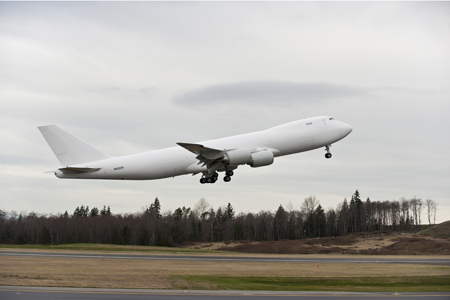
    EVERETT, Wash., Feb. 4, 2011 /PRNewswire/ — Boeing (NYSE: BA) successfully conducted the first flight of the fifth 747-8 Freighter Thursday. The airplane, coded as RC523, took off from Paine Field in Everett, Wash., for a 3-hour, 30-minute flight before returning to Paine Field.

    The flight included a standard 2-hour, 30-minute “B1” flight profile that Boeing conducts on all production airplanes prior to delivery, plus an hour of engineering testing woven into the profile.

    “The airplane performed well,” said Andy Hammer, test program manager for 747-8. “It was a fine start to the test plan for this airplane.”

    This is the fifth 747-8 Freighter being used in the flight-test program. Each airplane is used for a specific set of tests, with this airplane focusing on functionality and reliability testing.

    The airplane will remain based at Paine Field throughout its test plan.

  • |

    NTSB TO HOST INTERNATIONAL FAMILY ASSISTANCE CONFERENCE

    National Transportation Safety Board
    Washington, DC 20594

    FOR IMMEDIATE RELEASE: February 3, 2011
    SB-11-06

    Washington, DC – The National Transportation Safety Board is hosting a conference to share best practices and promote post-accident family assistance in all modes of transportation. Family Assistance: Promoting an International Approach for the Transportation Industry, will be held in Washington, DC on March 28 and 29, 2011. The conference will bring together family members, transportation accident investigation agencies, industry representatives, government agencies, and the news media to share perspectives on lessons learned in providing family assistance following transportation accidents in an international context.

    “Following a major aviation or passenger rail accident in the US, the NTSB has the responsibility to coordinate support for survivors and families,” said NTSB Chairman Deborah A.P. Hersman. “With this conference, we are marking the 15th anniversary of the enactment of the Aviation Disaster Family Assistance Act and the 10th anniversary of ICAO Circular 285, with a unique forum to identify lessons learned and draw from international experiences to improve the support for families in the wake of transportation tragedies worldwide.”

    The first day of the conference will include panel discussions featuring family members, transportation industry representatives, vendors, non-governmental organizations, transportation accident investigative agencies, and the news media examining their perspectives on transportation family assistance.

    The second day will feature a series of presentations by NTSB Transportation Disaster Assistance staff as they discuss the Board’s family assistance model from an operational perspective.

    This conference, being held at NTSB’s headquarters, is provided free of charge to those interested in the provision of family assistance in all modes of transportation. A complete agenda and list of speakers will be published prior to the conference. The first day will be webcast at www.ntsb.gov.

  • |

    NTSB INVESTIGATING OPERATIONAL ERROR NEAR NEW YORK

    National Transportation Safety Board
    Washington, DC 20594

    February 4, 2011

    The National Transportation Safety Board has been investigating an operational error that occurred near New York City in January.

    The Safety Board was notified of a Traffic Collision and Alerting System (TCAS) resolution advisory that occurred due to a near midair collision involving American Airlines flight 951 on January 20, 2011, at about 10:30 p.m. EasternStandard Time. The American Airlines aircraft, a Boeing777-200 (N7CA), had taken off from John F. Kennedy International Airport en route to Sao Paulo, Brazil and wasflying southeast. A flight of two U.S. Air Force C-17s was heading northwest toward McGuire Air Force Base, New Jersey. There were no injuries in the incident.

    The NTSB has interviewed air traffic controllers on duty at the time of the incident, and is gathering information from American Airlines and the Air Force.

    The air traffic controllers talking to each of the aircraft received conflict alerts, and immediately provided traffic advisories and turned their aircraft to resolve the conflict. In addition, the American Airlines crew responded to directions provided by TCAS. Radar data indicate that the aircraft came within a mile of each other at their closest point. The incident occurred about 80 miles southeast of New York City.

    Betty Koschig has been designated the NTSB’s Investigator-in-Charge for this incident. Further information will be released as it becomes available.

  • International SOS Evacuates 800 Clients From Egypt, Provides On-the-Ground Assistance in Wake of Turmoil

    CAIRO, Feb. 2, 2011 — International SOS, the world’s leading international healthcare, medical and security assistance and concierge services company, said it has evacuated over 800 people from Egypt today, who are primarily expatriate employees and families of International SOS clients, and students. Via seven flights, the passengers will be escorted to Frankfurt, Paris and Dubai, where International SOS reception teams are waiting to meet them. According to on the ground sources, operating flights in and out of Egypt has been very difficult, with significant delays and last minute cancellations.

    In the immediate wake of the uprising, International SOS activated a crisis management team at its London alarm center and began to coordinate operations with its Philadelphia, Frankfurt, Paris, Geneva, and Dubai alarm centers.

    This crisis team, whose initial members left within a few hours of the unrest, is made up of medical, security, aviation and logistics experts. In addition another team consisting of security specialists representing a joint venture from International SOS and Control Risks is working from Cairo, Alexandria, Asyut and Suez. The security specialists are providing real-time reports to assist members seeking information on colleagues in Egypt and on the ground conditions there. Missions are being planned and executed at the time of this release.

    “Some of our security specialists who were just in Tunisia are now in Egypt. They are able to deliver first-hand information and coordinate operations with our locally-based partners,” said Kevin Duffey, Managing Director of International SOS Assistance.

    International SOS estimates that calls to its alarm centers had increased by 180% over the past weekend. Our global team has handled calls from hundreds of clients. At the time of this release, 40 clients from private corporations, non-profit organizations, and universities have had over 800 travelers evacuated from Egypt.

    “We have been able to utilize our pre-established network in Egypt to provide transportation, security and medical care for our clients,” said Kevin. “During severe political upheaval and other situations that may impact travel, companies need to look after their employees who are abroad. Crisis plans as well as systems to track and communicate with their travelers are crucial in helping organizations fulfill their duty of care.”

    Additionally, International SOS and Control Risks have activated TravelTracker, a proprietary system to help identify members in the affected areas, and have responded to calls at International SOS’ 28 alarm centers around the world.

    About International SOS
    International SOS (http://www.internationalsos.com) is the world’s leading international healthcare, medical and security assistance and concierge services company. Operating in over 70 countries, International SOS provides integrated medical, clinical, security, and customer care solutions to organizations with international operations. A global team of over 8,000 employees led by 970 full-time physicians and 200 security specialists provides services including planning, preventative programs, in-country expertise and emergency response to 69 percent of the

  • |

    Dassault Falcon Focuses on the Growing Market in India as the Company Strengthens its Position in Emerging Markets Worldwide

    BANGALORE, India, February 4, 2011 — Dassault Falcon is presenting its Falcon fleet of large cabin, long range business jets at Aero India 2011, starting on February 9th in Bangalore. The Falcon range of aircraft will be on display alongside the Dassault Rafale fighter, which will perform in the air display. Dassault Falcon’s share of the Indian market is strong and growing as the benefits of business aviation are recognized by an increasing number of Indian companies and private owners. Private investment in India’s aviation infrastructure and support by the Indian authorities are making this dynamic market even more attractive.

    Dassault Falcon currently has over 60% share of the Indian market for large cabin/long range aircraft and is rapidly consolidating its position with an increase in local customer support and parts services. An Authorized Service Center is also under consideration, in addition to the existing Dassault liaison office in New Delhi which serves both the Indian military and Falcon operators.
    More than 20 Falcon aircraft are currently operating from airports in Delhi, Mumbai, Bangalore and Hyderabad. Another 15 aircraft are on order for delivery to Indian customers within the next two years. Almost half of the new aircraft orders are for the Dassault flagship Falcon 7X, the first business jet certified with a fully-digital flight control system.

    In 2010, Dassault Falcon reinforced its position in key markets such as India and South America – where the company has the largest market share in its segments – and Asia, specifically China, where aircraft sales are growing quickly. In India, Dassault built its reputation for advanced technology and efficient aircraft from its first military sales. Today, the Indian military operates 50 Mirage fighters. In the business aviation sector, Dassault Falcon’s success has been driven by new models with exceptional performance, comfort and fuel economy such as the Falcon 2000LX and the Falcon 7X.

    “We have been encouraged about the potential for long term growth in business aviation in India,” said John Rosanvallon, President and CEO of Dassault Falcon. “Business jets are now seen in the region as a powerful tool to enable quick and convenient access to customers within the country, and worldwide. The dramatic growth of the economy and the experience of travelling on commercial airlines have all contributed to the expansion of the market over the last few years. The worldwide crisis did not impact our regional sales as severely, and the second half of 2010 was much active for us.”

    The performance of the Falcon fleet is especially valued in India, where short airfields, elevated runways and high temperatures are common. The Falcon aircraft are also more economical to operate and more environmentally responsible than any other large cabin aircraft. Their efficient design and technological optimization means less weight, 20-60% less fuel consumption and lower emissions than other airplanes in their class.

    Dassault Falcon aircraft are very well suited to the Indian customer, offering long range – the Falcon 7X can connect Mumbai to Cape Town, Bangalore to the challenging London City Airport in the heart of the City and is the only jet in its category to meet the demanding performance requirements of the airport with its steep approach and noise restrictions.

    “With their exceptional performance and fuel efficiency, I have no doubt that the Falcon fleet is positioned for long term success in the region and that we will maintain a high level of market share, ” concluded John Rosanvallon.

    To support its growing fleet in India and the increased number of transient airplanes, Falcon Customer Service has based a Customer Service Manager and opened a spares distribution center with DHL in Mumbai. Dassault Falcon has already authorized service centers nearby in Dubai, Jeddah and Singapore.

    About Dassault Falcon
    Dassault Falcon is responsible for selling and supporting Falcon business jets throughout the world. It is part of Dassault Aviation, a leading aerospace company with a presence in over 70 countries across five continents. Dassault Aviation produces the Rafale fighter jet as well as the complete line of Falcon business jets. The company has assembly and production plants in both France and the United States and service facilities on multiple continents. It employs a total workforce of over 12,000. Since the rollout of the first Falcon 20 in 1963, 2,000 Falcon jets have been delivered to 67 countries worldwide. The family of Falcon jets currently in production includes the tri-jets-the Falcon 900EX, 900LX, and the 7X-as well as the twin-engine 2000LX.

  • |

    QBE Forms U.S. General Aviation Underwriting Group

    NEW YORK, Feb. 4, 2011 /PRNewswire/ — QBE the Americas has announced the creation of a U.S.-based general aviation underwriting operation.

    Headquartered in Atlanta, QBE the Americas’ Aviation Team is designed to expand the company’s global aviation activities. QBE is already a major aviation insurance writer in Europe, Australia, New Zealand, Asia and the Pacific.

    The new team of seasoned aviation insurance professionals with a proven track record consists of William P. McGloin, Roger M. Ridings, Michael Clark and Russell Walker.

    “The U.S. is the largest market for general aviation in the world,” says QBE’s Chief Executive Officer for the Americas, John Rumpler. “We’re pleased to start this operation that will offer a broad range of coverage and bring our company full circle as a true worldwide provider for general aviation insurance services. The aviation team that has been created will work in collaboration with QBE Aviation European Operations.”

    General aviation insurance includes all types of aircraft except for military and major airlines. QBE the Americas’ Aviation Team of seasoned aviation professionals will work with personal-use aircraft owners, as well as corporations and airports to provide physical damage, liability and workers’ compensation coverage.

    QBE Insurance Group Limited is one of the top 25 insurers and reinsurers worldwide. Headquartered in Sydney, Australia, QBE operates out of 49 countries around the globe, with a presence in every key insurance market. The Americas Division, headquartered in New York, conducts business through various property and casualty insurance subsidiaries in 10 countries. QBE’s Americas Division produced $4 billion in gross written premium in 2009 and an 89.7 percent combined operating ratio. QBE Insurance companies are rated “A” (Excellent) by A.M. Best and “A+” by Standard and Poor’s. For more information, visit qbe.com.

  • | |

    Delta TechOps, GOL Establish Long-Term Maintenance Partnership

    Five-year initial agreement will generate maintenance synergies for both companies; TechOps to provide engine overhauls, parts support, consulting services to growing GOL

    ATLANTA, Feb. 3, 2011 — Delta Air Lines’ maintenance division, Delta TechOps, has entered an exclusive maintenance, repair and overhaul (MRO) partnership with GOL Linhas Aereas Inteligentes S.A. , the largest low-cost and low-fare airline in Latin America. As part of the five-year deal, which includes an additional five-year option, Delta TechOps will provide engine overhauls for a minimum of 50 percent of GOL’s CFM56-7 engines and maintenance services for various parts and components on GOL’s fleet of Boeing 737NG aircraft.

    Delta TechOps also will provide consulting services related to maintenance workflow planning, materials and facility optimization, and tooling support and will assist GOL with its efforts to secure FAA Part 145 Repair Station Certification. In addition, GOL will assist Delta with some line maintenance services for Delta aircraft with extended ground time in Brazil.

    “The men and women in Delta TechOps are the most skilled and knowledgeable in the industry,” said Tony Charaf, president – Delta TechOps. “This partnership with GOL gives us a special opportunity to join hands and share our talents and expertise with another airline, while strengthening our ties in the South American market and extending our global MRO footprint.”

    “This partnership aims at further improving GOL’s low cost structure as well as the quality of its state-of-the-art maintenance center located in Brazil,” said Constantino Junior, GOL’s Founder and CEO. “We are proud to work with Delta TechOps.”

    Since establishing a third-party maintenance business a decade ago, Delta TechOps has grown its global customer base to include 150 customers and more than $500 million in annual revenues. The business is an important part of Delta’s efforts to diversify its global revenue base through ancillary businesses such as Delta Cargo, Delta Private Jets, Delta Global Services and MLT Vacations.

    About GOL Linhas Aereas Inteligentes S.A.

    GOL Linhas Aereas Inteligentes S.A. (NYSE: GOL and BM&FBOVESPA: GOLL4), (S&P/Fitch: BB-/BB-, Moody’s: Ba3), the largest low-cost and low-fare airline in Latin America, offers more than 900 daily flights to 59 destinations that connect all the important cities in Brazil and 14 major destinations in South America and Caribbean. The Company operates a young, modern fleet of Boeing 737 Next Generation aircraft, the safest and most comfortable of its class, with high aircraft utilization and efficiency levels. Fully committed to seeking innovative solutions through the use of cutting-edge technology, the Company – via its GOL, VARIG, GOLLOG, SMILES and VoeFacil brands – offers its clients easy payment facilities, a wide range of complementary services and the best cost-benefit ratio in the market.

  • |

    Southwest Airlines Increases Number of Hospitals Nationwide in Its 2011 Medical Transportation Grant Program

    DALLAS, Feb. 4, 2011 /PRNewswire via COMTEX/ —

    Southwest Airlines (NYSE: LUV) announced today that more than 60 nonprofit hospitals and charities from across the nation will be participants in its Medical Transportation Grant Program this year. Southwest has nearly doubled the grant program’s 2011 budget with hopes of assisting more than 5,500 patients and family members with their medical-related travel needs.Through the Southwest Airlines Medical Transportation Grant Program, the airline provides complimentary, roundtrip tickets to hospitals and medical transportation nonprofit organizations. The tickets are distributed by the organizations to deserving patients and their caregivers who must travel for medical care.

    “The feedback we receive from families who benefit from the Medical Transportation Grant Program reaffirms for us that we are meeting a great need during what can be a difficult time in these families’ lives,” said Debra Benton, Southwest Airlines Director of Community Relations and Charitable Giving. “Southwest is proud to be able to provide this program to even more nonprofit hospitals and charities as support for families affected by serious illness.”

  • |

    Press Release – FAA, JetBlue Agreement to Bring NextGen Precision to East Coast, Caribbean Routes

    WASHINGTON – The U.S. Department of Transportation’s Federal Aviation Administration (FAA) announced today that the FAA and JetBlue have signed a NextGen agreement that will allow the airline to fly more precise, satellite-based flights from Boston and New York to Florida and the Caribbean beginning in 2012.

    NextGen is the transformation of the U.S. national airspace system from a ground-based system of air traffic control to one based on satellites, which will enhance safety and reduce aviation congestion. Today’s NextGen announcement follows President Obama’s State of the Union Address last week, in which he stressed the importance of targeted investments to foster American innovation that will make our nation more competitive globally and strengthen our economy here at home.

    “In his State of the Union address, President Obama called for targeted investments that harness American innovation to strengthen our nation,” said U.S. Transportation Secretary Ray LaHood. “NextGen is a critical investment in the future of our transportation system, one that uses the latest technology to transform our airspace to make aviation safer, more efficient and more environmentally friendly.”

    Under the agreement, as many as 35 of JetBlue’s A320 aircraft will be equipped with Automatic Dependent Surveillance-Broadcast (ADS-B) avionics over the next two years, enabling them to fly in two major routes off the East Coast even if traditional radar coverage is not available. The improved accuracy, integrity and reliability of aircraft surveillance under ADS-B will allow JetBlue to take advantage of these routes at all times since the satellite-based system tracks the precise position of aircraft.

    The agreement will also allow JetBlue to fly a new route to the Caribbean, and could lead to the development of two new, shorter ADS-B-only routes to the Caribbean from Boston, New York and Washington. The FAA will collect valuable NextGen data by observing and conducting real-time operational evaluations of ADS-B on revenue flights.

    “NextGen will help improve the travel experience for passengers and give airlines more flexibility to find the most efficient way to reach their destinations,” said FAA Administrator Randy Babbitt. “This agreement will allow us to collect important data to further demonstrate the benefits of NextGen.”

    “As the youngest major airline in the United States, with a majority of our operations in the Northeast – arguably the most congested airspace in the world – JetBlue enthusiastically joins the FAA in this effort to begin rebuilding the skyways,” said JetBlue Airways CEO Dave Barger. “Our investment today will yield dividends far into the future, not just for JetBlue but for all airlines. Our customers and crewmembers deserve our best efforts.”

    The FAA has agreed to pay $4.2 million for the ADS-B avionics. JetBlue will provide flight operations, pilots, and aircraft maintenance and will pay for the cost of aircraft downtime while the ADS-B avionics are installed. JetBlue will also fund the necessary training for dispatchers and flight crews, including simulator time. The airline will demonstrate the cost savings of ADS-B technology and potentially equip the rest of its A320 fleet at its own expense with ADS-B avionics.

  • |

    NTSB Holding Family Assistance Symposium

    NTSB Holding Family Assistance Symposium
    Panel discussions during the March 28-29 event will help the transportation industry, the media, and investigative agencies learn how families are helped after accidents around the world.

    The National Transportation Safety Board will hold a two-day conference March 28-29 for family members, transportation accident investigation agencies, transportation industry representatives, government agencies, and the media to discuss family assistance after transportation accidents in an international context. The event coincides with the 15th anniversary of the Aviation Disaster Family Assistance Act and the 10th anniversary of ICAO Circular 285 and will give those who attend the chance to learn firsthand from those involved worldwide in family assistance, according to NTSB.

    Day one features four panel discussions and will be webcast. Day two includes training by the NTSB Transportation Disaster Assistance staff, who will give an overview of the NTSB model for family assistance operations.

    The tentative agenda shows the panel discussions will be:

    Family Members: Perspectives from those affected by accidents, a discussion of their needs, and how those needs are met through family assistance programs.
    Transportation industry, vendors, and non-governmental organizations: Responsibilities of the industry, their vendors, and non-governmental organizations.

    Government transportation accident investigation agencies: How investigative agencies provide information about accident investigations and their role in family assistance.

    Media: How the media report on family members following accidents and how family assistance has affected such reporting.

    The event will take place at the NTSB Conference Center, 429 L’Enfant Plaza SW, Washington, DC 20594. Registration is free and is being conducted separately for each day. Visit this page to register and for links to transportation family assistance resources.

    Tentative Agenda

    Perspectives from Family Members, Industry, Government, and Media

    Welcome and Introductions: The Honorable Deborah A.P. Hersman
    Commemoration of the 15th Anniversary of the Aviation Disaster Family Assistance Act
    Four high-level panel discussions designed to share best practices and lessons learned in the provision of family assistance in transportation accidents internationally.
    Family Members: Perspectives from those impacted by accidents, a discussion of their needs, and ways in which those needs are met through family assistance programs.
    Transportation industry, vendors, and non-governmental organizations: Perspectives on the responsibilities of the industry, their vendors, and non-governmental organizations in providing assistance.
    Government transportation accident investigation agencies: How investigative agencies provide information about the accident investigation and their role in family assistance.
    Media: How the media reports on family members following accidents and how family assistance has impacted such reporting.
    March 29, 2011

    The NTSB Family Assistance Model: An Introduction

    NTSB family assistance legislation overview; information flow and timelines; family assistance operations; conducting effective family briefings; personal effects best practices; victim identification concerns; site visits, memorials, anniversaries.

    SEE AGENDA

  • | |

    United and Continental Offer Rebooking Options to Customers Affected by Weather Forecast for Texas

    CUSTOMERS TRAVELING TO IMPACTED CITIES MAY RESCHEDULE WITHOUT PENALTY ON UNITED.COM OR CONTINENTAL.COM

    CHICAGO, Feb. 2, 2011 /PRNewswire via COMTEX/ —

    United Continental Holdings, Inc. (NYSE: UAL) today announced travel options for United and Continental customers whose flight plans may be affected by severe winter weather forecast for Texas. Weather conditions are expected to lead to the delay or cancellation of certain flights at Continental’s George Bush Intercontinental Airport Houston hub for travel from Feb. 2 through Feb. 4. Other cities throughout Texas may also be affected.

    Change Flights for No Fee at united.com or continental.com

    Customers scheduled on flights to, from or through the impacted areas may reschedule their itinerary with a one-time date or time change, and the change fees will be waived. If a flight has been canceled, a refund in the original form of payment may be requested. Complete details and eligible travel dates are available at united.com and continental.com.

    The fastest and most convenient way to change travel plans is via united.com or continental.com. Customers should continue to manage their reservations on the respective company’s website from which their ticket was purchased. Customers may also book a new reservation, change an existing reservation or check flight status by calling United Reservations at 800-UNITED-1 or Continental Reservations at 800-525-0280 or their travel agent. Another excellent way to receive information about flight delays, cancellations and gate changes is with United’s EasyUpdate service or Continental’s TripAlert service, which provide customers notifications via phone, text or e-mail.

  • | |

    TAT Technologies Wholly Owned Subsidiary, Piedmont Aviation Component Services Has signed a Five Year APU maintenance Agreement with Austrian Airlines

    February 3, 2011 — TAT Technologies Ltd. a leading provider of services and products to the commercial and military aerospace and ground defense industries, today announced that its wholly-owned subsidiary, Piedmont Aviation Component Services (“Piedmont”), has signed a five year APU (Auxiliary Power Unit – a small gas turbine engine) maintenance Agreement with Austrian Airlines (“Austrian”) covering Austrian Boeing 767 fleet GTCP331-200 APU. The maintenance agreement for the GTCP-331-200 model is in addition to an existing contract between Austrian and Piedmont for the CRJ200 fleet GTCP36-150RJ APU.

    Mr. Burkard Wigger, Vice President Technical Operations at Austrian Airlines said: “With Piedmont Aviation Component Services, we have found a professional partner who is very committed to our inquiries and comes up with tailored solutions that fit our demands. Piedmont offers expert knowledge in APU maintenance and has already proved to deliver reliable and satisfying services in our cooperation.”
    TAT’s President and CEO, Dr. Shmuel Fledel, commented on the new agreement: “We are proud of the solid relationship between Austrian and Piedmont. For the last 4 years we have been successful with the current 36-150RJ APU contract and the addition of the 331-200 APU model demonstrates the high level of confidence and cooperation between the two companies. The new APU agreement reinforces TAT’s leading position in the APU maintenance industry.”

  • | |

    Fraport Celebrates 10th Anniversary of Lima Airport Concession

    Win-win Privatization Project: Over $270 Million in Airport Investments and Over $700 Million in Payments to Peru Since 2001 – Passenger Traffic Surges 17 Percent in 2010 – Skytrax “Best Airport in South America” 2009 & 2010

    FRANKFURT, Germany, February 3, 2011 — Last night in the Peruvian capital, Fraport AG and its majority-owned Lima Airport Partners (LAP) joint venture company celebrated the 10th anniversary of the successful Jorge Chavez International Airport Lima concession, which began in February 2001. The event was attended by Peru’s first vice president Luis Giampietri and other high-ranking business and political leaders — underscoring the airport’s significance as a key gateway for the country. Speaking at the event, Fraport AG’s executive board chairman Dr. Stefan Schulte said: “We are proud of this win-win airport privatization concession which benefits not only travelers worldwide but serves as a strategic aviation gateway for Peru and the region.”

    “We have demonstrated our dedication and long-term commitment to this project. Traffic has grown from less than 4 million passengers in 2001 to more than 10 million in 2010. Jorge Chavez was the first airport to achieve investment grade status in the region. Lima Airport has won numerous awards because of its commitment to quality and high service standards. And, Lima Airport Partners has transferred more than $700 million to the Peruvian government since the beginning of the concession,” Schulte added.

    Lima Airport (LIM) welcomed about 10.3 million passengers in 2010, surging by 17.0 percent year-on-year. Since Fraport took over operations a decade ago, LIM has recorded a 10.8 percent compounded annual rate of growth in passenger traffic. Last year, passenger growth was driven, in particular, by additional frequencies on domestic routes. LIM handles well over 90 percent of the country’s international traffic. More international routes are expected in 2011, including several European destinations. Cargo throughput also advanced last year by 17.0 percent to nearly 272,000 metric tons, while aircraft movements climbed by 14.8 percent to more than 120,000 takeoffs and landings. Thus, LIM continues to strengthen its position as a regional air transportation hub for Latin America.

    LAP took over the operation of Lima Airport on February 14, 2001. Fraport has a 70.01 percent shareholding in Lima Airport Partners, followed by International Finance Corporation (IFC) with 19.99 percent and AC Capitales Safi of Peru (Fondo de Inversion en Infrastructura, Servicios Publicos y Recursos Naturales) with 10.0 percent. Under the 30-year airport concession (with a 10-year option to extend) Fraport assumed the contractual role of airport manager and is responsible for operations, security, planning, maintenance and other activities.

    Since 2001, Lima Airport Partners (LAP) has invested $272.5 million in modernizing and expanding the passenger terminal as well as improving airside infrastructure, computer and communications systems, and enhancing customer service. Milestones have included redevelopment of the terminal complex, the new Peru Plaza shopping mall in 2005, new gates and passenger loading bridges, various other airside improvements, implementation of SAP computer applications and Red Gigabit – an advanced computer communications network for LAP and other users of the airport community.

    “For the future, we see further growth and development. Jorge Chavez International Airport will continue to be a very important part of the Fraport Group family, and we will continue to develop the airport’s capacity – as the main gateway to Peru and the leading gateway to the region,” added Schulte.

    Fraport AG’s know-how has played a significant role in modernizing and expanding Peru’s international air transportation gateway during the past decade. Along with implementing high international aviation standards, LAP offers passengers a world-class and economically successful airport. LIM http://www.lima-airport.com) serves as an attractive calling card for this fascinating Andean country and the surrounding region. Peru’s vast tourism and economic potential and its strategic geographic location are important advantages for further developing Lima as a leading Latin American gateway.

  • |

    Boeing Marks a Milestone With Rollout of 1,000th 767


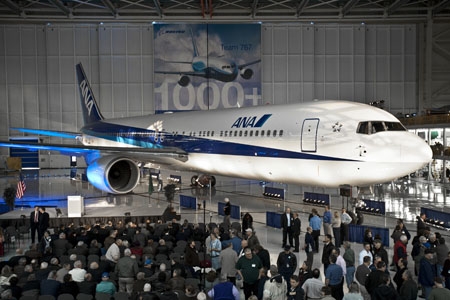
    EVERETT, Wash., Feb. 2, 2011 /PRNewswire/ — Boeing (NYSE: BA) marked a proud moment in the company’s history today at a ceremonial rollout of the 1,000th 767 airplane. Hundreds of current employees, joined by Boeing retirees who worked on the first 767, gathered to celebrate the occasion at the Everett, Wash., factory.

    “It was great to see so many people here today – the engineers, the technicians, the machinists – who have made the 767 the wonderful airplane it is,” said Jim Albaugh, president and CEO of Boeing Commercial Airplanes. “As we salute the 1,000th 767, the next 767 is already being built in a new bay where we can produce airplanes much more efficiently for years to come. We hope many of the new 767s will become U.S. Air Force tankers built right here.”

    The 1,000th airplane is a 767-300ER (extended range) passenger model for ANA (All Nippon Airways) and was the final 767 to complete assembly on the current production line. Final production work already is underway on the 1,001 unit in a new, smaller bay that repositions the production line toward a leaner, more efficient operation.

    Today’s milestone is a chance for the 767 family to celebrate its past, present and future showcased in this video: http://bit.ly/eMZIVv.
    Boeing has offered the 767 as the platform for its NewGen Tanker if it wins the U.S. Air Force KC-X Tanker competition. A decision on the contract award is expected early this year.

    The 767 family is a family of clean, quiet, fuel-efficient airplanes that provide maximum market versatility in the 200- to 300-seat market. The 767 family includes three passenger models – the 767-200ER, 767-300ER and 767-400ER – and a medium-widebody freighter, which is based on the 767-300ER fuselage.

  • |

    FAA Certifies Alakai Technologies’ Flight Data Monitoring System on AS350 Helicopters

    Smart system records, analyzes, and automatically reports FDM results for operators

    HOPKINTON, Mass., Feb. 2, 2011 /PRNewswire/ — Alakai Technologies (http://www.alakai1.com) announced today that the Federal Aviation Administration issued a Supplemental Type Certificate (STC) for installation of Alakai’s digital Flight Data Monitoring (FDM) systems and wireless Internet units on Eurocopter AS350 and EC130 helicopters. The AS350 and its derivatives, with over 4,000 helicopters sold, are used by police, forest service, oil exploration, flight-seeing and emergency medical service (EMS) operators worldwide.
    AS350 operators can now achieve comprehensive airline-style FDM (also known as Flight Operational Quality Assurance or FOQA) programs at a fraction of the cost for airline systems. Older, round-dial cockpits become part of a smarter, safer, more-connected aircraft. Operators benefit from Alakai’s on-board and backend algorithms that turn mountains of raw data into objective, actionable recommendations and decisions. The system works with older round-dial as well as the latest glass cockpit aircraft.

    GA-FDM (http://www.ga-fdm.com), a leading provider of Flight Data Monitoring solutions, will immediately begin offering the Alakai system to AS350 operators worldwide. GA-FDM analyzes the volume of data produced from each flight to help operators identify accident pre-cursors, reduce risks, enhance training, and reduce operating costs. Detailed FDM reports highlight aircraft and pilot performance, guided by expert suggestions for preventive and corrective measures. Customers experience significant operational savings, including reduced fuel and maintenance costs, safety improvements, enhanced training, and lower insurance costs.

    “We are excited to begin operational use in the AS350 fleet,” said Scott Meacham, co-founder of GA-FDM. “Alakai’s equipment makes comprehensive FDM programs affordable for single or small operators as well as large fleet customers, and allows operators to use objective data, information and knowledge to manage risk and assure continual safety improvements in their operations. Flight Data Monitoring is a critical component of every predictive and efficient Safety Management System.”

    About Alakai Technologies
    Alakai Technologies is a Hopkinton, Massachusetts-based corporation that develops, manufactures, integrates and certifies products that improve aircraft safety. Additional information can be found at http://www.alakai1.com.

    The Alakai system provides the most affordable, flexible FDM solutions for real-time analysis of engine, flight and aircraft motion parameters. The system includes a Web-enabled Digital Flight Data System with built-in engine and aircraft monitoring, embedded Inertial Measurement Unit (IMU) and accelerometers, flight analysis, and automatic wireless transfer for uploads over the Internet, and is capable of recording over 180 aircraft parameters depending upon avionics configuration. At the conclusion of each flight, the system sends synopsis emails to users, and automatically uploads flight and analysis results to Alakai’s servers, where experts review flights, analyze reports, and provide safety feedback to operators. The system also helps operators meet or exceed the recommendations called for in the FAA’s recent Notice of Proposed Rulemaking (NPRM) for EMS helicopters.

  • | |

    Air India Signs OnPoint Solution Agreement for Its GE90 Engine Fleet

    February 01, 2011
    Air India Signs OnPoint Solution Agreement for Its GE90 Engine Fleet
    –DUBAI– GE Aviation and India’s national carrier Air India have signed a 20-year OnPointSM solution agreement that covers its GE90 engines. The value of the agreement is not being released.

    Air India will expand its maintenance, repair and overhaul (MRO) capabilities at its Mumbai, India facility to include GE90 engine overhaul. The current schedule calls for the Mumbai facility to be certified for basic GE90 MRO by 2012. Eventually, Air India plans to build a new MRO facility in Nagpur, India, that will include GE90 testing capabilities.

    As part of the OnPoint solution agreement, GE will provide Air India with comprehensive material support, training and assistance on overhaul workscoping. While Air India develops its GE90 MRO capabilities, GE will provide the airline with overhaul services at GE’s MRO facilities to support the carrier’s GE90 engine fleet.

    “Air India has more than 40 years of providing high-quality MRO services in India,” said Nalin Jain, country director for GE Aviation. “Adding GE90 engine overhaul service is the perfect expansion of Air India’s MRO capabilities.”

    “Air India has already established partial capabilities on GE90 engines in Mumbai with the help of GE. Three engine overhauls were recently completed, saving us shipping costs and also reducing our turnaround time significantly. This will help us as we prepare to take on third-party work in the facility,” said Mr. K. M. Unni, SBU Head of the MRO SBU and Board Member, Air India.

    Air India ordered 23 GE90-powered Boeing 777 aircraft in 2005 and currently operates 20 of these aircraft with the remaining three aircraft to be delivered in the next few years.

    OnPoint solutions are flexible, long-term commitments designed to meet customers’ unique engine services needs. Backed by GE’s world-class support, these solutions help lower our customers’ cost-of-ownership and maximize the use of their assets. Available services include overhaul, on wing support, new and used serviceable parts, component repair, technology upgrades, engine leasing and diagnostics.

    Air India is the pioneer airline in India and has been in operation since 1932. The airline operated its first international flight in June 1948. Air India, which is inducting new aircraft to modernize its fleet and expand operations, has 159 aircraft, including the state-of-the-art Boeing 777s, Airbus A321s, Airbus A319s and Boeing 737 -800 in its fleet. Air India flies to 62 destinations in India and 51 destinations around the world. The carrier has a strong technical base and its engineering facility includes maintenance of aircraft, overhaul of engines, repair and overhaul of components, accessories and avionics. Thus the airline can provide all technical support to its fleet. Air India has well-trained, skilled technical manpower to carry out all complex tasks connected with civil aviation maintenance. For information on Air India, visit www.airindia.in.

    GE Aviation, an operating unit of GE (NYSE: GE), is a world-leading provider of jet and turboprop engines, components and integrated systems for commercial, military, business and general aviation aircraft. GE Aviation has a global service network to support these offerings. For more information, visit us at www.ge.com/aviation. Follow GE Aviation on Twitter at http://twitter.com/GEAviation and YouTube at http://www.youtube.com/user/GEAviation. For more information on ecomagination, visit http://www.ecomagination.com.

  • |

    Alitalia Signs OnPoint Fuel & Carbon Solutions Agreement

    –DUBAI– Alitalia has signed an OnPointSM Fuel & Carbon Solutions agreement with GE Aviation. Using proprietary decision software and fuel-consulting expertise, GE’s Fuel & Carbon Solutions will work with Alitalia to identify and track operational improvements that could reduce the airline’s fuel spend by an average of three percent on given segments.

    “Alitalia has a strong focus on the environment and operates very fuel-efficient engines, including the GE90, CF34, CF6 and CFM56* engines,” said John Gough, leader of GE Aviation’s OnPoint Fuel and Carbon Solutions. “GE’s Fuel & Carbon Solutions will help the airline further reduce the amount of fuel that it burns, which will help reduce its emissions and significantly cut operational costs.”

    “The continuous search for fuel consumption efficiency is one of the key points of Alitalia’s strategy to offer high-value solutions for shareholders and customers, while at the same time reducing the environmental impact to air transportation,” said Alessandro Loddo, Fuel Manager at Alitalia. “The selection of GE’s OnPoint Fuel and Carbon Solutions reinforces the Alitalia focus on technology innovation and paves the way for a structural enhancement of the company’s operational efficiency.”

    Part of GE’s ecomagination portfolio, Fuel & Carbon Solutions deliver results through a three-step process:
    1. Operational evaluation: Identify and collect data on the airline’s current fuel and carbon reduction programs, and quantify where the customer is today.
    2. Customized solution design: Further analyze data to isolate and prioritize potential improvements.
    3. Implementation support and verification: Work with customers to implement changes, and then measure and validate savings.

    Fuel typically accounts for about 30 percent of an airline’s expenses. With volatility in fuel prices during the last three years, airlines are looking for ways to manage this major portion of their cost base more effectively. Fuel & Carbon Solutions is one way for GE to work with its customers and develop effective fuel management solutions.

    Alitalia is Italy’s biggest airline with flights to 79 destinations – 26 in Italy and 53 international. The airline operates 4,500 flights weekly with a fleet of 149 aircraft.

    GE Aviation, an operating unit of GE (NYSE: GE), is a world-leading provider of jet and turboprop engines, components and integrated systems for commercial, military, business and general aviation aircraft. GE Aviation has a global service network to support these offerings. For more information, visit us at www.ge.com/aviation. Follow GE Aviation on Twitter at http://twitter.com/GEAviation and YouTube at http://www.youtube.com/user/GEAviation. For more information on ecomagination, visit http://www.ecomagination.com.

  • |

    Boeing, Comair Limited Announce Next-Generation 737 Order

    Airline company in South Africa selects 737-800 for fleet modernization
    Comair purchases Maintenance Performance Toolbox

    JOHANNESBURG, Feb. 2, 2011 — Boeing and Comair Limited today announced an order for eight Next-Generation 737-800s complete with the innovative new Boeing Sky Interior. Comair will use its new 737s to update the fleet of Comair’s low-fare airline, kulula.com. The airplanes are valued at approximately $646 million at current list prices. The order previously was attributed to an unidentified customer on Boeing’s orders and deliveries website.
    Launched in 2001 as South Africa’s first low-fare carrier, kulula.com currently operates an all-Boeing fleet of ten 737s, including three leased 737-800s. Comair also operates as a franchise partner of British Airways, with thirteen 737 airplanes flying domestically in South Africa and regionally in Southern Africa.

    “The purchase of new Boeing 737-800s is historic for our company and gives all our 1,800 staff a great feeling of pride,” said Gidon Novick, joint CEO of Comair Ltd. “The new fleet is an essential part of our efficiency drive, which will not only give us a cost leadership position in our industry, but also provide our customers with exceptional levels of reliability and comfort with the spacious new interior.”

    In addition to its 737-800 order, Comair is purchasing the Maintenance Performance Toolbox from Boeing Commercial Aviation Services. The Maintenance Performance Toolbox improves an airline’s fleet efficiency by integrating manufacturer and customer documentation, use of intelligent graphics, cross-document searching and linking aircraft fault data to specific maintenance actions. It also provides a comprehensive structural repair history for each airplane while reducing the time needed to find tail-specific technical information in time-critical situations, such as line maintenance troubleshooting and dispatch.

    “Comair is an amazing success story, as this airline company has posted operating profits each year since it was founded in 1946,” said Marlin Dailey, vice president of Sales and Marketing for Boeing Commercial Airplanes. “Today’s order demonstrates the value the 737-800 has already brought to its fleet and the confidence Comair has in this airplane.”

    Today’s operators fly 737s that are 5 percent more fuel-efficient than the first Next-Generation 737s delivered in 1998, and another 2 percent improvement is on the way. Boeing’s performance improvement package, now being certified, will boost Comair’s fuel efficiency a further 2 percent through aerodynamic and engine changes.
    Among the airlines that recently transported thousands of fans and football players throughout South Africa for the World Cup, Comair operates nearly 800 flights each week on its South African and regional routes.

  • |

    Boeing Delivers First 737-800 Boeing Sky Interior to China


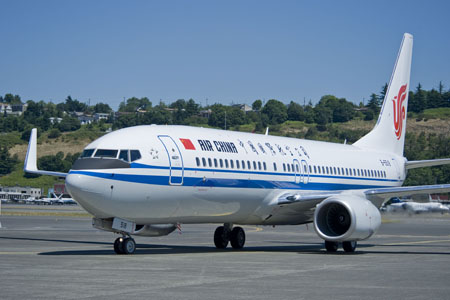
    SEATTLE, Feb. 1, 2011 — Boeing and Air China today celebrated the delivery of the airline’s first Next-Generation 737-800 with the innovative Boeing Sky Interior. With this new addition in its fleet, Air China has become the first Chinese airline to operate the 737-800 with the new Boeing Sky Interior, offering passengers an enhanced onboard experience with larger stowage bins and sculpted sidewalls, a LED lighting system with cove lighting and curved architecture and more intuitive passenger service units.

    Boeing Sky Interior is the latest in a series of improvements to the Next-Generation 737. The next to come will be a package of performance improvements that will reduce fuel consumption and carbon emissions by 2 percent – making the airplane a full 7 percent more efficient than the first Next-Generation 737s delivered. The performance improvements to the airframe and engine are in certification test, and will be phased into production between mid-2011 and early 2012.

    To date, 60 customers have ordered the new interior for 1,689 airplanes.

  • |

    Audit Initiated of FAA’s Air Traffic Facility Realignment

    The Office of Inspector General plans to review the Federal Aviation Administration’s (FAA) plans for consolidating the Nation’s air traffic facilities, many of which are approaching the end of their useful lives. We are conducting this review at the request of the former Ranking Members of the House Transportation and Infrastructure Committee and House Subcommittee on Aviation, who stated that the current budgetary environment and FAA’s efforts to develop the Next Generation Air Transportation System present the Agency with an opportunity to realign its network of facilities. They asked that, along with FAA’s plans, the OIG specifically examine the cost drivers and technical challenges related to this effort. Accordingly, our audit objectives are to assess: (1) FAA’s current plans for realigning and consolidating its air traffic facilities; (2) FAA’s process for evaluating the feasibility and cost effectiveness of these plans; and (3) the major cost, technical, and workforce challenges involved with realigning and consolidating air traffic facilities.

    Click to view the full FAA Facility Consolidation Audit Announcement .pdf

  • |

    Press Release: KLM Makes Upset Training Mandatory

    KLM, Holland’s flag carrier, has signed a deal with Arizona-based APS Emergency Maneuver Training to provide upset recovery training to ab initio pilots training at the airline’s flight school in Mesa. KLM has done its pilot training in sunny Mesa for 65 years at Falcon Field and APS is at neighboring Phoenix-Mesa Gateway. As technology mitigates many of the risk factors associated with airline flying, in-flight loss of control has emerged as the leading cause of airline crashes, according to a study released by Boeing last year. APS teaches pilots of all experience levels what to do when their world is turned upside down.

    Although recognition and prevention of unstable flight conditions is (or should be) a fundamental part of flight training, there are times when even the most careful and well-prepared pilot can find himself hanging from the harness thanks to weather, wake turbulence or other factors. APS teaches pilots how to put earth and sky back in their appropriate places without breaking the airplane, and the only way to do that is to intentionally upset aircraft. APS uses Extra 300s. KLM spokesman Robert van den Heuvel said KLM has made upset recovery a mandatory part of ab initio training for all its academy cadets and the deal with APS is a multi-year one.