press release

  • |

    Severe Winter Weather Continues to Affect United and Continental Flights in the Northeast Region This Week

    CUSTOMERS TRAVELING TO IMPACTED CITIES MAY RESCHEDULE WITHOUT PENALTY ON UNITED.COM OR CONTINENTAL.COM

    CHICAGO, Dec. 27, 2010
    United Continental Holdings, Inc. (NYSE: UAL) today extended travel options for United and Continental customers whose flight plans may be affected by severe winter weather in the Northeast region. Weather conditions are making air travel difficult, causing delays and cancellations of flights at Continental’s hub at New York / Newark Liberty International Airport and United’s hub at Washington Dulles. Flights at Newark are expected to resume on Monday afternoon, with a limited schedule. Operations at other airports throughout the Northeast region may also be affected.

    Change Flights for No Fee at united.com or continental.com

    Customers scheduled on flights, through Dec. 28, to, from or through the impacted areas may reschedule their itinerary with a one-time date or time change, and the change fees will be waived. If a flight has been canceled, a refund in the original form of payment may be requested. Complete details and eligible travel dates are available at united.com and continental.com.

    The fastest and most convenient way to change travel plans is via united.com or continental.com, and customers should continue to manage their reservations on the respective company’s website from which their ticket was purchased. Customers may also book a new reservation, change an existing reservation or check flight status by calling United Reservations at 800-UNITED-1 or Continental Reservations at 800-525-0280 or their travel agent.

    Another excellent way to receive information about flight delays, cancellations and gate changes is with United’s EasyUpdate service or Continental’s TripAlert service, which provide customers notifications via phone, text or e-mail.

  • |

    Letter to Chairmen Oberstar and Costello and Ranking Members Mica and Petri Regarding FAA’s Efforts to Implement RTCA Task Force Recommendations for NextGen

    Summary

    On December 21, we (DOT OIG) issued a letter to the Chairmen and Ranking Members of the House Transportation and Infrastructure Committee and Aviation Subcommittee regarding FAA’s efforts to implement the Next Generation Air Transportation System (NextGen). Last September, a RTCA task force recommended mid-term actions for advancing NextGen. The task force findings and recommendations are consistent with our work, covering areas such as maximizing the use of equipment already on aircraft and new procedures, enhancing information sharing among FAA and airspace users, and reducing delays. We are reporting our results thus far with respect to (1) FAA’s progress in responding to the task force report, (2) potential barriers to implementing the task force recommendations and realizing benefits, and (3) ongoing problems with a key modernization effort that could materially affect the pace of NextGen. In summary, FAA is incorporating RTCA’s recommendations in its NextGen plans but has not specified how it will execute key initiatives for addressing delays in major metropolitan areas. For example, FAA is still working to establish definitive milestones to integrate new airspace designs and procedures at metroplex locations. FAA also has yet to establish a mechanism for integrating metroplex initiatives with programs to better manage airport surface operations. At the same time, FAA faces several organizational, policy, logistical, and training challenges that could impede NextGen implementation in the midterm; these include working across diverse agency lines of business and establishing policies on data sharing. FAA must also resolve implementation problems with critical modernization projects, such as En Route Automation Modernization (ERAM)–a $2.1 billion NextGen tool for processing flight data–which has experienced software problems and delays at key sites.

  • |

    NASA AWARDS AGENCY CONSOLIDATED END-USER SERVICES (ACES) CONTRACT

    WASHINGTON — NASA awarded on Dec. 27 a 10-year contract to HP
    Enterprise Services of Herndon, Va., for Agency Consolidated End-user
    Services, or ACES.

    This firm-fixed-price, indefinite delivery/indefinite quantity
    contract has a maximum value of $2.5 billion and four-year base
    period with two three-year option periods. The contract will be
    managed at the NASA Shared Services Center (NSSC) in Mississippi.

    The ACES contract will develop a long-term outsourcing arrangement
    with the commercial sector to provide and manage most of NASA’s
    personal computing hardware, agency-standard software, mobile
    information technology (IT) services, peripherals and accessories,
    associated end-user services, and supporting infrastructure.

    NASA personnel use IT to support NASA’s core business, scientific,
    research and computational activities. HP Enterprise Services will
    provide, manage, secure and maintain these essential IT services for
    the agency.

    The NSSC is a partnership among NASA, Computer Sciences Corporation
    and the states of Mississippi and Louisiana. The NSSC performs
    selected business activities for all 10 NASA centers.

  • |

    NTSB REQUESTING COMMENTS ON PROPOSED PROCEDURAL RULES FOR AVIATION CERTIFICATE ENFORCEMENT CASE

    The NTSB has issued an Advance Notice of Proposed Rulemaking (ANPRM) seeking comments from the public regarding amendments to its procedural rules dealing with review of Federal Aviation Administration (FAA) certificate actions and its rules concerning applications for fees and expenses under the Equal Access to Justice Act.

    The NTSB listed three main reasons for its undertaking a review of 49 CFR parts 821 and 826: (1) to respond to parties’ suggestions for changing the rules; (2) to update rules that may be outdated; and (3) to modernize the rules to accommodate prospective electronic filing and document availability in case dockets.

    The ANPRM indicates that certain parties have approached the NTSB concerning emergency certificate actions, which involve cases in which the FAA issues an immediately effective order revoking or suspending a certificate. In such cases, the NTSB’s procedural rules allow a party to challenge the emergency status of the case, and provide an expedited timeline for doing so. The rules currently require the NTSB’s administrative law judges to “consider whether, based on the acts and omissions alleged in the Administrator’s order, and assuming the truth of such factual allegations, the Administrator’s emergency determination was appropriate under the circumstances.” The ANPRM invites public comments concerning this standard of review, as well as other aspects of the emergency review process, such as whether a hearing should occur to allow parties to provide evidence concerning whether the case should be treated as an emergency. The ANPRM further invites comments concerning whether parties should have an opportunity for another level of appeal to challenge the emergency status determination.

    In addition, the ANPRM also solicits comments concerning electronic filing of documents for aviation certificate cases, and requests specific consideration as to whether such electronic filing is feasible for individuals who opt not to retain an attorney. The ANPRM further seeks feedback concerning whether any outdated information exists in the current procedural rules.

    The 60-day comment period for the ANPRM concludes on February 22, 2011. The ANPRM may be accessed at the following link: http://origin.www.gpo.gov/fdsys/pkg/FR-2010-12-22/pdf/2010-32056.pdf.

  • Flight Attendants Safely Usher Travelers to Holiday Destinations

    Upcoming Anniversary of the 2009 Christmas Day Bomber Reminds All that There is Never a Holiday from Safety and Security Work for Flight Attendants

    WASHINGTON, Dec. 23, 2010 /
    — The Association of Flight Attendants-CWA (AFA), the world’s largest Flight Attendant union, reminds the traveling public of the heroic acts of Flight Attendants to thwart the terror attempt during the final approach of Delta flight 253 into Detroit on December 25, 2009. Flight Attendants are always vigilant and focused on their work as the last line of defense as well as their responsibilities as first responders. The traveling public can fly with confidence in the care of the nation’s Flight Attendants.

    “As the last line of defense, professional Flight Attendants are a vital link in the chain of commercial aviation security,” said AFA International President-Elect Veda Shook. “We are an integral part of a crew that works in concert for the security of each flight. In working to defend the best interests of professional Flight Attendants, AFA is in turn defending the best interests of the flying public and our national security.”

    One year ago on Christmas Day, Umar Farouk Abdulmutallab attempted to take down Delta flight 253 by detonating an explosive. Swift action by the crew stopped the potentially tragic events and saved the lives of everyone on board. The professional Flight Attendants quickly took control of the situation, successfully averting a possible tragedy. Two Flight Attendants, with the assistance of one passenger, extinguished the fire, stripped and searched the offender and ultimately restrained him. In the midst of the chaos, the rest of the Flight Attendant crew acted to maintain control of the cabin and ensure the well-being of all passengers.

    The flight deck remained locked down as Flight Attendants assumed their role as first responders and maintained their role as the last line of defense by taking any and all measures to protect the integrity of the flight deck. Relying on communication with the pilots, their training and on personal judgment, they implemented the appropriate response to the security threat.

    Trained and certified in passenger safety, the nation’s Flight Attendants will not only usher millions of passengers to friends and family over the holidays, but also stand alert and ready to respond to any potential threats in the aircraft cabin.

  • |

    He’s Making a List, Checking it Twice – Santa Claus is Coming to Town

    From One Continent to the Next, AirTran Airways Tracks Santa’s One-Night World Tour –

    ORLANDO, Fla., Dec. 24, 2010 /PRNewswire/ — For the seventh consecutive year, AirTran Airways, a subsidiary of AirTran Holdings, Inc. (NYSE: AAI), is providing its first of three Satellite-based Aviation Navigational Tracking Apparatus (S.A.N.T.A.) reports. The following information regarding Santa Claus’ international flight is based on data from AirTran Airways’ System Operations Control Center in Orlando:

    As December is shaping up for a somewhat warm time of year in Antarctica, the first confirmed satellite data found Santa and his reindeers flying up to a rookery to watch newborn penguin chicks cluster and brood at their parents’ feet.

    As Santa and his reindeer zipped up the coastline, they took to warmer summer climates in Santiago, Chile. Who can blame Santa for wanting to make a pit stop in a country known for its bountiful range of delicious desserts?

    Satellite data indicates that Santa next headed west over the Pacific Ocean, bringing holiday cheer to the lush island of New Zealand to unassumingly watch a rugby match before beginning his trek through Asia.

    As Santa covered Asia in record time, he slowed down to admire the terra cotta warriors and horse figurines in Beijing that date back to 210 BC. After a much-needed snack of cookies and hot chocolate on the Great Wall of China, Santa and his reindeer headed further west toward India.

    The next S.A.N.T.A. update is scheduled to cross the national wire at 3 p.m. EST.

  • |

    Severe Winter Weather Expected to Affect United and Continental Flights in the Northeast Region This Week

    CUSTOMERS TRAVELING TO IMPACTED CITIES MAY RESCHEDULE WITHOUT PENALTY ON UNITED.COM OR CONTINENTAL.COM
    CHICAGO, Dec. 23, 2010 /PRNewswire via COMTEX/ — United Continental Holdings, Inc. (NYSE: UAL) today announced travel options for United and Continental customers whose flight plans may be affected by severe winter weather forecast for the Northeast region. Weather conditions are expected to make air travel difficult, forcing some delays and cancellations of flights at United’s hub at Washington Dulles and Continental’s hub at New York / Newark Liberty International Airport for travel from Dec. 25 through Dec. 27. Operations at other airports throughout the Northeast region may also be affected.

    Change Flights for No Fee at united.com or continental.com

    Customers scheduled on flights to, from or through the impacted areas may reschedule their itinerary with a one-time date or time change, and the change fees will be waived. If a flight has been canceled, a refund in the original form of payment may be requested. Complete details and eligible travel dates are available at www.united.com and www.continental.com.

    The fastest and most convenient way to change travel plans is via united.com or continental.com, and customers should continue to manage their reservations on the respective company’s website from which their ticket was purchased. Customers may also book a new reservation, change an existing reservation or check flight status by calling United Reservations at 800-UNITED-1 or Continental Reservations at 800-525-0280 or their travel agent.

    Another excellent way to receive information about flight delays, cancellations and gate changes is with United’s EasyUpdate service or Continental’s TripAlert service, which provide customers notifications via phone, text or e-mail.

  • |

    Boeing Resumes 787 Flight Testing

    – Interim solution verified through extensive testing
    – Schedule assessment expected to conclude in January

    EVERETT, Wash., Dec. 23, 2010 — Boeing will resume flight test activities on the 787 Dreamliner later today. The company has installed an interim version of updated power distribution system software and conducted a rigorous set of reviews to confirm the flight readiness of ZA004, the first of the six flight test airplanes that will return to flight.

    “Initially, we will resume a series of Boeing tests that remain to be completed in the flight test program. That testing will be followed later by a resumption of certification testing,” said Scott Fancher, vice president and general manager of the 787 program. Today’s testing will include an intentional deployment of the Ram Air Turbine (RAT), which is a small turbine that is deployed when back-up power is required.

    Boeing and Hamilton Sundstrand completed testing of the interim software updates earlier this week. Verification of the system included laboratory testing of standalone components, integration testing with other systems, flight simulator testing and ground-based testing on a flight test airplane.

    In the last several weeks, the company continued ground testing as part of the certification program. Additional ground testing will be done by the company on the production version of the airplane to further verify performance of the changes being made.

    “As we return to flight test and determine the pace of that activity, we remain focused on developing a new program schedule,” Fancher added. “We expect to complete our assessment of the program schedule in January.”

    Flight testing of the 787 was suspended last month following an in-flight electrical incident on a test flight in Laredo, Texas.

  • |

    Press Release – FAA Proposes $330,000 Civil Penalty Against American Eagle Airlines

    For Immediate Release

    FORT WORTH – The Federal Aviation Administration (FAA) is proposing a $330,000 civil penalty against American Eagle Airlines Inc., of Fort Worth, for operating an Embraer 135 regional jet on 12 revenue passenger flights when it was not in compliance with Federal Aviation Regulations.

    The FAA alleges American Eagle mechanics failed to note broken passenger seats and armrests on two aircraft during a Dec. 18, 2008 inspection and did not follow the approved maintenance manual instructions during those inspections. FAA inspectors discovered seats on two aircraft that would not raise and stow into the upright and locked position for takeoffs and landings. FAA inspectors also found damaged center arm rests that would not stow in the upright and locked position.

    The FAA further alleges that American Eagle used one of the aircraft on 12 revenue passenger flights between the inspection and eventual repair of the seats and armrests. The other aircraft did not fly again until the airline completed the required work.

    American Eagle has 30 days from receipt of the FAA’s enforcement letter to respond to the agency.

  • |

    EASA proposes a new set of harmonised European rules to avoid crew fatigue

    EASA published today a Notice of Proposed Amendment (NPA 2010-14) on flight and duty time limitations and rest requirements (FTL) for commercial air transport by aeroplanes. FTL rules aim at avoiding crew fatigue by introducing limitations to the way crews can be scheduled by airlines. This NPA proposes a number of safety improvements and areas for European harmonisation.

    The European Parliament and the European Commission requested EASA to conduct a scientific and medical evaluation of the current regulation which allows national provisions in areas such as augmented flight crew, split duty, time zone crossing, reduced rest and standby, and to propose a set of fully harmonised rules. The new proposal is the result of the work of a rulemaking group that includes National Aviation Authorities, Airlines and Flight and Cabin Crew representatives.

    This proposal is the first step in a fully transparent public consultation process. Comments will be reviewed and a Comment Response Document (CRD) will be available for public consultation. At the end of the consultation process, EASA will present a final Opinion to the European Commission that will then launch the final process for adoption by the European Parliament and European Council in April 2012.

    http://easa.europa.eu/rulemaking/docs/npa/NPA%202010-14.pdf

  • |

    FAA Proposes $275,000 Civil Penalty Against Continental Airlines

    For Immediate Release
    December 22, 2010

    SEATTLE– The Federal Aviation Administration (FAA) is proposing a $275,000 civil penalty against Continental Airlines Inc., of Houston, for operating two Boeing 737-900ER (extended range) aircraft on 73 flights when they were not in compliance with Federal Aviation Regulations.

    The FAA alleges Continental mechanics failed to follow the 737 Airplane Maintenance Manual when they installed incorrect main landing gear wheel-tire assemblies on two aircraft and released them for service on Nov. 7 and 19, 2009.

    The manual contains specific instructions to mechanics not to use wheel-tire assemblies intended for the B-737-700, -800 and -900 on the heavier B-737-900ER. The manual says using the incorrect assemblies on the heavier version of the B-737 might lead to damage to the aircraft or injury to people working on and around the aircraft.

    Continental has 30 days from receipt of the FAA’s enforcement letter to respond to the agency

  • |

    FAA proposes $275,000 civil penalty against Continental Airlines

    For Immediate Release
    December 22, 2010

    SEATTLE– The Federal Aviation Administration (FAA) is proposing a $275,000 civil penalty against Continental Airlines Inc., of Houston, for operating two Boeing 737-900ER (extended range) aircraft on 73 flights when they were not in compliance with Federal Aviation Regulations.

    The FAA alleges Continental mechanics failed to follow the 737 Airplane Maintenance Manual when they installed incorrect main landing gear wheel-tire assemblies on two aircraft and released them for service on Nov. 7 and 19, 2009.

    The manual contains specific instructions to mechanics not to use wheel-tire assemblies intended for the B-737-700, -800 and -900 on the heavier B-737-900ER. The manual says using the incorrect assemblies on the heavier version of the B-737 might lead to damage to the aircraft or injury to people working on and around the aircraft.

    Continental has 30 days from receipt of the FAA’s enforcement letter to respond to the agency.

  • | |

    American Traveling Public Says ‘There Has to Be a Better Way’ to Conduct Air Travel Security Screening

    Overwhelming Majority Support a Trusted Traveler Program That Could Help Spur $84.6 Billion in More Travel

    Blue Ribbon Panel of Experts Convened By U.S. Travel Association to Make Recommendations in Coming Weeks

    WASHINGTON, Dec. 21, 2010 — As airports begin welcoming passengers during one of the busiest air travel periods of the year, a new survey reveals three in four air travelers believe “there has to be a better way” to conduct air travel security screening. Eight in 10 support a trusted traveler program that would provide alternative screening measures for American citizens who submit to a background check and meet other risk criteria. Respondents would take an average of two to three more trips per year if the hassle involved in flying could be reduced without compromising security. Those additional trips would add $84.6 billion in travel spending and support 888,000 additional jobs, according to research from the U.S. Travel Association.

    “Americans are clamoring for a better way, and it should be a wake-up call for our leaders in Washington,” said Roger Dow, president and CEO of the U.S. Travel Association, which commissioned the survey. “An efficient air travel security screening system that streamlines the process for trusted travelers can strengthen our security and economy. Let’s get to work building the system Americans crave.”

    A majority of those surveyed believe Congress should make air travel security a top priority in the new term that begins in January.

    According to the Consensus Research Group, which conducted the survey, “Travelers’ frustration with the system is not limited to just one or two security measures. It is across the board and includes a range of issues.”
    Among the survey findings:

    The U.S. Travel Association has convened a Blue Ribbon Panel for Frictionless Aviation Security comprised of industry and security experts and former government officials. The panel will recommend how to improve air travel security in a way that maximizes security and minimizes the burden on travelers. The panel is expected to issue its report in early 2011.

    The survey was conducted online by Consensus Research Group on behalf of the U.S. Travel Association between November 29 and December 10. The survey includes a nationally representative sample of 1,000 business and leisure air travelers who have flown during the past two years, are aged 25 or older, and who reside in the U.S.

    • Having to remove shoes before going through a metal detector received a higher negative response from those surveyed than newly implemented pat-down body searches by Transportation Security Administration (TSA) personnel.
    • Nearly 9 in 10 respondents believe it is possible to achieve an air travel screening system that is both secure and efficient, while virtually the same number believe if we can put a man on the moon, we can create a passenger security system that doesn’t frighten or inconvenience travelers.
    • Three in four air travelers support recruiting more professional security personnel who are trained to use personal observation, dogs and sophisticated computer analyses that have proven to be effective screening techniques in the past.

    One page summary of the survey:

    Travelers Frustrated with National Air Security System Public Believes “There Has To Be a Better Way”
    Three in four American travelers (75%) believe there has to be a better way to provide air travel security than the procedures used today.
    • Two-thirds of air travelers (66%) believe air travel security is a complicated problem and will not accept heavy-handed procedures unless they are more effective and efficient – 72% of business travelers agree.
    • Eight in ten (82%) agree that if we can put a man on the moon, we can create a passenger screening system that doesn’t frighten or inconvenience air travel passengers.
    More travelers describe the current passenger screening process as “inconsistent,” “stressful,” or “embarrassing” than describe it as being “fair” or “effective.”

    Top ten words air travelers use to describe today’s screening procedures:
    o Inconsistent 64% o Stressful 58% o Embarrassing 41% o Intimidating 40% o Intrusive 39%
    o Fair 30% o Ineffective 29% o Effective 23% o Rude 22% o Frightening 16%
    More would travel by air if the screening process was improved – and the economy would benefit.
    • Nearly two in every three air travelers (64%) said they would fly more if security procedures remained as effective but were less intrusive and less time-consuming.
    • Travelers would take an average of two to three more trips a year (2.48/year) if the hassle could be reduced without compromising security effectiveness. These additional trips could add $84.6 billion in spending and 888,000 more jobs.
    • 80% agree there should be alternative screening measures for American citizens who submit to a background check and meet other risk criteria. In fact, half (50%) of those who have traveled recently “strongly agree” with this.
    • Three in four air travelers (74%) support recruiting more professional security personnel who are trained to use personal observation, dogs and sophisticated computer analyses.
    • A majority of air travelers support common-sense measures such as creating a special security lane for frequent travelers (60%) and a special screening lane for families, infrequent travelers and people who need boarding assistance (58%).
    American travelers believe fixing air travel security should be a top priority in the 112th Congress.
    • A majority of air travelers (54%) believe Congress should make air travel security a top priority in the new term that begins in January.

  • | |

    American Airlines Schedules and Fares No Longer Available on Orbitz.com

    Citing Failure to Reach a Mutually Beneficial Commercial Agreement American Revokes Orbitz Authority to Display and Sell American Airlines Fares

    FORT WORTH, Texas, Dec. 21, 2010 — Effective immediately, American Airlines will discontinue displaying and selling fares through Orbitz (www.orbitz.com) and its subsidiary Orbitz for Business. Tickets for travel already purchased through Orbitz remain valid but changes must be made through American Airlines reservations by calling 1-800-433-7300.

    Tickets for travel on American Airlines and American Eagle – including all international and domestic classes of service – are widely available through a number of outlets, including American’s own website, AA.com, which features our Lowest Fare Guarantee. Tickets, fares and schedules are also available through American’s reservations agents, thousands of travel agencies in locations worldwide, other online travel agencies such as Priceline.com, and metasearch engines such as Kayak.com.

    “American Airlines regrets any inconvenience this may cause our customers. While we could not reach an agreement with Orbitz, we are committed to letting customers know of the multitude of options they have to purchase travel on American Airlines,” said Derek DeCross, Vice President – Sales. “In today’s competitive marketplace, it is important for American to be free to customize its product offerings to improve the customer experience as well as distribute its products in a way that does not result in unnecessary costs.”

    American also continues to provide its fare content to travel agency partners, both through global distribution systems and through American’s own direct connection technology that is powered by Farelogix. There is no charge to agencies for using American’s direct connection, which allows travel agencies to offer their customers more complete and tailored travel choices, including fares and optional services

  • |

    Boeing Receives US Air Force Contract for C-17 Training Devices

    ST. LOUIS, Dec. 22, 2010 — The Boeing Company today announced it has received a contract from the U.S. Air Force to deliver C-17 training devices to three sites. The contract value is $44 million initially and up to $72 million if two options are exercised.

    The first set of devices is an Integrated Training Center (ITC) to be delivered to Wright-Patterson Air Force Base, Ohio, in the first quarter of 2012. The ITC will consist of a weapon systems trainer, pilot and co-pilot station, loadmaster station and related courseware and support equipment. A second weapon systems trainer will be installed at McChord Air Force Base, Wash., in the third quarter of 2012 and a third ITC will go to a new C-17 training site in early 2013.

    “Wright-Patterson is set to receive its first of eight C-17s next year and McChord has 54,” said Mark McGraw, Boeing vice president for Training Systems & Services. “We are proud to add to the Air Force’s training capability and support warfighter readiness with these new devices.”

    The ITCs support pilot and co-pilot instruction in flight operations, mission planning and emergency procedures through computer-based training, advanced aircraft simulation and other desktop training devices. C-17 loadmasters also receive computer-based and aircraft training in addition to training on the loadmaster station, cargo loading models and cargo compartment trainer. Additionally, maintenance personnel can use the ITCs for training on engine run procedures.

  • |

    Boeing Completes Acquisition of Summit Aeronautic Group in Montana

    SEATTLE, Dec. 21, 2010 / — Boeing announced today the completion of the acquisition of the business and operations conducted by Summit Aeronautics Group in Helena, Montana. Terms of the transaction, announced on Nov. 22, were not disclosed.

    The newly acquired business will be named Boeing Helena. It will become part of Boeing Fabrication, a division of Boeing Commercial Airplanes. Boeing Helena will manufacture titanium and other hard-metal structures for Boeing commercial aircraft including the 747-8, 767 and 787.

    Forward-Looking Information Is Subject to Risk and Uncertainty
    Certain statements in this release may be “forward-looking” within the meaning of the Private Securities Litigation Reform Act of 1995. Words such as “may,” “will,” “should,” “expects,” “plans,” “intends,” “projects,” “believes,” “estimates,” “targets,” “anticipates,” and similar expressions are used to identify these forward-looking statements. Examples of forward-looking statements regarding the proposed acquisition of Summit include, but are not limited to, statements regarding the expected timetable for completing the transaction, future business prospects, our guidance relating to 2010 and 2011 financial and operating performance, product development and benefits and synergies of the transaction, as well as any other statement that does not directly relate to any historical or current fact. Forward-looking statements are based upon assumptions about future events that may not prove to be accurate. These statements are not guarantees of future performance and involve risks, uncertainties and assumptions that are difficult to predict. Actual outcomes and results may differ materially from what is expressed or forecasted in these forward-looking statements. As a result, these statements speak to events only as of the date they are made and we undertake no obligation to publicly update or revise any forward-looking statements, whether as a result of new information, future events or otherwise, except as required by federal securities laws. Specific factors that could cause actual results to differ materially from forward-looking statements include, but are not limited to, the effect of economic conditions in the United States and globally, the ability of the parties to satisfy the transaction conditions and complete the acquisition, the risk that competing offers will be made, our ability to successfully integrate Summit’s business and realize anticipated synergies, and other important factors disclosed previously and from time to time in our filings with the Securities and Exchange Commission.

  • |

    Massive flight cancellations into and out of Frankfurt – German domestic flights and connections to European destinations equally affected – Long-haul flights still being flown

    The winter weather over the past few days has severely disrupted flight operations and kept passengers stranded on the ground, especially at Lufthansa’s home airport in Frankfurt. Since the weather is expected to get even worse, Lufthansa has been forced to operate to a special timetable, in which numerous flights on German and European routes into and out of Frankfurt will have to be cancelled. This measure is necessary in order to reinstate flight operations on their customary stable basis. Lufthansa long-haul flights are not affected.

    All Lufthansa passengers are urged to check the status of their flight before beginning their journey at Arrival & Departure. Passengers on intraGerman flights are advised anyway to utilise an alternative means of travel. In view of the extraordinary situation, Lufthansa flight tickets can be used for journeys by train without any problem. Electronic tickets can be exchanged for travel vouchers at the customer-operated check-in terminals.

    Should there not be enough time to convert the ticket at a Lufthansa Quick-Check-in machine, Lufthansa recommends the purchase of a train ticket. The refund of the ticket can be obtained by presenting the train ticket and the flight ticket to the office that has issued the flight ticket after having completed the journey.

    Passengers affected by flight cancellations should contact the dedicated Lufthansa Call Center set up specially for the purpose. The free phone number to call from Germany is: 0800 850 60 70. Callers from outside Germany should phone their local Lufthansa phone number .

    Lufthansa deeply regrets the inconvenience caused to many of its passengers in these days and will do its utmost to lessen the impact as much as possible.

    Deutsche Lufthansa AG
    Corporate Communications

  • | |

    GOL Announces Commercial Agreement with Passaredo Linhas Aereas

    GOL adds six cities to its route network with Passaredo’s routes, which will be available in its sale channels

    SAO PAULO, Dec. 21, 2010 -FirstCall/ — GOL Linhas Aereas Inteligentes S.A., the largest low-cost and low-fare airline in Latin America, has signed a commercial agreement to sell, in all its sales channels, tickets of Passaredo Linhas Aereas, a Brazilian domestic airline that recorded growth of 130.89% last year.

    Passaredo currently operates 103 flights to 20 destinations in Brazil. As a result of the agreement, GOL will add the cities of Marilia, Ribeirao Preto, Sao Jose de Rio Preto (Sao Paulo), Barreiras, Vitoria da Conquista (Bahia) and Ji-Parana (Rondonia) to its route network. GOL, operating through Passaredo, also offers eight new direct flights, including Porto Alegre (Rio Grande do Sul) to Goiania (Goias) and Uberlandia (Minas Gerais) to Rio de Janeiro (Santos Dumont Airport).

    GOL passengers connecting with Passaredo flights will only need to check-in once and their baggage will go directly to the final destination.

    Based in Ribeirao Preto, Passaredo Linhas Aereas began operations in 1995. Its fleet currently comprises 15 aircraft – five Embraer EMB-120s and ten Embraer ERJ-145 jets, with a capacity for 30 and 50 passengers, respectively. By July 2011, however, it will be operating 23 aircraft, with the addition of eight already contracted ERJ-145s.

    “This is a strategic agreement for GOL because Passaredo is a well-known regional airline which will add important destinations to our route network, improving our penetration and offering our passengers new direct flight options”, declared Claudia Pagnano, GOL’s Market Vice-President.
    The routes will be handled by all GOL’s sales channels, available for purchase up to the day before the flight. The agreement does not include the accumulation of SMILES mileage on Passaredo flights.

    For Captain Felicio, the CEO of Passaredo Linhas Aereas, the company is assuming a strategic position in the market. “GOL is an excellent partner. We believe in a strong regional aviation market, where we will be operating with penetration for one of the leading airlines in Latin America. This is the system they use in North America and Europe”, he concluded.

    About Passaredo Linhas Aereas

    Passaredo has expanded more than any other airline in Brazil since 2004, recording annual growth of close to 100%, and currently operates 103 daily flights to 20 cities in 10 Brazilian states. It focuses on flights carrying up to 50 passengers, operating on medium-potential routes with high-tech aircraft, high fuel consumption efficiency and low-cost maintenance. Its aircraft are manufactured by Embraer and there are more than 1,200 units operating worldwide. Passaredo puts great emphasis on top-class customer service, prioritizing comfort, safety, efficiency and punctuality. Given its intention of maintaining its regional identity, the partnership with GOL will complement its operations, allowing it to offer a wider range of destinations to its clients.

    About GOL Linhas Aereas Inteligentes S.A.

    GOL Linhas Aereas Inteligentes S.A. (NYSE: GOL and BM&FBOVESPA: GOLL4), (S&P/Fitch: BB-/BB-, Moody`s: Ba3), the largest low-cost and low-fare airline in Latin America, offers more than 900 daily flights to 59 destinations that connect all the important cities in Brazil and 14 major destinations in South America and Caribbean. The Company operates a young, modern fleet of Boeing 737 Next Generation aircraft, the safest and most comfortable of its class, with high aircraft utilization and efficiency levels. Fully committed to seeking innovative solutions through the use of cutting-edge technology, the Company – via its GOL, VARIG, GOLLOG, SMILES and VoeFacil brands – offers its clients easy payment facilities, a wide range of complementary services and the best cost-benefit ratio in the market.

    This release contains forward-looking statements relating to the prospects of the business, estimates for operating and financial results, and those related to growth prospects of GOL. These are merely projections and, as such, are based exclusively on the expectations of GOL’s management concerning the future of the business and its continued access to capital to fund the Company’s business plan. Such forward-looking statements depend, substantially, on changes in market conditions, government regulations, competitive pressures, the performance of the Brazilian economy and the industry, among other factors and risks disclosed in GOL’s filed disclosure documents and are, therefore, subject to change without prior notice.

  • |

    AA Credit Union Employees Donate $3,090 to the North Texas Food Bank Virtual can Drive

    FORT WORTH, Texas, Dec. 20, 2010 — AA Credit Union has proudly presented the North Texas Food Bank (NTFB) with a $3,090 donation as a result of the Credit Union’s weeklong virtual canned food drive.

    In early December, Credit Union employees participated in a special Dress Down Days fund-raiser, contributing $5 a day or $20 for the entire week in exchange for being able to wear jeans and sneakers to work.

    The drive was part of the North Texas Food Bank’s “Close the Gap on Hunger in North Texas” campaign. “Close the Gap” is the NTFB’s three-year initiative to unite the community to narrow the food gap by providing access to 50 million meals annually by 2011.

    “Virtual Canned Food Drives eliminate the hidden costs associated with a regular canned food drive,” said Sophia Sindalovsky, Volunteer Coordinator of the NTFB. “It also provides much more assistance to North Texans by leveraging donations to provide four meals for every dollar raised. Giving has never been easier.” The Credit Union’s donation equates to nearly 12,360 meals for North Texans.

    “After donating hundreds of pounds of canned goods in last year’s drive, we were excited — and somewhat relieved — to throw our efforts behind a virtual canned food drive this year,” said Pedro Noda, the fund-raiser’s director and eMarketing Manager at AA Credit Union. “We’re excited to make this donation on behalf of AA Credit Union and the many employees who helped make this possible.”

    “This time of year, it is particularly important to remember those who are less fortunate,” said Angie Owens, AA Credit Union President and CEO. “I once again could not be more proud of all our employees for opening up their hearts to help the North Texas Food Bank reach such admirable goals.”

    About American Airlines Federal Credit Union

    AA Credit Union was founded in 1936, and today serves the present and retired employees of American Airlines, their family members and others who work in the air transportation industry. AA Credit Union has more than 223,000 member-owners and assets of more than $5 billion. As a cooperative financial services institution, the Credit Union’s goal is to provide the best possible benefits and services for its member-owners.

    About the North Texas Food Bank

    The North Texas Food Bank (NTFB) is a nonprofit hunger relief organization that distributes donated, purchased and prepared foods through a network of 1,146 feeding programs in 13 North Texas counties. The NTFB supports the nutritional needs of children, families and seniors through education, advocacy and strategic partnerships. Founded in 1982, the NTFB is a member of Feeding America (feedingamerica.org). Each month agency pantries distribute food to more than 53,000 families and on-site meal programs serve 435,000 meals/snacks. Every dollar donated to the NTFB provides four meals for the hungry. Imagine… A World Without Hunger. www.ntfb.org.

  • |

    Boeing Delivers Air Austral’s First Next-Generation 737-800

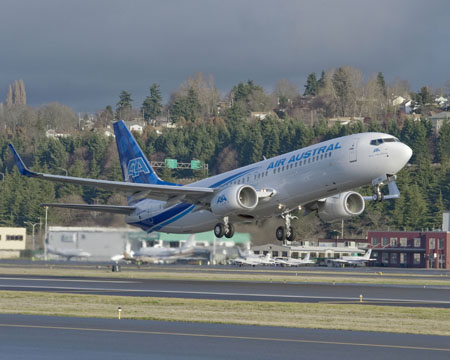
    SEATTLE, Dec. 20, 2010 — Boeing delivered a Next-Generation 737-800 to Air Austral, as part of the airline’s modernization plan for its medium-haul fleet. The airplane is the first of two the airline ordered to replace one 737-300 and one 737-500 in its fleet. The new airplane continues the Boeing-Air Austral relationship that began 20 years ago with the 737 Classic. The delivery ceremony was attended by Gerard Etheve, president of the directory and chief executive officer of Air Austral. The airline is headquartered in St. Denis, Reunion, a French Department island located east of Madagascar in the Indian Ocean.

  • | |

    Boeing Fabricará 3 Satélites para el Gobierno de México

    EL SEGUNDO, California, 20 de diciembre de 2010 — Boeing [NYSE: BA] anunció hoy la adjudicación de un contrato por aproximadamente US$1,000 millones de parte del gobierno mexicano para la entrega de un sistema integral de comunicaciones satelitales. El sistema, denominado MEXSAT, consta de tres satélites, dos estaciones terrenas, los sistemas de operaciones de red correspondientes y terminales de usuario de referencia. MEXSAT proveerá comunicaciones seguras para las necesidades de seguridad nacional de México, así como una cobertura mejorada para las telecomunicaciones civiles.

    “MEXSAT es la cuarta generación de satélites que Boeing ha suministrado a México para comunicaciones satelitales gubernamentales y civiles,” dijo Craig Cooning, director general ejecutivo (CEO) de Boeing Satellite Systems International. “MEXSAT ha sido desarrollado con base en 13 años de experiencia de parte de Boeing en el diseño y la fabricación de avanzados sistemas de satélites geoestacionarios para servicios móviles.”

    Conforme a los términos del contrato, Boeing entregará un sistema llave en mano completo que se compone de dos satélites geoestacionarios para servicios móviles (o “GEO-Mobile”) Boeing 702HP denominados MEXSAT 1 y MEXSAT 2, así como un satélite para banda C extendida y banda Ku, llamado MEXSAT 3, que proveerá servicios satelitales fijos (FSS) desde una órbita geosíncrona. El primer lanzamiento programado es el de MEXSAT 3, a finales de 2012.

    Cada satélite Boeing suministrará 14 kilowatts de potencia mediante alas de arreglos de cinco paneles solares dotadas de celdas fotovoltaicas de arseniuro de galio de triple unión de alta eficiencia. Cada una de las naves transportará un reflector de banda L de 22 metros para servicios satelitales móviles (MSS), complementado por una antena de banda Ku de 2 metros.
    Boeing subcontratará la fabricación del satélite MEXSAT 3 y de un centro de operaciones a su empresa asociada Orbital Sciences Corporation [NYSE: ORB]. MEXSAT 3, un satélite Orbital Star 2.4, brindará cobertura total al territorio mexicano y sus aguas patrimoniales, y transmitirá comunicaciones civiles a fin de coadyuvar al desarrollo socioeconómico del país.

    Asimismo, Boeing desarrollará dos estaciones terrenas equipadas con avanzada tecnología de flexibilidad de conformación del haz para dirigir haces puntuales de usuario móvil a dependencias gubernamentales que operan en México y sus aguas patrimoniales, tanto en el litoral del Pacífico como en el Golfo de México.

    Con anterioridad, Boeing suministró cinco satélites para el gobierno mexicano: los satélites Morelos 1 y Morelos 2, ambos puestos en órbita en 1985; los satélites Solidaridad 1 y Solidaridad 2, lanzados en 1993 y 1994; y el Satmex 5, lanzado en 1998. Solidaridad 2, que ya ha rebasado la vida útil estipulada en el contrato, aún continúa en servicio, y se espera que el satélite Satmex 5 deje de operar en 2012.

    Boeing Defense, Space & Security, una unidad de The Boeing Company, es una de las mayores empresas del mundo en el sector de defensa, espacio y seguridad. Se especializa en ofrecer a sus clientes soluciones innovadoras desarrolladas a partir de capacidades operacionales y es el fabricante más grande y versátil de aeronaves militares en el mundo. Con sede en St. Louis, Boeing Defense, Space & Security es una empresa de US$34,000 millones con una plantilla de 68,000 trabajadores en todo el mundo.

  • |

    Boeing to Build 3-Satellite System for Government of Mexico

    EL SEGUNDO, Calif., Dec. 20, 2010 — Boeing today announced that it has received a contract for approximately $1 billion from the government of Mexico to deliver an end-to-end satellite communications system. The system, known as MEXSAT, will consist of three satellites, two ground sites, associated network operations systems and reference user terminals. MEXSAT will provide secure communications for Mexico’s national security needs, as well as enhanced coverage for the country’s civil telecommunications.

    “MEXSAT is the fourth generation of satellites Boeing has provided to Mexico for government and civilian satellite communications,” said Craig Cooning, chief executive officer of Boeing Satellite Systems International. “MEXSAT builds on Boeing’s 13 years of experience in designing and delivering advanced geomobile systems.”

    Under the contract, Boeing will deliver a complete turnkey satellite system comprised of Boeing 702HP geomobile satellites MEXSAT-1 and MEXSAT-2 and one extended C- and Ku-band satellite, MEXSAT-3, which will provide fixed satellite services from geosynchronous orbit. MEXSAT-3 is scheduled to launch first, at the end of 2012.

    Each Boeing 702HP satellite will supply 14 kilowatts of power through five-panel solar array wings that use high-efficiency, ultra triple-junction gallium arsenide solar cells. Both satellites will carry a 22-meter L-band reflector for mobile satellite services, complemented by a 2-meter Ku-band antenna.

    Boeing will procure MEXSAT-3 and a spacecraft operations center from its supplier partner Orbital Sciences Corporation [NYSE: ORB]. MEXSAT-3, an Orbital Star 2.4 satellite, will provide full coverage of Mexico and its patrimonial seas and relay civil communications for socioeconomic development.

    Boeing also will develop two ground sites in Mexico with advanced beam-forming flexibility to direct mobile user spot beams to government agencies operating in Mexico and its patrimonial seas, including the Pacific Ocean and Gulf of Mexico.

    Boeing has previously provided five satellites that serve Mexico, beginning with Morelos 1 and Morelos 2, both launched in 1985; the Solidaridad 1 and Solidaridad 2 satellites, launched in 1993 and 1994; and Satmex 5, which was launched in 1998. Solidaridad 2, which has exceeded its contract life, is still in service, and Satmex 5 is expected to end its service life in 2012.

    A unit of The Boeing Company, Boeing Defense, Space & Security is one of the world’s largest defense, space and security businesses specializing in innovative and capabilities-driven customer solutions, and the world’s largest and most versatile manufacturer of military aircraft. Headquartered in St. Louis, Boeing Defense, Space & Security is a $34 billion business with 68,000 employees worldwide.

  • |

    Boeing-built C-17 Fleet Surpasses 2 Million Flight Hours


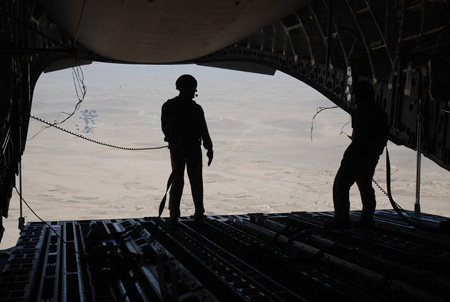
    LONG BEACH, Calif., Dec. 20, 2010 — The worldwide fleet of C-17 Globemaster III airlifters built by The Boeing Company [NYSE: BA] surpassed 2 million flying hours during an airdrop mission over Afghanistan on Dec. 10. Reaching 2 million flight hours equates to 1.13 billion nautical miles – the equivalent of a C-17 flying to the moon and back 2,360 times.
    The representative mission, flown by a U.S. Air Force C-17, airdropped 74,000 pounds of jet fuel in support of U.S. and coalition troops just south of Kabul.

    The C-17 has a mission readiness rate of more than 85 percent. It is the world’s only strategic airlifter with tactical capabilities that allow it to fly between continents, land on short, austere runways, and airdrop supplies precisely where they are needed.

    “There’s tremendous satisfaction in knowing that in those 2 million hours, the C-17 fleet has saved countless lives around the world,” said Bob Ciesla, Boeing C-17 program manager. “Boeing congratulates the U.S. Air Force and our international C-17 customers on reaching this milestone. We’re very proud that the C-17 continues to exceed expectations for performance and reliability.”

    The C-17 fleet, now in its 17th year of service, has supported humanitarian and disaster-relief missions worldwide. With 226 airlifters in service around the world, the C-17 fleet continues to operate at an accelerated rate due to the recent troop surge in Afghanistan, reaching the 2 million flight-hours milestone less than five years after reaching 1 million flight hours in March 2006, when 152 C-17s were in service. This year, lifesaving aeromedical evacuations of wounded troops from Afghanistan and Iraq, along with relief missions for natural disasters such as earthquakes in Pakistan, Chile and Haiti, have intensified the C-17’s normal workload.

    Boeing helps keep the C-17 flying through a worldwide support and sustainment program. “Boeing has had the honor of supporting the entire C-17 fleet since the delivery of the first aircraft to Charleston Air Force Base in 1993,” said Gus Urzua, program manager for the Boeing C-17 Globemaster III Sustainment Partnership. “Through innovative Performance-Based Logistics contracting and partnering with the Air Force, we have maintained the highest level of aircraft readiness while continuously reducing the cost of ownership.”

    While providing relief to Haiti in January and February, C-17s delivered nearly 14,000 short tons of cargo and transported some 25,000 passengers and 280 patients. C-17s also played a key role in a record year for airdrops in support of Operation Enduring Freedom in Afghanistan. As of Oct. 31, C-17s and other airlifters have airdropped more than 45 million pounds of cargo to troops in remote locations.

    Boeing has delivered 20 C-17s to international customers. The U.S. Air Force — including active duty, National Guard, and Air Force Reserve units — has taken delivery of 206. Other customers include the U.K. Royal Air Force, the Canadian Forces, the Royal Australian Air Force, the United Arab Emirates Air Force, the Qatar Emiri Air Force, and the 12-member Strategic Airlift Capability initiative of NATO and Partnership for Peace nations. India is expected to be the next C-17 customer.

    A unit of The Boeing Company, Boeing Defense, Space & Security is one of the world’s largest defense, space and security businesses specializing in innovative and capabilities-driven customer solutions, and the world’s largest and most versatile manufacturer of military aircraft. Headquartered in St. Louis, Boeing Defense, Space & Security is a $34 billion business with 68,000 employees worldwide. Follow us on Twitter: @BoeingDefense.

  • |

    Boeing to Increase 777 Production Rate

    SEATTLE, Dec. 20, 2010 — Boeing ( today announced its production rate for the 777 program will increase to 8.3 airplanes per month in the first quarter 2013. This is the second production increase announced for the program this year. In March the program announced it would increase production from five to seven airplanes per month beginning in mid-2011.
    “In response to strong customer demand globally, we are increasing our yearly production to 100 777s,” said Boeing Commercial Airplanes President and CEO Jim Albaugh. “The 777 is the twin-aisle market leader because of its superior operating economics, unmatched range and preference among travelers’ needs.”

    The 777 has a large installed operator base, and a track record of proven performance including 1,163 orders, 907 deliveries and a backlog of more than 250 airplanes. Suppliers are prepared to support the rate increase.
    Watch a video on what customers have to say about the 777 airplane: http://bit.ly/elmgWE.

    The current production rate decision is not expected to have a material impact on 2010 financial results.

    Forward-Looking Statements
    Certain statements in this report may be “forward-looking” within the meaning of the Private Securities Litigation Reform Act of 1995. Words such as “expects,” “intends,” “plans,” “projects,” “believes,” “estimates,” “targets,” “anticipates,” and similar expressions are used to identify these forward-looking statements. Forward-looking statements are based upon assumptions about future events that may not prove to be accurate. These statements are not guarantees of future performance and involve risks, uncertainties and assumptions that are difficult to predict. Actual outcomes and results may differ materially from what is expressed or forecasted in these forward-looking statements. As a result, these statements speak to events only as of the date they are made and we undertake no obligation to publicly update or revise any forward-looking statements, whether as a result of new information, future events or otherwise, except as required by federal securities laws. Specific factors that could cause actual results to differ materially from forward-looking statements include, but are not limited to, statements we make regarding our guidance relating to future financial and operating performance, the effect of economic conditions in the United States and globally, and general industry conditions as they may impact us or our customers, as well as the other important factors disclosed previously and from time to time in our other filings with the Securities and Exchange Commission.

  • |

    Boeing and Ethiopian Airlines Partner With Non-Profits to Deliver Needed Medical Supplies


    Ethiopian Airlines’ 777-200LR carries more than $500K worth of anesthesia equipment to Ethiopia’s largest hospital

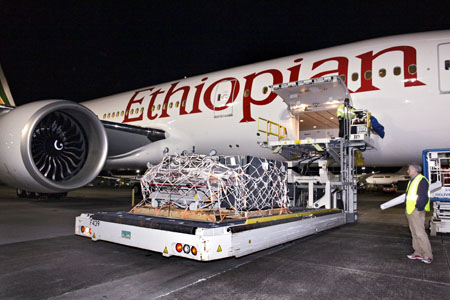
    EVERETT, Wash., Dec. 17, 2010 — Boeing partnered with Ethiopian Airlines and Seattle Anesthesia Outreach (SAO) for this week’s 777-200LR (longer range) delivery to Ethiopian Airlines to transport much needed anesthesia equipment to Black Lion Hospital – Ethiopia’s largest hospital.

    “Boeing and its airline partners have been working together to fill what is sometimes empty cargo space to help bring relief to people around the globe,” said Liz Warman, director of Boeing Global Corporate Citizenship for the Northwest region. “Our company has a history in humanitarian efforts. Our Humanitarian Delivery Flights program is another way we can continue leveraging our resources to help those in need.”

    “Since its inception, Ethiopian Airlines has been engaged in various corporate social responsibility activities, which support community initiatives and development efforts,” said Ato Girma Wake, CEO of Ethiopian Airlines. “We see our airplanes as not only a resource for our airline, but also a source of vital service for the people of Ethiopia and when we can use that resource in a manner such as this; it truly reaffirms our commitment to undertake social responsibilities whenever and wherever we can.”

    Ethiopian Airlines’ new 777-200LR (its second of five 777-200LRs on order) will deliver approximately 12,000 pounds (5,443 kg) of medical supplies, mainly anesthesia machines, monitors and books, from Seattle Anesthesia Outreach to Black Lion Hospital in Addis Ababa, Ethiopia. Black Lion Hospital is the largest hospital in Ethiopia as well as the largest teaching hospital for the University of Addis Medical School.

    “We’re thrilled at the opportunity to work with Boeing and Ethiopian Airlines to use this flight to support our efforts in Ethiopia,” said Dr. Mark Cullen, vice president and co-founder of SAO. “These supplies will prove critical when a group of 20 doctors travel to Ethiopia in February as part of our ongoing humanitarian trips to the region.”

    A majority of the medical supplies being shipped to Ethiopia were donated by Swedish Medical Center, which is the largest and most comprehensive non-profit health provider in the greater Seattle area. In addition to the donation of medical supplies, 12 affiliated physicians and clinical staff from Swedish have donated vacation time to volunteer as part of SAO’s humanitarian trips to Ethiopia.

    The Boeing Humanitarian Delivery Flights (HDF) program is a collaboration effort between Boeing, airline customers and non-profit organizations to deliver humanitarian aid throughout the world to communities in need or crisis. The humanitarian items are loaded into the empty cargo space of new airplanes being delivered and transported to the customer’s home destination.
    Ethiopian Airlines as a responsible corporate firm is committed to support worthy social activities, which are designed to help build sustainable livelihoods for individuals, the community and the society in general. In doing so, it has left its mark on major social initiatives.