Public Statement

  • |

    Spain: Boeing Completes Chinook

    Boeing Completes Chinook Industrial Cooperation Program in Spain

    MADRID, April 13, 2010 — The Boeing Company [NYSE: BA] today announced that it has successfully completed its industrial cooperation program for the third phase of the CH-47D Chinook rotorcraft upgrades performed for the Spanish Army’s Airmobile Force, FAMET. Boeing finished the industrial cooperation program on schedule while exceeding the $80 million requirement, demonstrating the company’s continued success in meeting its commitments.

    Over the 10-year program, Boeing completed 75 projects with 20 Spanish companies and institutions. All projects were coordinated through Isdefe, the company that negotiates and manages industrial cooperation agreements on behalf of the Spanish Ministry of Defense’s Armament and Material General Directorate.

    “In cooperation with Isdefe, Boeing is bringing high-value opportunities to Spanish industry,” said Gwen Kopsie, director of International Industrial Participation for Boeing Defense, Space & Security. “Spanish companies of all sizes were an integral part of the global supply base that brought state-of-the-art upgrades to the Spanish Army’s Chinook fleet. Many more Spanish companies also benefited from Boeing’s advanced technology transfer and training programs.”

    Boeing also supports Isdefe’s efforts to develop Spanish industry through a $13 million industrial cooperation program for the Harpoon advanced weapon control system. That program is on track for completion in 2012.
    “Boeing has been a partner to Spain for more than 75 years, serving the needs of both its commercial airplane customers and Spain’s military,” said Pedro Argüelles, president of Boeing Spain. “Today, Boeing’s presence in Spain remains strong thanks to our collaboration with airlines, government, academic institutions and industry. Through our Research & Technology Center in Madrid, we work with our partners in Spain to develop solutions for the environmental, safety and reliability, and air-traffic-control needs of today and tomorrow.”

    Boeing has successfully implemented industrial participation programs totaling more than US$41 billion in nearly 40 countries over the past 30 years.

    The Chinook is a true multi-role, vertical-lift platform. The primary Chinook mission is transport of artillery, troops, ammunition, fuel and supplies within military theaters of operation. CH-47s also have performed humanitarian-support, disaster-relief, rescue, firefighting and nation-building missions on six continents in all climates and conditions. The Chinook is currently in service with more than 18 countries worldwide.

    A unit of The Boeing Company, Boeing Defense, Space & Security is one of the world’s largest defense, space and security businesses specializing in innovative and capabilities-driven customer solutions, and the world’s largest and most versatile manufacturer of military aircraft. Headquartered in St. Louis, Boeing Defense, Space & Security is a $34 billion business with 68,000 employees worldwide.

  • |

    NTSB RELEASES 2009 AVIATION ACCIDENT STATST


    FOR IMMEDIATE RELEASE: April 8, 2010

    NTSB RELEASES 2009 AVIATION ACCIDENT STATISTICS; ON-DEMAND ACCIDENTS AT LOWEST LEVEL IN LAST 20 YEARS

    Washington, D.C. – The National Transportation Safety Board today released preliminary aviation accident statistics for 2009 showing an overall decrease in U. S. civil aviation accidents that includes general aviation and on-demand Part 135 operations. In fact, on-demand Part 135 operations had the lowest number of accidents and fatal accidents for that type of air operation in the last 2 decades.

    The total number of U.S. civil aviation accidents decreased from 1,658 in 2008 to 1,551 in 2009. Total fatalities also showed a decrease from 566 to 534. The majority of these fatalities occurred in general aviation and scheduled Part 121 operations.

    General aviation accidents decreased from 1,566 in 2008 to 1,474 in 2009. There were 272 fatal general aviation accidents, down from 275 the year before. However, the accident rate increased to 7.20 per 100,000 flight hours in 2009 from 6.86 in 2008, due to the decrease in the number total of flight hours. Although fatalities decreased from 494 to 474, the fatal accident rate increased to from 1.21 to 1.33.

    Last year, one fatal accident occurred involving a scheduled Part 121 operator. On February 12, 2009, a Colgan Air, Inc., Bombardier DHC-8- 400, operating as Continental Connection flight 3407, crashed outside of Buffalo , New York, resulting in 50 fatalities.

    On-demand Part 135 operations reported 47 accidents in 2009, a decrease from 58 in 2008. Fatalities also decreased from 69 in 2008 to 17 in 2009. The accident rate decreased to 1.63 per 100,000 flight hours in 2009 from 1.81 in 2008.

    Tables 1-12 providing additional statistics are available at: http://www.ntsb.gov/aviation/Stats.htm

  • |

    FAA Expands Air Traffic Education Program

    April 12–The Federal Aviation Administration announced today five new colleges and universities will be part of the Air Traffic Collegiate Training Initiative (AT-CTI). This is the third year the FAA has added schools to the AT-CTI program bringing the total number of schools participating to 36.

    The FAA AT-CTI program was first established in 1990 at Minneapolis Community and Technical College. The program helps recruit candidates for terminal and en route air traffic controller positions.

    Twenty-one institutions submitted applications early last year to join AT-CTI. The applications were evaluated based on the school’s organizational foundation and resources, organization credibility, air traffic basic curriculum and facilities.

    The five schools joining the program are: Sacramento City College, (Sacramento, CA), Florida Institute of Technology College of Aeronautics (Melbourne, FL), Texas State Technical College (Waco, TX), Western Michigan University (Battle Creek, MI), and Hesston College (Hesston, KS).

    CTI institutions are not given federal funds to teach air traffic control courses, however the FAA does provide curriculum and instructor notes on air traffic basics. The institutions independently incorporate the material into their aviation programs.

    The AT-CTI curriculum provides appropriate education, experience, and training which meet the basic requirements for the terminal and en route air traffic occupations. As a result, AT-CTI graduates may be permitted to bypass the initial five-week air traffic basics training when they report to the FAA Academy in Oklahoma City.

    No jobs are promised to students, but from fiscal years 2005 until 2009 over 3,000, or 41 percent, of the air traffic controllers hired graduated from an AT-CTI school.

    AT-CTI programs are currently available at these institutions: Aims Community College (Colorado), Arizona State University, Broward Community College (Florida), Community College of Baltimore County (Maryland), Community College of Beaver County (Pennsylvania), Daniel Webster College (New Hampshire), Dowling College (New York), Eastern New Mexico University, Embry Riddle–Daytona Beach (Florida), Embry Riddle–Prescott (Arizona), Florida Community College of Jacksonville, Green River Community College (Washington), Hampton University (Virginia), Inter-American University of Puerto Rico, Mount San Antonio (California), Jacksonville University (Florida), Kent State University (Ohio), LeTourneau University (Texas), Lewis University (Illinois), Metropolitan State College of Denver (Colorado), Miami Dade County College (Florida), Middle Georgia College, Middle Tennessee State University, Minneapolis Community and Technical College (Minnesota), Purdue University (Indiana), St. Cloud University (Minnesota), Tulsa Community College (Oklahoma), University of Alaska, University of North Dakota, University of Oklahoma, and Vaughn College of Aeronautics (New York).

  • |

    Boeing Appoints Antoine Balas Communications Director for France

    PARIS, April 12, 2010 — Boeing [NYSE: BA] has appointed Antoine Balas as Director of Corporate Communications for France. He will be responsible for developing the company’s communications strategies and engaging with key stakeholders in the French market.

    “France is a major customer and a strong partner for Boeing. Our industrial partnerships in France have been bolstered with the launch of the 787 Dreamliner”, said Yves Galland, president of Boeing France. “We are very pleased to welcome Antoine, who will work closely with the international teams to enhance the company’s reputation and help to grow our business in the country”.
    Balas, 39, has a 15-year career in corporate communications. From 1996 to 2004, he held various European positions within Honeywell International, including Communications Manager for the Aerospace organization in Europe. In 2004, he joined the French automotive supplier Valeo as Group Internal Communications Manager. In his last position at Valeo, he led Corporate Communications and Media Relations. He holds a degree in International Trade and a degree in Communications and Public Relations from ISERP.

    Since the opening of its Paris office in 2003, under the leadership of Yves Galland, Boeing has significantly increased its partnerships with French suppliers, creating the “Boeing French Team”. In France, more than 100 suppliers collaborate on Boeing programs.

  • |

    NTSB RELEASES 2009 AVIATION ACCIDENT STATISTICS

    ON-DEMAND ACCIDENTS AT LOWEST LEVEL IN LAST 20 YEARS

    Washington, D.C. – The National Transportation Safety Board
    today released preliminary aviation accident statistics for
    2009 showing an overall decrease in U. S. civil aviation
    accidents that includes general aviation and on-demand Part
    135 operations. In fact, on-demand Part 135 operations had
    the lowest number of accidents and fatal accidents for that
    type of air operation in the last 2 decades.

    The total number of U.S. civil aviation accidents decreased
    from 1,658 in 2008 to 1,551 in 2009. Total fatalities also
    showed a decrease from 566 to 534. The majority of these
    fatalities occurred in general aviation and scheduled Part
    121 operations.

    General aviation accidents decreased from 1,566 in 2008 to
    1,474 in 2009. There were 272 fatal general aviation
    accidents, down from 275 the year before. However, the
    accident rate increased to 7.20 per 100,000 flight hours in
    2009 from 6.86 in 2008, due to the decrease in the number
    total of flight hours. Although fatalities decreased from
    494 to 474, the fatal accident rate increased to from 1.21
    to 1.33.

    Last year, one fatal accident occurred involving a scheduled
    Part 121 operator. On February 12, 2009, a Colgan Air,
    Inc., Bombardier DHC-8- 400, operating as Continental
    Connection flight 3407, crashed outside of Buffalo , New
    York, resulting in 50 fatalities.

    On-demand Part 135 operations reported 47 accidents in 2009,
    a decrease from 58 in 2008. Fatalities also decreased from
    69 in 2008 to 17 in 2009. The accident rate decreased to
    1.63 per 100,000 flight hours in 2009 from 1.81 in 2008.

  • |

    Boeing Confirms Success on 787 Wing, Fuselage Ultimate Load Test


    EVERETT, Wash., April 7 /PRNewswire-FirstCall/ — Boeing (NYSE: BA) announced today that all test requirements were successfully met during the 787 Dreamliner’s ultimate load wing and fuselage bending test. This follows a thorough analysis of the results from a test on the 787 static test airframe.
    “Successfully completing this test is a critical step in the certification of the 787. This is further validation that the 787 performs as expected, even in the most extreme circumstances,” said Scott Fancher, vice president and general manager of the 787 program for Boeing Commercial Airplanes.
    On March 28, loads were applied to the test unit to replicate 150 percent of the most extreme forces the airplane is ever expected to experience while in service. The wings were flexed upward by approximately 25 feet (7.6 meters) during the test and the fuselage was pressurized to 150 percent of its maximum normal operating condition.
    In evaluating the success criteria for the test, Boeing specialists have been poring over the thousands of data points collected during the test to ensure that all parts of the airplane performed as expected.
    “The airframe performed as designed and retained the required structural integrity. These results continue to validate the design of the 787 as we move toward certification,” explained Fancher.

    Video of the static test can be found below:

  • |

    NTSB Safety Recommendations A-10-44 and -45

    The National Transportation Safety Board recommends that the
    Federal Aviation Administration:

    Require repetitive inspections for fatigue cracking of the
    nose landing gear actuator attachment foot areas on all
    Piper PA-46-310 and -350P engine mounts and require
    replacement, if necessary. (A-10-44)

    Require Piper to redesign the PA-46-310 and -350P engine
    mounts so that they are not susceptible to fatigue cracking
    in the attachment foot areas. (A-10-45)

    The National Transportation Safety Board (NTSB) has investigated two accidents involving Piper PA-46-350P airplanes that resulted from fatigue cracking in the attachment between the nose landing gear (NLG) actuator and the engine mount. Such fatigue cracks can lead to the collapse of the NLG, which could cause a serious or catastrophic accident if the separation occurred at a critical point during takeoff or landing or if the aircraft collided with parked aircraft or aircraft waiting at taxiways.

    On August 16, 2009, about 1130 eastern daylight time,1 a Piper PA-46-350P, N548C, experienced an NLG collapse during landing at the Orlando-Sanford International Airport, Sanford, Florida.2 The private pilot and passenger were uninjured, and the airplane sustained substantial damage. No flight plan was filed for the 14 Code of Federal Regulations (CFR) Part 91 personal flight, nor was one required to be filed by the Federal Aviation Administration (FAA). Visual meteorological conditions (VMC) prevailed at the time of the accident.

    On May 19, 2007, about 1305, a Piper PA-46-350P, N411MD, experienced an NLG collapse during landing at the Indianapolis Metropolitan Airport near Fishers, Indiana.3 The pilot and passenger were uninjured, and the airplane sustained substantial damage. No flight plan was filed for the 14 CFR Part 91 personal flight, nor was one required to be filed by the FAA. VMC prevailed at the time of the accident.

    The NLG actuator on Piper PA-46-350P airplanes is bolted via two attachment feet to the lower aft engine mount, which is constructed of welded tubes (see figure 1). The NLG actuator extends down and forward from the attachment feet and attaches to the NLG. During taxi, takeoff, and landing, the attachment feet transmit loads from the NLG to the engine mount, thus creating repetitive tensile stress in the engine mount attachment feet areas and, in some cases, leading to fatigue cracking.

    Piper PA-46-310 and -350P airplanes have either an original engine mount or a redesigned engine mount (see figure 2).5 In the original design, each attachment foot is a two-piece part consisting of a metal disk welded to the end of a metal tube, which is then welded to the engine mount support tubes. In the redesigned engine mount, each attachment foot is a one-piece machined part made from a single piece of steel, eliminating the welding within the feet themselves. However, on both the original and redesigned engine mounts, the attachment feet are welded to the engine mount support tubes, which is where fatigue cracking has been identified by the NTSB.

    The airplane in the Sanford, Florida, accident was equipped with a redesigned engine mount that was installed at the time of manufacture. The NTSB’s postaccident examination of N548C revealed that the right attachment foot had fractured at the engine mount support tube. The NTSB materials laboratory’s examination of the fractured foot revealed a fatigue crack emanating from multiple origins at the exterior of the joint where the attachment foot was welded to the support tube. At the time of the accident, the airplane was 8 years old and had accumulated 711 flight hours with 878 cycles since new (CSN).

    The airplane in the Fishers, Indiana, accident had a redesigned engine mount that was installed on March 21, 2003. The airplane had accumulated 542 flight hours and an estimated 1,400 cycles since then. At the time of the accident, the airplane was 7 years old and had accumulated a total of 772 flight hours.6 The NTSB’s postaccident examination of N411MD revealed that the right attachment foot had separated from the rest of the engine mount due to fatigue cracking7 where the attachment foot was welded to the support tube.
    The NTSB also notes that a similar incident of fatigue cracking of an NLG attachment foot was found on September 29, 2009, during a routine inspection of a Piper PA-46-350P airplane. The airplane was 5 years old and had accumulated a total of 678 flight hours with 600 CSN and was equipped with the redesigned engine mount.

    On April 22, 2002, Piper issued mandatory Service Bulletin (SB) 1103, recommending that operators of PA-46-310P, -350P, and -500TP8 airplanes inspect the NLG actuator attachment foot area of the original engine mounts for evidence of fatigue cracking. The SB indicated that such cracking had been found in this area of some original engine mounts.

    The inspection included visual and liquid penetrant inspection at the next regular scheduled maintenance event and each 100 hours in service or at the annual inspection, whichever occurred first. If cracks were found, the original engine mounts were to be replaced with the redesigned engine mounts before returning to service. SB 1103 does not subject the airplanes with redesigned engine mounts to repetitive inspections, and replacing the original engine mount with the redesigned engine mount relieves the need for repetitive inspections. Piper issued several inspections.

    The NTSB is concerned that the redesigned engine mounts on Piper P
    A-46-310 and -350P model airplanes have attachment foot areas susceptible to fatigue cracking similar to the fatigue cracks identified by Piper on the original engine mounts. The NTSB concludes that the tensile stresses applied to the redesigned engine mounts could lead to fatigue fractures in the NLG actuator attachment foot areas. However, redesigned engine mounts are not currently subject to the inspection provisions of SB 1103, nor is compliance with SB 1103 required.10 Although the NTSB is not aware of incidents or accidents involving original engine mounts that have not been inspected, the NTSB believes that inspections of the original engine mounts should also be mandatory in order to detect fatigue cracking.

    Therefore, the NTSB recommends that the FAA require repetitive inspections for fatigue cracking of the NLG actuator attachment foot areas on all Piper PA-46-310 and -350P engine mounts and require replacement, if necessary.

    As previously noted, Piper redesigned the engine mounts on the PA-46-310 and -350P in an effort to prevent fatigue cracking at the attachment foot areas. However, based on the accidents discussed above, this redesign does not appear to have been successful since fatigue cracking has also occurred in the redesigned engine mounts. Therefore, the NTSB recommends that the FAA require Piper to redesign the PA-46-310 and -350P engine mounts so that they are not susceptible to fatigue cracking in the attachment foot areas.
    Therefore, the National Transportation Safety Board recommends that the Federal Aviation Administration:

    Require repetitive inspections for fatigue cracking of the nose landing gear actuator attachment foot areas on all Piper PA-46-310 and -350P engine mounts and require replacement, if necessary. (A-10-44)

    Require Piper to redesign the PA-46-310 and -350P engine mounts so that they are not susceptible to fatigue cracking in the attachment foot areas. (A-10-45)

    In response to the recommendations in this letter, please refer to Safety Recommendations A-10-44 and -45. If you would like to submit your response electronically rather than in hard copy, you may send it to the following e-mail address: correspondence@ntsb.gov.

  • |

    CHARLESTON, WEST VIRGINIA RUNWAY OVERRUN

    NTSB TO OPEN PUBLIC DOCKET ON JANUARY 2010 CHARLESTON, WEST VIRGINIA RUNWAY OVERRUN

    As part of the Safety Board’s investigation into the runway overrun at Yeager Airport, Charleston, West Virginia, the NTSB will open the public accident docket on Thursday, April 8, 2010.

    On January 19, 2010, PSA Airlines d.b.a. US Airways Express flight 2495, a Bombardier CL600-2B19, registration N246PS, rejected the takeoff and ran off the end of the runway at Yeager Airport, Charleston, West Virginia. The airplane stopped in the engineered materials arresting system (EMAS).

    There were no injuries to the 31 passengers or 3 crew members onboard and the airplane received minor damage. The flight was operating under the provisions of 14 CFR Part 121 and its intended destination was Charlotte/Douglas International Airport, Charlotte, North Carolina.

    The Transportation Safety Board of Canada has assigned an Accredited Representative to assist the investigation under the provisions of ICAO Annex 13 as the State of the Manufacturer of the airplane.

    The information being released is factual in nature and does not provide any analysis. It will include investigative group factual reports, photographs, and other documents from the investigation. Additional material will be added to the docket as it becomes available. Analysis of the accident, along with conclusions and a determination of probable cause, will come at a later date when the final report on the investigation is completed.

  • |

    NTSB Release: Maintenance Causes 2008 Crash

    FOR IMMEDIATE RELEASE
    April 6, 2010
    SB-10-10

    POOR MAINTENANCE STARTED ACCIDENT CHAIN THAT RESULTED IN HIGH-SPEED RUNWAY EXCURSION THAT KILLED FOUR IN 2008, NTSB DETERMINES

    Washington, DC – A chartered business jet crashed at a South Carolina airport 18 months ago because of the operator’s inadequate maintenance of the airplane’s tires and the decision by the captain to attempt a high-speed rejected takeoff, which went against standard operating procedures and training, the NTSB determined today.

    On September 19, 2008, at 11:53 p.m. EDT, a Bombardier Learjet Model 60 (N999LJ) operated by Global Exec Aviation and destined for Van Nuys, California, overran runway 11 during a rejected takeoff at Columbia Metropolitan Airport. After the airplane left the departure end of runway 11, it struck airport lights, crashed through a perimeter fence, crossed a roadway and came to rest on a berm. The captain, the first officer, and two passengers were killed; two other passengers were seriously injured.

    The investigation revealed that prior to the accident the aircraft was operated while the main landing gear tires were severely underinflated because of Global Exec Aviation’s inadequate maintenance. The underinflation compromised the integrity of the tires, which led to the failure of all four of the airplane’s main landing gear tires during the takeoff roll.

    Shortly after the first tire failed, which occurred about 1.5 seconds after the airplane passed the maximum speed at which the takeoff attempt could be safely aborted, the first officer indicated that the takeoff should be continued but the captain decided to reject the takeoff and deployed the airplane’s thrust reversers. Pilots are trained to avoid attempting to reject a takeoff at high-speed unless the pilot concludes that the airplane is unable to fly; the investigation found no evidence that the accident airplane was uncontrollable or unable to become airborne.

    The tire failure during the takeoff roll damaged a sensor, which caused the airplane’s thrust reversers to return to the stowed position. While the captain was trying to stop the airplane by commanding reverse thrust, forward thrust was being provided at near-takeoff power because the thrust reversers were stowed. The Safety Board determined that the inadvertent forward thrust contributed to the severity of the accident.

    The Safety Board also found that neither the Federal Aviation Administration nor Learjet adequately reviewed the Airplane’s design after a similar uncommanded forward thrust accident that occurred during landing in Alabama in 2001. While the modifications put into place after the Alabama accident provided additional protection against uncommanded forward thrust upon landing, no such protection was provided for a rejected takeoff.

    “This accident chain started with something as basic as inadequate tire inflation and ended in tragedy,” said NTSB Chairman Deborah A.P. Hersman. “This entirely avoidable crash should reinforce to everyone in the aviation community that there are no small maintenance items because every time a plane takes off, lives are on the line.”

    The safety recommendations that the NTSB made to the Federal Aviation Administration as a result of this investigation are: provide pilots and maintenance personnel with information on the hazards associated with tire underinflation, including the required intervals for tire pressure checks, and allow pilots to perform pressure checks in air taxi operations to ensure that tires remain safely inflated at all times; require tire pressure monitoring systems for all transport category airplanes; identify and correct deficiencies in both Learjet’s thrust reverser system safety analysis and the FAA’s design certification process to ensure that hazards encountered in all phases of flight are mitigated; require that simulator training for pilots who conduct turbojet operations include opportunities to practice responding to events other than engine failures near takeoff speeds; require that pilots who fly air taxi turbojet operations have a minimum level of pilot operating experience in an airplane type before acting as pilot-in- command in that type; and require that airplane tire testing criteria reflect the loads that may be imposed on tires both during normal operating conditions and after the loss of one tire.

  • |

    Boeing Press Release:Training Class

    Boeing Completes First 787 Dreamliner Maintenance Training Class

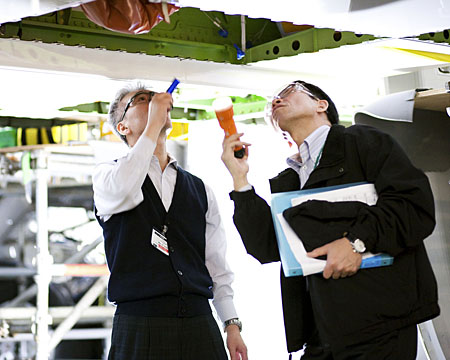
    EVERETT, Wash., April 6 — Boeing (NYSE: BA) today announced that it has completed the first maintenance training class for the 787 Dreamliner. The class consisted of 10 mechanics from 787 launch customer ANA (All Nippon Airways) and two regulators from the Japan Civil Aviation Bureau (JCAB).

    The mechanics, who completed the training last week, are the first of 150 ANA mechanics to be trained by Boeing over the next seven months. They spent more than 30 days learning how to maintain the world’s most advanced commercial jetliner, including 20 days of theoretical training, two days of engine runs and taxi testing, five days of practical training and five days of troubleshooting exercises. To conclude the training, students conducted component identification exams on production airplanes, as well as troubleshooting exams in the full flight simulator.

    To support the all-new 787, Boeing Training & Flight Services, a division of Commercial Aviation Services, Boeing Commercial Airplanes, has developed an all-digital, Internet-based teaching system for maintenance training, along with training tools that connect real-time to a virtual airplane and airplane systems.

    “Getting our mechanics trained and prepared is essential to being ready to take delivery of the airplane later this year,” said Michihide Kono, vice president of Engineering and Maintenance for ANA. “This is an important milestone for our ANA team and we are delighted to see the continued progress on the program.”

    The curriculum is designed to focus on performance-based training that incorporates real-world simulated maintenance scenarios for a more immersive training experience.

    “The use of personal tablet computers, interactive computer-based training, three-dimensional images and desktop simulation makes it possible to deliver training more efficiently,” said Sherry Carbary, vice president of Boeing Training & Flight Services, Commercial Aviation Services, Boeing Commercial Airplanes. “Our team is committed to providing our customers with the resources and tools they need to be successful.”

    The 787 comes with digital tools and databases that replace volumes of printed materials. The graphic and textual database has point-and-click features for more details, allowing mechanics to navigate through documents quickly to get the information they need to do their jobs.

    “This milestone is another important step along the way to being service-ready,” said Mike Fleming, director of 787 Services and Support, Boeing Commercial Airplanes. “Our goal is to make entry into service a seamless experience for our customers.”

    Fifty-seven customers around the world have ordered 866 787s since the program was launched in April 2004, making the Dreamliner the fastest-selling new commercial jetliner in history. Delivery of the first 787 is planned for the fourth quarter of 2010.

  • ICAO Consensus

    STRONG CONSENSUS REACHED AT ICAO SAFETY CONFERENCE ON WAYS TO REDUCE ACCIDENTS

    FOR IMMEDIATE RELEASE

    PIO 04/10

    MONTREAL, 1 April 2010 – A High-Level Safety Conference which concluded today established a strong mandate for the International Civil Aviation Organization (ICAO) to create a strategy to further reduce the global accident rate, through the sharing of safety-related information among Member States and the air transport industry.

    More than 600 participants at the four-day event, attended by Ministers and Directors General of Civil Aviation from 150 Member countries as well as industry representatives, recommended that ICAO create a global safety information exchange to enable analysis of key safety indicators. This will guide future strategic decisions related to the evolution of today’s air transportation system. The Conference called upon ICAO to facilitate the collection, analysis and dissemination of safety information provided by States and industry partners, throughout the international aviation community.

    The Conference further recommended that ICAO develop processes to give the general public access to relevant safety information, thereby allowing them to make an informed decision about the safety of air transportation and to further ensure that such information is used solely to improve aviation safety and not for retribution or the purpose of gaining economic advantage.

    “We have traditionally focused our efforts on accident reports as a means to improve safety. This new approach will help us to better identify and deal with safety threats before they result in accidents”, said Roberto Kobeh González, President of the Council of ICAO.

    “Regulators and industry must come to manage safety-critical information in the same way that they view accidents. Both must become triggers for action in preventing accidents,” he added.

    On Tuesday, ICAO, the Federal Aviation Administration of the United States (FAA), the Commission of the European Union (EC) and the International Air Transport Association (IATA) signed a Declaration of Intent on the development of a global safety information exchange agreement.

    In the months to come, the parties will establish an operational framework for the information exchange. It will address technical, confidentiality, legal and policy implications, as well as the relevance and timing of information collected.

    “ICAO has long promoted the concept of information sharing on a global scale so as to connect the various databases of regulators and industry. The recommendation from the Conference and the Declaration of Intent represent a breakthrough in achieving our objective of better utilizing data to reduce the accident rate globally and in specific regions and States around the world,” Mr. Kobeh emphasized.

    On the question of black boxes, the Conference recommended that ICAO look into technical enhancements that would improve the ability to locate and recover the units, such as longer time periods for signals, better resistance to crashes and floatability.

    “While the electronic transmission of information during flights is progressively improving, black boxes will remain absolutely indispensable for years to come as the primary source of technical data in cases of accidents or incidents,” Mr. Kobeh said.

    The Conference also called on States and industry to ensure improved communication and surveillance of flights over oceanic and remote areas through the use of all available technologies.

    Reaffirming the fundamental mission of ICAO to ensure the safety of international civil aviation, the Conference endorsed the creation of a new Annex to the Convention on International Civil Aviation, one dedicated exclusively to safety management principles.

    Recommendations from the Conference will be submitted to the Council of ICAO for consideration in the coming weeks.

  • |

    NTSB Meets

    NTSB TO MEET ON BUSINESS JET RUNWAY EXCURSION ACCIDENT THAT KILLED FOUR AND INJURED TWO IN SOUTH CAROLINA

    The National Transportation Safety Board will hold a public Board meeting on its investigation into an accident in which a chartered business jet crashed during a rejected takeoff in Columbia, South Carolina, 18 months ago.

    The purpose of the meeting will be to determine the probable cause of the accident and to consider proposed safety recommendations to reduce the likelihood of future such mishaps.

    On September 19, 2008, at 11:53 p.m. EDT, a Bombardier Learjet Model 60 (N999LJ) operated by Global Exec Aviation and destined for Van Nuys, California, overran runway 11 during a rejected takeoff at Columbia Metropolitan Airport. The captain, the first officer, and two passengers were killed; two other passengers were seriously injured.

  • Boeing Contribution

    Boeing Contribution to Shuttle Mission Includes Troubleshooting, Payload Prep

    KENNEDY SPACE CENTER, Fla., April 2, 2010 — The Boeing Company [NYSE: BA] has been providing NASA with a wide variety of hardware and services — including troubleshooting a stuck valve — to ensure Space Shuttle Discovery launches as scheduled on April 5.

    One of two helium isolation valves in the shuttle’s starboard Orbital Maneuvering System (OMS) pod failed in the open position on March 13 during helium tank preparations prior to OMS pod propellant loading. High-pressure helium is used to push propellants from storage tanks into small rocket motors used for routine orbital maneuvers.

    “As the original equipment manufacturer for the space shuttle and a major subcontractor on the program, Boeing engineers were a part of a NASA-led problem resolution team that analyzed the complex data and provided recommendations,” said John Mulholland, Boeing Space Shuttle Program vice president and program manager. “The team concluded that given the redundancy in the system, the space shuttle is safe to fly with the valve in this configuration.”

    Shuttle mission STS-131 will transport four experiment racks to the International Space Station (ISS), along with one systems rack, seven resupply stowage platforms, and four resupply stowage racks. Boeing engineers in Huntsville, Ala., designed and built two of the four experiment racks — the Expedite the Processing of Experiments to Space Station (EXPRESS) Rack 7 and the Window Observational Research Facility (WORF).

    EXPRESS Rack 7 is a multipurpose payload rack system that will store and support science experiments aboard the ISS. Experiments can be easily integrated into the system, which includes structural interfaces, power, command/data, video, cooling, nitrogen, vacuum exhaust, and other items needed to operate experiments in space.
    The WORF fits over the U.S. Destiny lab window and will maximize the use of the window via attachments for cameras, camcorders, and other instruments to capture imagery of the Earth and space.

    The mission also will deliver an Ammonia Tank Assembly (ATA) that Boeing refurbished at Kennedy Space Center. The ATA works in conjunction with the station’s External Active Thermal Control System to help cool the exterior and interior components of the ISS.

    The Boeing Checkout, Assembly and Payload Processing Services (CAPPS) team prepared the entire mission payload for launch. The services and support Boeing provides under its CAPPS contract include planning for and receiving payloads, maintaining associated ground support systems, integrating payloads with the space shuttle, launch support, and space shuttle post-landing payload activities.
    Boeing is the prime contractor to NASA for the ISS. In addition to designing and building all the major U.S. elements, Boeing also is responsible for ensuring the successful integration of new hardware and software — including components from international partners — as well as for providing sustaining engineering work for the ISS.

  • |

    FAA Proposes New Policy on Antidepressants for Pilots

    For Immediate Release
    April 2, 2010

    WASHINGTON, D.C. — The Federal Aviation Administration (FAA) today announced that it will consider the special issuance of a medical certificate to pilots who are taking medication for mild to moderate depression, conditions that now bar them from all flying duties.

    On a case-by-case basis beginning April 5, pilots who take one of four antidepressant medications – Fluoxetine (Prozac), Sertraline (Zoloft), Citalopram (Celexa), or Escitalopram (Lexapro) – will be allowed to fly if they have been satisfactorily treated on the medication for at least 12 months. The FAA will not take civil enforcement action against pilots who take advantage of a six-month opportunity to share any previously non-disclosed diagnosis of depression or the use of these antidepressants.

    “I’m encouraging pilots who are suffering from depression or using antidepressants to report their medical condition to the FAA,” said FAA Administrator Randy Babbitt. “We need to change the culture and remove the stigma associated with depression. Pilots should be able to get the medical treatment they need so they can safely perform their duties.”

    The FAA’s policy is consistent with recommendations from the Aerospace Medical Association, Aircraft Owners and Pilots Association, Air Line Pilots Association and the International Civil Aviation Organization. The Civil Aviation Authority of Australia, Transport Canada and the U.S Army already allow some pilots to fly using antidepressant medications.

    Psychiatrists and Aviation Medical Examiners who have specialized training under the Human Intervention and Motivation Study (HIMS) program will help the FAA evaluate and monitor pilots under this new policy. The HIMS program was established 40 years ago and has been highly effective for the assessment, treatment, and medical certification of pilots who need help with alcohol and drug issues.

  • |

    EU Banned List updated: Official Press Release

    Commission updates the list of airlines banned from the European airspace
    The European Commission has adopted the thirteenth update of the Community’s list of airlines banned in the European Union to include all air carriers of two additional countries: Sudan and the Philippines, on the basis of safety assessments by the International Civil Aviation Organization (ICAO). With this update, restrictions placed on Air Koryo from the Democratic People’s Republic of Korea and TAAG from Angola are partially lifted under certain conditions, while the operations of Iran Air will be restricted.

    Commission Vice-President Siim Kallas, responsible for Transport, said: “Safety comes first. We are ready to support countries that need to build up technical and administrative capacity to guarantee the necessary standards in civil aviation. But we cannot accept that airlines fly into the EU if they do not fully comply with international safety standards.”

    With this update, the Air Koryo licensed in the Democratic People’s Republic of Korea, subject to an operating ban since March 2006, is allowed to resume operations into the EU with two aircraft which are fitted with the necessary equipment to comply with mandatory international standards and following appropriate oversight by its authority. The rest of its fleet remains barred from operating into the EU.

    The Commission recognises the improvements in the operations of TAAG Angola Airlines by allowing the air carrier to operate under certain strict conditions with specific aircraft to all destinations in the EU, not only to Lisbon.

    The civil aviation authority of Angola is urged to intensify its oversight in relation to all carriers and continue the recertification of the other Angolan air carriers which remain banned from operating into the EU.

    The Commission imposes an operating ban on all operations of Sudanese air carriers, due to a poor safety performance of the civil aviation authority of Sudan resulting from persistent non-compliance with international standards in the area of oversight.

    The Commission acknowledges the recent efforts launched by the competent authorities to reform the civil aviation system in the Philippines and steps taken to address safety deficiencies reported by the FAA and ICAO and measures taken by two carriers – Philippines Airlines and Cebu Airlines – to ensure safety of operations. It is ready to support the Philippines to overcome serious safety deficiencies.

    In view of the significant safety concerns identified by ICAO in relation to the authorities, the Commission with the unanimous support of the Air Safety Committee is forced to follow the principle of precaution and impose an operating ban on all air carriers licensed in the Philippines. The Commission is ready to support the Philippine authorities and conduct a visit to the country.

    Following an examination of the safety of Iran Air’s operations into the EU through ramp checks of its aircraft in the Community, evidence of serious incidents and accidents suffered by the carrier and insufficient oversight from the authority over the past year, the Air Safety Committee concluded unanimously that the operations of Iran Air to the EU should be restricted. The carrier will only be allowed to use certain aircraft for flights to Europe. The Commission will visit Iran over the next months to verify the oversight of the Iranian civil aviation organisation and the safety situation of Iran Air.

    The results of a recent visit by the European Aviation Safety Agency to Albania indicate that the competent authority needs to strengthen its capabilities to ensure the oversight of the air carriers it licences. The authorities have been urged by the Commission to take prompt action to address these issues. The Commission will closely monitor the situation.

    The Commission follows closely the performance of Egyptian air carriers. A visit to Egypt to verify the oversight functions of the civil aviation authority and the performance of certain air carriers showed that this authority is carrying out its responsibilities correctly. The Commission will continue to cooperate closely with this authority to ensure that proposed improvements can be implemented.

    Today, the Community’s list has three carriers whose operations are fully banned in the European Union – Ariana Afghan Airlines from Afghanistan, Siem reap Airways International from Cambodia and Silverback Cargo Freighters from Rwanda.

    All carriers from 17 countries – 278 companies in total – are banned: Angola, Benin, the Democratic Republic of Congo, Djibouti, Equatorial Guinea, Gabon, (with the exception of three carriers which operate under restrictions and conditions), Indonesia, Kazakhstan (with the exception of one carrier which operates under restrictions and conditions), the Kyrgyz Republic, Liberia, Philippines, Republic of Congo, Sierra Leone, Sao Tome and Principe, Sudan, Swaziland and Zambia. 10 air carriers are allowed to operate under restrictions and conditions – Air Koryo from the Democratic People Republic of Korea, TAAG Angola Airlines, Air Astana from Kazakhstan, Iran Air from Iran Gabon Airlines, Afrijet and SN2AG from Gabon, Air Bangladesh, Air Service Comores and Ukrainian Mediterranean Airlines from Ukraine.

  • |

    Press Release: NTSB TO MEET

    National Transportation Safety Board
    Washington, DC 20594

    April 1, 2010
    NTSB TO MEET ON BUSINESS JET RUNWAY EXCURSION ACCIDENT THAT
    KILLED FOUR AND INJURED TWO IN SOUTH CAROLINA

    The National Transportation Safety Board will hold a public
    Board meeting on its investigation into an accident in which
    a chartered business jet crashed during a rejected takeoff
    in Columbia, South Carolina, 18 months ago.

    The purpose of the meeting will be to determine the probable
    cause of the accident and to consider proposed safety
    recommendations to reduce the likelihood of future such
    mishaps.

    On September 19, 2008, at 11:53 p.m. EDT, a Bombardier
    Learjet Model 60 (N999LJ) operated by Global Exec Aviation
    and destined for Van Nuys, California, overran runway 11
    during a rejected takeoff at Columbia Metropolitan Airport.
    The captain, the first officer, and two passengers were
    killed; two other passengers were seriously injured.

    The meeting will be held in Washington on Tuesday, April 6,
    20010, at 9:30 a.m. ET, in the NTSB Board Room and
    Conference Center at 429 L’Enfant Plaza, S.W.

    A live and archived webcast of the proceedings will be
    available on the Board’s website at
    http://www.ntsb.gov/Events/Boardmeeting.htm. Technical
    support details are available under “Board Meetings.” To
    report any problems, please call 703-993-3100 and ask for
    Webcast Technical Support.

    A summary of the Board’s final report, which will include
    its findings, probable cause and safety recommendations,
    will appear on the website shortly after the conclusion of
    the meeting. The entire report will appear on the website
    several weeks later.

  • |

    ICAO Press Release: Safety Conference

    FOR IMMEDIATE RELEASE
    STRONG CONSENSUS REACHED AT ICAO SAFETY CONFERENCE ON WAYS TO REDUCE ACCIDENTS
    MONTREAL, 1 April 2010 – A High-Level Safety Conference which concluded today established a strong mandate for the International Civil Aviation Organization (ICAO) to create a strategy to further reduce the global accident rate, through the sharing of safety-related information among Member States and the air transport industry.

    More than 600 participants at the four-day event, attended by Ministers and Directors General of Civil Aviation from 150 Member countries as well as industry representatives, recommended that ICAO create a global safety information exchange to enable analysis of key safety indicators. This will guide future strategic decisions related to the evolution of today’s air transportation system. The Conference called upon ICAO to facilitate the collection, analysis and dissemination of safety information provided by States and industry partners, throughout the international aviation community.

    The Conference further recommended that ICAO develop processes to give the general public access to relevant safety information, thereby allowing them to make an informed decision about the safety of air transportation and to further ensure that such information is used solely to improve aviation safety and not for retribution or the purpose of gaining economic advantage.

    “We have traditionally focused our efforts on accident reports as a means to improve safety. This new approach will help us to better identify and deal with safety threats before they result in accidents”, said Roberto Kobeh González, President of the Council of ICAO.

    “Regulators and industry must come to manage safety-critical information in the same way that they view accidents. Both must become triggers for action in preventing accidents,” he added.

    On Tuesday, ICAO, the Federal Aviation Administration of the United States (FAA), the Commission of the European Union (EC) and the International Air Transport Association (IATA) signed a Declaration of Intent on the development of a global safety information exchange agreement.

    In the months to come, the parties will establish an operational framework for the information exchange. It will address technical, confidentiality, legal and policy implications, as well as the relevance and timing of information collected.

    “ICAO has long promoted the concept of information sharing on a global scale so as to connect the various databases of regulators and industry. The recommendation from the Conference and the Declaration of Intent represent a breakthrough in achieving our objective of better utilizing data to reduce the accident rate globally and in specific regions and States around the world,” Mr. Kobeh emphasized.

    On the question of black boxes, the Conference recommended that ICAO look into technical enhancements that would improve the ability to locate and recover the units, such as longer time periods for signals, better resistance to crashes and floatability.

    “While the electronic transmission of information during flights is progressively improving, black boxes will remain absolutely indispensable for years to come as the primary source of technical data in cases of accidents or incidents,” Mr. Kobeh said.

    The Conference also called on States and industry to ensure improved communication and surveillance of flights over oceanic and remote areas through the use of all available technologies.

    Reaffirming the fundamental mission of ICAO to ensure the safety of international civil aviation, the Conference endorsed the creation of a new Annex to the Convention on International Civil Aviation, one dedicated exclusively to safety management principles.

    Recommendations from the Conference will be submitted to the Council of ICAO for consideration in the coming weeks.

    – END –

    PIO.04.10.ENGLISH PIO.04.10.FRENCH PIO.04.10.SPANISH PIO.04.10.RUSSIAN PIO.04.10.ARABIC PIO.04.10.CHINESE

    Posted in Uncategorized. Comments Off
    Sharing of Information highlight of second day of Safety Conference
    March 30, 2010 — oacicomm
    On the second day of the High-level safety Conference, the more than 600 participants from some 150 ICAO Member States and industry unequivocally endorsed the twin concepts of transparency and sharing of safety-related information among States and with major stakeholders within the global aviation community, as well as with the general public.

    There was agreement that ICAO should be the body charged with coordinating the integration of the safety information provided by the international community as well as for the dissemination of safety intelligence. To that end, ICAO would convene a group of experts to define and harmonize safety metrics, associated data requirements and analysis processes.

    ICAO would also develop a code of conduct on the sharing of safety information, so as to ensure that such information is used solely to improve aviation safety and not for retribution or the purpose of gaining economic advantage.

    Processes would be developed to provide the general public with access to relevant safety information which would allow them to make an informed decision about the safety of air transportation.

    Recommendations on these and other items will be reviewed and approved on the final day of the Conference, Thursday, 1 April. Recommendations will subsequently be submitted to the ICAO Council for consideration in the coming weeks.

    Earlier in the Conference, in line with the discussions on the sharing of information as a means to improve aviation safety levels around the world, ICAO and three other State and industry parties signed a Declaration of Intent on the Development of a Global Safety Information Exchange Agreement: the Federal Aviation Administration of the United States (FAA); the Commission of the European Union (EC); and the International Air Transport Association (IATA).

    In the weeks to come, representatives of the signatories will produce a work plan incorporating the following activities and concepts: identification of the safety information gathered by the Participants that would be most relevant to the enhancement of risk reduction activities; identification of the legal or policy constraints, if any, on the ability of Participants to share this information among the parties and development of mechanisms to overcome these constraints; identification of the appropriate timing of that information sharing; development of an efficient mechanism to ensure that this information is used to generate safety intelligence and identify critical safety trends in a timely fashion; development of policies and procedures to safeguard proprietary, confidentially submitted, and/or personal information in line with relevant applicable privacy laws, data sharing policies and regulations standardization of aspects of the audit metrics, data taxonomies etc, to maximize effective utilization of the safety information gathered in this process; and determination of how to disseminate this information globally as appropriate.

    Tomorrow the conference will discuss the creation of a new Annex to the Convention on International Civil Aviation, one dedicated to safety processes.

  • IATA PRESS RELEASE:

    Aviation Organizations Launch Safety Information Exchange

    Montreal – The International Air Transport Association (IATA), along with three governmental aviation safety organizations, took the first step to creating a global information exchange to improve aviation safety.

    IATA, together with the International Civil Aviation Organization (ICAO), the US Federal Aviation Administration (FAA), and the Commission of the European Union (EU), has signed a Declaration of Intent to exchange safety data. The signing took place during the ICAO High-Level Safety Conference in Montreal.

    “Today’s milestone agreement marks the first time the global aviation community has come together to work on a global safety information exchange. Data must drive our actions so that we can focus our joint efforts on reducing the greatest risks,” said Giovanni Bisignani, IATA’s Director General and CEO.

    “Working together with governments using global standards, safety has improved tremendously. In 1945, there were 9 million passengers and 247 fatalities. In 2009, 2.3 billion people flew with 685 fatalities. Every fatality is a human tragedy and reminds us that we must do better. Today’s agreement is one more important step to make a safe industry even safer,” said Bisignani.

    Audit data will be a key element in the project. IATA, ICAO, the FAA and the EU conduct audit programs that collect complementary safety information. “We must understand safety trends, not just from the handful of accidents each year, but by bringing together and analyzing data from millions of safe flights. With this we can take more effective action to reduce risks and improve safety performance,” said Bisignani.

    “There is no competition when it comes to safety. Cooperation is the way forward. We have a common goal of zero accidents and zero fatalities. The safety data from audits and oversight programs contains important parts of a whole picture. Agreeing to put this data together is a major step forward,” said Bisignani.

    The four organizations will now start work on a way to standardize safety audit information and ensure compliance with local privacy laws and policies. This is targeted to be completed within 12 to 18 months.

    The 2009 global accident rate, measured in hull losses per million flights of Western-built jet aircraft, was 0.71. This is a significant improvement of the 0.81 rate recorded in 2008. Compared to 10 years ago, the accident rate has been cut 36% from the 1.11 rate recorded in 2000.

  • NTSB-Near Collision over San Francisco

    NTSB INVESTIGATING NEAR MID-AIR COLLISION OVER SAN FRANCISCO INVOLVING COMMERCIAL JETLINER AND SMALL PLANE

    National Transportation Safety Board
    Washington, DC 20594

    March 30, 2010

    NTSB INVESTIGATING NEAR MID-AIR COLLISION OVER SAN FRANCISCO INVOLVING COMMERCIAL JETLINER AND SMALL PLANE

    The NTSB has launched an investigation to determine why a commercial jetliner and a small light airplane came within an estimated 300 feet of colliding over San Francisco on Saturday.

    At about 11:15 a.m. PDT on March 27, the crew of United Airlines Flight 889, a B777-222 (N216UA) destined for Beijing, China, carrying 251 passengers and a crew of 17, was cleared to takeoff from San Francisco International Airport (SFO) on runway 28L and climb to an initial altitude of 3,000 feet. The first officer, who was flying the aircraft, reported that after the landing gear was retracted and the jet was at an altitude of about 1,100 feet, the tower controller reported traffic at his 1 o’clock position. Immediately following the controller’s advisory, the airplane’s traffic collision avoidance system (TCAS) issued an audible alert of “TRAFFIC TRAFFIC.”

    The pilots saw a light high wing airplane, an Aeronca 11AC (N9270E), in a hard left turn traveling from their 1 o’clock to 3 o’clock position. The first officer pushed the control column forward to level the airplane. Both crew members reported seeing only the underside of the Aeronca as it passed to within an estimated 200-300 feet of the 777.

    TCAS then issued an “ADJUST VERTICAL SPEED” alert, followed by a “DESCEND, DESCEND” alert. The first officer complied and the flight continued to Beijing without further incident.

    NTSB investigator Scott Dunham is traveling to San Francisco to begin the investigation.

  • |

    Boeing Completes Ultimate-Load Wing Test on 787

    EVERETT, Wash., March 28 /PRNewswire-FirstCall/ — Boeing (NYSE: BA) today completed the ultimate-load wing up-bending test on the 787 Dreamliner static test unit. During the testing, loads were applied to the airframe to replicate 150 percent of the most extreme forces the airplane is ever expected to experience while in service. The wings were flexed upward by approximately 25 feet (7.6 meters) during the test.

    The initial results of the ultimate-load test are positive. More extensive analysis and review are required before the test can be deemed a success.

    “The test program has been more robust than any conducted on a Boeing commercial jetliner,” said Scott Fancher, vice president and general manager of the 787 program, Boeing Commercial Airplanes. “It has taken countless hours of hard work by the Boeing team and our partners to work through the static test program. Everyone who has been involved in this effort over the past several years should be very proud of their contributions to ensuring the safety of the 787 Dreamliner.

    “We are looking forward to the technical team’s report on the details of the test results,” said Fancher. It will take them several weeks to work through all of the data.
    During each second of the more than two-hour test, thousands of data points were collected to monitor the performance of the wing. Key data points are monitored real-time during the test, but all of the data will be evaluated in the weeks ahead.

  • IATA Wings of Change

    Santiago Chile-March 24-25

    The six page keynote address by the Secretary General of ICAO Mr Richard Benjamin at the IATA 2010 “Wings of Change” conference is available in pdf form here. The Wings of Change 2010 is the main Latin American forum which addresses the regulatory needs of the Latin American aviation industry in these challenging times. This biennial conference will once again cover the main topics facing airlines, aviation authorities, airports, regulators and other industry stakeholders.

    Among other things, the address talks about the safety conference, and discusses an Annex to the Chicago Convention dedicated to Safety Management to highlight safety as ICAO’s focus; issues in fatigue management; security challenges; Aviation Environmental Protection.

  • IATA Statement on US-EU Agreement

    For Immediate Release
    Date: 25 March 2010

    Geneva – The International Air Transport Association (IATA) released the following comments in response to today’s Memorandum of Consultation on Second Stage Open Skies agreement between the US and the European Union:

    “It is disappointing that, at this critical time, we did not make significant progress on the issue of ownership. The agreement was not a step backwards, but it did not move us forward. The long-term financial sustainability of the industry is dependant on normal commercial freedoms. I urge both governments to keep this on the radar screen for urgent follow-up,” said Giovanni Bisignani, IATA’s Director General and CEO.

    IATA welcomed the reaffirmation within the agreement that environmental issues leading up to COP-16 should continue to be addressed through the International Civil Aviation Organization (ICAO). “ICAO is the right forum to reach a global sectoral approach to deal with aviation’s carbon emissions. I welcome the agreement’s reaffirmation of this as the industry continues to pursue its ambitious environmental targets to improve fuel efficiency by 1.5% per year to 2020, cap net emissions from 2020 with carbon neutral growth and cut net carbon emissions in half by 2050 compared to 2005,” said Bisignani.

  • NTSB SENDING TEAM TO INVESTIGATE EMERGENCY MEDICAL SERVICES HELICOPTER ACCIDENT IN TENNESSEE

    The National Transportation Safety Board is sending a team
    to investigate the crash of an emergency medical services
    (EMS) helicopter this morning in Brownsville, Tennessee,
    about 55 miles northeast of Memphis. Three crewmembers were
    killed in the accident; there was no patient onboard at the
    time of the crash.

    NTSB Air Safety Investigator Ralph Hicks has been designated
    as Investigator-in-Charge and is traveling to the scene from
    the Safety Board’s regional office in Atlanta. NTSB Chairman
    Deborah A.P. Hersman will serve as principal spokesman
    during the on-scene investigation.

    Improving the Safety of (EMS) flight operations has been on
    the NTSB’s Most Wanted List of Safety Improvements since
    2008:
    http://www.ntsb.gov/Recs/mostwanted/aviation_improvesafety_e
    ms_flights.html

    Peter Knudson will be the press officer on-scene. Mr.
    Knudson may be reached on his cell phone (202-557-1350) when
    he arrives in Tennessee this afternoon.

  • |

    Boeing Comments on WTO’s Landmark Decision on Airbus Subsidies

    CHICAGO, March 23 /PRNewswire-FirstCall/ — Boeing issued the following statement following news reports quoting officials who indicated that the United States has prevailed on all of the major issues in the WTO’s final decision, which reaffirms its earlier interim decision, in the U.S. case against European subsidies to Airbus.

    “This is a powerful, landmark judgment and good news for aerospace workers across America who for decades have had to compete against a heavily subsidized Airbus. U.S. officials have estimated the commercial value to Airbus of all the government launch aid subsidies it has received at more than $178 billion (in 2006 dollars). Government subsidies have been used to support the creation of every Airbus product, including the A330/A340, which received more than $5 billion in development aid, and the A380, which received $4 billion in subsidies. Those and other European government subsidies to Airbus have significantly distorted the global market for large commercial airplanes, causing adverse effect to Boeing and costing America tens of thousands of high-tech jobs.

    “We appreciate the strong bipartisan efforts by both the executive and legislative branches of the U.S. government to right this wrong and ensure that America’s aerospace workers get a fair shake. Because of the U.S. government’s undiminished resolve to end illegal subsidies, this decision should level the competitive playing field once and for all with Airbus, as well as set an important precedent for other nations with aspirations to enter the commercial airplane business.

    “Airbus and its sponsor governments continue to re-affirm their commitment to using subsidized launch aid to fund the next Airbus airplane, the A350. We urge them to change course and fully comply with the WTO’s clear ruling. The WTO panel has painstakingly and professionally reviewed all of the evidence that’s been presented the past four years. It is extremely important to international trade and global economic growth that governments and businesses abide by the WTO’s rules. Markets, not parliaments, should pick the winners in the global aerospace industry.”

    Contact:
    Charlie Miller, +44-7802-399-622
    John Dern, 312-285-3754
    SOURCE Boeing

  • NTSB CHAIRMAN HIGHLIGHTS RUNWAY SAFETY

    National Transportation Safety Board
    Washington, DC 20594

    FOR IMMEDIATE RELEASE: March 23, 2010
    SB-10-09

    NTSB CHAIRMAN HIGHLIGHTS RUNWAY SAFETY AND HUMAN FATIGUE IN
    ADDRESS TO AIR TRAFFIC CONTROLLERS

    Washington, DC – In an address to the National Air Traffic
    Controllers Association (NATCA) in Orlando today, NTSB
    Chairman Deborah A.P. Hersman lauded controllers for their
    role in keeping the number of runway incursions low while
    challenging the Federal Aviation Administration to hasten
    the pace of its efforts to improve runway safety.

    Attributing the decline in runway related incidents and
    accidents in part to “robust procedures, safe designs, and
    well-trained and alert controllers and pilots,” Hersman said
    that “we still have a lot of work to do,” and that the FAA
    needs to move more aggressively to lower the risk of runway
    accidents.

    Hersman chaired the NTSB’s February meeting in which runway
    safety was again voted onto its Most Wanted List of Safety
    Improvements where it has been since its inception in 1990.
    The Safety Board’s recommendations to the FAA includes
    providing immediate warnings of probable collisions and
    incursions directly to flight crews in the cockpit;
    requiring specific ATC clearance for each runway crossing;
    requiring operators to install cockpit moving map displays
    or an automatic system that alerts pilots when a takeoff is
    attempted on a taxiway or a runway other than the one
    intended; and requiring a landing distance assessment with
    an adequate safety margin for every landing.

    Citing an ongoing investigation of an incident in which a
    767 landed on a taxiway in Atlanta in October, Hersman said
    that the NTSB took a strong interest in the event “because
    we want to know what led a professional flight crew to
    mistake a taxiway for a runway, whether the controllers
    could have detected the misaligned final approach to landing
    and intervened, and whether there are technological tools
    that can be used to prevent such incidents from ever
    occurring in the first place.” Although no one was injured
    in the incident, Hersman said that “if this event had
    resulted in a fatal collision, there would be – far and wide
    – immediate and understandable calls for changes.”

    Hersman also cited human fatigue as an area that the Safety
    Board has become particularly focused on, saying that “We
    are seeing fatigue as a causal or contributing factor in
    numerous accidents across all transportation modes.” The
    NTSB has made recommendations to the FAA to set working hour
    limits for flight crews, aviation mechanics, and air traffic
    controllers, and has asked the FAA develop a fatigue
    awareness and countermeasures training program for
    controllers and those who schedule them for duty.

    Recently, NATCA and the FAA established a working group to
    collaboratively address the human fatigue issues that the
    NTSB has identified. Hersman noted the significance of this
    positive step by the leadership of both organizations and
    called it a very encouraging development.

    Concluding with an invitation for air traffic controllers to
    participate in a three-day forum on pilot and controller
    excellence that the NTSB will be holding in Washington in
    May, Hersman emphasized the value of learning from the
    numerous examples of superior job performance by
    controllers. “Through our work we are very good at finding
    out what went wrong, but frankly, it is just as important to
    know what is going right, because we want to replicate that
    throughout the entire national airspace system,” she said.

    The complete text of Chairman Hersman’s speech may be
    obtained on the Board’s website at
    http://www.ntsb.gov/Speeches/hersman/daph100323.html

    ###