Aircraft

  • |

    Boeing and FAA to Team for Cleaner Skies, Quieter Airplanes

    WASHINGTON, June 24 /PRNewswire-FirstCall/ — The Boeing Company (NYSE: BA) and the U.S. Federal Aviation Administration announced today that they will work together to speed the development and application of environmentally progressive technologies for cleaner and quieter jet aircraft.

    As part of the FAA’s Continuous Lower Energy, Emissions and Noise (CLEEN) program, Boeing and the FAA each will contribute up to $25 million during the next five years to conduct flight demonstrations of emergent airframe and engine technologies that have the potential of reducing greenhouse gas emissions and community noise.

    “By combining our resources and expertise, we believe we can transition promising technologies from development into service more quickly to help reduce the environmental footprint of airplanes,” said Matt Ganz, vice president and general manager of Boeing Research & Technology, which is leading the program at Boeing. “We recognize the importance of protecting our ecosystem and are looking forward to working with the FAA on a variety of innovative solutions to help define the future.”

    The technologies being developed under the CLEEN program will be flight tested aboard two demonstration vehicles, a Next-Generation Boeing 737 in 2012, with a second series of test flights aboard a yet-to-be-determined twin-aisle airplane in 2013.

    This flight-test program builds on the success of the company’s Quiet Technology Demonstrators, which successfully highlighted a variety of noise reduction technologies during test flights aboard Boeing 777 aircraft from 2001 to 2005.

    According to Boeing CLEEN Program Manager Craig Wilsey, the technologies that will be developed and tested during demonstration flights include adaptive wing trailing edges and ceramic matrix composite acoustic engine nozzles.

    Adaptive trailing edges pertain to a collection of small controllable devices that are integrated into the aft portion of the wing. Most traditional wings are designed for best performance while at cruise, and have performance compromises during other flight phases. Adaptive trailing edges can help tailor the wing configuration to reduce fuel burn at takeoff, climb and cruise, and to reduce community noise at takeoff and landing.

    New-generation engines on commercial airplanes are more efficient, but require materials that are capable of withstanding higher temperatures than previous engines. Ceramic matrix composites offer the potential of better thermal and structural performance, while helping to reduce weight and acoustic footprint.

    In addition to Boeing Research & Technology, the company’s advanced central research, technology and innovation organization, Boeing’s CLEEN team is composed of engineers and support staff from Boeing Commercial Airplanes and Boeing Test & Evaluation.

    Boeing continues to take aggressive steps to improve the environmental performance of its products including:

    Producing the world’s newest commercial airplanes, the 787 Dreamliner and the 747-8, designed to be significantly more fuel-efficient and have lower emissions than earlier generation jetliners.

    Pioneering research into sustainable aviation biofuel made from biomass sources that do not compete with food crops or land or water use. Aviation biofuels have lower carbon emissions over their lifecycle and help lessen aviation’s dependence on fossil fuels.

    Developing ways to improve the efficiency of the global air traffic control network, which will enable passengers to arrive at their gates sooner and reduce the carbon footprint of commercial air travel.

  • |

    Aéropro – Crash kills 7 in Canada

    What: Aéropro Beechcraft A100 King Air en route from Jean-Lesage International Airport to Sept-Îles Airpor
    Where: 1.6 km N. of Jean-Lesage Int. Airport near Quebec
    When: June 23, 2010
    Who: 5 passengers, 2 crew, 7 fatalities
    Why: After takeoff, the pilot complained of a problem in his right engine. The pilot attempted to return to the airport, but the plane crashed into a residential neighborhood and exploded.

  • | | |

    Durban Emergency Landing

    What: One Time McDonnell Douglas MD-87 en route from Durban to Cape Town
    Where: Durban
    When: Jun 23rd 2010
    Why: After takeoff, the landing gear did not retract, according to the cockpit indicators. The pilot did a flyby to confirm, and the plane returned safely to King Shaka International Airport. Passengers took alternative flights. The MD-87 was flown to Johannesburg for maintenance and repairs.

  • | | |

    Helicopter fire in CA

    What: private helicopter crash en route from Paso Robles to Benecia
    Where: Paicines area field
    When: June 22, 2010
    Who: 4 aboard
    Why: The pilot and adult passenger were taking their daughters to choir practice. After the cockpit began to smell of smoke, the pilot landed in the field. Just prior to landing, flames erupted from the motor. The pilot and adult passenger quickly exited with their daughters, and a few moments later, the helicopter was engulfed in flames.

  • | |

    Neighborhood Cessna Crash Narrowly Misses Residents

    What: Wings and Wheels Cessna 210 #N30286
    Where: west of Lock Haven’s William T. Piper Memorial Airport
    When: Monday June 21, 2010
    Who: pilot and 2 USDA employees, all fatalities
    Why: The pilot had notified the airport about landing and fuel, but there was no emergency indicated to ATC prior to the crash. On approach to the airport, a block from the runway, the plane struck a house, a utility pole and three vehicles in a residential neighborhood. Pilot Patrick Jessup and the two federal employees, Rodney Whiteman and Dan Snider were fatalities; no one on the ground in the neighborhood was injured. The aircraft caught fire after impact and was destroyed.

    The flight had been chartered by the US Department of Agriculture to conduct aerial insect surveys.


  • | | |

    American Airlines eyes Boeing Engine Pylons

    Cracks in the engine pylons of three American Airlines Boeing 767’s are prompting concerns over the need of more frequent inspections of Boeing 767’s. The FAA says American and Boeing are looking for the cause of the cracking, which was discovered during routine metallurgical tests. Boeing is preparing a service bulletin establishing new guidelines for inspecting this particular part, over and above the every “1500 flights” which stands now. The flight which originally caught American’s attention had developed the cracks during the last 500 flights since its last pylon inspection. Caution about underlying structural issues is being addressed.

    The preliminary conclusion is that certain maintenance practices may play in the underlying cause of the cracking. A known issue is that some of the cracks arise from holes used to install bolts, implying that the bolt holes may compromise the structural integrity, or at least affect the pylon’s longevity; and may affect “fail-safe” design.

    The FAA has not yet mandated inspection of 767 other jets operated by other carriers, nor have they determined if winglets are a contributing factor.

  • | | | | | | |

    Banned List Carrier Hewa Bora Airways Averts Disaster


    Pictured: a Hewa Bora Airways McDonnell Douglas MD-82
    Click to view full size photo at Airliners.net
    Contact photographer Sean Mowatt

    What: Hewa Bora McDonnell Douglas MD-82 en route from Kinshasa N’Djili to Kisangani Democratic Republic of Congo to Goma
    Where: Kinshasa Democratic Republic of the Congo (Zaire)
    When: Jun 21 2010
    Who: 101 aboard
    Why: When a tire burst on takeoff, hydraulics and an engine were affected. The pilot had to return to the Kinshasa airport and dumped fuel next to the airport, but could not land well because of the damage. On landing, the plane veered off the runway but came to a stop safely in the rough off the runway. In fact, it is the condition of the runway that appears to have caused the problem–assuming the plane ran over a pothole or bump which caused the hydraulic problem and forced the left engine shutdown.

  • |

    Is Oxygen Hose Length an Issue?

    We talked about the May 16 cockpit fire on a United Boeing 757 (New York to Los Angeles) that made an emergency diversion to Dulles. That event involved an airborne cockpit fire so extreme that the pilot reached for the fire extinguishers to put out flames coming from his windshield—but he was brought up short by the length of the oxygen hose. In the smokey situation, it must have been a special concern to have the oxygen mask rip away from the pilot’s face. I can only assume there is other essential gear stored and unreachable due to the length of the hose, because I haven’t seen anyone talk about solving the hose length issue by moving the extinguishers closer.

    In fact, on some Boeing 757 and 767s the length of the hose attached to the pilot’s oxygen mask and smoke goggles is under scrutiny now by the FAA for being too short to reach the fire extinguishers. Apparently Boeing has resisted lengthening the hose because of the danger of the pilot getting tangled in the hose.

    Since the FAA is looking into the issue of the possibility of the hoses being too short, one can not help but wonder if this problem were a factor in the May 22 – Air India Express Flight 812 Boeing 737-800 crash at Mangalore International Airport, or the Jan 25 Ethiopian Airlines Flight 409 Boeing 737-800 that crashed into the Mediterranean Sea shortly after take-off from Beirut. How do we know that too-short hoses did not contribute to those tragic events?

    Conversely, if the 737 hose length is not too short and allows the pilot to reach where it essential for the pilot to reach, and there is no hose problem on the 737, then why has Boeing not corrected this problem on 757s and 767s?

  • | | | | |

    2nd Vladivostok Avia emergency landing in a week


    Pictured: A Vladivostok Avia Tupolev Tu-204-300
    Click to view full size photo at Airliners.net
    Contact photographer Maksimov Maxim

    What: Vladivostok Avia Tu-204 en route from Moscow to Blagoveshchensk
    Where: Yekaterinburg
    When: June 20, 2010
    Who: 116 passengers (11 children)
    Why: While en route, an engine malfunctioned and the flight had to divert from Blagoveshchensk to Yekaterinburg. A replacement jet was provided which is scheduled to take off at 7:30 Yekaterinburg time

  • | | | | |

    Thai Boeing Hits Turbulence


    Click to view full size photo at Airliners.net
    Contact photographer Mu yun

    What: Thai Airways Boeing 777-200 en route from Bangkok to Osaka
    Where: Kansai International Airport in the city of Izumisano in Osaka Prefecture
    When: Jun 20th 2010
    Who: 227 passengers and 17 crew, 4 injured
    Why: The flight encountered turbulence at 6:30 am over the Pacific Ocean off Kochi Prefecture

    The flight landed safely Osaka 15 minutes later. Three cabin crew and one passenger were hospitalized for injuries. The weather service says that the atmosphere was unstable due to a rain front.

  • | | | |

    Helicopter Hard Landing in Oregon


    Pictured: A Hillsboro Aviation Bell 206B-3 JetRanger III
    Click to view full size photo at Airliners.net
    Contact photographer Ted Quackenbush

    What: Hillsboro Aviation Robinson R22
    Where: quarter mile south of the Hillsboro Airport, east of the Washington County Fairgrounds
    When: Jun 19th, 2010 8:40 pm
    Who: pilot and passenger
    Why: On approach to the airport, the pilot lost power and attempted an emergency field landing. The helicopter flipped on landing, but the pilot and passenger were unhurt.

  • | |

    Cloud Nine Emergency Landing, Palm Beach

    What: Cloud 9 Helicopters Flight Training School Robinson 22
    Where: Palm Beach Gardens, North Palm Beach County
    When: June 19 2010
    Who: Pilot and trainee
    Why: On a training flight, equipment caught on fire and the helicopter had to make an emergency landing on Aviation Boulevard. The helicopter flipped but both the pilot and trainee “walked away.”

  • | | | |

    Candy Bomber Emergency Landing in Berlin


    Click to view full size photo at Airliners.net
    Contact photographer Stephan Karl

    What: Air Service Berlin Douglas C-47 Skytrain, Vintage DC3 “Rosinenbomber”
    Where: Berlin’s Schoenefeld airport
    When: June 19, 2010
    Who: 3 crew, 25 tourists, 7 injuries
    Why: After the left engine failed, the DC3 made an emergency landing at Schoenefeld airport in Berlin. The flight made a safe landing. The plane was part of a 1948-49 fleet that carried supplies during the Berlin Airlift, and is now used to shuttle tourists.

    On landing, the right wing and engine separated resulting in a small fire.

  • | | | |

    UK Light Crash Kills pilot

    What: Light crash
    Where: in a field next to the River Aire between Castleford and Methley.
    When: June 19, 2010 4 p.m.
    Who: 31 year old pilot
    Why: In west yorkshire, the plane crashed near the river Aire, killing the pilot.

  • | |

    Cessna tree-strike

    What: Oasis Flight Services. twin engine Cessna en route to Plymouth Municipal Airport
    Where: PLYMOUTH, Mass
    When: June 19 2010,5:15 p.m.
    Who: three aboard
    Why: After surveying, the Cessna was en route to the airport when it got stuck in a tree in a Plymouth neighborhood. No one was injured.

  • | |

    Ultralight Crash

    What: ultralight
    Where: east of Decatur Texas
    When: June 20, 2010
    Who: pilot
    Why: The ultralight crashed at 9:30 a.m.. The pilot was was flown by helicopter to Fort Worth’s John Peter Smith Hospital

  • | |

    Statement from the FAA

    Statement from the FAA in Response to the Associated Press Story about Temporary Flight Restrictions over the Gulf of Mexico
    For Immediate Release
    June 17, 2010

    WASHINGTON, D.C. — Today’s story by the Associated Press contains a number of inaccuracies with regard to the government’s oversight of flyovers in and around the oil spill in the Gulf of Mexico. Since May 28th, the FAA has approved every request to fly over the area–more than 176 requests. While the temporary flight restriction requires pilots to stay above 3,000 feet, the FAA is working with news organizations and granting exceptions so that pilots can fly at lower altitudes throughout the day.

    The reason for these requirements is safety, pure and simple. So far, there have been a number of reported near misses over the Gulf due to heavy traffic and pilots flying above the oil spill to give their passengers a closer look.

    On Sunday, a helicopter carrying a member of the Associated Press violated the temporary flight restriction around the oil clean-up efforts in the Gulf of Mexico. The helicopter operator was not authorized to fly into the restricted area and was flying at various altitudes well below 3,000 feet. For over 30 minutes, the pilot was not in communication with the Border Patrol aircraft that is providing traffic advisories for all participating aircraft. Border Patrol was forced to divert other traffic in the area, creating a dangerous situation for everyone involved. When the pilot was finally reached he was told to leave the area.

    A pilot deviation (an action that results in the violation of a Federal Aviation Regulation) is being filed against the helicopter pilot.

  • | |

    New Mexico Cessna Crash

    What: Rod Aviation twin-engine Cessna 310 en route from Cleburne Muncipal Airport to Ruidoso
    Where: near the Sierra Blanca Airport, which is located about 18 miles northeast of Ruidoso
    When: June 17 2010 @ 9:50 a.m
    Who: fatalities: Rodney and DeLaine Duree, both 50, and their son, Lake, Karl Richey, 46, and his wife, Kaeri, 44. Hospitalized: Richeys’ sons, Alexander, 16, and Christopher, 12.
    Why: The flight crashed while attempting to land and caused a forest fie which has now been contained. The purpose of the flight was to scatter a relative’s ashes in New Mexico.

  • | | |

    Canada: United Airlines Overrun


    Click to view full size photo at Airliners.net
    Contact photographer Hediye Akyuez

    What: United Airlines Embraer ERJ-145 en route from Washington DC to Ottawa
    Where: Ottawa
    When: Jun 16 2010
    Who: 33 passengers and 3 crew
    Why: On landing in rainy conditions, the plane was unable to slow down and overran the end of the runway. There were a few minor injuries (one pilot injured his leg, the other his neck and an elderly passenger injured her neck) and the plane’s collapsed nose gear damage is considered substantial.

    Passengers disembarked by following the exit route and jumping from one of the wings to the grass.

  • |

    Press Release: Boeing 787 Dreamliner Passes 1,000 Hours of Flying

    EVERETT, Wash., June 17 /PRNewswire-FirstCall/ — The Boeing 787 Dreamliner flight test fleet passed 1,000 hours of testing yesterday. The program estimates that it is about 40 percent through the test conditions required to certify the first version of the all-new jetliner.
    “More work remains but we are seeing excellent progress in flight test,” said Scott Fancher, vice president and general manager of the 787 program for Boeing Commercial Airplanes. “Even more important than the hours we’ve logged are the test conditions we have completed. The team is being very efficient in getting the data we need.”

    “It’s also important to note that we are making solid progress on the ground testing required on the flight test fleet as well,” Fancher said.

  • | | | |

    Ethiopia Flight Makes Cautionary Landing

    What: Ethiopian airplane Boeing 737-800 Flight 407 en route from Addis Ababa to Beirut
    Where: Beirut International Airport
    When: June 17 2010
    Who: 78 passengers
    Why: The flight returned to the airport because of an “undisclosed technical problem.” Crew noticed a door was rattling and had been closed improperly. (It is unclear if that was the technical problem.) The flight made a safe landing. The same plane was cleared for takeoff six hours later.

  • | | |

    Illegal Flight Ends in Colombia

    What: Cessna T210L en route from Medellín, Antioquia, Colombia to Quibdó, Colombia
    Where: Puente Iglesias, Fredonia Colombia
    When: June 15, 2010
    Who: 2 fatalities
    Why: Near Puente Iglesias, the illegal flight was lost at dusk over the Cauca river; no trace of the crew was found. Searchers found a bag containing 57 kilos of cocaine aboard. Witnesses to the crash said the crew had been seen on the plane in the river, but there had not been time to reach them before the plane sank in the river. Rescuers are looking for the bodies along the river.

    George’s Point of View

  • |

    Boeing Team Helps Royal Netherlands Air Force Achieve Aviation Milestone

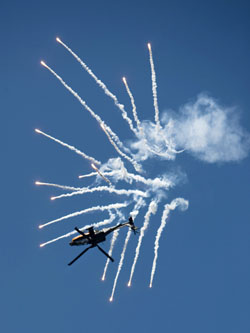
    GILZE-RIJEN AIRBASE, Netherlands, June 16, 2010 — Boeing ] and The Royal Netherlands Air Force (RNLAF) today made aviation history when a Boeing AH-64D Apache became the first rotorcraft in the world to fly using a blend of sustainable bio-kerosene and standard aviation jet fuel.
    The 20-minute flight, conducted at Gilze-Rijen Airbase, home of the RNLAF’s combat rotorcraft squadrons, was witnessed by dozens of industry observers and defense journalists.
    The sustainable biofuel used in the flight was produced using algae-based biomass and used cooking oil, and processed by UOP, LLC, a Honeywell company, into a Bio-Synthetic Paraffinic Kerosene (Bio-SPK), which has been used in previous commercial biofuel flights. In a series of preflight tests, the 50/50 bio-kerosene and traditional jet fuel blend met or exceeded the JP-8 fuel specifications for the Apache. No engine or airframe modifications were made prior to flight.
    “This is a tremendous achievement for the Royal Netherlands Air Force, Boeing, Honeywell, and the engine manufacturer GE Aviation in our efforts to develop sustainable aviation fuel solutions,” said Al Winn, vice president of Apache Programs for Boeing, who attended the demonstration. “Both Boeing’s commercial and military customers are pursuing alternatives to fossil fuels, sharing a vision that was demonstrated flawlessly by our Apache customer today.”

    “Today is an important milestone for the more intensive usage of sustainable bio-kerosene in aviation,” said Eimert van Middelkoop, Minister of Defense of the Netherlands.
    The RNLAF biofuel flight test program encompasses seven flights that will highlight the technical feasibility of flying rotorcraft using renewable fuels that do not reduce the availability of food crops or water. The Ministry of Defense of the Netherlands, which authorized the flight test program, has publicly stated its commitment to minimizing its environmental footprint of military aircraft.

    “This program also will help stimulate market development for aviation biofuel within the Netherlands that can help improve the environmental performance of commercial and military aviation,” said Jan Närlinge, president of Boeing Northern Europe.

    Boeing is engaged in sustainable biofuel research around the world and supported the Apache flight and the RNLAF through preflight planning, testing and technical consultation based on a strong body of biofuel experience. The company supplied technical support to a KLM Royal Dutch Airlines biofuel flight aboard a Boeing 747 in November 2009, and also to the U.S. Navy F/A-18 Super Hornet biofuel flight on Earth Day this year. Boeing also supported four previous biofuel flights using varying fixed-wing commercial aircraft and engine types.
    Extensive laboratory testing by fuel processors, feedstock providers and engine manufacturers has further shown that aviation biofuels meet or exceed the high performance and quality standards specified for military and commercial jet fuels.

    A unit of The Boeing Company, Boeing Defense, Space & Security is one of the world’s largest defense, space and security businesses specializing in innovative and capabilities-driven customer solutions, and the world’s largest and most versatile manufacturer of military aircraft. Headquartered in St. Louis, Boeing Defense, Space & Security is a $34 billion business with 68,000 employees worldwide.