press release

  • |

    Boeing Begins Assembly of First 747-8 Intercontinental

    EVERETT, Wash., — Boeing announced it began assembly of the first 747-8 Intercontinental at the factory in Everett, Wash. Late this week, mechanics took the first step in major assembly for the new airplane by loading its wing panels and spars in the assembly tools. The spar is the internal support structure that runs through the full length of the wing.

    “This milestone symbolizes the dedication, focus and hard work that our team, suppliers and customers have invested in designing this wonderful airplane,” said Mo Yahyavi, vice president and general manager of the 747 program, Boeing Commercial Airplanes. “The 747-8 Intercontinental will provide our customers with increased levels of passenger comfort, greatly improved fuel efficiency and reduced emissions and noise.”

    Deutsche Lufthansa AG was the first airline to order the new, fuel-efficient passenger airplane, contracting for 20 747-8 Intercontinentals, with purchase rights for an additional 20. “We are very pleased to see that the production on the 747-8 Intercontinental has begun,” said Nico Buchholz, senior vice president, Corporate Fleet of Deutsche Lufthansa AG. “We are looking forward to welcoming the aircraft in our fleet as it is a component of Lufthansa’s strategy to modernize its fleet and increase environmental stewardship. The 747-8 shows our clear commitment to customer orientation.”

    The new 747-8 Intercontinental is stretched 18.3 feet (5.6 m) from the 747-400 to provide 467 seats — 51 more than its predecessor — in a three-class configuration. GEnx-2B engines and a new wing design provide airlines a quieter, more fuel-efficient airplane. The 747-8 is 16 percent more fuel efficient and creates a 30 percent smaller noise footprint than its predecessor. The 747-8 also provides nearly equivalent trip costs and 13 percent lower seat-mile costs than the 747-400, plus 26 percent greater cargo volume.
    The 747-8 interior incorporates features from the 787 Dreamliner, including a new curved, upswept architecture that gives passengers a greater sense of space and comfort while adding more room for personal belongings. The architecture is accentuated by lighting technology that provides smooth transitions for a more restful flight.

    The 747-8, which includes the 747-8 Intercontinental and the 747-8 Freighter, was launched in November 2005. Boeing has 108 orders for the 747-8 — 32 for the 747-8 Intercontinental and 76 for the 747-8 Freighter. The first 747-8 Intercontinental is scheduled to deliver in late 2011.

  • ICAO Press Release: ICAO holds initial meeting on New volcanic ash contingency plan

    ICAO is furthering progress on the development of an internationally-harmonized safety risk management framework to provide for the safety of air transport operations in airspace contaminated by volcanic ash.

    The European and North Atlantic Regional office of ICAO will host a preparatory meeting tomorrow to begin the process of amending the regional volcanic ash contingency plan following the unprecedented disruptions caused by the recent eruption of Iceland’s Eyjafjallajökull volcano on 14 April,

    Stakeholders from the air transport and scientific communities will lay the basis for a more comprehensive meeting on 8-10 June, with the objective of delivering a revised North Atlantic Volcanic Ash Contingency Plan by 14 June.

    The results of the meeting will be incorporated into the work of the International Volcanic Ash Task Force established by the Council of ICAO on 29 April 2010.

  • FAA Proposes $572,150 in Civil Penalties Against Atlas Air, Inc.

    NEW YORK — The Federal Aviation Administration (FAA) has proposed to assess $572,150 in civil penalties against Atlas Air, Inc., of Purchase, NY, a scheduled air cargo airline, for alleged violations of the Federal Aviation Regulations.

    The FAA alleges that Atlas Air incorrectly installed a replacement cockpit window on a Boeing 747F, and then operated the aircraft on 49 flights between April 4 and April 27, 2009, when it was not in compliance with those regulations.

    The FAA said Atlas Air replaced one of the windows at the first officer’s position, but failed to use the methods, techniques and practices specified in the manufacturer’s maintenance manual or alternate procedures accepted by the FAA for the B-747F. The airline then approved the aircraft for return to service. As a result, the replacement window suffered pressurization leaks while in flight according to multiple reports made by crews operating or maintaining the aircraft. The FAA has proposed a penalty of $506,150 for those violations.

    In a second instance, the FAA alleges that on May 14 and 15, 2009, Atlas Air operated a Boeing 747 on international flights from Huntsville, AL, to Glasgow, Scotland, Luxembourg City and back to Huntsville without a required outboard engine pylon access panel door. The FAA said Atlas Air improperly fabricated a panel cover from aluminum sheet metal and affixed it with speed tape over the access door opening. On each of these flights, the panel came off the aircraft enroute and a new panel was fabricated and installed in the same manner at each subsequent stop. The FAA has proposed a civil penalty of $66,000 for those violations.

    Atlas Air has 30 days from receipt of the FAA’s enforcement letters to respond to the agency.

  • |

    Dutch Safety Board (DSB) Issues Accident Report on February 25, 2009 Accident of a Boeing 737-800 at Amsterdam Schiphol Airport (EHAM)

    The National Transportation Safety Board assisted in the investigation of the accident of Turkish Airlines flight 1951, a Boeing 737-800, registration TC-JGE, which occurred on February 25, 2009, while on approach to runway 18R at Amsterdam Schiphol Airport (EHAM), Amsterdam, Netherlands.

    Under the provisions of ICAO Annex 13, the investigation was conducted under the authority of the Dutch Safety Board ( – DSB) as the State of Occurrence. The United States, as State of Manufacture and Design of the Boeing 737, appointed an accredited representative from the NTSB’s Major Investigations Division to participate in the investigation and lead the U.S. investigative team. The U.S. team included NTSB technical advisors in flight crew operations, systems, powerplants, flight recorders, and survival factors. In addition, technical advisors from the FAA, Boeing, Honeywell, and CFM International were part of the team.

    The accredited representative and advisors participated throughout the investigation in the Netherlands, the United States, the United Kingdom, and France. On December 16, 2009, the DSB provided a copy of the draft final report to the U.S. team for review and comment.

    In accordance with ICAO Annex 13, the U.S. accredited representative provided the team’s comments to the DSB on February 13, 2010. The U.S. comments have been appended to the final version of the DSB report and consist of 1) a brief analysis of the factual data collected during the investigation; 2) detailed comments related to specific sections of the draft report; and 3) a summary of the findings from the engineering simulator testing conducted by the investigation.

  • Press Release: Aviation and climate change the focus of ICAO Environmental Colloquium

    From 11 to 14 May, strategies and programmes of ICAO, industry, academic/research institutions and international organizations to harness technological, scientific and economic solutions in the global fight against climate change will be reviewed. This includes key developments from the 15th Conference of the Parties (COP/15) of the United Nations Framework Convention on Climate Change, as well as two ICAO events – the Conference on Aviation and Alternative Fuels and the 8th Meeting of the Committee on Aviation Environmental Protection.

    The Colloquium provides a timely context for the exchange of views on aviation and climate change in anticipation of environment-related discussions and high-level decision-making at the 37th Session of the ICAO Assembly in September 2010.

    A one-day tutorial on 11 May will present a broad overview of aviation greenhouse gas emissions (GHG) and familiarize participants with the vocabulary and concepts used in the description, measurement, regulation, and management of aviation GHG emissions.

    Visit the home of the third ICAO Environmental Colloquium

  • |

    Press Release: Lufthansa and Boeing Celebrate 50 Years of Cooperation

    From the Boeing 707 to the Boeing 747-8 Intercontinental
    HAMBURG, May 8
    — Lufthansa entered the jet age with Boeing (NYSE: BA) 50 years ago. The airline and airplane manufacturer, both pre-eminent in the aviation industry, can look back on half a century of close and successful cooperation. Neither company shies away from taking the next step forward or from pushing technology and innovation to the next level. Together, Lufthansa and Boeing constantly work on even more efficient and environmentally progressive airplanes.

    Lufthansa began scheduled jet service with a Boeing 707 on a direct flight from Hamburg to New York on March 17, 1960. With this jetliner, Boeing accomplished a quantum leap: Seating 168 passengers, the new airplane accommodated nearly twice as many passengers as the biggest propeller-driven airplane of the time. Traveling at a higher altitude, the 707 reduced flying time from Hamburg to New York by half, to around eight hours.

    Since then, the airline business has continued to advance on many fronts. New technologies and materials have made flying even safer and more efficient. Passenger comfort has risen to unprecedented levels. Fuel consumption has been reduced by more than 70 per cent since the 1970s. And for the future, the air transport industry continues to develop new design criteria, then evaluate and implement them.

    Boeing and Lufthansa are taking their successful cooperation and shared commitment to innovation a major step forward with the introduction of the 747-8 Intercontinental. Lufthansa will soon be welcoming the latest Boeing model into its fleet. The airline placed orders with Boeing for a total of 20 747-8 Intercontinentals. The new 747-8 is cleaner, quieter and more fuel efficient than its predecessor, the 747-400, and adopts the interior cabin architecture and lighting technologies inspired by the 787 Dreamliner.

  • |

    The Federal Aviation Administration is pleased to participate in Public Service Recognition Week.

    This year’s theme, “Innovation and Opportunity,” gives you the chance to see the groundbreaking work being done within the FAA and explore the many ways to make a difference by choosing a career in public service. src: FAA

    2009 Video

    Honoring Our Public Servants. Connecting Citizens with Their Government.

    Celebrated since 1985, Public Service Recognition Week (PSRW) is a nationwide public education campaign honoring the men and women who serve our nation as federal, state, county and local government employees and ensure that our government is the best in the world. Each year, the President and Congress designate the first full week of May as PSRW and activities are held nationwide and around the world in celebration of public employees who put service above self.

    From the steps of the Capitol to the smallest towns, public servants use the week to educate citizens about the work that they do and why they have chosen public service careers. Throughout the week, communities take this occasion to host events from open houses to parades recognizing and thanking their local unsung heroes.

    Innovation and Opportunity
    This year’s theme, “Innovation and Opportunity,” gives citizens the chance to see the breadth of groundbreaking work being done in government, from renewable energy to tsunami warning systems, and to explore the many ways to make a difference by choosing careers in public service.
    src: Public Service Recognition Week Org

  • Aviation and climate change the focus of ICAO Environmental Colloquium

    ICAO Press Release From 11 to 14 May, strategies and programmes of ICAO, industry, academic/research institutions and international organizations to harness technological, scientific and economic solutions in the global fight against climate change will be reviewed. This includes key developments from the 15th Conference of the Parties (COP/15) of the United Nations Framework Convention on Climate Change, as well as two ICAO events – the Conference on Aviation and Alternative Fuels and the 8th Meeting of the Committee on Aviation Environmental Protection.

    The Colloquium provides a timely context for the exchange of views on aviation and climate change in anticipation of environment-related discussions and high-level decision-making at the 37th Session of the ICAO Assembly in September 2010.
    A one-day tutorial on 11 May will present a broad overview of aviation greenhouse gas emissions (GHG) and familiarize participants with the vocabulary and concepts used in the description, measurement, regulation, and management of aviation GHG emissions.

  • |

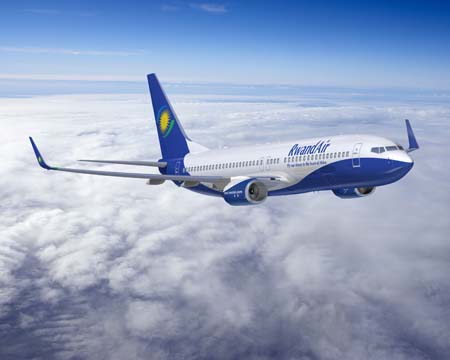
    Boeing and RwandAir announce an order for Next-Gen 787-800

    SEATTLE, May 6 — Boeing and RwandAir today announced an order for two Next-Generation 737-800s.

    Based in Kigali, Rwanda, the airline is renewing and expanding its fleet to broaden its network. RwandAir currently operates a fleet of regional jets.

    “Boeing’s Next-Generation 737-800s will enable us to eventually expand to regional hubs across Africa and the Middle East,” said John Mirenge, RwandAir chairman. “They will become the mainstay of our fleet.”

    “Boeing is honored that RwandAir has selected the Next-Generation 737-800 to support its fleet and growth strategy,” said Marlin Dailey, vice president of Sales, Boeing Commercial Airplanes. “The airplane offers reduced operating costs and environmental impact, as well as a new cabin interior that will delight RwandAir’s customers.”

    The new 737 Boeing Sky Interior features bigger stowage bins that pivot up and out of the way, and sculpted side walls that draw attention to the windows. A new design creates a more open feel in the cabin with overhead lighting that resembles the sky.

  • FAA Press Release: FAA Proposes $572,150 in Civil Penalties Against Atlas Air, Inc.

    For Immediate Release
    May 5, 2010

    NEW YORK — The Federal Aviation Administration (FAA) has proposed to assess $572,150 in civil penalties against Atlas Air, Inc., of Purchase, NY, a scheduled air cargo airline, for alleged violations of the Federal Aviation Regulations.

    The FAA alleges that Atlas Air incorrectly installed a replacement cockpit window on a Boeing 747F, and then operated the aircraft on 49 flights between April 4 and April 27, 2009, when it was not in compliance with those regulations.

    The FAA said Atlas Air replaced one of the windows at the first officer’s position, but failed to use the methods, techniques and practices specified in the manufacturer’s maintenance manual or alternate procedures accepted by the FAA for the B-747F. The airline then approved the aircraft for return to service. As a result, the replacement window suffered pressurization leaks while in flight according to multiple reports made by crews operating or maintaining the aircraft. The FAA has proposed a penalty of $506,150 for those violations.

    In a second instance, the FAA alleges that on May 14 and 15, 2009, Atlas Air operated a Boeing 747 on international flights from Huntsville, AL, to Glasgow, Scotland, Luxembourg City and back to Huntsville without a required outboard engine pylon access panel door. The FAA said Atlas Air improperly fabricated a panel cover from aluminum sheet metal and affixed it with speed tape over the access door opening. On each of these flights, the panel came off the aircraft enroute and a new panel was fabricated and installed in the same manner at each subsequent stop. The FAA has proposed a civil penalty of $66,000 for those violations.

    Atlas Air has 30 days from receipt of the FAA’s enforcement letters to respond to the agency.

  • |

    New FAA System Improves Air Safety at Juneau

    For Immediate Release
    May 4, 2010

    New FAA System Improves Air Safety at Juneau

    ANCHORAGE – A new surveillance technology called the Wide-Area Multilateration System (WAM) is now allowing air traffic controllers to track aircraft along the difficult approach to Juneau – a mountainous area where radar coverage isn’t possible.

    “This technology will allow more aircraft to fly into Juneau and it will give air traffic controllers the tools they need to safely and efficiently handle these flights,” said FAA Administrator Randy Babbitt.

    Air traffic controllers can now see aircraft approaching Juneau, something that wasn’t possible before WAM because of the rugged terrain surrounding the city. The mountains make radar coverage impossible since radar signals cannot pass through solid objects. Without radar coverage, controllers had to separate aircraft approaching Juneau by large distances in order to provide the appropriate safety margins. Air traffic controllers are now able to safely decrease the separation between them to five nautical miles.

    WAM is comprised of a network of small sensors deployed around Juneau. The sensors send out signals that are received and sent back by aircraft transponders. No other aircraft equipment is required. The system triangulates the returning signals to determine the precise location of each aircraft. Controllers are able to see those aircraft on their screens as if they were radar targets.

    WAM is being used in the near term while the agency rolls out Automatic Dependent Surveillance – Broadcast (ADS-B), the satellite-based surveillance system that will be deployed nationwide in 2013. WAM will then serve as a backup to ADS-B in the event of a GPS outage and provide an additional source of traffic broadcast to properly equipped aircraft. A WAM system is also operating in Colorado.

  • |

    NTSB INVESTIGATING NEAR COLLISION OF SOUTHWEST 737 AND NEWS HELICOPTER OVER HOUSTON HOBBY AIRPORT

    The NTSB has launched an investigation into the near collision of a Southwest Airlines jetliner and a news helicopter over a runway at Houston’s Hobby Airport last week.

    At about 12:25 p.m. CDT on Wednesday, April 28, a Southwest Airlines 737, flight 1322 (N242WN) and a Bell 207 news gathering helicopter (N6YJ), came within an estimated 125 feet vertically and 100 feet laterally from each other as both were departing the airport.

    The Baltimore-bound 737 with 135 passengers and a crew of five had been cleared to depart from runway 12R. At about the same time the helicopter was cleared to depart from another part of the airport. The near-collision occurred as the helicopter converged into the flight path of the 737 shortly after the jetliner lifted off from the runway. Both crews took evasive maneuvers to avoid colliding.

    NTSB investigator Betty Koschig, an air traffic control specialist based in Washington, is traveling to Houston tomorrow to begin the investigation.

    This is the second runway safety incident that the NTSB has investigated in the last two weeks. On April 19, a 737 and a small private plane came within about 200 feet of colliding over the airport in Burbank, Calif.

    Improving runway safety has been on the NTSB’s Most Wanted List of Safety Improvements since 1990:
    http://www.ntsb.gov/Recs/mostwanted/runways.htm

  • |

    NTSB: CREW ACTIONS AND SAFETY EQUIPMENT CREDITED WITH SAVING LIVES

    National Transportation Safety Board
    Washington, DC 20594

    FOR IMMEDIATE RELEASE: May 4, 2010
    SB-10-16

    Washington, DC — In addition to the decisions and actions of
    the flight crewmembers, overwater safety equipment likely
    saved lives that might have otherwise been lost to drowning,
    the NTSB said.

    Today the Safety Board met to conclude its 15-month
    investigation into the January 15, 2009, accident in which a
    US Airways A320 jetliner bound for Charlotte was ditched
    into the Hudson River after striking a flock of Canada geese
    shortly after departing New York’s LaGuardia Airport. All of
    the 150 passengers and five crewmembers survived.

    Investigators said that had the airplane not been equipped
    with forward slide/rafts, many of the 64 occupants of those
    rafts would likely have been submerged in the 41-degree
    Hudson River, potentially causing a phenomenon called “cold
    shock,” which can lead to drowning in as little as five
    minutes.

    The accident flight had the additional safety equipment
    available only because the particular aircraft operated that
    day happened to be certified for extended overwater (EOW)
    operations even though current FAA regulations did not
    require the flight from New York to Charlotte to be so
    equipped.

    Good visibility, calm waters, and proximity of passenger
    ferries, which rescued everyone on flight 1549 within 20
    minutes, were other post-accident factors the Safety Board
    credited with the survival of all aboard the aircraft.

    “Once the birds and the airplane collided and the accident
    became inevitable, so many things went right,” said NTSB
    Chairman Deborah A.P. Hersman. “This is a great example of
    the professionalism of the crewmembers, air traffic
    controllers and emergency responders who all played a role
    in preserving the safety of everyone aboard.”

    The Safety Board said that the probable cause of the
    accident was the ingestion of large birds into each engine,
    resulting in an almost total loss of engine power.
    Contributing to the severity of the fuselage damage and
    resulting unavailability of the aft slide/rafts, the Board
    cited the FAA’s inadequate ditching certification standards,
    lack of industry training on ditching techniques, and the
    captain’s resulting difficulty maintaining his intended
    airspeed on final approach due to task saturation resulting
    from the emergency situation.

    The report adopted by the Safety Board today validated the
    Captain’s decision to ditch into the Hudson River saying
    that it “provided the highest probability that the accident
    would be survivable.” Contributing to the survivability of
    the accident was the crew resource management between the
    captain and first officer, which allowed them to maintain
    control of the airplane, increasing the survivability of the
    impact with the water.

    In addressing the hazards that birds pose to aircraft of all
    sizes, the report noted that most bird strike events occur
    within 500 feet of the ground while flight 1549 struck geese
    at 2700 feet. Investigators said that this difference
    demonstrates that “bird strike hazards to commercial
    aircraft are not limited to any predictable scenario.”

    Concluding that engine screens or changes to design would
    not be a viable solution to protect against bird ingestion
    events on commercial jetliners, the Board made it clear that
    the potential for significant damage from encounters with
    birds remains a challenge to the aviation community.

    As part of its extensive examination into the behavior of
    the passengers and crewmembers from the time the plane left
    the gate at LaGuardia to the moment the last person was
    rescued in the river, the Board noted that since most of the
    passengers indicated that they had not paid attention to the
    preflight oral safety briefing, “more creative and effective
    methods of conveying safety information to passengers” was
    needed. Survival factors investigators also found that
    passengers had significant problems in donning the life
    vests that were stowed under each seat.

    The Board made 35 safety recommendations on engine and
    aircraft certification standards, checklist design, flight
    crew training, airport wildlife mitigation, cabin safety
    equipment, and preflight passenger briefings.

    “I believe the safety recommendations that have come out of
    this investigation have an extraordinary origin — a very
    serious accident in which everyone survived,” said Chairman
    Hersman. “Even in an accident where everyone survives, there
    are lessons learned and areas that could use improvement.
    Our report today takes these lessons learned so that, if our
    recommendations are implemented, every passenger and
    crewmember may have the opportunity to benefit from the
    advances in safety.”

  • |

    Press Release: NTSB CHAIRMAN ISASI SPEECH

    National Transportation Safety Board
    Washington, DC 20594

    FOR IMMEDIATE RELEASE: April 29, 2010
    SB-10-14

    NTSB CHAIRMAN DISCUSSES ADVANTAGES – AND LIMITATIONS – OF USING DATA-DRIVEN SYSTEMS TO IMPROVE AVIATION SAFETY

    National Transportation Safety Board Chairman Deborah A.P. Hersman said today that the use of data to manage and improve safety in the aviation industry has had a positive effect on the world’s improving aviation safety record but she cautioned against over-reliance on these systems to the neglect of forensic investigation.

    Addressing a conference of the International Society of Air Safety Investigators in Chantilly, Virginia, Hersman noted that “we have reached an era when aviation accidents are extremely rare…” One reason is the use of data – particularly, but not exclusively, Safety Management Systems (SMS) – in accident prevention and investigation.

    The Board has been advocating the use of SMS for a decade, having issued 17 recommendations in favor of implementing SMS in the aviation industry. When implemented correctly, Hersman said, “SMS holds real promise in a variety of scenarios.” She noted several instances where SMS helped
    eliminate potential unsafe conditions, notably a corporate flight operation that used flight data to determine that high bank angles occurred on repositioning flights, and a review of commercial aircraft approach data that indicated a high rate of TCAS (Traffic Alert and Collision Avoidance
    System) warnings at a particular airport. In these instances, she said, “data management adeptly identified a clearly measurable set of information and allowed for a relatively simple and effective solution.”

    However, Hersman noted, SMS works well for companies that are already “getting it right,” but may provide little more than false confidence for companies with less than robust safety cultures.

    Also, there are accidents caused by a combination of factors that SMS cannot possibly detect. As an example, Hersman mentioned the British Airways Boeing 777 crash at Heathrow Airport two years ago involving a dual engine failure on approach. It was not data analysis that solved the mystery, but detailed forensic analysis; the circumstances were so unusual that a data analysis system would not pick them up.

    Hersman said she hoped that with all the focus SMS will place on data collection and analysis, “let’s not lose focus on outcomes. The success of SMS won’t be measured by how much data we collect, but by how many lives we save.”

    “I will enthusiastically support any approach that will make our nation safer,” she said. “But I think we need a measured approach – one that acknowledges the potential benefits and limitations of SMS, and further, doesn’t discount tried and true methods for identifying vulnerabilities, such as accident investigations.”

  • Press Release: MEDIA INVITED TO INTERVIEW LAUNCH ABORT SYSTEM MANAGER

    NewsRelease
    National Aeronautics and
    Space Administration

    HAMPTON, Va. – In a little more than a week NASA’s next flight test, called Pad Abort-1, will lift off from the pad at the U.S. Army’s White Sands Missile Range, near Las Cruces, N.M.

    A team from NASA’s Langley Research Center will travel to support the test, scheduled for May 6.

    On Thursday, April 29, from 1 to 3 p.m., local media are invited to interview launch abort system (LAS) manager Kevin Rivers and chief engineer David McGowan before they travel to White Sands. Media should contact Amy Johnson at 757-864-7022 by noon Wednesday, April 28, if they would like to schedule an interview during that time.

    The LAS was designed to offer a safe, reliable method of removing the astronaut crew from danger should an emergency occur on the launch pad or during the vehicle’s climb to orbit. It employs ground-breaking rocket technology never tested before. The development of the Orion launch abort system is led by NASA Langley in partnership with Marshall Space Flight Center. Langley also designed and produced the crew module simulator that will be used for the flight test

    PA-1 is the first fully integrated test of the launch abort system that was developed for the Orion crew exploration vehicle as part of an ongoing mission to develop safer vehicles for human spaceflight applica¬tions. The Pad Abort-1 vehicle consists of a tower-like launch abort system positioned over a simulated crew module. For the test, the vehicle will be launched by its abort motor to a height of approximately one mile and approximately one mile downrange.

  • IATA Press Release: Improvements

    Demand Improvements Continue in March – Expect Volcano-Related Dip in April
    Geneva – The International Air Transport Association (IATA) announced that March 2010 international scheduled air traffic showed continued strengthening of demand. Compared to March 2009, passenger demand was up 10.3%, while cargo demand grew 28.1%. Both are improvements from the 9.0% and 26.3% growth for passenger and freight demand recorded in February.

    These are strong gains, but the data is being compared to March 2009, which was the low point for international air travel during the recession. “March results show that the pace of the upturn is strong. But the trauma of the recession is not over. The industry has lost two years of growth, and passenger and freight markets are still 1% below early 2008 highs. Nonetheless, the pace of improvement, based on an improving global economic situation, is much faster than anybody would have expected even six months ago,” said Giovanni Bisignani, IATA’s Director General and CEO. IATA noted that the International Monetary Fund revised global GDP growth forecasts from 3.0% to 4.3% for 2010.

    With a 78.0% load factor recorded in March, passenger load factors remain at record highs. While demand expanded by 10.3% in March, capacity increases stood at 2.0%, boosting the load factor and creating much tighter supply and demand conditions. Global capacity remains 3-4% below pre-crisis levels.

    International freight markets are also experiencing tighter supply and demand conditions. The 28.1% improvement in demand outpaced the 5.3% capacity expansion in March. This drove freight load factors to 57.1% — the highest since November 2002 when international freight load factors stood at 58.8%.

    International Passenger Demand
    Regional demand patterns continue to reflect the asymmetrical nature of the economic rebound.

    • Asia-Pacific carriers posted strong demand growth of 12.6%, against a capacity expansion of 1.3%. The strength of the rebound in the region’s economies is supporting Asia-Pacific’s demand improvement. China’s economy grew by 11.9% in the first quarter while India’s economy is growing by 7.0%. There is also greater optimism for a return to economic growth in Japan.
    • European carriers posted traffic growth of 6.0%, considerably weaker than the global improvements, but better than the 4.0% growth in February. This is the result of sluggish home economies and continuing high unemployment rates. European carriers reduced capacity by 0.8% compared to the previous year.
    • North American carriers posted a traffic growth of 7.8%, lagging the global average, although considerably improved from the 4.4% recorded in February. Uncertainty over government budget cuts and tax increases is dampening demand for air travel, compared to other regions, particularly Asia-Pacific. North American carriers posted the highest load factor among the regions (81.6%) as a result of continuing careful capacity management.
    • Middle Eastern carriers recorded the strongest traffic growth at 25.9%. While economic growth of 5% in the region is supporting some of this increase, a large part is attributed to market share gains on long-haul markets, connecting passengers over Middle Eastern hubs. Load factors of 76.2% were slightly below the global average.
    • African carriers are now starting to see improving growth, having suffered market share declines for several years. During March, demand was up 13.6% and load factors grew to 67.4% for the month.
      Latin American carriers posted the weakest growth of any region, increasing only 4.6% in March. This is in sharp contrast to February when the region’s carriers grew by 8.5%. The reduction is largely due to the impact of the earthquake in Chile.

    International Cargo Demand

    Global air freight is now within 1% point of recovering to its previous high point of early 2008. International air freight volumes shrank by over one quarter during the second half of 2008. The upturn in the business inventory cycle has almost eliminated that decline, although the upturn for international air freight has taken twice as long as the collapse.

    Despite the sluggish US economy, North American carriers have seen an international freight rebound (+32.2%). Both export and import volumes are very strong in the emerging economies of Asia-Pacific (+34.1%) and in Latin America which recorded the strongest growth at 47.9%.

    European carriers showed the weakest improvement in freight demand at 11.7%, largely due to the slow economic recovery in the region.
    The strong traffic recovery is expected to show a dip in April as a result of the eruption of an Icelandic volcano in April that saw the shutdown of large portions of European airspace over a six-day period. “European carriers were already showing the weakest recovery from the financial crisis through March. The volcanic ash crisis hit the weakest part of the industry the hardest. The majority of the US$1.7 billion in lost revenues was by Europe’s carriers. Passenger confidence is not affected and we expect a quick rebound. The combined impact of lost business and added costs will certainly hit the bottom line,” said Bisignani.

    March Aviation Traffic Results

    Mar 2010 vs. Mar 2009 RPK Growth ASK Growth PLF FTK Growth AFTK Growth
    Africa 13.6% 11.0% 67.4 45.8% 8.9%
    Asia/Pacific 12.6% 1.3% 79.1 34.1% 12.5%
    Europe 6.0% -0.8% 78.1 11.7% -5.2%
    Latin America 4.6% -0.7% 73.3 47.9% 24.6%
    Middle East 25.9% 14.8% 76.2 35.5% 15.0%
    North America 7.8% 0.6% 81.6 32.2% -1.1%
    Industry 10.3% 2.0% 78.0 28.1% 5.3%
    YTD 2010 vs. YTD 2009 RPK Growth ASK Growth PLF FTK Growth AFTK Growth
    Africa 10.4% 8.2% 67.0 34.6% 7.4%
    Asia/Pacific 10.5% 0.3% 78.6 35.9% 11.1%
    Europe 4.3% -0.6% 75.7 10.3% -6.6%
    Latin America 8.2% 1.4% 77.0 40.3% 22.2%
    Middle East 25.0% 15.8% 75.1 34.0% 17.0%
    North America 5.0% -1.5% 78.4 31.6% -3.0%
    Industry 8.6% 1.6% 76.6 27.8% 4.0%

    Notes for Editors:

    • IATA (International Air Transport Association) represents some 230 airlines comprising 93% of scheduled international air traffic
    • Explanation of measurement terms:
      • RPK: Revenue Passenger Kilometres measures actual passenger traffic
      • ASK: Available Seat Kilometres measures available passenger capacit
      • PLF: Passenger Load Factor is % of ASKs used. In comparison of 2009 to 2008, PLF indicates point differential between the periods compare
      • FTK: Freight Tonne Kilometres measures actual freight traffi
      • AFTK: Available Freight Tonne Kilometres measures available total freight capacit
      • FLF: Freight Load Factor is % of AFTKs used
    • IATA statistics cover international scheduled air traffic; domestic traffic is not included
    • All figures are provisional and represent total reporting at time of publication plus estimates for missing data. Historic figures may be revised
    • International passenger traffic market shares by region in terms of RPK are: Europe 37.6%, Asia-Pacific 28.8%, North America 15.2%, Middle East 11.0%, Latin America 4.1%, Africa 3.3%
    • International freight traffic market shares by region in terms of FTK are: Asia-Pacific 44.9%, Europe 24.7%, North America 15.9%, Middle East 10.4%, Latin America 2.8%, Africa 1.3%
  • |

    President of Boeing Korea Announced

    CHICAGO, April 27, 2010 — The Boeing Company today named Pat Gaines as president of Boeing Korea, effective June 4.
    In a move designed to continue the company’s success in Korea, Gaines will succeed Bill Oberlin, who will retire in July after 25 years with Boeing.

    Gaines will lead Boeing’s enterprise-wide business in Korea, while strengthening the company’s local presence and finding new ways to pursue growth and productivity initiatives.

    “Pat’s leadership experience in global business and operations align directly with our ongoing efforts to increase our presence and collaboration with customers, partners, communities and employees in Korea. In this regard he will be able to build on the solid foundation established by the excellent work Bill Oberlin has done in Korea,” said Shep Hill, president of Boeing International and Senior Vice President, Business Development and Strategy.

    Gaines, a 23-year company veteran, joins Boeing Korea following a position in Boeing Commercial Airplanes in Seattle, where he served as vice president of Customer Support for Asia-Pacific. He has extensive experience in global operations and led the efforts that established the joint venture between FlightSafety International and Boeing, now known as Boeing Training and Flight Services.

    Oberlin came to Korea in 2002 as president of Boeing Korea. He joined Boeing in 1985 and was credited with sales of key Boeing products, such as CH-47 Chinook helicopters, F-15Ks and AEW&C Peace Eye aircraft, as well as commercial airplanes and related services to airline customers in Korea.

    Oberlin was recognized in Korea for his contributions to the local business community as chairman of the American Chamber of Commerce in Korea (2003-2004 and 2007-2008) and as an executive member of the U.S.-Korea Business Council. He was an active proponent of the Korea-U.S. Visa Waiver Program, which allows qualified Korean nationals to travel to the U.S. visa free. Oberlin also worked to support the pending Free Trade Agreement between Korea and the U.S. In 2008, he was appointed to serve on the National Competitiveness Improvement Committee under the President of the Republic of Korea.

    “Bill played a significant role in strengthening our presence and stakeholder relationships in the Republic of Korea. His representation of the company has been characterized by outstanding leadership, unquestioned integrity and demonstrated results,” added Hill. “Korea is an important market for Boeing and presents many opportunities for Boeing and Korea to work together in ways to advance our common interests. We have a solid business plan and a long-term view of the market, and we look forward to continuing the legacy of a true partnership between Boeing and our customers and partners in Korea.”

    Gaines served in the U.S. military as an airborne ranger and a warrant officer pilot. He attended the United States Military Academy at West Point and graduated with honors and a degree in Engineering.

    Boeing shares a successful 50-year relationship with Korea. In 1988, Boeing opened an office in Seoul to work closely with Korean customers and partners. Today, more than 160 Boeing employees work across the country.

  • FAA Calls on Airlines to Limit Cockpit Distractions


    For Immediate Release
    April 26, 2010
    Contact: Sasha Johnson
    Phone: (202) 267-3883

    WASHINGTON, D.C. — The Department of Transportation’s Federal Aviation Administration (FAA) today called on air carrier operators to create and enforce policies that will limit distractions in the cockpit and keep pilots focused on transporting passengers safely.

    “There is no room for distraction when your job is to get people safely to their destinations,” said Transportation Secretary Ray LaHood. “The traveling public expects professional pilots to focus on flying and on safety at all times.”

    The Information for Operators (InFO) guidance reminds crewmembers and air carriers that any cockpit distraction that diverts attention from required duties can “constitute a safety risk.” This includes the use of personal electronic devices for activities unrelated to flight.

    Last October the pilots of Northwest 188 over-flew their destination by 150 miles because they were using their laptop computers for personal activities and lost situational awareness.

    “Every aviation professional needs to take the issue of distractions in the cockpit seriously,” said FAA Administrator Randy Babbitt. “And when there are two or more professionals on the flight deck, they must hold each other to the highest safety standards. Allowing distractions is unacceptable.”

    The FAA’s Sterile Cockpit Rule prohibits pilots from engaging in any type of distracting behavior during critical phases of flight, including take-off and landing.

    In this InFO, the FAA is asking air carriers to address the issue of distraction through their crew training programs and to create a safety culture to control cockpit distractions.

    As technology advances, laptops and other devices are becoming valuable tools for pilots to use in their routine duties. But they must only be used in the cockpit if they assist pilots in safely operating an aircraft.

  • FAA Controllers in Philadelphia Transition to Next Generation Air Transportation System Technology

    For Immediate Release
    April 26, 2010
    Contact: Tammy L. Jones or Paul Takemoto
    Phone: (202) 267-3883

    WASHINGTON, D.C. — As part of the Federal Aviation Administration’s (FAA) plan to modernize the national airspace system, controllers in the Philadelphia area now have the capability to use a satellite-based system to more efficiently and safely track and separate aircraft.

    “This new technology is a tremendous leap forward in transforming the current air traffic control system,” said FAA Administrator Randy Babbitt. “The operational benefits in Philadelphia extend as far as Washington, DC, and New York, which has some of the most congested airspace in the world.”

    Called Automatic Dependent Surveillance-Broadcast (ADS-B), the new system is a core technology under the Next Generation Air Transportation System (NextGen). By using ADS-B, air traffic controllers have more precise information while separating aircraft in the sky and on the runways, leading to greater efficiency and safety benefits. Controllers who have access to ADS-B receive one-second update rates compared to four-and-a- half second update rates with radar.

    Potentially, they will be able to reduce separation in the en route environment from the current five nautical miles to three, saving both time and money for the airlines while reducing the carbon footprint. Pilots flying aircraft equipped with ADS-B know precisely where they are and are able to see other properly equipped aircraft. They also have access to better information on area weather and receive flight information electronically, such as airmen notices and temporary flight restrictions.

    Philadelphia is one of four key sites that the FAA selected to demonstrate ADS-B services. The other sites include Houston, Louisville, KY, and Juneau, AK. The sites were selected because of their unique airspace environments and local needs.

    ADS-B coverage at Philadelphia extends 60 nautical miles out and approximately 10,000 feet up. It also covers the surface area and the approach corridors to the runways. Philadelphia was selected because of its current automation platform that is used by air traffic controllers, called the Standard Terminal Automated Replacement System. Also, UPS has equipped for ADS-B services and a large amount of their operations are conducted at Philadelphia International Airport. In addition, US Airways is in the process of equipping its aircraft to use ADS-B.

    Philadelphia Airport also has Airport Surface Detection Equipment (ASDE-X), which provides detailed coverage of movement on runways and taxiways allowing controllers to detect potential conflicts. The ASDE-X at Philadelphia has been upgraded to receive ADS-B data. Additionally, the ASDE-X surveillance data will be used as a Traffic Information Service – Broadcast (TIS-B) source so pilots can see non-ADS-B targets on their cockpit displays.

    FAA is installing the ground infrastructure for ADS-B. The agency has proposed that airlines and private aircraft install ADS-B avionics by 2020. Some airlines and private aircraft have already started equipping in advance of that date. ADS-B is expected to be available nationwide by 2013.

  • |

    Dreamliner Weather Testing

    787 Dreamliner Undergoing Extreme Weather Testing in Florida

    VALPARAISO, Fla., April 22 — The Boeing 787 Dreamliner has begun a series of extreme-weather tests at Valparaiso, Fla. A special hangar at the McKinley Climatic Laboratory at Eglin Air Force Base allows the airplane to experience heat as high as 115 degrees Fahrenheit (46 Celsius) and as low as minus 45 degrees Fahrenheit (minus 43 Celsius).

    After the airplane is stabilized at either the hot or cold temperatures, flight test technicians will follow the Airplane Maintenance Manual to perform the steps required to prepare the airplane for flight release and operate under these conditions. Sensors and monitors will allow the test team to determine if all systems hardware and software operate as expected.

    Cold-weather testing is being conducted first, with preliminary hot-weather testing to follow. Additional extreme-weather testing will be conducted later in the flight test program.

    “We have Dreamliner customers who will operate the 787 in a wide variety of environments throughout the world,” said Scott Fancher, vice president and general manager of the 787 program for Boeing Commercial Airplanes. “This testing is about ensuring that the airplane meets the expectations of our customers.”

    A crew of approximately 100 people traveled from Seattle to support the test operations on ZA003, the third 787 airplane to be built.

    The McKinley Climatic Laboratory is the second remote testing location for the 787 Dreamliner. The second airplane in the fleet, ZA002, performed a variety of tests in Victorville, Calif., last month. The testing in Florida is expected to last nearly two weeks.

    About the Boeing 787 Dreamliner
    The 787 Dreamliner is an all-new twinjet designed to meet the needs of airlines around the world in providing nonstop service between mid-size cities with new levels of efficiency. The airplane will bring improved levels of comfort to passengers with larger windows, bigger baggage bins and advances in the cabin environment, including lower cabin altitude, higher humidity and cleaner air. Delivery of the first 787 is planned for the fourth quarter of 2010.

    Fifty-seven customers around the world have ordered 866 787s since the program was launched in April 2004, making the Dreamliner the fastest-selling new commercial jetliner in history. Delivery of the first 787 is planned for the fourth quarter of 2010.

  • IATA Press Release-Volcano Crisis Cost Airlines $1.7 Billion

    Volcano Crisis Cost Airlines $1.7 Billion in Revenue – IATA Urges Measures to Mitigate Impact

    Berlin – The International Air Transport Association (IATA) estimated that the Icelandic volcano crisis cost airlines more than $1.7 billion in lost revenue through Tuesday—six days after the initial eruption. For a three-day period (17-19 April), when disruptions were greatest, lost revenues reached $400 million per day.

    “Lost revenues now total more than $1.7 billion for airlines alone. At the worst, the crisis impacted 29% of global aviation and affected 1.2 million passengers a day. The scale of the crisis eclipsed 9/11 when US airspace was closed for three days,” said Giovanni Bisignani, IATA’s Director General and CEO.

    IATA noted there are some cost savings related to the flight groundings. For example, the fuel bill is $110 million a day less compared to normal. But airlines face added costs including from passenger care. “For an industry that lost $9.4 billion last year and was forecast to lose a further $2.8 billion in 2010, this crisis is devastating. It is hitting hardest where the carriers are in the most difficult financial situation. Europe’s carriers were already expected to lose $2.2 billion this year—the largest in the industry,” said Bisignani.

    Mitigating the Financial Impact

    “As we are counting the costs of the crisis we must also look for ways to mitigate the impact. Some of our airport partners are setting industry best practice. London Heathrow and Dubai are waiving parking fees and not charging for repositioning flights. Others airports must follow,” said Bisignani.

    But the larger role is for governments. Bisignani made three specific requests for regulatory relief:

    Relax Airport Slot Rules: IATA urged that rules on take-off and landing slot allocation (use it or lose it) be relaxed to reflect the extra-ordinary nature of the crisis.
    Lift Restrictions on Night Flights: IATA urged governments to relax bans on night flights so carriers can take every opportunity to get stranded passengers back home as soon as possible.
    Address Unfair Passenger Care Regulations: “This crisis is an act of god—completely beyond the control of airlines. Insurers certainly see it this way. But Europe’s passenger rights regulations take no consideration of this. These regulations provide no relief for extraordinary situations and still hold airlines responsible to pay for hotels, meals and telephones. The regulations were never meant for such extra-ordinary situations. It is urgent that the European Commission finds a way to ease this unfair burden,” said Bisignani.
    Bisignani also urged governments to examine ways for governments to compensate airlines for lost revenues. Following 9/11, the US government provided $5 billion to compensate airlines for the costs of grounding the fleet for three days. The European Commission also allowed European states to provide similar assistance.

    “I am the first one to say that this industry does not want or need bailouts. But this crisis is not the result of running our business badly. It is an extra-ordinary situation exaggerated with a poor decision-making process by national governments. The airlines could not do business normally. Governments should help carriers recover the cost of this disruption,” said Bisignani.

    Re-Opening Air Space

    On Monday, the European Commission announced revised measures for handling airspace closures, following widespread criticism of their methodology.

    “Airspace was being closed based on theoretical models not on facts. Test flights by our members showed that the models were wrong. Our top priority is safety. Without compromising on safety, Europe needed to find a way to make decisions based on facts and risk assessment, not theories,” said Bisignani.

    “The decision to categorize airspace based on risk was a step in the right direction. Unfortunately, not all states are applying this uniformly. It is an embarrassing situation for Europe, which after decades of discussion, still does not have an effective Single European Sky. The chaos and economic losses of the last week are a clarion call to Europe’s political leaders that a Single European Sky is critical and urgent,” said Bisignani.

  • |

    NTSB Press Release

    NTSB TO HOLD A PUBLIC FORUM ON PROFESSIONALISM IN AVIATION

    ( Washington , DC ) The National Transportation Safety Board
    will hold a safety forum on professionalism in aviation
    beginning Tuesday, May 18, 2010. The three-day, en-banc forum
    will be chaired by NTSB Chairman Deborah A.P. Hersman.

    “NTSB’s investigations into the midair collision over the
    Hudson River last August, the crash of Colgan Air flight 3407
    in February 2009, and the October 2009 Northwest pilots’
    overflight of their intended airport provided the impetus for
    this forum because all of them clearly demonstrated the
    hazards to aviation safety when pilots and air traffic
    controllers depart from standard operating procedures and
    established best practices,” Hersman said. “During the forum,
    we will gather information on the screening, selection and
    training of pilots and controllers and methods to reinforce
    professionalism and excellence.”

    Panelists participating in the forum will represent industry,
    government agencies, labor, academia, and professional
    associations. A technical panel composed of NTSB staff from
    the Offices of Aviation Safety and Research and Engineering,
    and the NTSB Board Members, who will make up the Board of
    Inquiry, will question the panelists.

    Dr. Tony Kern, an internationally recognized human factors and
    pilot performance expert, is the forum’s keynote speaker. The
    names of the participating panelists and the agenda will be
    provided in early May.

  • |

    PR: Boeing Test Flight


    EVERETT, Wash., April 20 — The U.S. Federal Aviation Administration (FAA) granted Boeing (NYSE: BA) expanded type inspection authorization (TIA) today, clearing the way for its personnel to fully participate in future test flights and for the collection of required flight-test data. Initial TIA was granted Feb. 11, which supported the collection of flutter certification data.
    The expanded TIA marks the FAA’s confirmation that the airplane and team are ready to collect additional certification data. Boeing achieved the expansion by demonstrating the readiness of the airplane throughout a variety of speeds, altitudes and configurations.

    “This TIA expansion is another significant step toward delivering airplanes to our customers. We remain on track to deliver the first airplane to ANA this year,” said Scott Fancher, vice president and general manager of the 787 program, Commercial Airplanes.
    In addition to receiving expanded TIA, Boeing finalized the aerodynamic configuration of the 787.

    “We have completed sufficient testing to decide that no additional changes to the external lines or shape of the airplane are required,” said Fancher. “Having an airplane match its expected performance with so few changes is rare and speaks to the maturity of the design.”
    The 787 flight-test fleet logged its 500th hour of flying April 16. On Sunday, ZA003, the flight-test airplane outfitted with interior elements, landed in Florida, where it will go through extreme weather testing at McKinley Climatic Laboratory at Eglin Air Force Base.

    Boeing released two videos highlighting flutter and ground effects testing. These videos feature commentary by the pilots and the chief project engineer and are available on www.boeing.com and www.newairplane.com.

  • |

    Press Release: HELIPROPS

    Bell Helicopter Professional Pilots Safety Program or HELIPROPS
    Notice Number: NOTC2236
    Bell Helicopter, Textron Inc. safety publication, Helicopter Professional Pilots Safety Program or HELIPROPS, designed for helicopter pilots is now available electronically online. Bell ’s newsletter Human AD Airworthiness for Humans is published quarterly in English and Spanish and is distributed to readers in approximately 121 countries.

    A popular feature of the newsletter are articles from helicopter pilot’s own experiences flying in “unusual situations;” all for the purpose of exchanging safety information, best practices, etc, pilot to pilot.

    The web site, www.heliprops.com is a free resource for pilots, mechanics, owners – operators, students and enthusiasts. From the web site readers are able to download the Human AD newsletter, HELIPROPS Safety Posters. The FAAST program is committed to the reduction of helicopter accidents and encourages FAAST members as well as other airmen to review this valuable source of safety information.

    For more information visit the following links:

    English: http://www.bellhelicopter.com/en/training/pdf/heliprops_21_3.pdf”>http://www.bellhelicopter.com/en/training/pdf/heliprops_21_3.pd”>http://www.bellhelicopter.com/en/training/pdf/heliprops_21_3.pdf
    Spanish: http://www.bellhelicopter.com/en/training/pdf/heliprops_21_3_span.pdf

  • |

    Press Release: ICAO ASSESSES SITUATION

    ICAO ASSESSES SITUATION OF AIR TRANSPORT FOLLOWING ERUPTION OF EYJAFJALLAJOKULL VOLCANO IN ICELAND

    he Council of the International Civil Aviation Organization (ICAO) met yesterday to review the current situation and welcomed the decision by the Ministers of Transport of the European Union (EU) to gradually reopen the European airspace, in a safe and coordinated manner.

    Today, the Organization’s Air Navigation Commission considered near-term initiatives to advance the science of aviation safety and airspace contaminated by volcanic ash.

    Both meetings included participation by the International Air Transport Association (IATA).

    The International Airways Volcano Watch (IAVW) system, established by ICAO in coordination with the World Meteorological Organization (WMO), is providing critical information to States, allowing them to exercise their responsibility as regards the use of their airspace.

    No incidents or accidents have been reported due to volcanic ash as a result of the smooth operation of the IAVW system that was established in 1987 to detect and track the movement of volcanic ash in the atmosphere and to warn States and aviation users. To this end, continuously updated information concerning the area affected by volcanic ash has been issued by the Volcanic Ash Advisory Centre (London) as required by the ICAO provisions.

    In light of the unprecedented disruptions to air traffic, however, it is clear that more effort needs to be undertaken to establish a global safety risk framework for routinely determining safe levels of operation in airspace contaminated by volcanic ash. ICAO invites States, the scientific community, aviation safety professionals, manufacturers, airports and airlines to provide valuable input to the development of such a framework.