Public Statement

  • |

    Bell Boeing V-22 Program Delivers 6th Osprey Trainer to US Marines

    ST. LOUIS, Sept. 27, 2010 — The Bell Boeing V-22 Program, a strategic alliance between Boeing [NYSE: BA] and Bell Helicopter, has delivered the sixth and final MV-22 Osprey Containerized Flight Training Device (CFTD) to the U.S. Marines. In the past year, the team has delivered five CFTDs to the Marines, as well as upgrades to two trainers delivered previously.

    The CFTD trains aircrew on basic aircraft familiarization and handling qualities. Additional training capabilities include systems/subsystems operation, communication, malfunctions, day and night flying, use of night-vision goggles, formation flying, aerial refueling and landing on ships. The device is intended to train crews for any task that might be performed in the aircraft, while limiting the monetary and environmental costs and safety risks of in-flight training.

    The sixth device was delivered to Marine Corps Air Station (MCAS) New River, N.C., on Aug. 16, six weeks early. MCAS New River has six devices, including the first CFTD — delivered in 2007 — plus three full-flight, motion-based simulators and one non-motion-based flight training device. MCAS Miramar, Calif., has four CFTDs. An upgrade delivered to Miramar this month brought all CFTDs to full concurrency with the Osprey aircraft.

    "The V-22 Integrated Product Team has made all of these early deliveries possible,” said Mark McGraw, vice president, Boeing Training Systems & Services. “They delivered three devices on this contract early, and all of them for the lowest per-unit cost our customer has seen."

    All CFTDs can be locally networked to allow for more robust training capabilities. The CFTDs at MCAS New River also are able to network with AV-8 Harriers at MCAS Cherry Point, N.C.

    The V-22 Osprey is a tiltrotor aircraft manufactured by Boeing and Bell Helicopter, a Textron Inc. [NYSE: TXT] company. Bell and Boeing are teamed in a Strategic Alliance Agreement for the design, production and sustainment of the V-22.

    Bell Helicopter, a wholly owned subsidiary of Textron Inc., is an industry-leading producer of commercial and military, manned and unmanned vertical lift aircraft and the pioneer of the revolutionary tiltrotor aircraft. Globally recognized for world-class customer service, innovation and superior quality, Bell’s global work force serves customers flying Bell aircraft in more than 120 countries. More information is available at www.bellhelicopter.com.

    Textron Inc. is a multi-industry company that leverages its global network of aircraft, defense, industrial and finance businesses to provide customers with innovative solutions and services. Textron is known around the world for its powerful brands such as Bell Helicopter, Cessna Aircraft Company, Jacobsen, Kautex, Lycoming, E-Z-GO, Greenlee, and Textron Systems. More information is available at www.textron.com.

  • |

    Boeing NewGen Tanker Win Would Bring 11,000 Jobs, $693 Million to Washington

    EVERETT, Wash., Sept. 27, 2010 — The Boeing Company today announced that the state of Washington will benefit from an estimated 11,000 total jobs and generate an estimated $693 million in annual economic impact if the Boeing NewGen Tanker is selected as the U.S. Air Force’s next aerial refueling aircraft.

    Boeing submitted its proposal July 9 to replace 179 of the Air Force’s 400 Eisenhower-era KC-135 aircraft. The Air Force is expected to award a contract later this year.

    "The Boeing team in Washington state has an outstanding track record meeting the needs of U.S. warfighters by delivering the finest military derivatives of commercial aircraft in the world," said Dennis Muilenburg, president and CEO of Boeing Defense, Space & Security. "I am confident that the thousands of men and women at Boeing and our suppliers working on the NewGen Tanker will carry on that same tradition of excellence for many years to come."

    "One of the great strengths of Boeing is our unique ability to form teams made up of both commercial and defense personnel to find innovative and best-value solutions for our customers," said Jim Albaugh, president and CEO of Boeing Commercial Airplanes. "Nowhere is this more apparent than here in Puget Sound, where we have been supporting both commercial and military customers for nearly 100 years."

    Currently, Boeing has 72,000 employees in Washington and works with more than 2,700 suppliers/vendors, delivering a total $3.3 billion in annual economic impact.

    The NewGen Tanker is a widebody, multi-mission aircraft based on the proven Boeing 767 commercial airplane and updated with the latest and most advanced technology. Capable of fulfilling the Air Force’s needs for transport of fuel, cargo, passengers and patients, the combat-ready NewGen Tanker will meet or exceed the 372 mandatory requirements described in the service’s final KC-X Request for Proposal released Feb. 24.

    The NewGen Tanker will be made with a low-risk approach to manufacturing that relies on existing Boeing facilities in Washington state and Kansas as well as U.S. suppliers throughout the nation, with decades of experience delivering dependable military tanker and derivative aircraft. Nationwide, the NewGen Tanker program will support approximately 50,000 total U.S. jobs with Boeing and more than 800 suppliers in more than 40 states.

    The Boeing NewGen Tanker also will be more cost-effective to own and operate than a larger, heavier tanker. It will save American taxpayers more than $10 billion in fuel costs over its 40-year service life because it burns 24 percent less fuel than the competitor’s airplane.

    Boeing has been designing, building, modifying and supporting tankers for decades. These include the KC-135 that will be replaced in the KC-X competition, and the KC-10 fleet. The company also has delivered four KC-767Js to the Japan Air Self-Defense Force and is on contract to deliver four KC-767As to the Italian Air Force.

    The Boeing Aerial Refueling Technology demonstrator (BART) will be on display at Westlake Park (401 Pine St.) in Seattle on Sept. 28 from 9 a.m. to 3:30 p.m. BART’s tour schedule is available at www.UnitedStatesTanker.com/TankerTrek. More information on Boeing’s NewGen Tanker, including video clips and an interactive tour of the aircraft, is available at www.UnitedStatesTanker.com. For more information on joining the company’s efforts, visit www.RealAmericanTankers.com.

  • |

    Press Release – FAA Celebrates Recovery Act Funded Airfield Upgrades at Kentucky’s Georgetown-Scott County Regional Airport

    WASHINGTON, D.C. — The U.S. Department of Transportation’s Federal Aviation Administration celebrated the completion of an airfield upgrade at Georgetown-Scott County Regional Airport in Kentucky, paid for with $3 million in American Recovery and Reinvestment Act funds.

    “Airport Recovery Act projects are helping boost local economies all across the country,” said U.S. Transportation Secretary Ray LaHood. “The Recovery Act is helping us keep our runways safe and well maintained.”

    Recovery Act funds provided the full cost of repaving Georgetown-Scott County Regional Airport’s 5,500 foot-long runway. The runway had deteriorated and had not been fully repaved in nearly 17 years. The construction also included the widening of the ends of the parallel taxiway, which will now be able to accommodate larger aircraft turning on and off the runway.

    “General aviation is incredibly important to local communities nationwide and the Recovery Act is funding necessary safety improvements and upgrades that otherwise might not get done,” said FAA Administrator Randy Babbitt.

    Nationwide, $1.3 billion in Recovery Act money has been made available for both airport improvement projects and air traffic control facility and system upgrades. Because of low construction bids for projects, more Recovery Act dollars were available for additional facilities and equipment as well as airport projects. These Recovery Act grants have been distributed to airports that serve commercial passengers, cargo and general aviation.
    ###

  • |

    Press Release – FAA Proposes $4.855 Million Civil Penalty Against Evergreen Airlines

    For Immediate Release
    September 24, 2010

    EATTLE — The Federal Aviation Administration (FAA) has proposed a $4,855,000 civil penalty against Evergreen International Airlines of McMinnville, Ore., for allegedly using pilots on 232 revenue flights who had not been trained in accordance with an FAA-approved training program.

    The flights were made between Feb. 19 and July 9, 2009, on aircraft equipped with a new flight management system (FMS) that was different enough from the prior system that it required a specific training program for pilots who were flying the aircraft. The FAA alleges Evergreen did not complete its FAA-approved training for pilots before assigning them to fly revenue trips using the new FMS.

    “We put rules and regulations in place to keep air transportation safe and we expect airlines to comply,” said U.S. Transportation Secretary Ray LaHood.

    The FAA alleges Evergreen line pilots received ground training and a check ride on the new FMS, but that the company did not provide required familiarization flights supervised by the company’s check pilots despite being told to do so by the FAA.

    The familiarization flights are part of the FAA-approved training program for Evergreen aircraft equipped with the FMS. Evergreen also failed to distribute copies of the required system manual to crews who would be using the FMS.

    Subsequent to these improperly conducted flights, Evergreen has ensured that its pilots are trained in accordance with its FAA-approved training program and continues to operate under an FAA-approved training program.

    “Even though Evergreen now complies with its training program, this penalty is appropriate because requiring operators to complete required, approved training is the only way to make sure crews are fully qualified to operate the equipment and systems to manage flights safely,” said FAA Administrator Randy Babbitt.

    Evergreen has 30 days from the receipt of the FAA’s civil penalty letter to respond to the agency.

  • Russia’s S7 Airlines to be Part of oneworld From 15 November

    VANCOUVER, British Columbia, Sept. 23, 2010. S7 Airlines, Russia’s leading domestic carrier, will become part of oneworld® effective Monday, 15 November, offering the alliance’s full range of services and benefits from then and substantially expanding its network throughout Russia and the rest of the Commonwealth of Independent States – in the latest step by oneworld to establish itself as the world’s premier alliance in what is turning out to be a breakthrough year for the group.

    From 15 November, 2010 members of the S7 Priority frequent flyer programme will be able to earn and redeem mileage awards on all oneworld partners, which includes some of the biggest and best airlines in the world – American Airlines, British Airways, Cathay Pacific Airways, Finnair, Iberia, Japan Airlines, LAN Airlines, Malev Hungarian Airlines, Mexicana, Qantas and Royal Jordanian and almost 20 affiliated airlines.

    S7 Priority Platinum and Gold cardholders will have oneworld Emerald and Sapphire status respectively, gaining them access to more than 500 airport lounges worldwide offered by the alliance’s airlines. S7 Priority Silver cardholders will have oneworld Ruby status.

    All S7 Priority Platinum, Gold and Silver cardholders will soon be sent new membership cards, bearing the oneworld logo, to ensure they receive their alliance benefits from 15 November.

    Also from 15 November, members of the established oneworld airlines’ frequent flyer programs will be able to earn and redeem awards and tier status points and receive all other oneworld benefits on S7.

    Its network – covering 90 destinations and 28 countries, including 45 points in Russia and some 25 destinations in other parts of the Commonwealth of Independent States (CIS) – will from then be covered by oneworld’s full and extensive range of alliance fares and sales products.

    S7’s Russian domestic market is the world’s largest country in terms of land mass, the ninth most populous and with the eighth biggest gross domestic product. Currently seven of oneworld’s established airlines – British Airways, Cathay Pacific, Finnair, Iberia, Japan Airlines, Malev Hungarian Airlines and Royal Jordanian – serve Moscow, plus St Petersburg and Ekaterinburg in Russia.

    S7 Airlines to join oneworld on 15 November…2

    The new oneworld recruit will add 55 destinations in the region to the alliance map, and nine countries, in Armenia, Azerbaijan, Georgia, Kazakhstan, Kyrgyzstan, Moldova, Tajikistan, Turkmenistan and Uzbekistan. This will almost triple the number of destinations served by oneworld in Russia, the CIS and other parts of East Europe to a total 84 destinations in 26 countries.

    For S7, joining oneworld will strengthen its competitive offering and its financial position, enabling it to offer customers an unrivalled alliance global network served by partners including some of the best and biggest airlines in the world.

    Its addition will extend oneworld’s global coverage to a total of more than 750 destinations in almost 150 countries, served by a total of 8,500 departures a day operated by a combined fleet of some 2,250 aircraft, carrying 300 million passengers a year, with annual revenues of more than US$85 billion.

    British Airways has been supporting S7 through its 18-month alliance implementation project, as its oneworld sponsor airline, with working groups covering some 35 streams of activity.

    Work is well advanced in linking up S7’s IT systems to those of oneworld’s established members. Projects are also nearing completion to bring S7’s various internal processes and procedures into line with the alliance’s requirements, and extensive employee training and communications programmes are now underway at the S7 and the alliance’s existing members, to ensure they are ready to provide oneworld’s customer services and benefits across the expanded alliance from 15 November.

    oneworld Managing Partner John McCulloch said: “S7 will expand oneworld’s network substantially in a key region of growing travel demand, with a carrier that matches our demanding quality requirements, while enabling S7 to offer its customers a truly global network on quality partners. We are delighted to be welcoming them to the oneworld alliance.”

    S7 Chief Executive Vladimir Obyedkov said: “S7 Airlines is delighted to be joining the world’s premier global airline alliance. Becoming part of oneworld will be one of the most significant steps in S7’s history. It will enable us to offer our customers a truly global network served by partners who include some of the best known and most admired airlines in the world, while our frequent flyers will have more opportunities to earn and redeem mileage rewards and enjoy all their other benefits. It will also strengthen us financially, through revenues from passengers transferring to our network from our oneworld partners and the cost reduction opportunities the alliance offers.”

    About S7 Airlines

    S7 is Russia’s leading airline in terms of domestic passenger carryings, customer service quality and innovation.

    It is the first carrier in Russia to convert to an all Western-built Airbus and Boeing fleet and the first to adopt full electronic ticketing and on-line reservations and sales. It holds the internationally recognised IOSA (International Air Transport Association Operational Safety Audit) certification, renewed in October 2008.

    S7 offers a two-class product to international standards on all departures – Business Class and Economy.

    Its fleet, decorated in a distinctive bright green livery, includes 28 Airbus A320 family types, two Airbus A310s, two Boeing 767s, four Boeing 737-400s and four Boeing 737-800s, with an average age of nine years.

    S7 carried 5.6 million passengers in 2009, with a bigger share of the domestic Russian air travel market than any other airline. Including its international network, it is Russia’s second biggest carrier.

    Its main hub Moscow Domodedovo is the capital’s most modern airport. Its secondary hubs are Novosibirsk and Irkutsk. Its international destinations include oneworld hubs Madrid and Bangkok.

    S7 is one the most progressive airlines in Russia giving passengers new standards of service, supported by the use of latest technology. Tracing its origins back to 1957, it changed its brand name from Sibir Airlines four years ago with a radical rebranding to make it stand out from its competitors as customer-friendly, quality, modern carrier – winning the annual national award “People’s mark / Brand No 1 in Russia”.

    Since its election as a oneworld member designate in May 2009, S7 has launched code-sharing with alliance partners Iberia and Royal Jordanian. S7 also code-shares with oneworld member elect Air Berlin.

    The airline generated profits of US$151 million (operating) and US$18 million (net) in 2009 on revenues of US$1.1 billion. S7 employs 2,596 staff and uses SITA as its main IT platform. It is 75 per cent privately owned.

    S7’s English-language website is www.s7.ru/en/index.html

    About oneworld

    oneworld enables its members to offer their customers more services and benefits than any airline can provide on its own. These include a broader route network, opportunities to earn and redeem frequent flyer miles and points across the combined oneworld network and more airport lounges.

    oneworld also offers more alliance fares than any of its competitors.

    oneworld was named the World’s Best Alliance two weeks ago in the 2010 World Airline Awards and has been voted the World’s Leading Airline Alliance for the past seven years in the World Travel Awards. It is the only winner of this award since it was introduced in 2003.

    Already in oneworld’s “breakthrough year”:

    • India’s leading carrier Kingfisher Airlines became a oneworld member elect in June – followed by Air Berlin in July.
    • Japan Airlines has been expanding its co-operation with its oneworld partners since reaffirming its membership of the alliance in February, filing days later with American Airlines for anti-trust immunity for a joint business across the Pacific and more than doubling its code-sharing with British Airways.
    • American Airlines, British Airways, Iberia, Finnair and Royal Jordanian in July received long-awaited final approval for their application for anti-trust immunity across the Atlantic and the proposed transatlantic joint business between American, BA and Iberia.
    • British Airways and Iberia are on track to complete their merger by the end of the year.
    • LAN Airlines celebrated its 10th anniversary as a oneworld member on 1 June. Since joining, it has added to the grouping its affiliates in Argentina, Ecuador and Peru.
    • oneworld added the World Airline Awards’ World’s Best Alliance title to the World Travel Awards’ World’s Leading Airline Alliance trophies it has won for the past seven years, as the only winner of that award since it was introduced in 2003.

  • |

    Boeing Receives Florida Governor’s Business Expansion Award

    TALLAHASSEE, Fla., Sept. 22, 2010 — The Boeing Company [NYSE: BA] today received the Governor’s Business Expansion Award from Enterprise Florida at the Governor’s 2010 Business Diversification Awards ceremony in Tallahassee. The Boeing operation at Cecil Field in Jacksonville, Fla., won the award after the site received the consolidated U.S. Navy F/A-18 work and the U.S. Air Force QF-16 contract. The consolidation and contract win will add approximately 75 jobs to the Cecil Field facility.

    “This expansion to our work scope will allow us to be even more responsive to our customers by colocating related programs in one spot,” said Gary Phillips, Cecil Field site executive for Boeing. “We’re honored that the governor’s office has recognized our expansion as a significant contribution to the community of Jacksonville and the Duval County area.”
    “Florida’s entrepreneurs and business leaders are major contributors to the state’s economic growth,” said Enterprise Florida President and CEO John Adams Jr. “Today, we recognized some of their exemplary accomplishments in creating marketable products and services, which are increasing Florida’s competitiveness and building a future economy that will serve all segments of our population very well.”
    With the addition of the F/A-18 Structural Repair Facility, Cecil Field’s capabilities now include avionics repairs and upgrades; aircraft modification and maintenance; structural and composite component repair; and full nondestructive inspection. The Boeing team at Cecil Field draws on a decade of experience to support Navy and Marine Corps F/A-18A-F aircraft service, repair and modification programs. The facility, located at Cecil Commerce Center, includes 479,000 square feet of maintenance, manufacturing, warehousing and office space.
    “Boeing is proud to be part of the Jacksonville community,” Phillips said. “With our growth now and in the future, we look forward to making a positive impact here for many years to come.”
    A unit of The Boeing Company, Boeing Defense, Space & Security is one of the world’s largest defense, space and security businesses specializing in innovative and capabilities-driven customer solutions, and the world’s largest and most versatile manufacturer of military aircraft. Headquartered in St. Louis, Boeing Defense, Space & Security is a $34 billion business with 68,000 employees worldwide.

  • | |

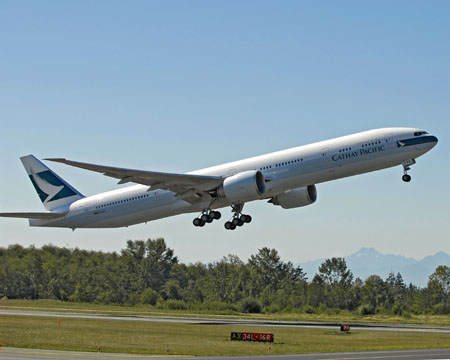
    Boeing, Cathay Pacific Airways Finalize Contract for Six 777-300ERs

    SEATTLE, Sept. 22 — Boeing and Cathay Pacific Airways today announced the Hong Kong-based carrier has exercised existing purchase rights for six additional Boeing 777-300ERs (extended range).

    The six new airplanes, with an estimated value of US$1.6 billion at Boeing list prices, will increase Cathay Pacific’s 777-300ER future fleet from 30 to 36.
    Cathay Pacific, one of the world’s largest operators of the popular jetliner, also operates 12 Boeing 777-300s and five 777-200s.

    “Cathay Pacific is a valued long-time Boeing customer. The global reach of Cathay Pacific’s 777 fleet showcases the airplane’s exceptional performance features and its passenger appeal around the world,” said Marlin Dailey, vice president of Sales for Boeing Commercial Airplanes. “This additional commitment from a world-class operator like Cathay Pacific is a testament to the greater efficiency, economics and reliability of the 777-300ER.”

    Cathay Pacific first announced its selection of the 777-300ER in 2005. This announcement is Cathay Pacific’s fourth increase in its acquisition plans for the long-range jetliner.

    “We are very pleased to confirm this purchase of six more Boeing 777-300ERs – a superb aircraft that already has significantly enhanced our operations on key long-haul routes,” said Cathay Pacific Chief Executive Tony Tyler. “We have been very impressed by the operating economics of these aircraft, while their high efficiency has resulted in a reduced environmental impact. As we continue to enhance our fleet, the 777-300ER will play a crucial role in our operations in the years to come.”
    The Boeing 777 is the world’s most successful twin-engine, long-haul airplane. The 777-300ER extends the 777 family’s span of capabilities, bringing twin-engine efficiency and reliability to the long-range market.

    Boeing incorporated several performance enhancements for the 777-300ER, extending its range and payload capabilities. Excellent performance during flight testing, combined with engine efficiency improvements and design changes that reduce drag and airplane weight, contributed to the increased capability.

    In addition to Boeing 777s, Cathay Pacific operates 47 747-400s in both passenger and cargo versions. The airline also has ordered 10 Boeing 747-8 Freighters. The highly efficient new cargo airplane will augment the airline’s fleet of 25 747 Freighters used to connect Hong Kong to a wide range of international markets.
    Sixty-one customers around the world have ordered more than 1,100 777s.

  • |

    Press Release – FAA Celebrates Recovery Act Funded Airfield Upgrades at Kentucky’s Georgetown-Scott County Regional Airport

    For Immediate Release
    September 23, 2010

    WASHINGTON, D.C. — The U.S. Department of Transportation’s Federal Aviation Administration celebrated the completion of an airfield upgrade at Georgetown-Scott County Regional Airport in Kentucky, paid for with $3 million in American Recovery and Reinvestment Act funds.

    “Airport Recovery Act projects are helping boost local economies all across the country,” said U.S. Transportation Secretary Ray LaHood. “The Recovery Act is helping us keep our runways safe and well maintained."

    Recovery Act funds provided the full cost of repaving Georgetown-Scott County Regional Airport’s 5,500 foot-long runway. The runway had deteriorated and had not been fully repaved in nearly 17 years. The construction also included the widening of the ends of the parallel taxiway, which will now be able to accommodate larger aircraft turning on and off the runway.

    “General aviation is incredibly important to local communities nationwide and the Recovery Act is funding necessary safety improvements and upgrades that otherwise might not get done,” said FAA Administrator Randy Babbitt.

    Nationwide, $1.3 billion in Recovery Act money has been made available for both airport improvement projects and air traffic control facility and system upgrades. Because of low construction bids for projects, more Recovery Act dollars were available for additional facilities and equipment as well as airport projects. These Recovery Act grants have been distributed to airports that serve commercial passengers, cargo and general aviation.

  • | |

    NTSB INVESTIGATING NEAR MIDAIR COLLISION

    National Transportation Safety Board
    Washington, DC 20594

    September 23, 2010

    NTSB INVESTIGATING NEAR MIDAIR COLLISION OVER MINNEAPOLISINVOLVING COMMERCIAL JETLINER AND SMALL CARGO AIRCRAFT

    The National Transportation Safety Board is investigating a near midair collision between a commercial jetliner and a small cargo aircraft that came within an estimated 50 to 100 feet of colliding near the Minneapolis-St. Paul Airport (MSP).

    On September 16, 2010, about 6:49 a.m. CDT, US Airways flight 1848 (AWE 1848), an Airbus 320, was cleared for takeoff on runway 30R en route to Philadelphia, Pennsylvania, carrying five crewmembers and 90 passengers. At the same time, Bemidji Aviation Services flight 46 (BMJ46), a Beech 99 cargo flight with only the pilot aboard, was cleared for takeoff on runway 30L en route to La Crosse, Wisconsin. Weather conditions at the time were reported as a 900-foot ceiling and 10 miles visibility below the clouds.

    Immediately after departure, the tower instructed the US Airways crew to turn left and head west, causing the flight to cross paths with the cargo aircraft approximately one- half mile past the end of runway 30L. Neither pilot saw the
    other aircraft because they were in the clouds, although the captain of the US Airways flight reported hearing the Beech 99 pass nearby. Estimates based on recorded radar data indicate that the two aircraft had 50 to 100 feet of vertical separation as they passed each other approximately 1500 feet above the ground.

    The US Airways aircraft was equipped with a Traffic Alert and Collision Avoidance System (TCAS) that issued climb instructions to the crew to avert collision. The Beech 99 was not equipped with TCAS and the pilot was unaware of the proximity of the Airbus. There were no reports of damage or injuries as a result of the incident.

    NTSB and FAA investigators conducted a preliminary investigation at the Minneapolis airport traffic control tower on September 18th and 19th and are continuing to review the circumstances of this incident.

  • |

    Press Release – Pilots and Air Traffic Controllers Share Safety Data

    For Immediate Release
    September 22, 2010

    WASHINGTON — The Federal Aviation Administration (FAA) today announced a safety program that for the first time will integrate voluntary safety information self-reported by pilots and air traffic controllers. This data-sharing program will give the FAA a more complete picture of the national airspace system by collecting, assessing and reviewing safety events from the perspective of both pilots and air traffic controllers.

    United Airlines and its pilots have the first agreement in place to participate in a demonstration program. The FAA expects to sign similar agreements with other carriers in the future.

    “Safety is our number-one priority,” said U.S. Transportation Secretary Ray LaHood. Having pilots and controllers provide information abut potential air safety problems will help us correct them before they become accidents.”

    “This revolutionary program will give us an incredible amount of data that will help us find problems, make corrections and avoid incidents,” said FAA Administrator Randy Babbitt. “I applaud air traffic controllers, pilots and airlines for their dedication to keeping our aviation system as safe as possible.”

    For the first time, information from the Aviation Safety Action Program (ASAP) and the Air Traffic Safety Action Program (ATSAP) will be merged, so input from both pilots and controllers can help guide safety decisions. The program will develop processes and policies to share and analyze relevant safety information in a non-punitive way, consistent with the basic principles of Safety Management Systems. These systems are widely used within the FAA and the aviation industry.

    ASAP encourages aviation employees to voluntarily report safety information that may help identify potential precursors to accidents. The ASAP process resolves safety issues through corrective action rather than through punishment or discipline. Each program is based on a safety partnership that includes the FAA and the aviation operator, and usually includes a third party, such as the reporting employee’s labor organization. In today’s agreement, the airline’s labor organization is the United chapter of the Air Line Pilots Association (ALPA). Today, 73 air carriers have 169 ASAP programs for pilots, mechanics, flight attendants, and dispatchers.

    ATSAP is an agreement between the FAA and the National Air Traffic Controllers Association (NATCA) that is designed to foster a voluntary, cooperative, non-punitive environment for FAA air traffic employees to openly report safety concerns As a result of ATSAP, all parties have access to valuable safety information that otherwise might never have been discovered or reported. The FAA analyzes the information to develop skill enhancements or system corrective actions that will help solve safety problems.

    Voluntary reporting programs have significantly contributed to the nation’s impressive aviation safety record, including improvements to training and enhanced operations and maintenance procedures.

  • | |

    FAA: “Line Up and Wait” Training Now Available

    “Line Up and Wait” Training Now Available
    On Sept. 30, 2010, the familiar ATC instruction “taxi in position and hold” will become history. Instead, expect to hear “line up and wait” when ATC issues instruction for a pilot to taxi onto a departure runway and wait for takeoff clearance. Another procedure change that occurred on June 30, 2010, requires ATC to issue an explicit clearance to aircraft crossing any runway (active, inactive, and closed). To help pilots with these important procedure changes, FAA added an online training module to www.FAASafety.gov. The course is titled “Line Up and Wait: Taxi Authorization and Runway Clearance Guidance for Airmen,” and is listed in the Featured Courses portal on the FAASafety.gov home page.

    The course provides a good review of safe taxi operations, ATC procedures and phraseology, and pilot responsibilities. It also reviews best practices for avoiding runway incursions, such as knowing and understanding the meaning of the runway hold markings. Some three-fourths of runway incursions result from a failure to comply with this marking.

    Additional details on both procedure changes are available in the Aeronautical Informational Manual (AIM) and Pilot/Controller Glossary, located under the Air Traffic section of www.faa.gov. You can also reference more specific information on line up and wait with FAA Notice JO 7110.536.

  • | | | | | |

    MAK Finds Aviastar Inadequate

    MAK, the Interstate Aviation Committee investigated the Mar 22nd crash of the Aviastar-TU Tupolev TU-204-100 ferry flight en route from Hurghada Egypt to Moscow, and banned it from operating as a passenger airline. On the day of the crash, after the flight control computer failed, the Tu-204 flew 700 feet left of the runway when it was landing. The pilot was found to have “poor training” on simulators that did not correspond with the plane. According to Flight Global, “the crew failed to execute a go-around.”

  • |

    Boeing Projects Steady Growth for Commercial Airplanes Market in Africa

    More than 700 airplanes, worth $80 billion, needed in region over 20 years

    CAPE TOWN, South Africa, Sept. 21 — Boeing forecasts that air carriers in Africa will experience steady growth over the next 20 years as air travel in Africa continues to grow with the economy.

    The African economy is projected to grow 4.8 percent in 2010 following 2.9 percent growth in 2009. This strong growth results from worldwide recovery stimulating demand for African exports as well as imports into the continent. West Africa shows the strongest growth with foreign interest in petroleum development.

    “As the demand for African commodities grows and foreign development and tourism increase, African carriers will require a modernized fleet in order to compete on routes historically dominated by foreign carriers,” said Mike Warner, senior market analyst for Boeing Commercial Airplanes, today at a media briefing in Cape Town.

    “Africa’s current fleet is nearly 20 years old on average in a market that demands newer, more fuel-efficient airplanes to help offset the rising cost of fuel.”

    Boeing’s forecast calls for the delivery of more than 700 airplanes with a value of approximately $80 billion for the African airplane market over the next 20 years.

    Growth in the airline market, along with the demand to replace older, less fuel-efficient single-aisle airplanes and regional jets with new-generation, more fuel-efficient models, will drive new airplane deliveries.

    Strong demand exists to support increased non-stop routes between Africa and Europe, the United States, the Middle East, India, and China. Twin-aisle fleets will evolve in the region as airlines continue to expand international services. Boeing forecasts that twin-aisle airplanes will account for 32 percent of new airplanes delivered to African carriers over the next 20 years compared to 23 percent worldwide. Single-aisle airplanes will represent 60 percent of the African new-airplane market, compared to 69 percent worldwide.

    Newer airplane types such as the Next-Generation 737 and 787 Dreamliner offer significant advantages in environmental performance as well as improved capabilities, fuel efficiency and maintenance costs.
    Today’s market update was part of a series of briefings that highlight Boeing’s airplane capabilities and advantages as well as discuss the African aviation market for the next 20 years. Boeing kicked off the effort at last month’s Aviation & Allied Business Leaders conference in Gaborone, Botswana. Later this year, Boeing will participate in the Airlines Association of South Africa Annual General Meeting in Manzini, Swaziland, in October and the African Airlines Association General Assembly and conference in Addis Ababa, Ethiopia, in November.

  • | |

    NTSB: No Rush to Judge

    George’s Point of View

    As urgent as the idea of an NTSB recommendation sounds, there is apparently no rush. The latest NTSB safety recommendation to EASA is rooted in a 2001 crash: American Airlines Airbus Flight 587. (see narrative below)

    Probable cause of this accident was the in-flight separation of the vertical stabilizer as a result of the loads beyond ultimate design that were created by the first officer’s unnecessary and excessive rudder pedal inputs. (i.e. The pilot used the rudder and it fell off.)

    (To put this into simplistic car terms, your car just skidded on some ice. You did some fancy and extreme steering which may or may not have been necessary. And the steering wheel just came off in your hands. Pretty much all you can do now is spectate and die.)

    The pilot’s unnecessary and excessive rudder pedal input was based on a violent wake turbulence encounter. The pilot’s “unnecessary and excessive” rudder pedal input broke the rudder.

    Isn’t this a dubious conclusion? Isn’t this like blaming a car crash on a driver hitting brakes too hard? The airbus had just taken off and encountered turbulence. Since when do flight controls not handle “aggressive input”?

    Initial suggestions included pilot retraining. (I.E. don’t fix the problem, train the pilots to work around it.) This month, the NTSB encouraged modification of European certification standards. In other words, the NTSB wants to physically limit the rudder movement to what the design can safely manage. Maybe that makes more sense than expecting a pilot engaged in a desperate struggle to save a failing plane to have to make accommodations for flighty flight controls.

    Some take the angle that the problem lies in the rudder design and/or composition. In 2001, the FAA was one of those so inclined.

    On November 16, 2001, the FAA issued emergency AD 2001-23-51 warning of failure of the vertical stabilizer-to-fuselage attachment fittings, transverse (side) load fittings, or rudder-to-vertical stabilizer attachment fittings, if not corrected, could result in loss of the vertical stabilizer and/or rudder and consequent loss of control of the airplane. The FAA considers that, before structural failure, it may be possible to detect indications of possible failure modes that could result in separation of the vertical stabilizer from the airplane. These indications include edge delaminations, cracked paint, surface distortions, other surface damage, and failure of the transverse (side) load fittings. Similarly, indications of failure of the rudder assembly, which could lead to failure of the vertical stabilizer, may also be detectable with such an inspection.

    This failure has happened more than once.

    In the Air Transat flight 961 incident (also a 300 series Airbus) out of Varadero, Cuba, the rudder disintegrated. The pilot in that flight questions the integrity of the rudder design and composition.

    Here another point that has been commonly made. Aircraft have had rudders made of aluminum for 70 years without them disintegrating. With high tech composites, planes are falling out of the sky.

    In March 2006, US safety investigators recommended rudder inspections on Airbus A300-600 jets because a FedEx A300-600 rudder damaged during maintenance.

    Tested on the ground by Fed Ex engineers, in the Fed-Ex A300 cargo plane, the hydraulic system which actuates the rudder tore a hole around the hinges exactly where the rudders of both flight 961 and flight 587 did. Coincidence? I think not.

    Does the certification process need an overhaul? I think so.

    Have a couple of dead pilots again become convenient scapegoats for/by using the very computer controlled flight control system that they believed protected them? I bet I know what the pilots think.

    Flight 587, Official NTSB narrative of the crash
    On November 12, 2001, about 0916:15 eastern standard time, American Airlines flight 587, an Airbus Industrie A300-605R, N14053, crashed into a residential area of Belle Harbor, New York, shortly after takeoff from John F. Kennedy International Airport (JFK), Jamaica, New York. Flight 587 was a regularly scheduled passenger flight to Las Americas International Airport, Santo Domingo, Dominican Republic, with 2 flight crewmembers, 7 flight attendants, and 251 passengers aboard the airplane. The airplane’s vertical stabilizer and rudder separated in flight and were found in Jamaica Bay, about 1 mile north of the main wreckage site. The airplane’s engines subsequently separated in flight and were found several blocks north and east of the main wreckage site. All 260 people aboard the airplane and 5 people on the ground were killed, and the airplane was destroyed by impact forces and a postcrash fire. Flight 587 was operating under the provisions of 14 Code of Federal Regulations (CFR) Part 121 on an instrument flight rules flight plan. Visual meteorological conditions prevailed at the time of the accident.

    The accident airplane arrived at JFK about 2231 on the night before the accident. The airplane had been flown from San Jose, Costa Rica, to JFK with an intermediate stop in Miami International Airport, Miami, Florida. During postaccident interviews, the pilots of the flight leg from MIA to JFK indicated that the flight was smooth and uneventful.

    Flight 587 was the first leg of a 1-day roundtrip sequence for the flight crew. American Airlines records indicated that the captain checked in for the flight about 0614 and that the first officer checked in about 0630. The gate agent working the flight arrived at the departure gate about 0645. She stated that the flight attendants were already aboard the airplane at that time and that the captain and the first officer arrived at the gate about 0700.

    About 0710, the airplane fueling process began. The airplane fueler indicated that, during the fueling process, he saw one of the pilots perform an exterior inspection of the airplane. He finished the fueling process about 0745 and stated that he saw nothing unusual regarding the airplane.

    Statements provided to the Port Authority of New York and New Jersey Police Department by American Airlines maintenance and avionics personnel indicated that, sometime between 0730 and 0800, the captain reported that the number 2 pitch trim and yaw damper system would not engage. Two avionics technicians were sent to the airplane to investigate the problem. They performed an auto flight system (AFS) check, which indicated a fault with the number 2 flight augmentation computer. The circuit breaker was then reset, another AFS check was performed, and no fault was detected. In addition, an autoland system check was performed, and that test also did not detect a fault. The avionics technicians estimated that they were in the cockpit for 5 to 7 minutes.

    The cockpit voice recorder (CVR) recording began about 0845:35. The CVR indicated that, about 0859:58, the airplane was cleared to push back from the gate. About 0901:33, the ground controller provided the flight crew with taxi instructions to runway 31L, and the first officer acknowledged these instructions. About 0902:05, the captain told the first officer, “your leg, you check the rudders.” (The first officer was the flying pilot, and the captain was the nonflying pilot.) Data from the flight data recorder (FDR) showed that, about 0902:07, the rudder pedal check began. The FDR data also showed that a maximum right rudder pedal deflection of about 3.7 inches was recorded about 0902:11 and that a maximum left rudder pedal deflection of 3.6 inches was recorded about 0902:19. About 0902:23, the first officer responded, “rudders check.” The FDR data showed that the rudder pedals returned to their neutral position about 0902:25.

    About 0906:53, the ground controller provided the pilots of Japan Air Lines flight 47, a Boeing 747-400, with taxi instructions to runway 31L. About 0908:01, the ground controller instructed the Japan Air Lines pilots to contact the local (tower) controller. About 0908:58, the ground controller instructed the flight 587 pilots to follow the Japan Air Lines airplane and to contact the local controller. The first officer acknowledged this instruction.

    About 0911:08, the local controller cleared the Japan Air Lines airplane for takeoff. About 0911:36, the local controller cautioned the flight 587 pilots about wake turbulence and instructed the pilots to taxi into position and hold for runway 31L. The first officer acknowledged the instruction. About 0913:05, the local controller instructed the Japan Air Lines pilots to fly the bridge climb and to contact the departure controller at the New York Terminal Radar Approach Control (TRACON). About 0913:21, the flight 587 captain said to the first officer, “you have the airplane.”

    About 0913:28, the local controller cleared flight 587 for takeoff, and the captain acknowledged the clearance. About 0913:35, the first officer asked the captain, “you happy with that [separation] distance?” About 3 seconds later, the captain replied, “we’ll be all right once we get rollin’. He’s supposed to be five miles by the time we’re airborne, that’s the idea.” About 0913:46, the first officer said, “so you’re happy.”

    The National Transportation Safety Board’s airplane performance study for this accident0 determined that flight 587 started its takeoff roll about 0913:51 and lifted off about 0914:29, which was about 1 minute 40 seconds after the Japan Air Lines airplane. About 0914:43, the local controller instructed the flight 587 pilots to turn left, fly the bridge climb, and contact the New York TRACON departure controller. About 5 seconds later, the captain acknowledged this instruction. Radar data indicated that the airplane climbed to 500 feet above mean sea level (msl) and then entered a climbing left turn to a heading of 220º. About 0915:00, the captain made initial contact with the departure controller, informing him that the airplane was at 1,300 feet msl and climbing to 5,000 feet msl. About 0915:05, the departure controller instructed flight 587 to climb to and maintain 13,000 feet msl, and the captain acknowledged this instruction about 5 seconds later. About 0915:29, the CVR recorded the captain’s statement “clean machine,” indicating that the gear, flaps, and slats had all been retracted.

    About 0915:35, flight 587 was climbing through 1,700 feet msl with its wings approximately level. About 1 second later, the departure controller instructed flight 587 to turn left and proceed direct to the WAVEY navigation intersection (located about 30 miles southeast of JFK). About 0915:41, the captain acknowledged the instruction. The controller did not receive any further transmissions from flight 587.

    FDR data indicated that, about 0915:36, the airplane experienced a 0.04 G drop in longitudinal load factor, a 0.07 G shift to the left in lateral load factor, and about a 0.3 G drop in normal (vertical) load factor. The airplane performance study found that these excursions were consistent with a wake turbulence encounter. Between 0915:36 and 0915:41, the FDR recorded movement of the control column, control wheel, and rudder pedals. Specifically, the control column moved from approximately 0º (neutral) to 2º nose up, 2º nose down, and back to 0º; the control wheel moved a total of seven times, with peaks at 18º right, 30º left, 37º right, 34º left, 5º left, 21º left, and 23º right, before moving to between 5º and 6º left; and the rudder pedals moved from about 0.1 inch left (the starting point for the pedals) to about 0.1 inch right and 0.2 inch left before moving to 0.1 inch left. The airplane performance study indicated that, during this time, the rudder moved from 0º (neutral) to about 2º left, about 0.6º right, and back to 0º.

    During the wake turbulence encounter, the airplane’s pitch angle increased from 9º to 11.5º, decreased to about 10º, and increased again to 11º. The airplane’s bank angle moved from 0º (wings level) to 17º left wing down, which was consistent with the turn to
    the WAVEY navigation intersection.

    At 0915:44.7, the captain stated, “little wake turbulence, huh?” to which the first officer replied, at 0915:45.6, “yeah.” At 0915:48.2, the first officer indicated that he wanted the airspeed set to 250 knots, which was the maximum speed for flight below 10,000 feet msl. At that point, the airplane was at an altitude of about 2,300 feet msl.

    FDR data indicated that, about 0915:51, the load factors began excursions that were similar to those that occurred about 0915:36: the longitudinal load factor dropped from 0.20 to 0.14 G, the lateral load factor shifted 0.05 G to the left, and the normal load factor dropped from 1.0 to 0.6 G. The airplane performance study found that these excursions were also consistent with a wake turbulence encounter. According to the FDR, the airplane’s bank angle moved from 23º to 25º left wing down at 0915:51.5, the control wheel moved to 64º right at 0915:51.5, and the rudder pedals moved to 1.7 inches right at 0915:51.9.

    At 0915:51.8, 0915:52.3, and 0915:52.9, the CVR recorded the sound of a thump, a click, and two thumps, respectively. At 0915:54.2, the first officer stated, in a strained voice, “max power.” At that point, the airplane was traveling at 240 knots. About 0915:55, the captain asked, “you all right?” to which the first officer replied, “yeah, I’m fine.” One second later, the captain stated, “hang onto it. Hang onto it.” The CVR recorded the sound of a snap at 0915:56.6, the first officer’s statement “let’s go for power please” at 0915:57.5, and the sound of a loud thump at 0915:57.7. According to the airplane performance study, the vertical stabilizer’s right rear main attachment fitting fractured at 0915:58.4, and the vertical stabilizer separated from the airplane immediately afterward. At 0915:58.5, the CVR recorded the sound of a loud bang. At that time, the airplane was traveling at an airspeed of about 251 knots.

    According to the FDR, the rudder pedals moved from 1.7 inches right to 1.7 inches left, 1.7 inches right, 2.0 inches right, 2.4 inches left, and 1.3 inches right between 0915:52 and 0915:58.5. Also, the FDR showed that the control wheel moved 64º to the right at 0915:51.5, 78º (full) to the left at 0915:53.5, 64º to the right at 0915:55.5, and 78º to the left at 0915:56.5.

    The airplane performance study estimated that, at 0915:53.2, the rudder was deflected 11º to the left, and the sideslip angle at the airplane’s center of gravity (cg) was about 4º to the left (after peaking temporarily at 5º to the left).21 At 0915:56.8, the rudder was deflected 10.2º to the left, and the sideslip angle was about 7º to the left. At 0915:58.4 (the time that the right rear main attachment fitting fractured), the rudder was deflected between 10º and 11º to the right, the sideslip angle was between 11º and 12º to the right, and the airplane experienced a 0.2 G shift to the right in lateral load factor.

    The CVR recorded, at 0916:00.0, a sound similar to a grunt and, 1 second later, the first officer’s statement, “holy [expletive].” At 0916:04.4, the CVR recorded a sound similar to a stall warning repetitive chime, which lasted for 1.9 seconds. At 0916:07.5, the first officer stated, “what the hell are we into…we’re stuck in it.” At 0916:12.8, the captain stated, “get out of it, get out of it.” The CVR recording ended 2 seconds later. The airplane was located at 40º 34′ 37.59″ north latitude and 73º 51′ 01.31″ west longitude. The accident occurred during the hours of daylight.

  • |

    NTSB Safety Recommendation

    Mr. Patrick Goudou
    Executive Director
    European Aviation Safety Agency
    Postfach 10 12 53
    D-50452 Cologne, Germany

    The National Transportation Safety Board (NTSB) is an independent U.S. Federal Government agency charged by the U.S. Congress with investigating transportation accidents, determining their probable cause, and making recommendations to prevent similar accidents from occurring. We are providing the following information in support of the safety recommendations in this letter. The NTSB is making these recommendations because they are designed to prevent accidents and save lives.

    On November 12, 2001, about 0916 eastern standard time, an Airbus A300-605R,1 N14053, operated as American Airlines flight 587, crashed into a residential area of Belle Harbor, New York, shortly after takeoff from John F. Kennedy International Airport, Jamaica, New York.2 Following an encounter with wake turbulence from a preceding Boeing 747 (747), the first officer made a series of full alternating rudder pedal inputs before the airplane’s vertical stabilizer and rudder separated in flight; both were found in Jamaica Bay about 1 mile north of the main wreckage site.

    The NTSB determined that the probable cause of the American Airlines flight 587 accident was the in-flight separation of the vertical stabilizer as a result of the loads beyond ultimate design3
    that were created by the first officer’s unnecessary and excessive rudder pedal inputs. Contributing to these rudder pedal inputs were characteristics of the Airbus A300-600
    rudder system design and elements of the American Airlines Advanced Aircraft Maneuvering Program (AAMP).4
    1 The Airbus A300-605R is one of several variants of the A300-600 series airplane. The “5” refers to the type of engine installed on the airplane, and the “R” refers to the airplane’s ability to carry fuel in the horizontal stabilizer.
    2 For more information, see In-Flight Separation of Vertical Stabilizer, American Airlines Flight 587, Airbus Industrie A300-605R, N14053, Belle Harbor, New York, November 12, 2001, Aircraft Accident Report NTSB/AAR-04/04 (Washington, DC: National Transportation Safety Board, 2004).
    3 The ultimate design load is the maximum load to be expected in service multiplied by a safety factor of 1.5.
    4 According to American Airlines, AAMP was “advanced training for experienced aviators involving upsets in aircraft attitude” that consisted of ground school and simulator flight training.
    5 The leading 747, United Airlines flight 896, was en route from Hong Kong to Chicago O’Hare International Airport. The 747 was eastbound at FL370. At the time of the upset, both flights were under Seattle Air Route Traffic Control Center control, and when Air Canada flight 190 was cleared from FL350 to FL370, the 747 was ahead of and above Air Canada flight 190. The Transportation Safety Board of Canada calculated that, at the time of the upset, United Airlines flight 896 was 10.7 nautical miles ahead of Air Canada flight 190. According to postaccident interviews and cockpit voice recorder data, although the flight crewmembers of Air Canada flight 190 knew they were following a 747, they were unaware of their trailing distance to United Airlines flight 896.
    6 Encounter with Wake Turbulence, Air Canada Airbus A319-114 C-Gbhz, Washington State, United States, 10 January 2008, Aviation Investigation Report A08W0007 (Gatineau, Quebec, Canada: Transportation Safety Board of Canada, 2010). .
    7 In the Airbus A319, a side-stick controller is used to control pitch and roll.
    8 The vertical stabilizer is attached to the airplane’s aft fuselage. The vertical stabilizer provides supporting structure for the rudder, which is an aerodynamic control surface that is used to make the airplane yaw, or rotate, about its vertical axis. An airplane cannot be flown without its vertical stabilizer.
    9 According to 14 Code of Federal Regulations (CFR) 25.301(a), the limit load is the highest load that the airplane structure is expected to experience while in service. According to 14 CFR 25.305(a), the airplane must be designed to withstand this load without detrimental permanent deformation, and the deformation may not interfere with safe operation.
    10 For more information, see table 4 of NTSB/AAR-04/04.
    11 APC excursions occur when the dynamics of the airplane and the dynamics of the pilot combine to produce an unstable system. For more information, see National Research Council, Aviation Safety and Pilot Control—Understanding and Preventing Unfavorable Pilot-Vehicle Interactions (Washington, DC: National Academy Press, 1997).
    12 This change in pedal sensitivity is not characteristic of a variable ratio control system, such as employed on other airplanes, which retains a relatively uniform aircraft response throughout the airspeed envelope.
    13 On September 13, 2005, the NTSB acknowledged that, on behalf of France, the European Aviation Safety Agency (EASA) would perform the functions and tasks of the State of Design with respect to International Civil Aviation Organization Annex 8 in the field of airworthiness; therefore, EASA would be responsible for responding to Safety Recommendation A-04-63.

    The circumstances of the American Airlines flight 587 accident are similar to a more recent accident involving an Airbus model A319. On January 10, 2008, about 0848 central standard time, an Airbus Industrie A319, Canadian registration C-GBHZ, operated as Air Canada flight 190, experienced an in-flight upset after encountering wake turbulence from a 747 while climbing from flight level (FL) 360 to FL370.5 The flight crew declared an emergency and diverted the flight to Calgary, where it landed uneventfully. Of the 5 crewmembers and 83 passengers on board, 2 crewmembers and 8 passengers sustained minor injuries, and 3 passengers sustained serious injuries. Visual meteorological conditions prevailed, and an instrument flight rules flight plan was filed for the scheduled domestic passenger flight from Victoria International Airport, British Columbia, Canada, to Toronto Pearson International Airport, Ontario, Canada. The Transportation Safety Board of Canada investigated this accident;6 the NTSB and Bureau d’Enquêtes et d’Analyses provided accredited representatives and technical advisors to the investigati

    Data from the flight data recorder (FDR) indicate that, during the upset, the airplane experienced several roll and vertical load factor oscillations and lost about 1,000 feet of altitude. Although the autopilot was engaged during the start of the wake vortex encounter, after about 3 seconds, the autopilot was disengaged, and there was a series of large oscillatory inputs on the left side-stick controller.7 In addition, the FDR recorded a series of three to four alternating rudder pedal inputs (right pedal, then left pedal) over the next 15 seconds. During these inputs, the airplane continued to oscillate in roll, reaching a maximum roll of 55º. At the same time, the recorded acceleration was also oscillating, with peaks of -0.46 G to +0.49 G of lateral load factor and peaks of -0.76 G to +1.57 G of vertical load factor.

    Because of the severity of the upset, following the emergency landing at Calgary, the airplane was grounded pending an inspection by Airbus engineers. During an extensive inspection, the vertical stabilizer8 was removed from the airplane and scanned ultrasonically to inspect for damage to the stabilizer’s composite components. No damage was found, and the stabilizer was reattached and the airplane returned to service.
    Although no damage to the stabilizer was found, an analysis of the accident performed by Airbus indicated that the rear vertical stabilizer attachment fitting sustained loads 29 percent above its design limit load.9 Simulation work performed by Airbus revealed that these high loads were primarily the result of the flight crew’s series of alternating rudder pedal inputs and were not the result of the wake turbulence. Information and animations provided by Airbus showed that if the pilots had not made any control inputs after the wake encounter, the airplane would have righted itself with minimum altitude loss and g-loading.

    Prevention of High Loads Resulting From Pilot Rudder Pedal Inputs

    The rudder system design for the Airbus A320 airplane family, which includes the A319, is functionally similar to the design for the Airbus A300/A310 airplane family. Both families use a variable-stop rudder travel limiter, which mechanically limits available rudder pedal deflection as airspeed increases. Consequently, at high airspeeds, these systems require lighter pedal forces and smaller pedal displacements to obtain maximum available rudder than at low airspeeds.10 Investigation of the American Airlines flight 587 accident revealed that variable-stop systems produce dramatically larger aircraft responses to the same rudder input at higher airspeeds than at lower airspeeds, which can surprise a pilot and serve as a trigger for an aircraft-pilot coupling (APC)11 event.12

    As a result of findings from the American Airlines flight 587 investigation, the NTSB issued Safety Recommendation A-04-63, which asked the French Direction Générale de l’Aviation Civile13 to do the following:

    Review the options for modifying the Airbus A300-600 and the Airbus A310 to provide increased protection from potentially hazardous rudder pedal inputs at high airspeeds and, on the basis of this review, require modifications to the A300-600 and A310 to provide increased protection from potentially hazardous rudder pedal inputs at high airspeeds.

    In the same report, the NTSB issued a companion recommendation, A-04-58, to the Federal Aviation Administration (FAA). On September 13, 2005, the NTSB classified Safety
    Recommendation A-04-63 “Open—Acceptable Response.” On April 6, 2009, the European Aviation Safety Agency (EASA) responded that Airbus had analyzed several modifications, and a reduced pedal travel limiting unit (PTLU) was identified as the most promising solution to address this recommendation. On March 19, 2010, EASA further indicated that “its previously held position on the pilot training out as being an efficient and sufficient measure to avoid any new hazardous situations has to be reconsidered following more recent service experience which confirms that crew use of rudder pedal inputs in upset encounters cannot be ‘trained out.’” EASA therefore indicated that it plans to require the PTLU on Airbus A310 and A300-600 aircraft models. The NTSB will consider how the proposed changes are responsive to Safety Recommendation A-04-63 when EASA provides further details about the PTLU. In the meantime, the NTSB still believes that the changes called for in this recommendation are necessary. Therefore, the NTSB reiterates Safety Recommendation A-04-63.

    Yaw Axis Certification and Rudder Pedal Sensitivity

    The similarities between the Air Canada flight 190 and American Airlines flight 587 crewmembers’ responses to wake encounters indicate that the Airbus A320 family is also susceptible to potentially hazardous rudder pedal inputs at higher airspeeds. In both events, the vertical stabilizer limit loads were exceeded by a large margin as a result of the alternating rudder inputs. In the American Airlines flight 587 accident, the pilot applied four full alternating rudder inputs; after the fourth input, the aerodynamic loads on the vertical stabilizer exceeded the vertical stabilizer’s ultimate design load (at about twice the maximum load), and it separated from the airplane. In the Air Canada flight 190 accident, the pilot applied three alternating rudder inputs and exceeded the limit load by 29 percent.

    Rudder control systems with a variable ratio rudder travel limiter may provide better protection against high loads from sustained rudder pedal inputs at high airspeeds than systems with a variable-stop rudder travel limiter because variable ratio rudder travel limiter systems retain a relatively uniform aircraft response throughout the airspeed envelope and require more physical effort from a pilot (in terms of force and displacement) to produce cyclic full rudder inputs at high speeds. There is no certification standard regarding rudder pedal sensitivity or any requirement for the sensitivity to remain constant at all airspeeds. As discussed above, the Airbus A320 rudder control system design characteristics are comparatively similar to those of the Airbus A300-600 and A310 and may serve as a trigger for an APC event at high airspeeds. The NTSB concludes that, as demonstrated by the American Airlines flight 587 and Air Canada flight 190 accidents, certification standards for transport-category aircraft regarding yaw sensitivity to rudder pedal inputs must ensure that airplane designs minimize the potential for APC susceptibility and better protect against high loads in the event of large rudder inputs.

    As a result of the American Airlines flight 587 accident investigation, the NTSB issued Safety Recommendations A-04-56 and -57, which asked the FAA to do the following:

    Modify 14 Code of Federal Regulations Part 25 to include a certification standard that will ensure safe handling qualities in the yaw axis throughout the flight envelope, including limits for rudder pedal sensitivity. (A-04-56)

    After the yaw axis certification standard recommended in Safety Recommendation A-04-56 has been established, review the designs of existing airplanes to determine if they meet the standard. For existing airplane designs that do not meet the standard, the FAA should determine if the airplanes would be adequately protected from the adverse effects of a potential [APC] after rudder inputs at all airspeeds. If adequate protection does not exist, the FAA should require modifications, as necessary, to provide the airplanes with increased protection from the adverse effects of a potential APC after rudder inputs at high airspeeds. (A-04-57)

    On March 1, 2005, the FAA indicated that the current standards governing the performance and design of yaw control systems may need to be redefined. The FAA added that it was evaluating the existing standards and conducting a study to identify critical rudder control system parameters and human interaction with those controls. The FAA further indicated that, based on the results of the study, it would determine whether the current standards need to be updated and would work with industry to develop rudder control standards. On August 3, 2005, the NTSB classified Safety Recommendations A-04-56 and -57 “Open—Acceptable Response.” As a result of the investigation of the Air Canada flight 190 accident, the NTSB reiterated Safety Recommendations A-04-56 and -57. The NTSB concludes that the yaw axis handling qualities standards envisioned in Safety Recommendations A-04-56 and -57 would increase the safety of all aircraft, not just those whose initial airworthiness certificate is issued by the FAA. Therefore, the NTSB recommends that EASA modify EASA Certification Specifications for Large Aeroplanes CS-25 to ensure safe handling qualities in the yaw axis throughout the flight envelope, including limits for rudder pedal sensitivity. Further, the NTSB recommends that, after the yaw axis certification standard recommended in Safety Recommendation A-10-119 has been established, EASA review the designs of existing airplanes to determine if they meet the standard. For existing airplane designs that do not meet the standard, EASA should determine if the airplanes would be adequately protected from the adverse effects of a potential APC after rudder inputs at all airspeeds. If adequate protection does not exist, EASA should require modifications, as necessary, to provide the airplanes with increased protection from the adverse effects of a potential APC after rudder inputs at high airspeeds.

    Therefore, the National Transportation Safety Board recommends that the European Aviation Safety Agency:
    Modify European Aviation Safety Agency Certification Specifications for Large Aeroplanes CS-25 to ensure safe handling qualities in the yaw axis throughout the flight envelope, including limits for rudder pedal sensitivity. (A-10-119)
    After the yaw axis certification standard recommended in Safety Recommendation A-10-119 has been established, review the designs of existing airplanes to determine if they meet the standard. For existing airplane designs that do not meet the standard, the European Aviation Safety Agency (EASA) should determine if the airplanes would be adequately protected from the adverse effects of a potential aircraft-pilot coupling (APC) after rudder inputs at all airspeeds. If adequate protection does not exist, EASA should require modifications, as
    necessary, to provide the airplanes with increased protection from the adverse effects of a potential APC after rudder inputs at high airspeeds. (A-10-120)
    In addition, the National Transportation Safety Board reiterates the following recommendation to the European Aviation Safety Agency:
    Review the options for modifying the Airbus A300-600 and the Airbus A310 to provide increased protection from potentially hazardous rudder pedal inputs at high airspeeds and, on the basis of this review, require modifications to the A300-600 and A310 to provide increased protection from potentially hazardous rudder pedal inputs at high airspeeds. (A-04-63)

    The National Transportation Safety Board reiterated three safety recommendations (A-04-56 through -58) and reiterated and reclassified one safety recommendation (A-02-01) to the Federal Aviation Administration.

    In response to the recommendations in this letter, please refer to Safety Recommendations A-10-119 and -120 and A-04-63. If you would like to submit your response electronically rather than in hard copy, you may send it to the following e-mail address: correspondence@ntsb.gov. If your response includes attachments that exceed 5 megabytes, please e-mail us asking for instructions on how to use our secure mailbox. To avoid confusion, please use only one method of submission (that is, do not submit both an electronic copy and a hard copy of the same response letter).

    Chairman HERSMAN, Vice Chairman HART, and Members SUMWALT, ROSEKIND, and WEENER concurred with these recommendations.

    By: Deborah A.P. Hersman
    Chairman

  • |

    Previously announced increase to 35 per month to be extended to 38 per month in second quarter 2013

    SEATTLE, Sept. 16 — Boeing announced today its production rate for the Next-Generation 737 program will increase to 38 airplanes per month in the second quarter of 2013. This decision comes just months after announcing a rate increase on the company’s best-selling commercial jetliner from 31.5 to 35 airplanes per month in early 2012.

    "Increasing production is in response to customer demand for this airplane," said Boeing Commercial Airplanes President and CEO Jim Albaugh. "Airlines want this innovative airplane sooner to renew their fleets to serve their customers. We made this decision after careful evaluation by Boeing and our supplier partners."

    Key factors to the rate decision include the company’s current backlog of more than 2,000 Next-Generation 737s, current options that customers are expected to exercise and ongoing sales campaigns. The rate increase is not expected to have a material impact on 2010 financial results.

    Next-Generation 737 customers have benefited from continuous innovation of the airplane since its introduction in 1997. The first five airlines will receive the new 737 Boeing Sky Interior by the end of this year. Customers will gain from a two percent reduction in the airplane’s fuel consumption by early 2012, through a combination of airframe and engine improvements.

    The 2010 Current Market Outlook, Boeing’s long-term forecast of air traffic volumes and commercial airplane demand, projects a market of over 21,000 single-aisle airplanes over the next 20 years, accounting for an anticipated 69 percent of the airplanes delivered and an estimated 47 percent of the $3.6 trillion total market value.

    Forward-Looking Statements

    Certain statements in this report may be "forward-looking" within the meaning of the Private Securities Litigation Reform Act of 1995. Words such as "expects," "intends," "plans," "projects," "believes," "estimates," "targets," "anticipates," and similar expressions are used to identify these forward-looking statements. Forward-looking statements are based upon assumptions about future events that may not prove to be accurate. These statements are not guarantees of future performance and involve risks, uncertainties and assumptions that are difficult to predict. Actual outcomes and results may differ materially from what is expressed or forecasted in these forward-looking statements. As a result, these statements speak to events only as of the date they are made and we undertake no obligation to publicly update or revise any forward-looking statements, whether as a result of new information, future events or otherwise, except as required by federal securities laws. Specific factors that could cause actual results to differ materially from forward-looking statements include, but are not limited to, statements we make regarding our guidance relating to future financial and operating performance, the effect of economic conditions in the United States and globally, and general industry conditions as they may impact us or our customers, as well as the other important factors disclosed previously and from time to time in our other filings with the Securities and Exchange Commission.

  • |

    Boeing Press Release: Changes needed in training methodologies to engage next generation

    SINGAPORE, Sept. 15 — The commercial aviation industry will require 466,650 pilots and 596,500 maintenance personnel over the next 20 years to accommodate the strong demand for new and replacement aircraft, according to a crew assessment forecast from Boeing. Airlines will need an average of 23,300 new pilots and 30,000 new maintenance personnel per year from 2010 to 2029.

    The crew assessment forecast is based on Boeing’s Current Market Outlook, widely regarded as the most comprehensive and respected analysis of the commercial aviation market. “When you add up all the numbers, you quickly understand the issues facing this industry,” said Roei Ganzarski, chief customer officer, Boeing Training & Flight Services. “Our challenge is adapting our training to engage the future generation of people who will fly and maintain the more than 30,000 airplanes that will be delivered by 2029.”

    The largest growth in both pilots and maintenance workers will be in the Asia-Pacific region with a requirement for 180,600 and 220,000 respectively. Within Asia, China will experience the greatest need for pilots and maintenance personnel — 70,600 and 96,400 respectively.

    North America will need 97,350 pilots and 137,000 maintenance workers; Europe will need 94,800 pilots and 122,000 maintenance personnel; Africa will need 13,200 pilots and 15,000 maintenance personnel; the Middle East will need 32,700 pilots and 44,500 maintenance personnel; Latin America will need 37,000 pilots and 44,000 maintenance personnel; and the CIS will need 11,000 pilots and 14,000 maintenance personnel.

    “To accommodate this growing demand, it will be vital to match training with the learning styles of students to come,” Ganzarski said. During the recent Asia Pacific Aviation Training Symposium in Kuala Lumpur, Ganzarski called for changes to current training methodologies. “As an industry, we need to adapt to the learning styles of tomorrow’s technologically savvy pilots and mechanics, and ensuring that training is globally accessible, adaptable to individual needs and competency-based.”

  • | | | |

    FAA: Testimony – Statement of Peggy Gilligan

    September 16, 2010
    Statement of Peggy Gilligan, Associate Administrator for Aviation Safety Before the House of Representatives, Committee on Transportation and Infrastructure, Subcommittee on Aviation on Pilot Fatigue

    Chairman Costello, Congressman Petri, Members of the Subcommittee:

    Thank you for inviting me to appear before you this morning to discuss the Federal Aviation Administration’s (FAA) efforts to mitigate the impacts of pilot fatigue to enhance aviation safety. Updating FAA’s regulatory requirements on pilot fatigue has been a high priority for Secretary LaHood and Administrator Babbitt. As you know, Administrator Babbitt was formerly a commercial pilot, so his interest in and insights about pilot fatigue have been longstanding, and were helpful in making rulemaking on this matter an Administration priority. Their assistance and guidance on this matter have been invaluable. I am pleased that their focus has enabled the FAA to publish a Notice of Proposed Rulemaking (NPRM) on September 14, 2010, that proposes changes to the current flight duty and rest regulations. The NPRM represents a comprehensive proposal that is the result of extensive outreach to the aviation industry, labor and the scientific community. Unlike the existing requirements, the proposal would establish a single, scientifically-based regulatory approach for all Part 121 operators, including domestic and international passenger and cargo operations, as well as supplemental carriers.

    While the publication of this NPRM is a huge step forward, I want to stress that it is the latest step in a long history of FAA efforts to mitigate fatigue. We held symposia on fatigue and worked with aviation industry and the scientific community to gather data to meet the scheduling demands of the industry (including ultra long-range flights), without compromising safety. As the science of fatigue matured, we worked to educate the industry to mitigate risks as they were identified. The new proposal reflects our drive to reach consensus across different facets of the aviation industry.

    In the past, I have said something that is worth repeating now: regardless of what regulatory framework is in place, mitigating the effects of fatigue is a shared responsibility. The FAA has the responsibility to put the framework in place. The air carrier has the responsibility to schedule its flight crews responsibly and in accordance with that framework. The pilot has the ultimate responsibility to use the hours set aside for rest to actually rest, to report for duty in a fit condition, and to notify the airline when he or she is too fatigued or otherwise not fit for duty. Nothing about the latest proposal changes those basic responsibilities.

    In the aftermath of the Colgan Air Flight 3407 accident in February 2009, the FAA placed great emphasis on all safety factors that either were, or could have been, a contributing cause to the accident. Secretary LaHood and Administrator Babbitt issued an Airline Safety Call to Action for the foremost aviation safety experts to discuss the best ways to make an already safe industry even safer. Fatigue was clearly a factor of some concern, given that one member of the Colgan flight crew commuted from the West Coast prior to reporting for duty and the evidence suggested that she may not have had sufficient rest.

    In addition to the Call to Action, Administrator Babbitt convened an Aviation Rulemaking Committee (ARC) comprised of representatives from airline management and pilot labor unions to review fatigue-related issues and to make specific scientifically-based recommendations that could be the basis of rulemaking. The ARC delivered its report and recommendations in September 2009. The report and recommendations reflected consensus on many issues, but there were a handful of issues where the ARC did not reach consensus. In addition, the ARC was not charged with performing any type of economic analysis, which the FAA must provide in any rulemaking initiative.

    The NPRM utilizes accepted assumptions as to what causes fatigue and creates a framework that addresses those risks. For example, it is generally accepted that higher levels of activity cause more fatigue and that most people need eight hours of sleep in a 24 hour period in order to perform effectively and remain alert. It is also acknowledged that an average person needs in excess of nine hours of sleep in order to recover from accumulated sleep deprivation and the quality of the sleep an individual gets is usually affected by the time of day in which it occurs, with nighttime sleeping being more restorative.

    Using these assumptions as a basis, the NPRM focuses on the nature of the operation. During a duty period, how many take-offs and landings does the pilot fly? Do the operations involved cross time zones and, if so, how many? Are the operations during the day or at night? The proposal recognizes that basing hourly restrictions solely on the total number of hours of duty time or flight time does not have as much meaning as factoring in what kind of operations were being flown during that period. Different operations result in different fatigue levels and that reality must be recognized in any new regulatory framework.

    The NPRM would impose requirements for rest, flight time, and duty time. There is a proposed nine hour rest requirement prior to flying related duty. In addition, flight time restrictions include limits for every 28-day period, as well as annual limits. The flight time restrictions also reflect all operations flown for the carrier by the pilot, even if some of those flights are ferrying operations or other flights not flown under Part 121. Finally, both the flight time and duty time restrictions proposed would reflect differences in the types of operations flown as well as when they are flown, and require shorter duty periods for certain times of day and quantities of takeoffs and landings.

    The proposal would also gives carriers the option of integrating a Fatigue Risk Management System (FRMS) into their scheduling systems. FRMS is a carrier-specific method of evaluating how best to mitigate fatigue, based on active monitoring and evaluation by the carrier and flightcrew members. In this case, the carrier would model its schedules to determine where there may be risk from fatigue. The carrier would develop mitigation strategies to eliminate or mitigate that risk. The FAA will determine that the FRMS provides an equivalent level of protection as afforded by the rule and approve the carrier’s system. FRMS were strongly supported by both labor and management in the ARC, because it ensures that each schedule is analyzed and proper mitigation is implemented.

    This approach has the potential to provide a cooperative and flexible means of monitoring and mitigating fatigue during operations when the prescriptive approach is not optimal. We are seeking public comments about how best to realize that potential. An FRMS requires a carrier to develop numerous processes and structures within an operation. These measures lead to effective management and mitigation of fatigue on the part of both the carrier and its employees that might affect the operation.

    One area that I know is of great interest to this Committee is pilot commuting, which our NPRM discusses in the preamble. The ARC made no recommendation on commuting. However, the ARC did point out that pilots are required to report to work fit for duty; and that means rested. Although our proposal does not include specific restrictions on commuting, it does make some modifications to ensure that all pilots, including those who commute, are meeting the existing requirements to report fit for duty.

    As I noted at the beginning of this statement, pilot personal responsibility is critical to whatever fatigue rule is ultimately adopted, whether or not commuting restrictions are imposed. Pilots must commute responsibly, but this proposal broadens that responsibility to include the air carrier, who must be aware of how pilots are commuting to work and must make a determination that each pilot is fit for duty. It is unreasonable to assume that a pilot is resting while commuting, either locally or long distance, and our proposal requires air carriers to consider the commuting times pilots needs to reach their home base while still receiving the required opportunity for rest. It also calls on co-workers – other crew members, dispatchers, etc. – to determine that pilots they’re working with are fit for duty. We believe mandating this shared responsibility will address the risks posed by a pilot failing to identify that he or she is not sufficiently rested – and therefore not fit for duty.

    Finally, one of the most challenging issues we have had to resolve in order to move forward with a new fatigue regulatory proposal is that of the costs associated with a new rule compared with the benefits that are expected to accrue from a new requirement. All of us in government and industry associated with aviation are dedicated to enhancing aviation safety. This is what we work for day in and day out. At the same time, we seek to ensure that rules do not impose excessive, unjustified, or unnecessary costs on airlines, airline employees, and consumers. We are required to provide the public with information about the projected costs and benefits associated with any regulatory proposal. Reducing fatigue, through whatever means, may result in the carriers having to add more pilots to comply with new standards, thus adding costs. We believe, however, that carriers will optimize their crew schedules within any new regulatory requirements to continue to be as efficient as possible.

    While we prefer and seek out regulatory options that result in net benefits, there is no absolute requirement that monetary benefits of regulatory proposals outweigh monetary costs. But the benefits, both quantifiable and nonquantifiable, must justify the associated costs. While we have explicitly sought public comments about possible improvements in the proposed rule, we believe it meets that standard. It is important to understand that increasing airline safety creates a number of important social benefits, some of which are hard to quantify.

    Though producing this NPRM did take longer than we expected, we believe we have a solid starting point for a new and better way forward in this area. While this is not the last step in this process, I am extremely proud of the FAA team for this achievement. I would like to thank the many, many members of the Administration, the aviation and labor community, and the scientific community for their tireless efforts to assist Secretary LaHood and Administrator Babbitt in moving forward with the proposed fatigue NRPM. I would also like to acknowledge the support of Congress and the families of victims of the Colgan accident and other family groups in this area.

    There is work to be done in order to make the NPRM ultimately into a final rule, but I am confident that this comprehensive proposal is a step forward and I look forward to receiving public comments and to working with all interested parties, including this Committee, to finalize improved flight duty and rest standards that will enhance safety because that is our shared ultimate goal.

    Thank you for this opportunity to appear before you. I would be happy to answer any questions at this time.

  • | |

    FAA Release: Speech – “Respect and Consideration”

    “Respect and Consideration”
    Michael Huerta, Indianapolis, IN
    September 15, 2010

    National Black Coalition of FAA Employees National Convention

    Good morning, and thanks for inviting me.

    You’re holding this conference at an important juncture for our society. And you’re holding it in a place that’s been a lightning rod for the very things that are perplexing our nation at this time.

    I’m going to raise some hot button issues today, and I by no means am poising myself as the One Who Holds the Answer. But what I am doing – and what I’m hoping that you’ll do alongside me – is to discuss these issues – the ones that are turning up the heat on the kettle we call America.

    As everybody knows, all last week there was a horrendous display of religious, ethical and cultural intolerance in Florida. No one can say that terrorism is the answer. But burning a holy book – a book held near and dear by millions of Americans – well, that did nothing to bring about healing, much less win an argument. Pouring salt into an open wound is not, in my opinion, the springboard to intelligent discourse.

    Instead of raising a concern, they raised the temperature – put fuel to the fire – agitated – whatever you want to call it.

    And in New York City, we have another situation of equal tension. The plans to build a mosque near Ground Zero have both sides in an uproar.

    So here’s my question to you: we are indeed the land of the free and the home of the brave. We are a land of religious tolerance. We’re a land where equality is supposed to be the law of the land.

    So if all this is true, why is it that we’re having the same argument over and over and over again?

    It comes down to respect. And by “respect,” I mean consideration – thinking about something from someone else’s point of view.

    As far as both of those issues are concerned, I must say that just because you have a right doesn’t make you right; that just because you can, doesn’t mean you should.

    If you remember the movie, you know that this is what caused the problem in Jurassic Park. One of the more memorable lines from the movie was delivered by an eccentric mathematician who thought cloning dinosaurs was a bad idea. He said, “You were so busy wondering whether or not you could create these things that you never stopped to wonder if you should.” In the haste to make a buck – or a statement – they plowed ahead without thinking about long-term consequences. Or maybe even short-term consequences.

    That’s a fictional example, but it fits. We’re talking about something that is scary, and has really, really big teeth. Both sides on these issues – the books and the mosque, not the dinosaurs – are raising points that are at the very core of our freedoms.

    But, and this is unfortunate for us, there’s more time spent slinging mud than there is building a bridge.

    You can build a bridge with brick and mortar, with concrete and steel.

    But the bridge between opposing sides must be built with respect. You must be considerate of what the other person has to say.

    Everyone here who’s faced discrimination of any kind knows this to be true. Screaming an epithet at someone who just screamed one at you is not the answer. But it’s our nature to say, You hurt me, I hurt you. An eye for an eye. A tooth for a tooth.

    All of which leaves you with a bunch of one-eyed guys trying to gum each other to death.

    At the agency, we’re not necessarily facing things that are quite that blatant, but we are indeed in an era of change – not just for our work place, but for the entire NAS. The things that we’ve grown comfortable with, like ground-based radar – well, they’re changing as new technology comes along. We’re obligated to change along with them. We’re obligated to see things from a different perspective.

    There was a time, I’m sure, that the idea of horseless carriages seemed pretty strange. And cable TV? Why on earth would anyone pay for cable when you can get TV for free with an antenna? I’ve heard more than once about moms and grandmas who said, “Don’t even take that microwave oven out of the box. I don’t need it, and I won’t use it. And you shouldn’t either.”

    Those examples make us smile, but there are others in our workplace that grate against the grain. For those of you who are used to filling out the paperwork with an actual piece of paper, you’re butting heads with a new generation that can’t figure out why anyone would use paper when you can do it on-line.

    And what about tracking systems that are leading us to cost accounting? We never had to do that before, why should we do it now? Don’t you trust me? Don’t you think I’m doing my job?

    Those are just a couple of things rolling our way. As we know, in an era where the budget isn’t getting any bigger and the work we’re being asked to do isn’t getting any smaller, well, change is upon us.

    It’s a NextGen workplace, and I’m not just talking about satellites. Randy says, “Be ready for Destination 2025,” and he’s right. It’s time for us to recognize that we must adapt to new scenarios, even ones that make us a little uncomfortable – maybe a lot uncomfortable. If we’re going to provide safe, efficient, secure, environmentally friendly service, there’s no other way. We know that the approach we’ve taken has worked so far, but it is indeed time for a change.

    And just like the larger social issues I raised at the beginning, some of the changes we’ll agree with and some we won’t. Some we’ll like and some we might even despise. But at the core of this must be respect – consideration for co-workers, colleagues, friends, supervisors, managers, even – even someone who works for a different line of business. We laugh at that one, but we’re not going to get to Destination 2025 unless and until we learn to work across organizational boundaries.

    I’m looking to you for the support that will make it happen. The kind of support that ripples through an organization and energizes it. Raising the level of those around you is one of the strong themes I see at this conference, and that is definitely the right way to go, definitely the right thing to do.

    So let me close with this. I know where I stand on these issues, but where I stand is not as important right now as it is for us to remember that what makes us great is that we allow differing opinions, differing views, differences of race and creed; and that while we might not respect the opinion on the other side of the argument, we still have respect for that person.

    This is a time for us to show ourselves for what it is we are supposed to be: the land of the free, and a land big enough to have room for ideas with which we disagree, even ideas that we despise with the very essence of our being.

    Let me close again by saying thank you for the invitation. Thank you for holding a conference where important ideas can be raised. You have my respect and my best wishes for success. Thank you.

  • | |

    Pilot Fatigue

    Statement of Peggy Gilligan, Associate Administrator for Aviation Safety
    Before the House of Representatives, Committee on Transportation and Infrastructure, Subcommittee on Aviation on Pilot Fatigue

    Chairman Costello, Congressman Petri, Members of the Subcommittee:

    Thank you for inviting me to appear before you this morning to discuss the Federal Aviation Administration’s (FAA) efforts to mitigate the impacts of pilot fatigue to enhance aviation safety. Updating FAA’s regulatory requirements on pilot fatigue has been a high priority for Secretary LaHood and Administrator Babbitt. As you know, Administrator Babbitt was formerly a commercial pilot, so his interest in and insights about pilot fatigue have been longstanding, and were helpful in making rulemaking on this matter an Administration priority. Their assistance and guidance on this matter have been invaluable. I am pleased that their focus has enabled the FAA to publish a Notice of Proposed Rulemaking (NPRM) on September 14, 2010, that proposes changes to the current flight duty and rest regulations. The NPRM represents a comprehensive proposal that is the result of extensive outreach to the aviation industry, labor and the scientific community. Unlike the existing requirements, the proposal would establish a single, scientifically-based regulatory approach for all Part 121 operators, including domestic and international passenger and cargo operations, as well as supplemental carriers.

    While the publication of this NPRM is a huge step forward, I want to stress that it is the latest step in a long history of FAA efforts to mitigate fatigue. We held symposia on fatigue and worked with aviation industry and the scientific community to gather data to meet the scheduling demands of the industry (including ultra long-range flights), without compromising safety. As the science of fatigue matured, we worked to educate the industry to mitigate risks as they were identified. The new proposal reflects our drive to reach consensus across different facets of the aviation industry.

    In the past, I have said something that is worth repeating now: regardless of what regulatory framework is in place, mitigating the effects of fatigue is a shared responsibility. The FAA has the responsibility to put the framework in place. The air carrier has the responsibility to schedule its flight crews responsibly and in accordance with that framework. The pilot has the ultimate responsibility to use the hours set aside for rest to actually rest, to report for duty in a fit condition, and to notify the airline when he or she is too fatigued or otherwise not fit for duty. Nothing about the latest proposal changes those basic responsibilities.

    In the aftermath of the Colgan Air Flight 3407 accident in February 2009, the FAA placed great emphasis on all safety factors that either were, or could have been, a contributing cause to the accident. Secretary LaHood and Administrator Babbitt issued an Airline Safety Call to Action for the foremost aviation safety experts to discuss the best ways to make an already safe industry even safer. Fatigue was clearly a factor of some concern, given that one member of the Colgan flight crew commuted from the West Coast prior to reporting for duty and the evidence suggested that she may not have had sufficient rest.

    In addition to the Call to Action, Administrator Babbitt convened an Aviation Rulemaking Committee (ARC) comprised of representatives from airline management and pilot labor unions to review fatigue-related issues and to make specific scientifically-based recommendations that could be the basis of rulemaking. The ARC delivered its report and recommendations in September 2009. The report and recommendations reflected consensus on many issues, but there were a handful of issues where the ARC did not reach consensus. In addition, the ARC was not charged with performing any type of economic analysis, which the FAA must provide in any rulemaking initiative.

    The NPRM utilizes accepted assumptions as to what causes fatigue and creates a framework that addresses those risks. For example, it is generally accepted that higher levels of activity cause more fatigue and that most people need eight hours of sleep in a 24 hour period in order to perform effectively and remain alert. It is also acknowledged that an average person needs in excess of nine hours of sleep in order to recover from accumulated sleep deprivation and the quality of the sleep an individual gets is usually affected by the time of day in which it occurs, with nighttime sleeping being more restorative.

    Using these assumptions as a basis, the NPRM focuses on the nature of the operation. During a duty period, how many take-offs and landings does the pilot fly? Do the operations involved cross time zones and, if so, how many? Are the operations during the day or at night? The proposal recognizes that basing hourly restrictions solely on the total number of hours of duty time or flight time does not have as much meaning as factoring in what kind of operations were being flown during that period. Different operations result in different fatigue levels and that reality must be recognized in any new regulatory framework.

    The NPRM would impose requirements for rest, flight time, and duty time. There is a proposed nine hour rest requirement prior to flying related duty. In addition, flight time restrictions include limits for every 28-day period, as well as annual limits. The flight time restrictions also reflect all operations flown for the carrier by the pilot, even if some of those flights are ferrying operations or other flights not flown under Part 121. Finally, both the flight time and duty time restrictions proposed would reflect differences in the types of operations flown as well as when they are flown, and require shorter duty periods for certain times of day and quantities of takeoffs and landings.

    The proposal would also gives carriers the option of integrating a Fatigue Risk Management System (FRMS) into their scheduling systems. FRMS is a carrier-specific method of evaluating how best to mitigate fatigue, based on active monitoring and evaluation by the carrier and flightcrew members. In this case, the carrier would model its schedules to determine where there may be risk from fatigue. The carrier would develop mitigation strategies to eliminate or mitigate that risk. The FAA will determine that the FRMS provides an equivalent level of protection as afforded by the rule and approve the carrier’s system. FRMS were strongly supported by both labor and management in the ARC, because it ensures that each schedule is analyzed and proper mitigation is implemented.

    This approach has the potential to provide a cooperative and flexible means of monitoring and mitigating fatigue during operations when the prescriptive approach is not optimal. We are seeking public comments about how best to realize that potential. An FRMS requires a carrier to develop numerous processes and structures within an operation. These measures lead to effective management and mitigation of fatigue on the part of both the carrier and its employees that might affect the operation.

    One area that I know is of great interest to this Committee is pilot commuting, which our NPRM discusses in the preamble. The ARC made no recommendation on commuting. However, the ARC did point out that pilots are required to report to work fit for duty; and that means rested. Although our proposal does not include specific restrictions on commuting, it does make some modifications to ensure that all pilots, including those who commute, are meeting the existing requirements to report fit for duty.

    As I noted at the beginning of this statement, pilot personal responsibility is critical to whatever fatigue rule is ultimately adopted, whether or not commuting restrictions are imposed. Pilots must commute responsibly, but this proposal broadens that responsibility to include the air carrier, who must be aware of how pilots are commuting to work and must make a determination that each pilot is fit for duty. It is unreasonable to assume that a pilot is resting while commuting, either locally or long distance, and our proposal requires air carriers to consider the commuting times pilots needs to reach their home base while still receiving the required opportunity for rest. It also calls on co-workers – other crew members, dispatchers, etc. – to determine that pilots they’re working with are fit for duty. We believe mandating this shared responsibility will address the risks posed by a pilot failing to identify that he or she is not sufficiently rested – and therefore not fit for duty.

    Finally, one of the most challenging issues we have had to resolve in order to move forward with a new fatigue regulatory proposal is that of the costs associated with a new rule compared with the benefits that are expected to accrue from a new requirement. All of us in government and industry associated with aviation are dedicated to enhancing aviation safety. This is what we work for day in and day out. At the same time, we seek to ensure that rules do not impose excessive, unjustified, or unnecessary costs on airlines, airline employees, and consumers. We are required to provide the public with information about the projected costs and benefits associated with any regulatory proposal. Reducing fatigue, through whatever means, may result in the carriers having to add more pilots to comply with new standards, thus adding costs. We believe, however, that carriers will optimize their crew schedules within any new regulatory requirements to continue to be as efficient as possible.

    While we prefer and seek out regulatory options that result in net benefits, there is no absolute requirement that monetary benefits of regulatory proposals outweigh monetary costs. But the benefits, both quantifiable and nonquantifiable, must justify the associated costs. While we have explicitly sought public comments about possible improvements in the proposed rule, we believe it meets that standard. It is important to understand that increasing airline safety creates a number of important social benefits, some of which are hard to quantify.

    Though producing this NPRM did take longer than we expected, we believe we have a solid starting point for a new and better way forward in this area. While this is not the last step in this process, I am extremely proud of the FAA team for this achievement. I would like to thank the many, many members of the Administration, the aviation and labor community, and the scientific community for their tireless efforts to assist Secretary LaHood and Administrator Babbitt in moving forward with the proposed fatigue NRPM. I would also like to acknowledge the support of Congress and the families of victims of the Colgan accident and other family groups in this area.

    There is work to be done in order to make the NPRM ultimately into a final rule, but I am confident that this comprehensive proposal is a step forward and I look forward to receiving public comments and to working with all interested parties, including this Committee, to finalize improved flight duty and rest standards that will enhance safety because that is our shared ultimate goal.

    Thank you for this opportunity to appear before you. I would be happy to answer any questions at this time.

  • |

    FAA: Phraseology Change

    Line Up and Wait Phraseology Change
    Notice Number: NOTC2554

    Beginning September 30, 2010 , the words “Line Up and Wait” will replace the words “Position and Hold” to instruct a pilot to enter the runway to await take-off clearance. Under the new “Line Up and Wait” phraseology, the controller will:

    – State your call-sign;
    – State the departure runway;
    – State “Line Up and Wait”.

    · Exercise Caution. Be aware the phrase “Traffic Holding in Position” will continue to be used to advise other aircraft that traffic has been authorized to “Line Up and Wait” on an active runway.

    · REMEMBER: Never cross a hold line without explicit ATC instructions. You may not enter a runway unless you have been:

    – Instructed to cross or taxi onto that specific runway
    – Cleared to take off from that runway, or
    – Instructed to “Line Up and Wait” on that specific runway.

    Please visit: www.faa.gov/go/runwaysafety/ for more details on the change as well as to view an instructional animation explaining the new phraseology.

    If in doubt ASK!

  • |

    LIMITATIONS OF “SEE AND AVOID” CONCEPT AND DISTRACTED AIR TRAFFIC CONTROLLER LED TO MID-AIR COLLISION OVER HUDSON RIVER, NTSB DETERMINES

    National Transportation Safety Board
    Washington, DC 20594
    FOR IMMEDIATE RELEASE: September 14, 2010
    SB-10-37

    The National Transportation Safety Board today determined that the probable cause of last year’s midair collision over the Hudson River that resulted in the deaths of all nine persons aboard the two aircraft were the inherent limitations of “see-and-avoid” concept and a Teterboro Airport air traffic controller’s nonpertinent telephone conversation at the time of the collision. The see-and-avoid technique of averting mid-air collisions was not effective because of the difficulty the airplane pilot had in seeing the helicopter until the final seconds before the collision. In addition, the Teterboro Airport local controller engaged in a personal telephone conversation, which distracted him from his air traffic control duties, including the timely transfer of communications for the accident airplane to the Newark Liberty International Airport (EWR) tower and correcting the airplane pilot’s incorrect read-back of the EWR tower frequency.

    The Safety Board met today in a five-hour public meeting to determine the probable cause of the accident and issued five recommendations to the Federal Aviation Administration for improving the safety of the national airspace, and in particular, the airspace over the Hudson River near New York City. The Safety Board noted that contributing to the cause of the accident were the ineffective use by both pilots of their aircrafts’ electronic advisory system to maintain awareness of other air traffic, FAA’s procedures for transfer of communications among air traffic facilities near the Hudson River, and FAA regulations that did not provide for adequate vertical separation of aircraft operating over the Hudson River.

    On August 8, 2009, a Piper PA-32R-300 airplane, N71MC, and a Eurocopter AS350BA helicopter, N401LH, operated by Liberty Helicopters, collided over the Hudson River near Hoboken, New Jersey. The airplane flight was operating under the provisions of 14 Code of Federal Regulations (CFR) Part 91, with a pilot and two passengers. The helicopter flight, which carried a pilot and five passengers, was conducting an air tour of the area under the provisions of 14 CFR Parts 135 and 136. No flight plans were filed or were required for either flight, and visual meteorological conditions prevailed at the time of the accident.

    “This collision could have been prevented,” NTSB Chairman Deborah A.P. Hersman said. “While traffic alerts go a long way in helping pilots “see and avoid” other aircraft, these technologies are not, in and of themselves, enough to keep us safe. Strong operating procedures, professionalism, and commitment to the task at hand – these are all essential to safety.”

    As a result of the accident investigation, the NTSB made recommendations to the FAA regarding changes within the special flight rules area (SFRA) surrounding the Hudson River corridor; vertical separation among aircraft operating in the Hudson River SFRA; see-and-avoid guidance; and helicopter electronic traffic advisory systems.

    A synopsis of the Board’s report, including the probable cause, conclusions, and recommendations, is available on the NTSB’s website, at http://ntsb.gov/Publictn/2010/AAR1005.html.

    The Board’s full report will be available on the website in several weeks.

  • |

    Press Release: Boeing Assembles First 747-8 Intercontinental Forward Fuselage

    EVERETT, Wash., Sept. 14 — Boeing achieved another significant milestone for the first 747-8 Intercontinental Sunday night with the assembly of the airplane’s forward fuselage. The 89-foot, 2-inch (27.2 meters) fuselage section, featuring the airplane’s signature upper deck, was moved from the assembly tool for sealing and testing before beginning systems installation.
    The 747-8 features a stretched fuselage compared to that of the 747-400. It is 18 feet, 4 inches (5.6 meters) longer than its predecessor. Much of the stretch — 13 feet, 4 inches (4.1 meters) — is located in the forward fuselage. The remaining additional 5 feet (1.5 meters) are located aft of the wing. The 747-8’s stretched fuselage provides for 51 additional seats to accommodate 467 passengers in a typical three-class configuration and 26 percent more cargo volume.

    The Boeing 747-8 Intercontinental is the new, high-capacity 747 that offers the lowest operating costs and best economics of any large passenger airplane, while providing enhanced environmental performance.

  • | | |

    FAA: September/October 2010 issue of FAA Safety Briefing,


    Come Fly with Me

    September 14–The September/October 2010 issue of FAA Safety Briefing, which focuses on proficiency and its absolute importance for pilots and aviation maintenance technicians, also includes a must-read article for pilots. FAA’s Paul Greer writes about the complicated subject of receiving compensation for your flying. He says, “Flying and getting paid for it has been a dream that most pilots have had at one time or another. It’s been done by generations of pilots, but it’s also an area ripe with opportunities for new (and even older) pilots to run afoul of the regulations.” Read all about it on page 12 of the September/October 2010 issue.

  • |

    RITA Press Release: Long Tarmac Delays in July Down Dramatically from Last Year

    Monday, September 13, 2010 – The nation’s largest airlines reported only three flights in July with tarmac delays of more than three hours, compared to 161 flights in July 2009, with only a slight increase in the rate of canceled flights, according to the Air Travel Consumer Report released today by the U.S. Department of Transportation (DOT).

    Data filed with the Bureau of Transportation Statistics (BTS) showed the only tarmac delays longer than three hours reported in July by the 18 airlines that file on-time performance with DOT involved three American Eagle Airlines flights departing Chicago’s O’Hare airport on July 23, a day in which the Chicago area experienced a severe thunderstorm and a number of aircraft were caught on the runway. July was the third full month of data since the new aviation consumer rule went into effect on April 29. There were only four tarmac delays of more than three hours in May and June 2010 combined, compared to 302 during the same two-month period of 2009. BTS is a part of DOT’s Research and Innovative Technology Administration (RITA).

    The largest carriers canceled 1.4 percent of their scheduled domestic flights in July, slightly up from the 1.2 percent cancellation rate of July 2009. They posted a 1.5 percent cancellation rate in June 2010.

    The new tarmac delay rule prohibits U.S. airlines operating domestic flights from permitting an aircraft to remain on the tarmac for more than three hours without deplaning passengers, with exceptions allowed only for safety or security or if air traffic control advises the pilot in command that returning to the terminal would disrupt airport operations. The Department will investigate tarmac delays that exceed this limit.

    The monthly report also includes data on on-time performance, chronically delayed flights, flight cancellations and the causes of flight delays by the reporting carriers. In addition, it has information on airline bumping, reports of mishandled baggage filed with the carriers, and consumer service, disability and discrimination complaints received by DOT’s Aviation Consumer Protection Division. This report also includes reports of incidents involving pets traveling by air, as required to be filed by U.S. carriers.

    On-time Performance

    The reporting carriers recorded an overall on-time arrival rate of 76.7 percent in July, down from the 77.6 percent on-time rate of July 2009, but better than June 2010’s 76.4 percent.

    Tarmac Delays

    In July, the carriers filing on-time performance data reported that .1030 percent of their scheduled flights had tarmac delays of two hours or more, up from .0840 percent in June. There were three flights with tarmac delays of more than three hours in July.

    Chronically Delayed Flights

    At the end of July, there were six flights that were chronically delayed – more than 30 minutes late more than 50 percent of the time – for three consecutive months. There were an additional 53 flights that were chronically delayed for two consecutive months. There were no chronically delayed flights for four consecutive months or more. A list of flights that were chronically delayed for a single month is available from BTS (www.bts.gov).

    Causes of Flight Delays

    In July, the carriers filing on-time performance data reported that 6.21 percent of their flights were delayed by aviation system delays, compared to 6.56 percent in June; 8.13 percent by late-arriving aircraft, compared to 8.12 percent in June; 6.37 percent by factors within the airline’s control, such as maintenance or crew problems, compared to 6.29 percent in June; 0.79 percent by extreme weather, compared to 0.74 percent in June; and 0.05 percent for security reasons, compared to 0.04 percent in June. Weather is a factor in both the extreme-weather category and the aviation-system category. This includes delays due to the re-routing of flights by DOT’s Federal Aviation Administration in consultation with the carriers involved. Weather is also a factor in delays attributed to late-arriving aircraft, although airlines do not report specific causes in that category.

    Data collected by BTS also shows the percentage of late flights delayed by weather, including those reported in either the category of extreme weather or included in National Aviation System delays. In July, 37.61 percent of late flights were delayed by weather, down 4.59 percent from July 2009, when 39.42 percent of late flights were delayed by weather, and down 6.98 percent from June when 40.43 percent of late flights were delayed by weather.

    Detailed information on flight delays and their causes is available on the BTS site on the World Wide Web at http://www.bts.gov.

    Mishandled Baggage

    The U.S. carriers reporting flight delays and mishandled baggage data posted a mishandled baggage rate of 3.79 reports per 1,000 passengers in July, an improvement over July 2009’s rate of 4.06, but up from June 2010’s 3.72 rate.

    Incidents Involving Pets

    In July, carriers reported eight incidents involving the loss, death or injury of pets while traveling by air, up from the six incidents reported in both July 2009 and June 2010. July’s incidents involved five deaths, one injury, and two lost pets.

    Complaints About Airline Service

    In July, the Department received 1,094 complaints about airline service from consumers, up 32.3 percent from the 827 complaints filed in July 2009, but down 22.9 percent from the 1,419 complaints received in June 2010.

    Complaints About Treatment of Disabled Passengers

    The report also contains a tabulation of complaints filed with DOT in July against airlines regarding the treatment of passengers with disabilities. The Department received a total of 56 disability-related complaints in July, higher than the total of 54 complaints filed in July 2009, but lower than the 60 received in June 2010.

    Complaints About Discrimination

    In July, the Department received 12 complaints alleging discrimination by airlines due to factors other than disability – such as race, religion, national origin or sex – down from both the total of 17 recorded in July 2009 and 22 received in June 2010.

    Consumers may file their complaints in writing with the Aviation Consumer Protection Division, U.S. Department of Transportation, C-75, W96-432, 1200 New Jersey Ave. SE, Washington, DC 20590; by voice mail at (202) 366-2220 or by TTY at (202) 366-0511; or on the web at http://airconsumer.dot.gov.

    Consumers who want on-time performance data for specific flights should call their airline’s reservation number or their travel agent. This information is available on the computerized reservation systems used by these agents.

    The Air Travel Consumer Report can be found on DOT’s World Wide Web site at http://airconsumer.dot.gov. It is available in “pdf” and Microsoft Word format.

    Air Travel Consumer Report July 2010
    Key On-Time Performance and Flight Cancellation Statistics

    Based on Data Filed with the Bureau of Transportation Statistics by the 18 Reporting Carriers

    Overall

    76.7 percent on-time arrivals

    Highest On-Time Arrival Rates

    1. Hawaiian Airlines – 94.7 percent

    2. Alaska Airlines – 88.7 percent

    3. United Airlines – 83.0 percent

    Lowest On-Time Arrival Rates

    1. ExpressJet Airlines – 68.6 percent

    2. Comair – 69.1 percent

    3. Delta Air Lines – 69.9 percent

    Flights with Longest Tarmac Delays

    1. American Eagle flight 4120 from Chicago O’Hare to Knoxville, TN, 7/23/10 – delayed on tarmac 214 minutes

    2. American Eagle flight 4241 from Chicago O’Hare to Raleigh/Durham, NC, 7/23/10 – delayed on tarmac 199 minutes

    3. American Eagle flight 4196 from Chicago O’Hare to Baltimore/Washington International Airport – delayed on tarmac 198 minutes

    (There were only three flights with tarmac delays of more than three hours in July)

    Highest Rates of Canceled Flights

    1. Comair – 3.7 percent

    2. Pinnacle Airlines – 2.9 percent

    3. Delta Air lines – 2.7 percent

    Lowest Rates of Canceled Flights

    1. Hawaiian Airlines – 0.0 percent*

    2. Continental Airlines – 0.2 percent

    3. Alaska Airlines – 0.4 percent

    *Hawaiian canceled two flights in July