press release

  • |

    Press Release – FAA Issues First-Ever Spaceport Grants to Strengthen Commercial Space Activities

    For Immediate Release
    September 30, 2010

    WASHINGTON – The Federal Aviation Administration (FAA) announced a new grant program designed to fund projects that develop and expand commercial space transportation infrastructure. The Space Transportation Infrastructure Matching Grants will be awarded to four separate projects located in Alaska, California, Florida, and New Mexico.

    “The Obama administration is committed to making sure the United States remains the world leader in space development and exploration,” said FAA Administrator Randy Babbitt. “This new grant program underscores that commitment, and will help ensure that the commercial space industry can meet our current and future space transportation needs.”

    In June of this year the Obama administration unveiled a new National Space Policy that recognizes opportunities and advancements in commercial space capabilities. The 2010 policy lays out more specific ways for the government to make use of commercial capabilities.

    The FAA’s Office of Commercial Space Transportation will administer the new Space Transportation Infrastructure Matching Grants. The first matching grants include: $43,000 for the New Mexico Spaceport Authority to provide an Automated Weather Observing System; $227,195 to the Alaska Aerospace Corporation for a Rocket Motor Storage Facility; $125,000 to the East Kern Airport District in Mojave, Calif., for an emergency response vehicle; and, $104,805 to the Jacksonville Airport Authority in Florida to develop a Spaceport Master Plan for Cecil Field. Under the law, the FAA can provide matching funds for specific projects being carried out by public entities involved in commercial space activities.

    The United States’ space program has three sectors – civil, military and commercial. The FAA’s Office of Commercial Space Transportation is responsible for licensing, regulating and promoting the commercial-sector space industry. Since the office was created in 1984, the FAA has issued licenses for more than 200 launches, licensed the operation of eight FAA-approved launch sites known as spaceports, and has helped ensure that no loss of life or serious injury has been associated with these efforts.

  • |

    NASA AWARDS $3.3 MILLION TO TRIBAL COLLEGES AND UNIVERSITIES

    WASHINGTON — NASA will award $3.3 million over three years to support
    academic excellence in science, technology, engineering and
    mathematics (STEM) education at tribal colleges and universities.

    The awards are part of a Cooperative Agreement Notice released by the
    NASA Office of Education’s Minority University Research and Education
    Program for the Tribal Colleges and Universities Project (TCUP).

    Three institutions were selected through a merit-based, peer-reviewed
    competition for funding. Awards will go to Kiksapa Consulting, LLC of
    Mandan, N.D.; Salish Kootenai College of Pablo, Mo.; and the American
    Indian Higher Education Consortium in Alexandria, Va. The awards have
    a three-year period of performance and range in value from $215,000
    to $592,000.

    NASA’s TCUP is a STEM education grant and mentoring program
    specifically targeting tribal colleges and universities. The goal of
    the project is to expand opportunities to academic institutions that
    prepare Native Americans to enter the nation’s STEM workforce through
    internships, fellowships, research experiences, outreach, information
    exchange, capacity building and infrastructure development.

    The first round of awards is valued at $1.107 million. Each award is
    expected to use NASA’s unique contributions in STEM education to
    enhance tribal college academic experiences and improve educators’
    abilities to engage their students.

  • AP says ICAO says Liquid ban stays; US says it goes

    According to AP, U.S. Homeland Security Secretary Janet Napolitano said Tuesday it’s too early to say when aviation officials can lift a ban on liquids on board flights despite international officials saying it could come as early as 2012.

    The US has not set a date.

    However the ICAO says the ban should continue as long as there’s a threat but they have set a phase out date in 2013.

  • |

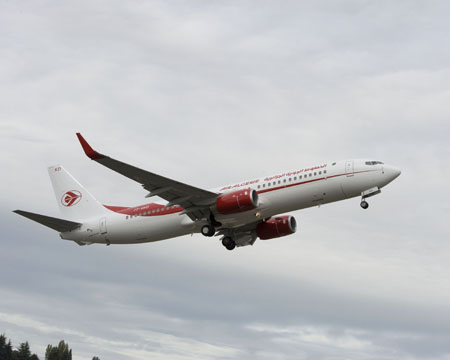
    Press Release: Boeing Delivers 11th 737-800 Airplane to Air Algerie


    SEATTLE, Sept. 29 — Boeing today delivered to Air Algerie its 11th 737-800.

    Air Algerie, the state-owned flag carrier of Algeria, operates a fleet composed primarily of Boeing 737s and some 767s. Boeing is scheduled to deliver two additional 737-800s in 2010 as well as four more in 2011. Air Algerie will be operating 17 737-800s in 2011 for a total of 22 Next-Generation 737 airplanes to complement its fleet.

    “The Boeing 737-800 has played an instrumental part in contributing to the success of Air Algerie’s growth in the region,” said Abdelwahid Bouabdallah, director general of Air Algerie.

    More than 120 customers around the world have ordered more than 5,000 Next-Generation 737s.

  • |

    IATA Press Release: Opportunity for a Global Framework on Environment – IATA Urges Agreement at ICAO Assembly

    Montreal – The International Air Transport Association (IATA) urged the governments of the world to reach an agreement on a global framework to manage international aviation’s emissions at the 37th Assembly of the International Civil Aviation Organization (ICAO).

    “The biggest challenge for this Assembly is to reach an agreement on a global solution to manage emissions from international aviation. A united aviation industry of airlines, airports, air navigation service providers, manufacturers and general aviation has made ambitious commitments to cap and eventually cut its emissions. To be successful, governments must endorse these commitments in a globally agreed framework,” said Giovanni Bisignani, IATA’s Director General and CEO, to a group of delegates attending the ICAO Assembly in Montreal.

    The aviation industry is united behind three targets: (1) a 1.5% average annual improvement in fuel efficiency to 2020, (2) capping net emissions from 2020 with carbon-neutral growth and (3) cutting emission in half by 2050 compared to 2005. “No other industrial sector has made such ambitious global commitments. Even UN Secretary General Ban Ki-moon commended the aviation industry as a role model for other industries to follow,” said Bisignani.

    Bisignani highlighted several key elements which could help facilitate global consensus:

    • Place and Process: The Executive Secretary of the United Nations Framework Convention on Climate Change (UNFCCC), Christiana Figueres, confirmed that ICAO is the forum for dealing with emissions from international aviation and that any agreement at ICAO would not, in any way, impact the position of any state on non-aviation issues discussed in the UNFCCC process.
    • Developing Nations: Even within a global agreement, ICAO has a track record of accommodating the needs of developing states. For example, ICAO’s global framework for noise reduction included extended timelines for developing states.
    • Growth: The industry’s global solution will facilitate growth and the economic benefits it brings even while reducing emissions. This will be achieved through the industry’s four- pillar strategy of investments in technology, more efficient infrastructure, more effective operations and globally coordinated positive economic measures.

    “Major blockers are being removed. The industry is ready. And most governments agree that a global framework is needed. There are still some hurdles to overcome, but we are moving in the right direction,” said Bisignani who noted that important regional groupings and individual states have indicated their wish for an agreement.

    The planned inclusion of aviation into the European emissions trading scheme in 2012 has helped to focus governments on the urgency of a global solution. “If this Assembly ends without an agreement, the next opportunity is 2013. In the meantime the industry would be faced with a growing patchwork of conflicting and overlapping measures. For example, against global opposition, Europe would have to try to move forward with its unilateral emissions trading scheme,” said Bisignani.

    “No government or industry player will want to face the consequences of such a development. It would lead to a breakdown of the global standards on which global aviation was built, a patchwork of uncoordinated taxes and schemes, strained bilateral relations and serious challenges on sovereignty issues,” said Bisignani.

    “The livelihoods of 32 million people and $3.5 trillion in economic activity depend on the success of global aviation. As leaders, everyone attending this Assembly has a great responsibility to continue building a safe, secure, efficient and sustainable future for this wonderful industry. The industry is committed to supporting governments in reaching agreement on a responsible solution for aviation and the environment. I am optimistic that we will be successful,” said Bisignani.

    The ICAO Assembly will discuss environmental issues in its Executive Committee on Thursday 30 September with conclusions to be reported by the Assembly’s conclusion on 8 October.

  • |

    IATA Press Release: Global Safety Information Exchange Launched

    Montreal – The International Air Transport Association (IATA), along with three governmental aviation safety organizations, today signed an agreement to launch the Global Safety Information Exchange. Creating a comprehensive global information exchange to improve safety is the most ambitious private/public safety partnership in aviation history.

    IATA, together with the International Civil Aviation Organization (ICAO), the US Department of Transportation (DOT), and the Commission of the European Union (EC), signed a Memorandum of Understanding (MOU) to create the framework and path forward to launch the Global Safety Information Exchange. The MOU signing took place following the opening session of the ICAO Assembly and was signed by IATA Director General Giovanni Bisignani, ICAO Secretary General Raymond Benjamin, US DOT Secretary Ray LaHood, and EU Vice President Siim Kallas.

    “Air is the safest way to travel. We achieved this level of safety precisely because governments and industry have cooperated transparently to identify risks and implement solutions. Today’s agreement takes the long history of cooperation to a new level by tearing down silos around the data that we have and sharpening our focus on the greatest risks to aviation safety,” said Giovanni Bisignani, IATA’s Director General and CEO.

    “We have a long history of working together with governments using global standards to lower the accident rate. In 1945, there were 9 million passengers and 247 fatalities. In 2009, 2.3 billion people flew with 685 fatalities. Every fatality is a human tragedy and reminds us that we must do better. Today’s agreement signals a new era of multilateral cooperation between industry and government to make the skies safer,” said Bisignani.

    The four organizations will start their cooperation by selecting the safety information each group currently collects, which would be the most relevant to the goal of improving safety by risk reduction. IATA will make the largest contribution of airline data by providing de-identified information from the IATA Operational Safety Audit (IOSA) program. This will include de-identified information from the 345 airlines that are on the IOSA registry (230 IATA members and 115 non-members). IOSA sets the standard of safety for airlines and aggregated IOSA audit information will complement audit information from the other partners in developing global safety priorities.

    A steering group will be formed and will have representatives from each of the four organizations. ICAO will act as the coordinator of the information exchange.

    The 2009 global accident rate, measured in hull losses per million flights of Western-built jet aircraft, was 0.71. Through the first six months of 2010, the accident rate was 0.64. Compared to 10 years ago, the accident rate has been cut 36% from the 1.11 rate recorded in 2000.

  • |

    Press Release – FAA Announces Over $2.5 Million in Additional Recovery Act Airport Grants

    For Immediate Release
    September 28, 2010

    WASHINGTON – The U.S. Department of Transportation’s Federal Aviation Administration (FAA) today announced that three additional airport projects have been selected for funding, paid for with more than $2.5 million in American Recovery and Reinvestment Act dollars that became available because of airport projects that came in under budget nationwide.

    “With these additional Recovery Act dollars, we can provide a bigger boost to economic growth while we modernize more of our nation’s airports,” said U.S. Transportation Secretary Ray LaHood.

    Earlier this month, the FAA announced that five other airport projects would receive $9 million in Recovery Act funding that became available thanks to low bids and under-budget airport projects.

    “We are thrilled that we have been able to stretch Recovery Act dollars to meet the needs of more airports. These projects will improve airport operations and help our airspace system to run more efficiently,” said FAA Administrator Randy Babbitt.

    The three additional rehabilitation projects are:

    • Lawrence, Mass., Municipal Airport
      An ARRA grant for $1.2 million will fund several pavement rehabilitation projects on airport taxiways and aircraft parking aprons.
    • Hartsfield-JacksonAtlanta International Airport
      This $1 million ARRA grant will fund the ongoing construction and paving of the new international terminal apron.
    • CharlesM. Schulz-Sonoma County Airport, Santa Rosa, Calif.
      A $379,000 ARRA grant will allow the airport to complete the second phase of its terminal rehabilitation and replace the terminal building roof.

    Under the Recovery Act, more than $1.3 billion has been made available nationwide for both airport improvement projects and air traffic control facility and system upgrades. Because of low construction bids for projects, more Recovery Act dollars were available for additional facilities, equipment and airport projects. These grants have been distributed to airports that serve commercial passengers, cargo and general aviation.

  • |

    NASA INVITES VIRGINIA STUDENTS TO BECOME 2011 AEROSPACE SCHOLARS

    NEWS RELEASE: 10-089

    HAMPTON, Va. — Are you looking for an experience that is out of this world? Planning a mission to Mars and gaining college credit are just two perks high school juniors in Virginia can experience through The Virginia Aerospace Science and Technology Scholars (VASTS) program.

    The program, in its fourth year at NASA Langley Research Center in Hampton, Va., is now accepting applications for its interactive on-line science, technology, engineering and math program. The semester-long curriculum teaches students about aerospace exploration. Learning takes place through simulations, weekly reading assignments, online games, video segments and online quizzes. The program is open to high school juniors, including homeschoolers, across the Commonwealth. Deadline for application is Nov. 5.

    Based on course performance, scholars may be selected to spend a week at NASA Langley where they will work with scientists and engineers, design and build robotic rovers, learn about NASA careers and plan a human mission to Mars.

    Student comments are the best testimonial for the program:

    “This program has prepared me by opening my eyes to the type of requirements that I must meet in order to pursue a career in math and science,” said Iriat Faisal of George C. Mason High School in Bridgewater, Va.

    “I loved the academy,” said Courtney Maimon from Osbourn Park High School in Manassas, Va. “Everyone here is so driven. It’s fun getting to work with people who have the same interests as me.”

    “The curriculum helped me improve many of my skills, such as focusing, writing, communicating with others and listening to what other people have to say,” said Anthony Guadino-Sullivan from West Springfield High School in Springfield, Va. “The academy prepared me to think the impossible can be done, to respect others’ ideas and input and taught me the importance of teamwork.”

    Upon completion of the program, students can receive up to four college credits from Thomas Nelson Community College.

    The Virginia Aerospace Science and Technology Scholars program uses a NASA-developed curriculum with a space-based theme and is aligned with Virginia Standards of Learning. Master educators work with students online, providing guidance and feedback on assignments.

    VASTS is a partnership between the Virginia Space Grant Consortium and NASA Langley Research Center with assistance from the Virginia Department of Education and industry partners.

    For more information on the VASTS program and for an application, visit

    www.vasts.spacegrant.org

  • |

    NASA INVITES PUBLIC TO DISCUSS “WHAT MATTERS NEXT” AT TEDxNASA

    HAMPTON, Va. — NASA is inviting the public to join agency leaders and innovators from a variety of fields on Nov. 4 to discuss “What Matters Next.” Discussions and presentations on the theme will be the centerpiece of the second TEDxNASA, a daylong event modeled on the TED (Technology, Entertainment and Design) conferences that bring together leading thinkers to create a dialogue on important global challenges.

    NASA’s Langley Research Center and the National Institute of Aerospace, both in Hampton, Va., are sponsoring TEDxNASA at the Ferguson Center for the Arts in nearby Newport News. It is free and open to the public and will also be streamed on the TEDxNASA website. Registration opens on Oct. 11 and runs through Oct. 24. For more information on the event and how to register or view, visit:

    http://tedxnasa.com

    “At TEDxNASA we’re able to bring together artists and engineers, rocket scientists and musicians,” said Lesa Roe, director of Langley. “Together we can create extraordinary conversations about what matters next and ideas to help us meet world challenges.”

    More than 20 top speakers — focusing on education, innovation, family, technology, literature art and NASA — will share inspiring and thought-provoking stories as they do at a full TED event. The challenge of those presenting is to give the talk of their lives in 18 minutes or less, based on the theme. NASA’s Chief Technologist Bobby Braun and Jim Green, director of the Planetary Science Division in the Science Mission Directorate at NASA Headquarters in Washington, are among those slated to speak. Green will present at the same time NASA’s EPOXI spacecraft is flying by and snapping close-up images of comet Hartley 2, more than 11 million miles away from Earth.

    Last year’s TEDxNASA event attracted international best-selling author Mitch Albom, Carnegie Hall humorist and guitar virtuoso Mike Rayburn and Virginia Tech robotic pioneer Dennis Hong, among others.

    Reporters interested in attending the event should contact Kathy Barnstorff at kathy.barnstorff@nasa.gov.

    TED is a nonprofit organization devoted to “ideas worth spreading.” Started as a four-day conference in California 25 years ago, TED has grown to support those world-changing ideas with multiple initiatives. Conference presentations are made available for free at TED.com. TED speakers have included Bill Gates, Al Gore, Jane Goodall, Sir Richard Branson, and many others. The “x” in TEDxNASA indicates it is an independently organized TED event.

    -end-

  • |

    Boeing, Air China Announce Order for Boeing 777s

    SEATTLE, Sept. 27 Boeing and Air China today announced an order for four 777-300ERs (Extended Range), which have a total average list price value of $1.1 billion at current list prices.

    “This is a great day in the history of our long and enduring partnership with Air China,” said Marlin Dailey, vice president of Sales & Marketing for Boeing Commercial Airplanes. “Today’s order of 777s also underscores Air China’s confidence in the world’s most successful twin-engine, long-haul airplane.”

    Air China, the flag carrier of the People’s Republic of China, will use the airplanes to expand its international routes.

    “The 777-300ER will be the backbone of our long-haul international fleet,” said Fan Cheng, vice president of Air China. “The airplane’s high efficiency and performance features will enable Air China to launch more direct long-haul routes to meet the increasing demand of our passengers.”

    The Boeing 777 is the world’s most successful twin-engine, long-haul airplane. The 777-300ER extends the 777 family’s span of capabilities, bringing twin-engine efficiency and reliability to the long-range market. The airplane carries 365 passengers up to 7,930 nautical miles (14,685 km).

    Boeing incorporated several performance enhancements for the 777-300ER, extending its range and payload capabilities. Excellent performance during flight-testing, combined with engine efficiency improvements and design changes that reduce drag and airplane weight, contributed to the increased capability.

  • |

    Southwest Airlines to Acquire AirTran; Spreading Low Fares Farther

    DALLAS, Sept 27, 2010

    Southwest Airlines (NYSE: LUV) announced today that it has entered into a definitive agreement to acquire all of the outstanding common stock of AirTran Holdings, Inc. (NYSE: AAI), the parent company of AirTran Airways (AirTran), for a combination of cash and Southwest Airlines’ common stock.

    At Southwest Airlines’ closing stock price of $12.28 on September 24, 2010, the transaction values AirTran common stock at $7.69 per share, or approximately $1.4 billion in the aggregate, including AirTran’s outstanding convertible notes. This represents a premium of 69 percent over the September 24, 2010 closing price of AirTran stock. Under the agreement, each share of AirTran common stock will be exchanged for $3.75 in cash and 0.321 shares of Southwest Airlines’ common stock, subject to certain adjustments, based on Southwest Airlines’ share price prior to closing. Including the existing AirTran net indebtedness and capitalized aircraft operating leases, the transaction value is approximately $3.4 billion.

    The agreement has been unanimously approved by the boards of directors of each company, and closing is subject to the approval of AirTran stockholders, receipt of certain regulatory clearances, and fulfillment of customary closing conditions.

    “Today is an exciting day for our Employees, our Customers, the communities we serve, and our Shareholders,” said Gary C. Kelly, Chairman, President, and CEO of Southwest Airlines. “As we approach our 40th Anniversary of providing exceptional Customer Service at everyday low fares, the acquisition of AirTran represents a unique opportunity to grow Southwest Airlines’ presence in key markets we don’t yet serve and takes a significant step towards positioning us for future growth.

    “This acquisition creates more jobs and career opportunities for our combined Employee groups, as a whole. It allows us to better respond to the economic and competitive challenges of our industry, and fits perfectly within our strategy for our fifth decade of service. It offers Customers more low-fare destinations as we extend our network and diversify into new markets, including significant opportunities to and from Atlanta, the busiest airport in the U.S. and the largest domestic market we do not serve, as well as Washington, D.C. via Ronald Reagan National Airport. The acquisition also allows us to expand our presence in key markets, like New York LaGuardia, Boston Logan, and Baltimore/Washington. It presents us the opportunity to extend our service to many smaller domestic cities that we don’t serve today, and provides access to key near-international leisure markets in the Caribbean and Mexico. Finally, this accelerates our goal to boost profits and achieve our financial targets.”

    The acquisition will significantly expand Southwest Airlines’ low-fare service to many more Customers in many more domestic markets, creating hundreds of additional low-fare itineraries for the traveling public. Moreover, the expansion of low fares should generate hundreds of millions in annual savings to consumers. Based on an economic analysis by Campbell-Hill Aviation Group, LLP*, Southwest Airlines’ more expansive low-fare service at Atlanta, alone, has the potential to stimulate over two million new passengers and over $200 million in consumer savings, annually. These savings would be created from the new low-fare competition that Southwest Airlines would be able to provide as a result of the acquisition, expanding the well-known “Southwest Effect'” of reducing fares and stimulating new passenger traffic wherever it flies.

    “Both companies have dedicated people with kindred Warrior Spirits, who care about each other, and who care about serving Customers. We will continue to build upon our outstanding Customer experiences, strong and unique Cultures, and award-winning, safe operations,” said Kelly. “We believe this acquisition can benefit all Stakeholders. Ultimately, we are very excited to spread low fares farther and look forward to working together with AirTran to realize the new opportunities and benefits we expect to derive from this combination.”

    Bob Fornaro, AirTran Airways’ Chairman, President and CEO said, “This agreement is great news for our Crew Members, our shareholders, our customers and the communities we serve. Joining Southwest Airlines will give us opportunities to grow, both professionally as individuals and as a group, in ways that simply would not be possible without this agreement. This agreement with Southwest is a testament to the success and hard work of the more than 8,000 AirTran Crew Members who have built this airline. I am tremendously proud of the things we have accomplished together and look forward to continuing that great work during this next exciting chapter of our history.”

    AirTran revenues and operating income, excluding special items, for the twelve months ending June 30, 2010, were $2.5 billion and $128 million, respectively. Southwest Airlines revenues and operating income, excluding special items, for the twelve months ending June 30, 2010, were $11.2 billion and $843 million, respectively. The proposed transaction, including the anticipated benefit of net synergies, but excluding the impact of one-time acquisition and integration costs, is expected to be accretive to Southwest Airlines pro forma fully-diluted earnings per share in the first year after the close of the transaction and strongly accretive thereafter. Net annual synergies are expected to exceed $400 million by 2013. One-time costs related to the acquisition and integration of AirTran are expected to be in the range of $300 million to $500 million.

    As of June 30, 2010, the combined unrestricted cash and short-term investments of the two companies was $3.7 billion. Southwest Airlines intends to fund approximately $670 million in cash consideration for the transaction out of cash on hand. Since June 30, Southwest’s cash and short-term investments balance has increased from $3.1 billion to $3.3 billion. In addition, Southwest Airlines has a fully available, unsecured revolving credit facility of $600 million.

    Based on current operations, the combined organization would have nearly 43,000 Employees and serve more than 100 million Customers annually from more than 100 different airports in the U.S. and near-international destinations. In addition, the combined carriers’ all-Boeing fleet consisting of 685 active aircraft would include 401 Boeing 737-700s, 173 Boeing 737-300s, 25 Boeing 737-500s, and 86 Boeing 717s, with an average age of approximately 10 years, one of the youngest fleets in the industry. Southwest Airlines also announced, previously, that it is evaluating the opportunity to introduce the Boeing 737-800 into its domestic network to complement its current fleet, providing opportunities for longer-haul flying and service to high-demand, slot-controlled, or gate-restricted markets. This acquisition supports Southwest Airlines’ evaluation of the Boeing 737-800.

    Until closing, Southwest Airlines and AirTran will continue to operate as independent companies. After closing, Bob Fornaro will continue to be involved in the integration of the two companies. Southwest Airlines plans to integrate AirTran into the Southwest Airlines Brand by transitioning the AirTran fleet to the Southwest Airlines livery, developing a consistent Customer Experience, and consolidating corporate functions into its Dallas headquarters. Subject to receipt of necessary approvals, Southwest Airlines’ integration plans include transitioning the operations of the two carriers to a Single Operating Certificate. Plans for existing AirTran facilities will be developed by integration teams and decisions will be announced at appropriate times. The carriers’ frequent-flyer programs will be combined over time, as well.

    Terms of the Agreement

    Under the agreement, each share of AirTran common stock will be exchanged for $3.75 in cash and 0.321 shares of Southwest Airlines’ common stock, subject to certain adjustments. The number of shares to be issued by Southwest Airlines is subject to adjustment if the average of Southwest Airlines closing prices for the 20 trading days ending three trading days prior to closing is below $10.90 or above $12.46. This adjustment mechanism is intended to provide at least $7.25 in value and up to $7.75 in value per share of AirTran common stock. If the average closing price noted above exceeds $12.46, the value will be $7.75 with fewer shares of Southwest common stock issued. If the average closing price noted above is less than $10.90, the value will be $7.25 with additional shares of Southwest common stock issued. Additionally, Southwest Airlines has the option of substituting cash in lieu of issuing incremental shares if the average closing stock price is less than $10.90. Assuming an exchange ratio of 0.321 and the conversion of AirTran’s outstanding convertible notes, AirTran stockholders would receive approximately 57 million shares of Southwest Airlines common stock, which represents approximately seven percent of the pro forma Southwest Airlines common shares outstanding, as well as approximately $670 million in cash.

    Citigroup Global Markets Inc. and Dahlman Rose & Company acted as financial advisors to Southwest Airlines. Vinson & Elkins L.L.P. acted as legal counsel to Southwest Airlines.

  • |

    American Airlines and American Eagle Add More Service to and From Mexico

    American Also Will Expand Its Existing Codeshare Relationship With Alaska Airlines On Flights Between West Coast and Mexico

    FORT WORTH, Texas, Sept. 27 /PRNewswire/ — American Airlines and its regional affiliate, American Eagle, are increasing their service to and from Mexico. American said the additional service is a result of increased demand, in part related to the suspension of flights by Mexicana Airlines on Aug. 11.

    Here are the new flights to be operated by American Airlines:

    • Dallas/Fort Worth – Mexico City – currently 4 daily round trips, increasing to 5 on Nov. 18.
    • Miami – Mexico City – currently 3 daily round trips, increasing to 4 on Nov. 18.
    • Miami – Cancun – currently 4 daily round trips on weekdays and 5 daily round trips on weekends, increasing to 5 every day of the week on Feb. 10, 2011.
    • Chicago – Mexico City – add one new daily round trip on Dec. 16.

    Here are the new flights to be flown by American Eagle:

  • Dallas/Fort Worth – Guadalajara – currently 2 daily round trips – one on American Airlines and one on American Eagle. On Nov. 18, the route goes to two daily round trips on American. On Dec. 16, the service will increase to 3 daily round trips – one new round trip on American Eagle, in addition to the two round trips on American.
  • Dallas/Fort Worth – Aguascalientes – currently one daily round trip on American Eagle, increasing to two on Nov. 18.
  • Dallas/Fort Worth – Leon – currently 3 daily round trips on American Eagle, increasing to 4 on Dec. 16.
  • Dallas/Fort Worth – Veracruz – new round trip on American Eagle, effective Feb. 10, 2011, pending government approvals.
  • Dallas/Fort Worth – Queretaro – new round trip on American Eagle, effective Feb. 10, 2011, pending government approvals.

Here are additional services to and from Mexico on which American intends to codeshare with Alaska Airlines/Horizon Air. American will place its AA* code on flights operated by Alaska Airlines or Horizon Air in the following U.S.-Mexico markets, implementing the services later this year after all regulatory approvals are received:

  • Los Angeles – Mexico City***
  • Los Angeles – Guadalajara***
  • Los Angeles – La Paz (operated by Horizon Air)
  • Los Angeles – Loreto (operated by Horizon Air)
  • Los Angeles – Mazatlan
  • Los Angeles – Puerto Vallarta
  • Los Angeles – Ixtapa/Zihuatanejo
  • Los Angeles – Manzanillo
  • San Diego – Puerto Vallarta
  • San Francisco – Puerto Vallarta

*** American will be selling both local (Los Angeles area) and connecting service (to/from another American or American Eagle flight from other cities) on these two routes. For all other markets listed, American will sell only connecting service.

About American Airlines

American Airlines, American Eagle and AmericanConnection® serve 250 cities in 40 countries with, on average, more than 3,400 daily flights. The combined network fleet numbers more than 900 aircraft. American’s award-winning website, AA.com®, provides users with easy access to check and book fares, plus personalized news, information and travel offers. American Airlines is a founding member of the oneworld® Alliance, which brings together some of the best and biggest names in the airline business, enabling them to offer their customers more services and benefits than any airline can provide on its own. Together, its members serve nearly 700 destinations in more than 130 countries and territories. American Airlines, Inc. and American Eagle Airlines, Inc. are subsidiaries of AMR Corporation. AmericanAirlines, American Eagle, AmericanConnection, AA.com, We know why you fly and AAdvantage are trademarks of American Airlines, Inc. (NYSE: AMR)

AmericanAirlines® We know why you fly®

Current AMR Corp. releases can be accessed on the Internet.

The address is http://www.aa.com

  • |

    Bell Boeing V-22 Program Delivers 6th Osprey Trainer to US Marines

    ST. LOUIS, Sept. 27, 2010 — The Bell Boeing V-22 Program, a strategic alliance between Boeing [NYSE: BA] and Bell Helicopter, has delivered the sixth and final MV-22 Osprey Containerized Flight Training Device (CFTD) to the U.S. Marines. In the past year, the team has delivered five CFTDs to the Marines, as well as upgrades to two trainers delivered previously.

    The CFTD trains aircrew on basic aircraft familiarization and handling qualities. Additional training capabilities include systems/subsystems operation, communication, malfunctions, day and night flying, use of night-vision goggles, formation flying, aerial refueling and landing on ships. The device is intended to train crews for any task that might be performed in the aircraft, while limiting the monetary and environmental costs and safety risks of in-flight training.

    The sixth device was delivered to Marine Corps Air Station (MCAS) New River, N.C., on Aug. 16, six weeks early. MCAS New River has six devices, including the first CFTD — delivered in 2007 — plus three full-flight, motion-based simulators and one non-motion-based flight training device. MCAS Miramar, Calif., has four CFTDs. An upgrade delivered to Miramar this month brought all CFTDs to full concurrency with the Osprey aircraft.

    "The V-22 Integrated Product Team has made all of these early deliveries possible,” said Mark McGraw, vice president, Boeing Training Systems & Services. “They delivered three devices on this contract early, and all of them for the lowest per-unit cost our customer has seen."

    All CFTDs can be locally networked to allow for more robust training capabilities. The CFTDs at MCAS New River also are able to network with AV-8 Harriers at MCAS Cherry Point, N.C.

    The V-22 Osprey is a tiltrotor aircraft manufactured by Boeing and Bell Helicopter, a Textron Inc. [NYSE: TXT] company. Bell and Boeing are teamed in a Strategic Alliance Agreement for the design, production and sustainment of the V-22.

    Bell Helicopter, a wholly owned subsidiary of Textron Inc., is an industry-leading producer of commercial and military, manned and unmanned vertical lift aircraft and the pioneer of the revolutionary tiltrotor aircraft. Globally recognized for world-class customer service, innovation and superior quality, Bell’s global work force serves customers flying Bell aircraft in more than 120 countries. More information is available at www.bellhelicopter.com.

    Textron Inc. is a multi-industry company that leverages its global network of aircraft, defense, industrial and finance businesses to provide customers with innovative solutions and services. Textron is known around the world for its powerful brands such as Bell Helicopter, Cessna Aircraft Company, Jacobsen, Kautex, Lycoming, E-Z-GO, Greenlee, and Textron Systems. More information is available at www.textron.com.

  • |

    Boeing NewGen Tanker Win Would Bring 11,000 Jobs, $693 Million to Washington

    EVERETT, Wash., Sept. 27, 2010 — The Boeing Company today announced that the state of Washington will benefit from an estimated 11,000 total jobs and generate an estimated $693 million in annual economic impact if the Boeing NewGen Tanker is selected as the U.S. Air Force’s next aerial refueling aircraft.

    Boeing submitted its proposal July 9 to replace 179 of the Air Force’s 400 Eisenhower-era KC-135 aircraft. The Air Force is expected to award a contract later this year.

    "The Boeing team in Washington state has an outstanding track record meeting the needs of U.S. warfighters by delivering the finest military derivatives of commercial aircraft in the world," said Dennis Muilenburg, president and CEO of Boeing Defense, Space & Security. "I am confident that the thousands of men and women at Boeing and our suppliers working on the NewGen Tanker will carry on that same tradition of excellence for many years to come."

    "One of the great strengths of Boeing is our unique ability to form teams made up of both commercial and defense personnel to find innovative and best-value solutions for our customers," said Jim Albaugh, president and CEO of Boeing Commercial Airplanes. "Nowhere is this more apparent than here in Puget Sound, where we have been supporting both commercial and military customers for nearly 100 years."

    Currently, Boeing has 72,000 employees in Washington and works with more than 2,700 suppliers/vendors, delivering a total $3.3 billion in annual economic impact.

    The NewGen Tanker is a widebody, multi-mission aircraft based on the proven Boeing 767 commercial airplane and updated with the latest and most advanced technology. Capable of fulfilling the Air Force’s needs for transport of fuel, cargo, passengers and patients, the combat-ready NewGen Tanker will meet or exceed the 372 mandatory requirements described in the service’s final KC-X Request for Proposal released Feb. 24.

    The NewGen Tanker will be made with a low-risk approach to manufacturing that relies on existing Boeing facilities in Washington state and Kansas as well as U.S. suppliers throughout the nation, with decades of experience delivering dependable military tanker and derivative aircraft. Nationwide, the NewGen Tanker program will support approximately 50,000 total U.S. jobs with Boeing and more than 800 suppliers in more than 40 states.

    The Boeing NewGen Tanker also will be more cost-effective to own and operate than a larger, heavier tanker. It will save American taxpayers more than $10 billion in fuel costs over its 40-year service life because it burns 24 percent less fuel than the competitor’s airplane.

    Boeing has been designing, building, modifying and supporting tankers for decades. These include the KC-135 that will be replaced in the KC-X competition, and the KC-10 fleet. The company also has delivered four KC-767Js to the Japan Air Self-Defense Force and is on contract to deliver four KC-767As to the Italian Air Force.

    The Boeing Aerial Refueling Technology demonstrator (BART) will be on display at Westlake Park (401 Pine St.) in Seattle on Sept. 28 from 9 a.m. to 3:30 p.m. BART’s tour schedule is available at www.UnitedStatesTanker.com/TankerTrek. More information on Boeing’s NewGen Tanker, including video clips and an interactive tour of the aircraft, is available at www.UnitedStatesTanker.com. For more information on joining the company’s efforts, visit www.RealAmericanTankers.com.

  • |

    Press Release – FAA Celebrates Recovery Act Funded Airfield Upgrades at Kentucky’s Georgetown-Scott County Regional Airport

    WASHINGTON, D.C. — The U.S. Department of Transportation’s Federal Aviation Administration celebrated the completion of an airfield upgrade at Georgetown-Scott County Regional Airport in Kentucky, paid for with $3 million in American Recovery and Reinvestment Act funds.

    “Airport Recovery Act projects are helping boost local economies all across the country,” said U.S. Transportation Secretary Ray LaHood. “The Recovery Act is helping us keep our runways safe and well maintained.”

    Recovery Act funds provided the full cost of repaving Georgetown-Scott County Regional Airport’s 5,500 foot-long runway. The runway had deteriorated and had not been fully repaved in nearly 17 years. The construction also included the widening of the ends of the parallel taxiway, which will now be able to accommodate larger aircraft turning on and off the runway.

    “General aviation is incredibly important to local communities nationwide and the Recovery Act is funding necessary safety improvements and upgrades that otherwise might not get done,” said FAA Administrator Randy Babbitt.

    Nationwide, $1.3 billion in Recovery Act money has been made available for both airport improvement projects and air traffic control facility and system upgrades. Because of low construction bids for projects, more Recovery Act dollars were available for additional facilities and equipment as well as airport projects. These Recovery Act grants have been distributed to airports that serve commercial passengers, cargo and general aviation.
    ###

  • |

    Press Release – FAA Proposes $4.855 Million Civil Penalty Against Evergreen Airlines

    For Immediate Release
    September 24, 2010

    EATTLE — The Federal Aviation Administration (FAA) has proposed a $4,855,000 civil penalty against Evergreen International Airlines of McMinnville, Ore., for allegedly using pilots on 232 revenue flights who had not been trained in accordance with an FAA-approved training program.

    The flights were made between Feb. 19 and July 9, 2009, on aircraft equipped with a new flight management system (FMS) that was different enough from the prior system that it required a specific training program for pilots who were flying the aircraft. The FAA alleges Evergreen did not complete its FAA-approved training for pilots before assigning them to fly revenue trips using the new FMS.

    “We put rules and regulations in place to keep air transportation safe and we expect airlines to comply,” said U.S. Transportation Secretary Ray LaHood.

    The FAA alleges Evergreen line pilots received ground training and a check ride on the new FMS, but that the company did not provide required familiarization flights supervised by the company’s check pilots despite being told to do so by the FAA.

    The familiarization flights are part of the FAA-approved training program for Evergreen aircraft equipped with the FMS. Evergreen also failed to distribute copies of the required system manual to crews who would be using the FMS.

    Subsequent to these improperly conducted flights, Evergreen has ensured that its pilots are trained in accordance with its FAA-approved training program and continues to operate under an FAA-approved training program.

    “Even though Evergreen now complies with its training program, this penalty is appropriate because requiring operators to complete required, approved training is the only way to make sure crews are fully qualified to operate the equipment and systems to manage flights safely,” said FAA Administrator Randy Babbitt.

    Evergreen has 30 days from the receipt of the FAA’s civil penalty letter to respond to the agency.

  • Russia’s S7 Airlines to be Part of oneworld From 15 November

    VANCOUVER, British Columbia, Sept. 23, 2010. S7 Airlines, Russia’s leading domestic carrier, will become part of oneworld® effective Monday, 15 November, offering the alliance’s full range of services and benefits from then and substantially expanding its network throughout Russia and the rest of the Commonwealth of Independent States – in the latest step by oneworld to establish itself as the world’s premier alliance in what is turning out to be a breakthrough year for the group.

    From 15 November, 2010 members of the S7 Priority frequent flyer programme will be able to earn and redeem mileage awards on all oneworld partners, which includes some of the biggest and best airlines in the world – American Airlines, British Airways, Cathay Pacific Airways, Finnair, Iberia, Japan Airlines, LAN Airlines, Malev Hungarian Airlines, Mexicana, Qantas and Royal Jordanian and almost 20 affiliated airlines.

    S7 Priority Platinum and Gold cardholders will have oneworld Emerald and Sapphire status respectively, gaining them access to more than 500 airport lounges worldwide offered by the alliance’s airlines. S7 Priority Silver cardholders will have oneworld Ruby status.

    All S7 Priority Platinum, Gold and Silver cardholders will soon be sent new membership cards, bearing the oneworld logo, to ensure they receive their alliance benefits from 15 November.

    Also from 15 November, members of the established oneworld airlines’ frequent flyer programs will be able to earn and redeem awards and tier status points and receive all other oneworld benefits on S7.

    Its network – covering 90 destinations and 28 countries, including 45 points in Russia and some 25 destinations in other parts of the Commonwealth of Independent States (CIS) – will from then be covered by oneworld’s full and extensive range of alliance fares and sales products.

    S7’s Russian domestic market is the world’s largest country in terms of land mass, the ninth most populous and with the eighth biggest gross domestic product. Currently seven of oneworld’s established airlines – British Airways, Cathay Pacific, Finnair, Iberia, Japan Airlines, Malev Hungarian Airlines and Royal Jordanian – serve Moscow, plus St Petersburg and Ekaterinburg in Russia.

    S7 Airlines to join oneworld on 15 November…2

    The new oneworld recruit will add 55 destinations in the region to the alliance map, and nine countries, in Armenia, Azerbaijan, Georgia, Kazakhstan, Kyrgyzstan, Moldova, Tajikistan, Turkmenistan and Uzbekistan. This will almost triple the number of destinations served by oneworld in Russia, the CIS and other parts of East Europe to a total 84 destinations in 26 countries.

    For S7, joining oneworld will strengthen its competitive offering and its financial position, enabling it to offer customers an unrivalled alliance global network served by partners including some of the best and biggest airlines in the world.

    Its addition will extend oneworld’s global coverage to a total of more than 750 destinations in almost 150 countries, served by a total of 8,500 departures a day operated by a combined fleet of some 2,250 aircraft, carrying 300 million passengers a year, with annual revenues of more than US$85 billion.

    British Airways has been supporting S7 through its 18-month alliance implementation project, as its oneworld sponsor airline, with working groups covering some 35 streams of activity.

    Work is well advanced in linking up S7’s IT systems to those of oneworld’s established members. Projects are also nearing completion to bring S7’s various internal processes and procedures into line with the alliance’s requirements, and extensive employee training and communications programmes are now underway at the S7 and the alliance’s existing members, to ensure they are ready to provide oneworld’s customer services and benefits across the expanded alliance from 15 November.

    oneworld Managing Partner John McCulloch said: “S7 will expand oneworld’s network substantially in a key region of growing travel demand, with a carrier that matches our demanding quality requirements, while enabling S7 to offer its customers a truly global network on quality partners. We are delighted to be welcoming them to the oneworld alliance.”

    S7 Chief Executive Vladimir Obyedkov said: “S7 Airlines is delighted to be joining the world’s premier global airline alliance. Becoming part of oneworld will be one of the most significant steps in S7’s history. It will enable us to offer our customers a truly global network served by partners who include some of the best known and most admired airlines in the world, while our frequent flyers will have more opportunities to earn and redeem mileage rewards and enjoy all their other benefits. It will also strengthen us financially, through revenues from passengers transferring to our network from our oneworld partners and the cost reduction opportunities the alliance offers.”

    About S7 Airlines

    S7 is Russia’s leading airline in terms of domestic passenger carryings, customer service quality and innovation.

    It is the first carrier in Russia to convert to an all Western-built Airbus and Boeing fleet and the first to adopt full electronic ticketing and on-line reservations and sales. It holds the internationally recognised IOSA (International Air Transport Association Operational Safety Audit) certification, renewed in October 2008.

    S7 offers a two-class product to international standards on all departures – Business Class and Economy.

    Its fleet, decorated in a distinctive bright green livery, includes 28 Airbus A320 family types, two Airbus A310s, two Boeing 767s, four Boeing 737-400s and four Boeing 737-800s, with an average age of nine years.

    S7 carried 5.6 million passengers in 2009, with a bigger share of the domestic Russian air travel market than any other airline. Including its international network, it is Russia’s second biggest carrier.

    Its main hub Moscow Domodedovo is the capital’s most modern airport. Its secondary hubs are Novosibirsk and Irkutsk. Its international destinations include oneworld hubs Madrid and Bangkok.

    S7 is one the most progressive airlines in Russia giving passengers new standards of service, supported by the use of latest technology. Tracing its origins back to 1957, it changed its brand name from Sibir Airlines four years ago with a radical rebranding to make it stand out from its competitors as customer-friendly, quality, modern carrier – winning the annual national award “People’s mark / Brand No 1 in Russia”.

    Since its election as a oneworld member designate in May 2009, S7 has launched code-sharing with alliance partners Iberia and Royal Jordanian. S7 also code-shares with oneworld member elect Air Berlin.

    The airline generated profits of US$151 million (operating) and US$18 million (net) in 2009 on revenues of US$1.1 billion. S7 employs 2,596 staff and uses SITA as its main IT platform. It is 75 per cent privately owned.

    S7’s English-language website is www.s7.ru/en/index.html

    About oneworld

    oneworld enables its members to offer their customers more services and benefits than any airline can provide on its own. These include a broader route network, opportunities to earn and redeem frequent flyer miles and points across the combined oneworld network and more airport lounges.

    oneworld also offers more alliance fares than any of its competitors.

    oneworld was named the World’s Best Alliance two weeks ago in the 2010 World Airline Awards and has been voted the World’s Leading Airline Alliance for the past seven years in the World Travel Awards. It is the only winner of this award since it was introduced in 2003.

    Already in oneworld’s “breakthrough year”:

    • India’s leading carrier Kingfisher Airlines became a oneworld member elect in June – followed by Air Berlin in July.
    • Japan Airlines has been expanding its co-operation with its oneworld partners since reaffirming its membership of the alliance in February, filing days later with American Airlines for anti-trust immunity for a joint business across the Pacific and more than doubling its code-sharing with British Airways.
    • American Airlines, British Airways, Iberia, Finnair and Royal Jordanian in July received long-awaited final approval for their application for anti-trust immunity across the Atlantic and the proposed transatlantic joint business between American, BA and Iberia.
    • British Airways and Iberia are on track to complete their merger by the end of the year.
    • LAN Airlines celebrated its 10th anniversary as a oneworld member on 1 June. Since joining, it has added to the grouping its affiliates in Argentina, Ecuador and Peru.
    • oneworld added the World Airline Awards’ World’s Best Alliance title to the World Travel Awards’ World’s Leading Airline Alliance trophies it has won for the past seven years, as the only winner of that award since it was introduced in 2003.

  • |

    Boeing Receives Florida Governor’s Business Expansion Award

    TALLAHASSEE, Fla., Sept. 22, 2010 — The Boeing Company [NYSE: BA] today received the Governor’s Business Expansion Award from Enterprise Florida at the Governor’s 2010 Business Diversification Awards ceremony in Tallahassee. The Boeing operation at Cecil Field in Jacksonville, Fla., won the award after the site received the consolidated U.S. Navy F/A-18 work and the U.S. Air Force QF-16 contract. The consolidation and contract win will add approximately 75 jobs to the Cecil Field facility.

    “This expansion to our work scope will allow us to be even more responsive to our customers by colocating related programs in one spot,” said Gary Phillips, Cecil Field site executive for Boeing. “We’re honored that the governor’s office has recognized our expansion as a significant contribution to the community of Jacksonville and the Duval County area.”
    “Florida’s entrepreneurs and business leaders are major contributors to the state’s economic growth,” said Enterprise Florida President and CEO John Adams Jr. “Today, we recognized some of their exemplary accomplishments in creating marketable products and services, which are increasing Florida’s competitiveness and building a future economy that will serve all segments of our population very well.”
    With the addition of the F/A-18 Structural Repair Facility, Cecil Field’s capabilities now include avionics repairs and upgrades; aircraft modification and maintenance; structural and composite component repair; and full nondestructive inspection. The Boeing team at Cecil Field draws on a decade of experience to support Navy and Marine Corps F/A-18A-F aircraft service, repair and modification programs. The facility, located at Cecil Commerce Center, includes 479,000 square feet of maintenance, manufacturing, warehousing and office space.
    “Boeing is proud to be part of the Jacksonville community,” Phillips said. “With our growth now and in the future, we look forward to making a positive impact here for many years to come.”
    A unit of The Boeing Company, Boeing Defense, Space & Security is one of the world’s largest defense, space and security businesses specializing in innovative and capabilities-driven customer solutions, and the world’s largest and most versatile manufacturer of military aircraft. Headquartered in St. Louis, Boeing Defense, Space & Security is a $34 billion business with 68,000 employees worldwide.

  • | |

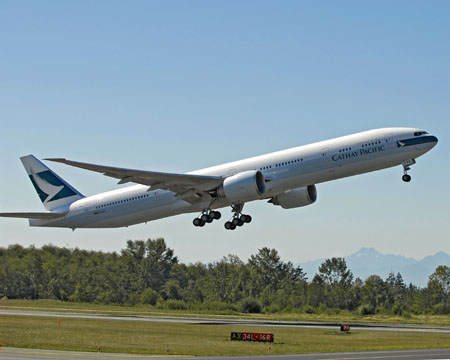
    Boeing, Cathay Pacific Airways Finalize Contract for Six 777-300ERs

    SEATTLE, Sept. 22 — Boeing and Cathay Pacific Airways today announced the Hong Kong-based carrier has exercised existing purchase rights for six additional Boeing 777-300ERs (extended range).

    The six new airplanes, with an estimated value of US$1.6 billion at Boeing list prices, will increase Cathay Pacific’s 777-300ER future fleet from 30 to 36.
    Cathay Pacific, one of the world’s largest operators of the popular jetliner, also operates 12 Boeing 777-300s and five 777-200s.

    “Cathay Pacific is a valued long-time Boeing customer. The global reach of Cathay Pacific’s 777 fleet showcases the airplane’s exceptional performance features and its passenger appeal around the world,” said Marlin Dailey, vice president of Sales for Boeing Commercial Airplanes. “This additional commitment from a world-class operator like Cathay Pacific is a testament to the greater efficiency, economics and reliability of the 777-300ER.”

    Cathay Pacific first announced its selection of the 777-300ER in 2005. This announcement is Cathay Pacific’s fourth increase in its acquisition plans for the long-range jetliner.

    “We are very pleased to confirm this purchase of six more Boeing 777-300ERs – a superb aircraft that already has significantly enhanced our operations on key long-haul routes,” said Cathay Pacific Chief Executive Tony Tyler. “We have been very impressed by the operating economics of these aircraft, while their high efficiency has resulted in a reduced environmental impact. As we continue to enhance our fleet, the 777-300ER will play a crucial role in our operations in the years to come.”
    The Boeing 777 is the world’s most successful twin-engine, long-haul airplane. The 777-300ER extends the 777 family’s span of capabilities, bringing twin-engine efficiency and reliability to the long-range market.

    Boeing incorporated several performance enhancements for the 777-300ER, extending its range and payload capabilities. Excellent performance during flight testing, combined with engine efficiency improvements and design changes that reduce drag and airplane weight, contributed to the increased capability.

    In addition to Boeing 777s, Cathay Pacific operates 47 747-400s in both passenger and cargo versions. The airline also has ordered 10 Boeing 747-8 Freighters. The highly efficient new cargo airplane will augment the airline’s fleet of 25 747 Freighters used to connect Hong Kong to a wide range of international markets.
    Sixty-one customers around the world have ordered more than 1,100 777s.

  • |

    Press Release – FAA Celebrates Recovery Act Funded Airfield Upgrades at Kentucky’s Georgetown-Scott County Regional Airport

    For Immediate Release
    September 23, 2010

    WASHINGTON, D.C. — The U.S. Department of Transportation’s Federal Aviation Administration celebrated the completion of an airfield upgrade at Georgetown-Scott County Regional Airport in Kentucky, paid for with $3 million in American Recovery and Reinvestment Act funds.

    “Airport Recovery Act projects are helping boost local economies all across the country,” said U.S. Transportation Secretary Ray LaHood. “The Recovery Act is helping us keep our runways safe and well maintained."

    Recovery Act funds provided the full cost of repaving Georgetown-Scott County Regional Airport’s 5,500 foot-long runway. The runway had deteriorated and had not been fully repaved in nearly 17 years. The construction also included the widening of the ends of the parallel taxiway, which will now be able to accommodate larger aircraft turning on and off the runway.

    “General aviation is incredibly important to local communities nationwide and the Recovery Act is funding necessary safety improvements and upgrades that otherwise might not get done,” said FAA Administrator Randy Babbitt.

    Nationwide, $1.3 billion in Recovery Act money has been made available for both airport improvement projects and air traffic control facility and system upgrades. Because of low construction bids for projects, more Recovery Act dollars were available for additional facilities and equipment as well as airport projects. These Recovery Act grants have been distributed to airports that serve commercial passengers, cargo and general aviation.

  • | |

    NTSB INVESTIGATING NEAR MIDAIR COLLISION

    National Transportation Safety Board
    Washington, DC 20594

    September 23, 2010

    NTSB INVESTIGATING NEAR MIDAIR COLLISION OVER MINNEAPOLISINVOLVING COMMERCIAL JETLINER AND SMALL CARGO AIRCRAFT

    The National Transportation Safety Board is investigating a near midair collision between a commercial jetliner and a small cargo aircraft that came within an estimated 50 to 100 feet of colliding near the Minneapolis-St. Paul Airport (MSP).

    On September 16, 2010, about 6:49 a.m. CDT, US Airways flight 1848 (AWE 1848), an Airbus 320, was cleared for takeoff on runway 30R en route to Philadelphia, Pennsylvania, carrying five crewmembers and 90 passengers. At the same time, Bemidji Aviation Services flight 46 (BMJ46), a Beech 99 cargo flight with only the pilot aboard, was cleared for takeoff on runway 30L en route to La Crosse, Wisconsin. Weather conditions at the time were reported as a 900-foot ceiling and 10 miles visibility below the clouds.

    Immediately after departure, the tower instructed the US Airways crew to turn left and head west, causing the flight to cross paths with the cargo aircraft approximately one- half mile past the end of runway 30L. Neither pilot saw the
    other aircraft because they were in the clouds, although the captain of the US Airways flight reported hearing the Beech 99 pass nearby. Estimates based on recorded radar data indicate that the two aircraft had 50 to 100 feet of vertical separation as they passed each other approximately 1500 feet above the ground.

    The US Airways aircraft was equipped with a Traffic Alert and Collision Avoidance System (TCAS) that issued climb instructions to the crew to avert collision. The Beech 99 was not equipped with TCAS and the pilot was unaware of the proximity of the Airbus. There were no reports of damage or injuries as a result of the incident.

    NTSB and FAA investigators conducted a preliminary investigation at the Minneapolis airport traffic control tower on September 18th and 19th and are continuing to review the circumstances of this incident.

  • |

    Press Release – Pilots and Air Traffic Controllers Share Safety Data

    For Immediate Release
    September 22, 2010

    WASHINGTON — The Federal Aviation Administration (FAA) today announced a safety program that for the first time will integrate voluntary safety information self-reported by pilots and air traffic controllers. This data-sharing program will give the FAA a more complete picture of the national airspace system by collecting, assessing and reviewing safety events from the perspective of both pilots and air traffic controllers.

    United Airlines and its pilots have the first agreement in place to participate in a demonstration program. The FAA expects to sign similar agreements with other carriers in the future.

    “Safety is our number-one priority,” said U.S. Transportation Secretary Ray LaHood. Having pilots and controllers provide information abut potential air safety problems will help us correct them before they become accidents.”

    “This revolutionary program will give us an incredible amount of data that will help us find problems, make corrections and avoid incidents,” said FAA Administrator Randy Babbitt. “I applaud air traffic controllers, pilots and airlines for their dedication to keeping our aviation system as safe as possible.”

    For the first time, information from the Aviation Safety Action Program (ASAP) and the Air Traffic Safety Action Program (ATSAP) will be merged, so input from both pilots and controllers can help guide safety decisions. The program will develop processes and policies to share and analyze relevant safety information in a non-punitive way, consistent with the basic principles of Safety Management Systems. These systems are widely used within the FAA and the aviation industry.

    ASAP encourages aviation employees to voluntarily report safety information that may help identify potential precursors to accidents. The ASAP process resolves safety issues through corrective action rather than through punishment or discipline. Each program is based on a safety partnership that includes the FAA and the aviation operator, and usually includes a third party, such as the reporting employee’s labor organization. In today’s agreement, the airline’s labor organization is the United chapter of the Air Line Pilots Association (ALPA). Today, 73 air carriers have 169 ASAP programs for pilots, mechanics, flight attendants, and dispatchers.

    ATSAP is an agreement between the FAA and the National Air Traffic Controllers Association (NATCA) that is designed to foster a voluntary, cooperative, non-punitive environment for FAA air traffic employees to openly report safety concerns As a result of ATSAP, all parties have access to valuable safety information that otherwise might never have been discovered or reported. The FAA analyzes the information to develop skill enhancements or system corrective actions that will help solve safety problems.

    Voluntary reporting programs have significantly contributed to the nation’s impressive aviation safety record, including improvements to training and enhanced operations and maintenance procedures.

  • | |

    FAA: “Line Up and Wait” Training Now Available

    “Line Up and Wait” Training Now Available
    On Sept. 30, 2010, the familiar ATC instruction “taxi in position and hold” will become history. Instead, expect to hear “line up and wait” when ATC issues instruction for a pilot to taxi onto a departure runway and wait for takeoff clearance. Another procedure change that occurred on June 30, 2010, requires ATC to issue an explicit clearance to aircraft crossing any runway (active, inactive, and closed). To help pilots with these important procedure changes, FAA added an online training module to www.FAASafety.gov. The course is titled “Line Up and Wait: Taxi Authorization and Runway Clearance Guidance for Airmen,” and is listed in the Featured Courses portal on the FAASafety.gov home page.

    The course provides a good review of safe taxi operations, ATC procedures and phraseology, and pilot responsibilities. It also reviews best practices for avoiding runway incursions, such as knowing and understanding the meaning of the runway hold markings. Some three-fourths of runway incursions result from a failure to comply with this marking.

    Additional details on both procedure changes are available in the Aeronautical Informational Manual (AIM) and Pilot/Controller Glossary, located under the Air Traffic section of www.faa.gov. You can also reference more specific information on line up and wait with FAA Notice JO 7110.536.

  • |

    Boeing Projects Steady Growth for Commercial Airplanes Market in Africa

    More than 700 airplanes, worth $80 billion, needed in region over 20 years

    CAPE TOWN, South Africa, Sept. 21 — Boeing forecasts that air carriers in Africa will experience steady growth over the next 20 years as air travel in Africa continues to grow with the economy.

    The African economy is projected to grow 4.8 percent in 2010 following 2.9 percent growth in 2009. This strong growth results from worldwide recovery stimulating demand for African exports as well as imports into the continent. West Africa shows the strongest growth with foreign interest in petroleum development.

    “As the demand for African commodities grows and foreign development and tourism increase, African carriers will require a modernized fleet in order to compete on routes historically dominated by foreign carriers,” said Mike Warner, senior market analyst for Boeing Commercial Airplanes, today at a media briefing in Cape Town.

    “Africa’s current fleet is nearly 20 years old on average in a market that demands newer, more fuel-efficient airplanes to help offset the rising cost of fuel.”

    Boeing’s forecast calls for the delivery of more than 700 airplanes with a value of approximately $80 billion for the African airplane market over the next 20 years.

    Growth in the airline market, along with the demand to replace older, less fuel-efficient single-aisle airplanes and regional jets with new-generation, more fuel-efficient models, will drive new airplane deliveries.

    Strong demand exists to support increased non-stop routes between Africa and Europe, the United States, the Middle East, India, and China. Twin-aisle fleets will evolve in the region as airlines continue to expand international services. Boeing forecasts that twin-aisle airplanes will account for 32 percent of new airplanes delivered to African carriers over the next 20 years compared to 23 percent worldwide. Single-aisle airplanes will represent 60 percent of the African new-airplane market, compared to 69 percent worldwide.

    Newer airplane types such as the Next-Generation 737 and 787 Dreamliner offer significant advantages in environmental performance as well as improved capabilities, fuel efficiency and maintenance costs.
    Today’s market update was part of a series of briefings that highlight Boeing’s airplane capabilities and advantages as well as discuss the African aviation market for the next 20 years. Boeing kicked off the effort at last month’s Aviation & Allied Business Leaders conference in Gaborone, Botswana. Later this year, Boeing will participate in the Airlines Association of South Africa Annual General Meeting in Manzini, Swaziland, in October and the African Airlines Association General Assembly and conference in Addis Ababa, Ethiopia, in November.

  • |

    Previously announced increase to 35 per month to be extended to 38 per month in second quarter 2013

    SEATTLE, Sept. 16 — Boeing announced today its production rate for the Next-Generation 737 program will increase to 38 airplanes per month in the second quarter of 2013. This decision comes just months after announcing a rate increase on the company’s best-selling commercial jetliner from 31.5 to 35 airplanes per month in early 2012.

    "Increasing production is in response to customer demand for this airplane," said Boeing Commercial Airplanes President and CEO Jim Albaugh. "Airlines want this innovative airplane sooner to renew their fleets to serve their customers. We made this decision after careful evaluation by Boeing and our supplier partners."

    Key factors to the rate decision include the company’s current backlog of more than 2,000 Next-Generation 737s, current options that customers are expected to exercise and ongoing sales campaigns. The rate increase is not expected to have a material impact on 2010 financial results.

    Next-Generation 737 customers have benefited from continuous innovation of the airplane since its introduction in 1997. The first five airlines will receive the new 737 Boeing Sky Interior by the end of this year. Customers will gain from a two percent reduction in the airplane’s fuel consumption by early 2012, through a combination of airframe and engine improvements.

    The 2010 Current Market Outlook, Boeing’s long-term forecast of air traffic volumes and commercial airplane demand, projects a market of over 21,000 single-aisle airplanes over the next 20 years, accounting for an anticipated 69 percent of the airplanes delivered and an estimated 47 percent of the $3.6 trillion total market value.

    Forward-Looking Statements

    Certain statements in this report may be "forward-looking" within the meaning of the Private Securities Litigation Reform Act of 1995. Words such as "expects," "intends," "plans," "projects," "believes," "estimates," "targets," "anticipates," and similar expressions are used to identify these forward-looking statements. Forward-looking statements are based upon assumptions about future events that may not prove to be accurate. These statements are not guarantees of future performance and involve risks, uncertainties and assumptions that are difficult to predict. Actual outcomes and results may differ materially from what is expressed or forecasted in these forward-looking statements. As a result, these statements speak to events only as of the date they are made and we undertake no obligation to publicly update or revise any forward-looking statements, whether as a result of new information, future events or otherwise, except as required by federal securities laws. Specific factors that could cause actual results to differ materially from forward-looking statements include, but are not limited to, statements we make regarding our guidance relating to future financial and operating performance, the effect of economic conditions in the United States and globally, and general industry conditions as they may impact us or our customers, as well as the other important factors disclosed previously and from time to time in our other filings with the Securities and Exchange Commission.